
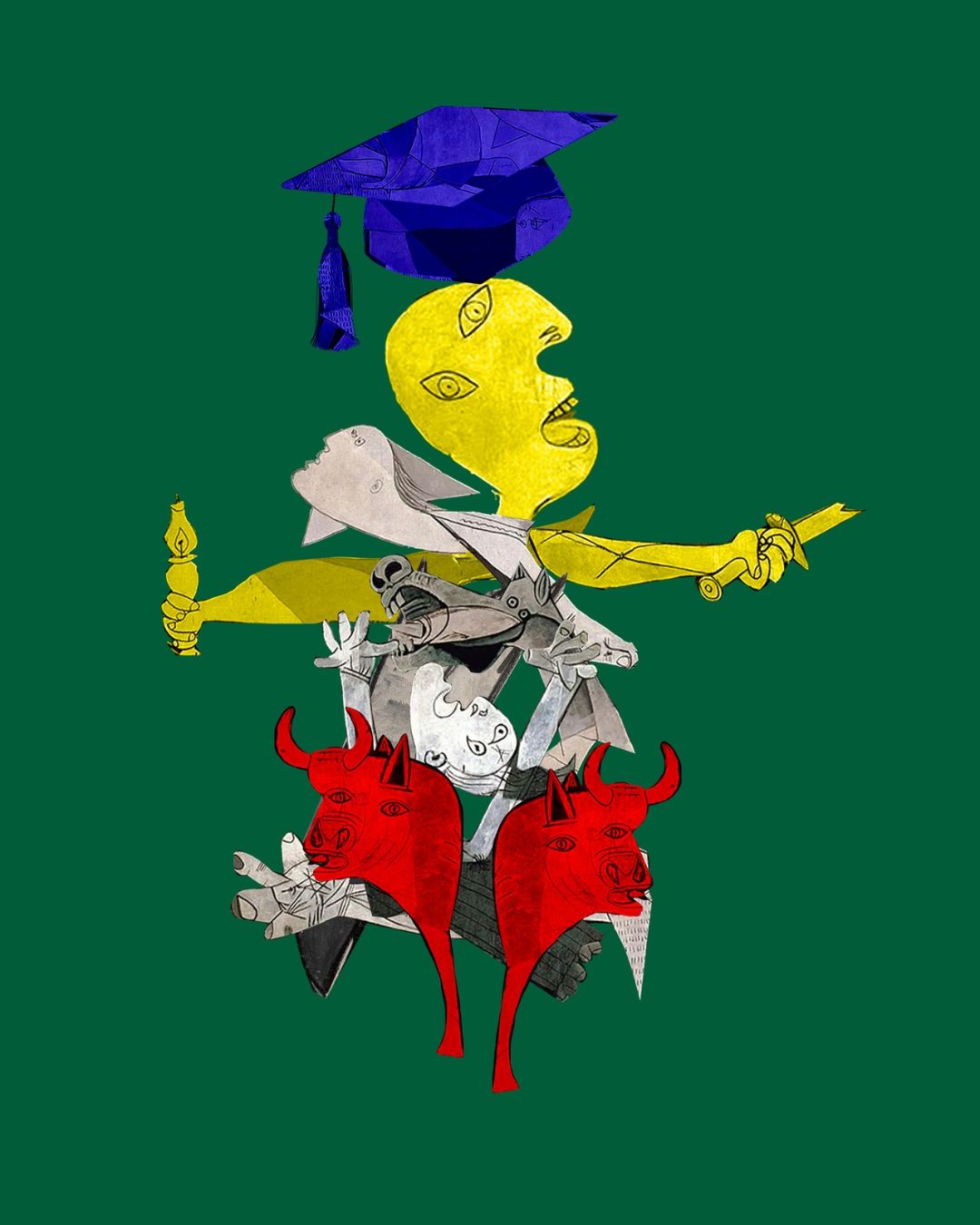
The student is admitted into the university, but the university does not necessarily admit the student into its conception of the fully legitimate intellectual subject.
I refuse to approach the institutional murders of Dalit students as aberrations interrupting an otherwise emancipatory educational order. My argument begins with a proposition I have explored in my critique of mainstream psychology: neoliberal institutions do not merely impose external discipline; they manufacture subjects who learn to experience structural contradictions as personal inadequacies. Education has become one of the principal laboratories of this transformation. The student is no longer simply a learner but an entrepreneurial project, perpetually responsible for increasing their human capital, demonstrating resilience, optimising performance, and converting their existence into measurable achievement. The institution supplies the obstacles; the student is instructed to develop the psychological competencies necessary to survive them. Should the student fail, the institution discovers a deficiency in the individual rather than a contradiction in its own organisation. This is the necessary false consciousness of neoliberal pedagogy, the systematic conversion of social antagonism into personal responsibility. In India, caste supplies this consciousness with its history.
To prevent the risk of diverting from my primary argument, I will keep the discussion categorised into different subsets of the proportion I am trying to make; the following must be seen not in chronological coherence, but as an intersectional cause-and-effect relationship among one another, essential to understanding the argument.
The Unconscious of the Institution
The discipline of pedagogy must be interrogated alongside the institutions it claims to improve. Its false consciousness consists, in part, of imagining that teaching is a neutral encounter between educator and learner, that institutional authority is merely functional, and that educational outcomes can be understood independently of the relations through which knowledge is produced and recognised.
I am, in particular, suspicious of the pedagogical celebration of resilience. Resilience can name a genuine human capacity. Institutional discourse, however, frequently transforms it into an obligation imposed upon those injured by the institution itself. The question ceases to be why the institution produces conditions of alienation and becomes why the student has not developed sufficient psychological resources to withstand them. I blame my unfortunate kin, the psychologists, for this. Structural violence is repackaged as a deficit in coping. The vocabulary of wellbeing becomes a technology for preserving the conditions that make wellbeing difficult, ‘life skill’.
This is where the reductionist tendencies of mainstream psychology become politically consequential. When psychological distress is detached from its historical and institutional conditions, the subject becomes the principal site of intervention while the social order responsible for producing distress escapes scrutiny. The student must learn to regulate their emotions, optimise their performance, develop coping mechanisms, and return to the competitive arena. The institution need not undergo an equivalent transformation. What appears as therapeutic assistance can therefore become an institutional demand for adaptation. The question is no longer whether the environment is tolerable, just, or democratically organised, but whether the individual has acquired the competencies necessary to tolerate it.
Now, according to me, the institution functions not only through explicit rules and sanctions but through the symbolic order within which a student becomes recognisable as intelligent, deserving, troublesome, deficient, or legitimate. Its gaze is not merely observational. It participates in producing the identity it claims simply to discover. The student learns to encounter themselves through the judgments of an institutional Other whose authority appears universal, natural, and beyond appeal. For a Dalit student, this symbolic order can impose an impossible double demand: demonstrate exceptional competence while remaining grateful for admission, challenge discrimination without becoming the supposedly difficult student, expose institutional prejudice without threatening the institution's preferred image of itself. Resistance can be interpreted as evidence of inadequacy, while silence is mistaken for consent. The institution congratulates itself on the civility of a social order whose conflicts it has merely rendered unspeakable.
The institution becomes the judge of the wound it has helped produce, the interpreter of the testimony directed against it, and the final arbiter of whether its own conduct deserves condemnation. Its claim to neutrality is therefore not an absence of power. It is one of power's most disgusting yet exquisite disguises.
The Erotic Economy of Caste: Conditional Inclusion as Institutional Fetish
What I find especially disturbing about the institutional murder of Dalit students is the possibility that the educated Brahmanical consciousness derives a peculiar narcissistic satisfaction from admitting the Dalit subject into its sanctified enclosure while retaining the power to determine the conditions of their belonging. I approach this through a Freudian vocabulary of repression, ambivalence, repetition, and the death drive, not to diagnose individual perpetrators from a distance, but to interrogate the unconscious investments of an institutional order that celebrates its apparent progressivism while repeatedly failing those whose presence unsettles its inherited monopoly over knowledge. There is something perverse about an institution that desires the evidence of equality without accepting its consequences. It welcomes the Dalit student’s admission, achievement, and eventual success as proof of its own modernity. It wants the image of emancipation. But it may resist the more consequential demand that the Dalit student be recognised as an equal subject entitled to question its knowledge, expose its contradictions, and transform its distribution of authority.
I would call this an erotics of conditional inclusion. By erotics, I mean an unconscious economy of desire, possession, repudiation, and mastery, not a claim about the sexual motives of particular individuals. The institution desires to possess the image of its own egalitarianism. The Dalit student becomes the object through which the institution admires itself; it's a masochistic overcoming of a sadistic unconscious; it is evidence that it has supposedly overcome the very social order whose advantages continue to structure its existence.
The institution wants the Dalit subject present as proof that caste has been transcended, but not necessarily as a political subject capable of exposing how caste continues to organise the institution. The Dalit student is henceforth caught in a peculiar libidinal arrangement, welcomed as evidence of institutional virtue, scrutinised as a potential disturbance, and required to demonstrate that their presence will not threaten the symbolic order that has admitted them. The institution's self-image depends upon the very inclusion whose consequences it may be unwilling to confront.
Freud’s account of repression offers a clear way to look at this contradiction. What a social order cannot acknowledge in itself does not simply disappear; it can return in displaced, distorted, and repetitive forms. The educated caste consciousness may sincerely identify with constitutional equality while reproducing inherited distinctions through everyday judgements, administrative discretion, intellectual hierarchies, and unequal distributions of credibility. Its conscious self-image is progressive; its institutional conduct can remain organised by an unexamined social inheritance.
The contradiction survives because the institution experiences its declared values as proof of its innocence.
Here, I find the concept of fetish particularly useful. The fetishistic operation is not simply hypocrisy. It is the capacity to preserve a cherished belief in the face of contradictory evidence by displacing the contradiction onto something manageable. The institution possesses its equality policies, diversity statements, counselling services, and anti-discrimination committees as reassuring objects of institutional virtue. Their existence becomes a substitute for examining whether they actually transform the conditions of discrimination. The institution can acknowledge caste in principle while refusing to recognise its own participation in caste's reproduction.
The fetish protects the institution from the consequences of what it already knows.
The death drive offers a further, necessarily interpretive, vocabulary for examining institutional repetition. It cannot responsibly be reduced to a conscious desire for another person's death. Rather, it directs our attention to the persistence of destructive arrangements even when their consequences are known, condemned, and periodically mourned. An institution encounters the devastation associated with caste discrimination, announces concern, conducts inquiries, revises procedures, and then risks returning to the conditions under which the same fundamental contradictions remain unresolved.
The repetition itself becomes the scandal.
I want to be precise about the accusation. It would be irresponsible to claim that Brahmins as individuals, or every educated person from a dominant caste, consciously desires the destruction of Dalit students. That would replace structural analysis with an unsupported psychological generalisation. The sharper proposition concerns a Brahmanical institutional order whose beneficiaries can remain attached to arrangements that reproduce domination, even when they consciously disavow caste discrimination. The unconscious investment is not necessarily in a particular student's suffering. It lies in preserving a social arrangement whose transformation would require relinquishing inherited authority.
The resulting perversity lies in the coexistence of declared equality and reproduced inequality, of progressive self-understanding and institutional abandonment, of humanitarian language and the repeated failure to protect those whose vulnerability the institution is responsible for addressing. The most atrocious possibility is not that the institution secretly wishes every Dalit student dead. It is that the institution can continue to reproduce destructive conditions without experiencing their continuation as an intolerable indictment of itself.
That is the institutional fetish of innocence that the university gets off of, to welcome the Dalit into the caste village, retain the village's social grammar, and then treat the consequences as though they had arrived from somewhere else.
The Melancholic Subject of Caste
In meetings and gatherings, one common theme among Ambedkarites in their speeches and testimonials was that we have all gone through multiple instances where adhering to the idea of our existence took over our sanity. When caste first made its verdict known to me, I lost the world as a place in which my desire could be addressed. The mourning follows the loss of an object, while melancholia occurs when the lost object is not relinquished but withdrawn into the ego, so that “the shadow of the object” falls upon the self. In caste, the lost object is not simply a person, a fellowship, a room, or a recognition. It is the promise of belonging itself, the fantasy that the university, the nation, the police, the classroom, might one day receive me without requiring my diminishment.
I mourned, at first. I mourned the friend who became silent, the teacher whose praise arrived with an unspoken condition, the institution that admitted my body but not my authority. But mourning became impossible because the loss was continually denied. When reality refuses to confirm a loss, the ego cannot complete the work of mourning. It turns the loss inward. This is the obscene achievement of casteist melancholia; it persuades the wounded subject to become the site of punishment for a violence they did not author. Freud describes how, in melancholia, self-reproaches are often reproaches against a loved or needed object, displaced onto the ego. I began to hate myself with an intensity I could not otherwise direct at those whose compassion I still deserved. I wanted to be seen by the very authority that had taught me my seeing did not count. My love for the institution persisted precisely because it had been made scarce; my rage at it could not be spoken without risking expulsion, so it returned as an attack upon my own worth. Until one day I embodied ‘what way emancipation’.
I want to name the thought of death for what it is, not proof of my pathology, but the psychic form taken by an unbearable social truth. In mourning, Freud says, the world becomes poor and empty; in melancholia, the ego itself becomes poor and empty. Caste makes the Dalit subject undergo both losses at once: the world is emptied of justice, and then the self is emptied of the right to grieve that emptiness. The suicidal impulse, where it arises, is the institution’s violence returning as a private sentence. It is the moment when the social murder becomes so complete that the subject is asked to perform its final act alone.
But I refuse this final displacement. My melancholia is not a defect of coping; it is an archive of refused mourning. I carry the shadow of every object this order has taken from me, and in carrying it I also carry the evidence. If I weep, I weep not because I am weak, but because I know precisely what has been lost, a self that might have lived without having to prove, again and again, that it deserved to exist. My grief is my most rigorous knowledge. My survival is not submission to the institution; it is the refusal to let the institution write the last sentence of my life.
The university must answer for the world it reproduces
I refuse the consolation that the institution is merely a mirror of society. A university is also an instrument through which society reproduces itself, and therefore a site at which that reproduction can be interrupted. My conclusion is deliberately uncompromising. The university’s legitimacy begins not with its claim to teach the world, but with its willingness to transform the relations of power through which it inhabits that world.