
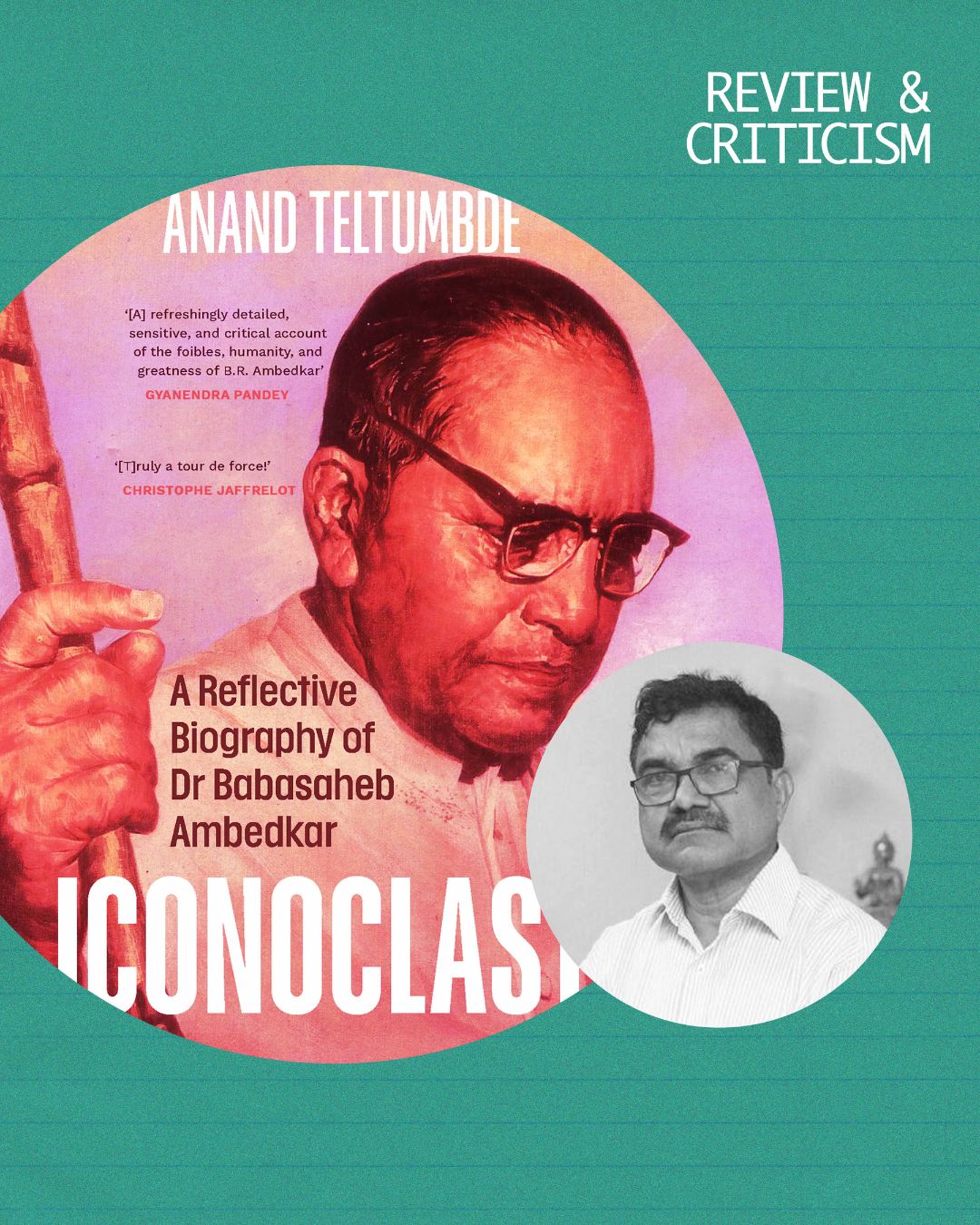
Finnish composer Jean Sibelius famously said, “Pay no attention to what the critics say... Remember, a statue has never been set up in honour of a critic!” (Torne, p. 27). This quote is fitting in the context of the book Iconoclast: A Reflective Biography of Dr Babasaheb Ambedkar by Anand Teltumbde, published in 2024. Questioning the omnipresent statues honouring Ambedkar, Teltumbde presents a trenchant critique of the supposed tendency of Ambedkar’s followers to limit Ambedkar to being a mere icon, a mere symbol, an empty signifier. According to him, Ambedkar should be saved from his devotees (mainly Dalits), for whom he is no less than a God. He announces in the preface that his aim in the book is to present “Babasaheb Ambedkar as a historical person in flesh and blood – to bring his greatness alive rather than make him an inert godhead and place him on a high pedestal for worship” (p. xxxiv). To achieve this, Teltumbde passes Ambedkar’s persona through a “sieve of rationality” and lays bare the “astounding inconsistency” in Ambedkar’s thinking that will shock his devotees out of their “devotional inebriation” (p. xxxiii-vii).
Teltumbde’s book is an addition to the increasing corpus of scholarly work written around the larger-than-life persona of Dr B. R. Ambedkar; A Part Apart (2023), Ambedkar in London (2024), Becoming Babasaheb (2023), The Foresighted Ambedkar (2024), Ambedkar: A Life (2022), Babasaheb: My Life With Dr Ambedkar (2022), to name a few. However, his book sings a different tune. Not only does he supply scholarly research and write with utmost clarity and precision, but he also does not shy away from polemics and brings into uncomfortable dimensions of Ambedkar’s persona. It is another matter if he is right or wrong; his project is certainly not hagiographic, but whether this reflection amounts to pathography is up to us to decide. But it is clear that Teltumbde narrates the story of Ambedkar’s life and legend with the skills of a consummate storyteller and expert commentator, and the result is a riveting book that would surely keep the reader immersed for 600-odd pages. The book is divided into eight chapters, the first seven of which chronicle Dr Ambedkar’s life from birth in the army town of Mhow to his death after conversion to Buddhism. Throughout the narrative, Teltumbde provides relatively lesser-known information and photos, along with his astute observations, reflections, and hypotheses. The final 8th chapter of the biography titled The Legend Lives On explains how Ambedkar, an iconoclast, came to be iconised by his followers after his death.
Dr Anand Teltumbde is a well-known public intellectual and civil rights activist in India. He has been a vocal critic of autocratic governance and has been extensively writing about caste, class, and Hindutva politics. Teltumbde was branded as a Maoist by the state machinery and sent to prison for his alleged involvement in the Bhima Koregaon violence (2018). It is in prison that Teltumbde wrote most of Iconoclast. As a public intellectual, Teltumbde has most persuasively argued for the convergence of caste and class politics. Unfortunately, these two brands of politics have become synonymous in India with the Ambedkarite and Marxist parties, respectively. Teltumbde has been a vocal critic of the shortcomings of both these groups, accruing both disdain and praise from these sections. In his attempt to bridge this unholy rift, Teltumbde shuns both “ism,s” of Ambedkarism and Marxism and identifies with neither group.1 I think his writings reflect a position of a critic: always an envious one, but certainly not without pitfalls. If one sees any video interview or talk of Teltumbde, he chuckles as he speaks, and one feels some revelation is at hand. One notices him brimming with an aura of superior or secretive knowledge. Similarly, in the book, there is a promise that the author will reveal something that has never been revealed before. To summarise, the big reveal of the book is as follows.
To begin with, Ambedkar’s story is not rags-to-riches; he came from a relatively well-off army family and was “extraordinarily lucky” to have rich friends and Maharajas helping him financially (p. 51). If during the Mahad Satyagraha, Ambedkar had let his followers pick up arms against Brahmin orthodoxy, the history of Dalit politics would have been entirely different (p. 104). If during the Roundtable conferences, Ambedkar had considered the Proportional Representation (PR system), instead of the first-past-the-post (FPTP) type of electoral system, “all his lifelong struggle for representation could have been automatically taken care of” (p. 154). If Ambedkar had stuck to the formula of class and caste politics that he stumbled upon when he started the Independent Labour Party (ILP), there could have been a “revolutionary transformation of Indian Politics” (p. 268). This formula, however, was “squandered under existential pressures” exerted by his own caste members (p. 268). “Radical Ambedkar” was co-opted as a statesman by the grand scheme of Gandhi-Nehru. In the Constituent Assembly debates, Ambedkar maintained silence over abolishing caste and the inclusion of economic rights in the fundamental rights (p. 368-70). Drafting the constitution, Ambedkar was just a hack, playing the lawyer for Congress’s interests, and became “a Modern Manu” (p. 338). Ambedkar’s conversion to Buddhism stemmed from disillusionment and had “disconnection with the original objective” (p. 464). This is the crux of the revelatory claims that Teltumbde makes about Ambedkar.
It is not difficult to see a major hindsight bias in Teltumbde’s narrative focused on what Ambedkar could have done. In this reflective biography, there are many “ifs”, “maybes”, and “could haves”. It is projected that Ambedkar lacked the gift of foresight and showed inconsistent behaviour. This revelation, however, is also disappointingly not new. Teltumbde had made similar remarks earlier too. At times, he has derided the hard-won struggles like the reservation, constitutional safeguards, and conversion.2 But in his early writing, Teltumbde was judicious enough not to berate Ambedkar so unabashedly. In a few of his writings, he even attempted to safeguard Ambedkar from saffron co-option and Marxist detractors.3 Now it is disheartening to see that behind the veneer of a “reflective” biography, Teltumbde bolsters a thesis that refutes Ambedkar’s claim to universality and immortality. The prudence expected of a seasoned critic is hardly on display as Teltumbde overgeneralizes, overhypes, and comes dangerously close to being a sensationalist.
In addition to portraying Ambedkar as someone who made many puerile mistakes,4 Teltumbde raises serious charges against him, alleging that his views were regressive and patriarchal. Teltumbde highlights that, unlike Jotiba Phule, Ambedkar never taught Ramabai to read and write, and he shamed the Mahar women of Kamathipura engaged in prostitution.5 Teltumbde also cites Ambedkar’s Nagpur facilitation speech delivered on 15 October 1956, where he ridiculed Congress women parliamentarians, and remarked, “There is no shame like women giving up their own dharma and roaming around in politics… If women go to legislative bodies, then what are the men to do? …who is supposed to look after their children?” (qtd. in Teltumbde, p. 476).6 The rhetoric of this speech is surely unbecoming of a person considered a champion of gender equality. However, by this time, Ambedkar was just a month away from his death; several of his emancipatory projects had been thwarted, and his embittered remarks might be motivated by the lack of support he received from parliamentarians for the Hindu Code Bill. Teltumbde does not juxtapose this with his lifelong fight in securing women’s rights and in his haste to find fault with Ambedkar declares that, “He could not rise above the moral dilemma of the upper caste radicals and reformers who would support the education and autonomy of women while simultaneously restricting their potential roles to those of ‘wives’ and ‘mothers’ and away from ‘non-wives’ and ‘prostitutes’” (p. 479). If this is true, how would one explain Ambedkar’s encouragement of women’s participation in politics? For example, under the chairmanship of Mrs Kirtibai Patil, the second session of the All-Indian Depressed Classes Women’s Conference, held at Nagpur on July 20, 1942, unanimously passed the resolution that, like the general female representation in the Central and Provincial Legislatures, seats should be reserved for women of the Depressed Classes in all legislative and other representative bodies. Dr Ambedkar presided over the conference and famously said, “I am a great believer in Women’s organization…Ever since I began to work among the Depressed Classes, I made it a point to carry women along with men. That is why you will see that our Conferences are always mixed Conferences. I measure the progress of a community by the degree of progress which women have achieved” (BAWS 17:3, p. 282). Teltumbde should refrain from cherry-picking anomalous rhetorical lapses on Ambedkar’s part and downplaying his entire fight against Brahminical patriarchy.
As Jayasaleen Raj points out in his review of the book, it is surprising that among the 17 scholars asked to blurb the book, there is no Dalit scholar. Raj writes, “This omission underscores the dominance of non-Dalit perspectives and their authority over institutionalised Ambedkarite scholarship”. It is worth noting that even a scholar of Teltumbde’s stature has misspelled the name of Jotiba Phule. Gail Omvedt had remarked, “Phule takes his name from the black peasant devata Jotiba, not from ‘Jyoti’. The spelling of his name is a clear Brahmin-non-Brahmin marker in Marathi. Getting this wrong means not knowing people’s names” (p. 12). There are 12 instances where “Jyoti” is used, and only one instance where the correct spelling “Joti” is used. Teltumbde and his publisher should have been mindful of this nuance.
Further, the last and shortest chapter of the book is also its most substandard one. It attempts to cover more than half a century of the Ambedkarite movement in less than 70 pages. Everything is hurriedly explained, from the rift between RPI leaders to the rise and fall of the Dalit Panthers, to the enigma of the BSP. Legendary political leaders like Kanshiram and Mayawati do not even get one page each. Even Dadasaheb Gaikwad, who, according to Teltumbde, could have rightfully taken Ambedkar’s legacy forward, does not get his due. It remains unexplained why he ultimately joined the Congress Party. All the failures and rifts in Dalit politics are attributed to Ambedkarites’ praxis and its supposed “anti-communist slant” (p. 557). Teltumbde claims that the entire post-Ambedkar movement reflects the singular obsession to treat Marxism as the enemy. Is this a fair assessment of the Indian political situation? Were there no Dalit communist leaders in India like Jiban Dhupi, R.B More, Ramchandra Dome, K. G. Satyamurthy, etc.? Did Dalits not form their own political parties? Did Dalits not form the base of all communist parties in India?
The pan-Indian Dalit movement is much more nuanced than a simple Ambedkarite vs. Marxist animosity. Yet, in his critical postmortem of Ambedkar and Ambedkarite politics, Teltumbde’s touchstone has been class and Marxist politics; then shouldn’t one pause and evaluate whether Marxist politics has succeeded in India or not? Which radical upper-caste leftist leader genuinely tried to incorporate caste into politics? Has the Indian left not splintered into numerous factions? Have communist parties not aligned with capitalistic forces? Were atrocities against Dalits not commonplace in left-ruled states? These questions are not for whataboutism, and I have no problem with Teltumbde’s criticism of Ambedkar and his followers. Being a product of his time and context, Ambedkar, of course, has shortcomings like all great leaders. But the whole enterprise of bringing ‘radical’ or ‘real’ in Ambedkar smacks of familiar paternalism with which time and again, Dalits have been subjected to incessant scrutiny to shield the graver sins of dominant classes. Teltumbde adopts the same sacrosanct and patronizing attitude that has been adopted by Brahmins of all stripes, communist or otherwise, in which only they are capable of dialectics and intellectual tradition; the rest are simply pseudo-Ambedkarites or “fantical followers” (p. 557). Is Teltumbde’s rhetoric not insulting when he writes that Dalits are incapable of seeing the State as anything but a benefactor and they “would never understand the nuance of the political economy of post-colonial India that transformed their world for the worse. Blinded by their devotional instincts, they would never see the hand of the anti-Ambedkar forces in promoting the Ambedkar cult and transforming them into inert devotees” (p. 547). Who would tell Teltumbde that Dalits are not cultish but defensive, and most of them intuitively know that their mere presence unsettles the status quo and threatens Brahmanical state machinery. These “inert devotees” are the ones who have kept Ambedkar alive by flocking to the streets whenever the government has tried to kill him by harming his writings and vision.7 Despite this, Ambedkar is not an icon for the broader public, not because Dalits have made him into an “inert icon” but simply because of the caste prejudice of others.
Teltumbde slips from being a neutral arbiter of class and caste and comes across as unusually harsh on Ambedkarites when he brands them as “bhakts”, incapable of dialectics. No Ambedkarite would tolerate the epithet of ‘bhakts’ for obvious reasons, but assuming they exist, who are they? Teltumbde talks about different kinds of Dalits: constitutionalist Dalits, Buddhist Dalits, capitalist Dalits, diasporic Dalits, BJP Dalits, landless Dalits, intellectual Dalits, opportunistic Dalits, etc., but ultimately coalesces them all into a “slogan-shouting crowd of automatons” (p. 547). In his assessment, all of these Dalits are ‘bhakts’. Then the happiest readers of this ‘reflective’ biography would be those “bunch of Brahmin boys” of the Indian left, eager to claim leadership of a movement which, according to Teltumbde, is in shambles.8 In Teltumbde’s vitriol, no follower of Ambedkar (except himself, of course) can stand firm.9 As, all of them have been plain idiots or gullible masses. He declares that now “the majority of the Dalits are with the BJP,” and do not even tolerate “the smell of the Left” (p. 557).
But, barring his debate with Abhinav Sinha and his introduction to Dr Ambedkar’s unfinished work, India and Communism, Teltumbde has hardly historicized class politics with the similar scrutiny which he reserved for caste politics.10 In this biography too, Teltumbde puts excessive emphasis on Ambedkar’s flirtation with class politics and completely ignores the question of religion. As Ashok Gopal points out in his review, “Teltumbde does not delve into Ambedkar’s central concern – how does one give democracy an ethical base in a country where religion has a powerful influence, and the dominant religion does not espouse democratic principles?” For Teltumbde, Ambedkar was at his most radical when he experimented with communism and formed the Independent Labour Party (ILP) (p. 268). Everything else is deemed inconsequential or worse, a failure in comparison. This is an injury to Ambedkar’s legacy, who, in my opinion, was equally, if not more, radical at various points in his life: leaving Hinduism, drafting the constitution, and converting to Buddhism.
I agree with Teltumbde’s insistence on shunning both “isms”: Marxism and Ambedkarism, and his exhortation that “It must be realised by both Dalits as well as Communists that no ism, howsoever it might have worked in the past, is going to be applicable to the volatile contemporary and future world” (2017, p. 72). But how this is going to happen remains unanswered. As much as Ambedkar is the fulcrum for Dalits, Marx has been zealously guarded by sentimental Brahmins. One can see how Teltumbde himself was castigated and trashed by Marxists for calling out their dogmas.11 In his essay To the Self-Obsessed Marxists and the Pseudo-Ambedkarites, he defends his position against them, writing, “They (Marxists) should not be conceited in trashing historical movements and peoples’ heroes just because they did not belong to their tribe” (5). However, shockingly, in this biography, Teltumbde himself adopts a similar nonchalant attitude regarding Ambedkar.
In an interview, talking about his childhood, Teltumbde reflects, “Long before I was a communist by conviction, I was an Ambedkarite by birth! The point is that there was nothing to be read about Ambedkar at that time. So there was no question of becoming an Ambedkarite by conviction” (29). Ideally, it is the responsibility of public intellectuals like Teltumbde to define, dissect, and disseminate what Ambedkarism actually means so people can become Ambedkarites by conviction. But alas, Teltumbde declared that there is nothing like Ambedkarism.12 As a result, the capaciousness of the Dalit movement, with its several experiments (some of which succeeded and some failed miserably), has been reduced to a stunted and sterile landscape in Teltumbde’s penchant for pessimistic and reductive rhetoric. Now, he stands in the shade of those caged statues of Ambedkar and chips away at whatever symbolic resistance these statues have accrued. Paradoxically, Teltumbde was born in the same “den of Ambedkarism” and is part of the same circle of legatees – Mahar, Maharashtrian, and Middle-class – that he criticizes so vociferously.13 Then, it is only natural that we turn our gaze to him and, in his own style of “could have-should have” interrogation, ask why Dr. Anand Teltumbde, with his superior and exceptional intelligence, has not yet brought the anticaste and anticlass revolution himself?14 As pointed out at the beginning, I think this is why statues are not built in honour of critics: because criticism, when done irresponsibly, leaves nothing but critics all the way down.
Book: Iconoclast: A Reflective Biography of Dr Babasaheb Ambedkar
Author: Anand Teltumbde
Publisher: Penguin Random House India Pvt. Limited
Date of Publication: Sep 2024
ISBN: 9780670093885, 0670093882
Page Count: 676
Notes
- There is a strong leaning toward communism in his ideas; however, Teltumbde does not specifically characterize himself as a Communist or Marxist. In his essay To The Self-Obsessed Marxist and the Pseudo-Ambedkarites, he wrote, “My self-initiation into Marxism dates back to my early childhood, and by conviction I do follow Marxist methodology, but I still would not call myself a Marxist. Because, firstly, the kind of dogma the Marxists reflect I would never subscribe to, and secondly, I might shun all these isms because they also unconsciously serve as identities and eventually divide people”. In his introduction to B.R. Ambedkar: India and Communism, referring to both Ambedkarism and Marxism, he wrote, “These isms could only be beacons, but the specific path shall have to be carved out by the people themselves in the concrete situation they find themselves in. With this realization, the identitarian obsession should melt away” (72).
- See his writings like Reservations: A Spark and the Blaze (2024), his essay Strategy of Conversion to Buddhism: Intent and Aftermath in The Radical in Ambedkar, and his article disproving the historicity of the Bhima Koregaon battle, The Myth of Bhima Koregaon Reinforces the Identities It Seeks to Transcend
- See his writings such as B.R. Ambedkar India and Communism, Introduction by Anand Teltumbde (2017), Ambedkar on Muslim (2003).
- Author of A Part Apart: The Life and Thought of B.R. Ambedkar, Ashok Gopal, reviewing Iconoclast writes, “Speaking about Ambedkar’s inconsistencies, Teltumbde claims Ambedkar “declared to the people that if they found his opinion conflicting, they should simply dismiss the previous ones and take the latest one” (559). It was Gandhi who made such a statement (Harijan, 30 September 1939). Ambedkar said something profound about taking responsibility for learning and unlearning (BAWS1: 139)”.
- Shailaja Paik, in her book The Vulgarity of Caste: Dalits, Sexuality and Humanity in Modern India (2022), provides a much better critique of Ambedkar’s gendered response to Tamasha women and prostitution, without generalization and ignoring the complexity of casteized gender roles.
- This speech is mentioned in the Marathi BAWS:18 III (534-35) and also in Hindi BAWS:40 (463-70), but I could not find it in the third English edition (2020) of BAWS available online.
- In 1988, when the Maharashtra government wanted to publish an altered version of Ambedkar’s seminal work Riddle in Hinduism, several Ambedkarite organisations led a massive protest. See the article Works in Progress: The Struggle to Publish B.R. Ambedkar’s Writing by Aathira Konikkara. It has been a struggle to publish anti-caste writings; Teltumbde himself knows this well; he has been at the forefront of disseminating B.R. Ambedkar’s writing, being one of the first people to digitise BAWS volumes and disseminate them with a search-compatible CD-ROM.
- Ambedkar, in his interview with American Journalist Mr. Selling, called communists like Dange and other bunch of Brahmin boys (BAWS 17:1, 425).
- In his essay exhorting “pseudo Ambedkarites” who have “killed Ambedkar”, Teltumbde writes, “I am the one who has never shown any iota of bhakti to Babasaheb Ambedkar, unlike your tribe, but sincerely followed his role model in excelling in whatever I did”.
- Other notable work is Scripting the Change: Selected Writings of Anuradha Ghandy. But in general, one can ask where are the books titled Radical in EMS Namboodiripad, The Real M.N. Roy, etc?
- See the essay titled The Tragic Regression of Anand Teltumbde: From ‘Mahad: The Making of First Dalit Revolt’ to ‘Bridging the Unholy Rift’ by Abhinav Sinha.
- “Alas, he is packaged into an ideology – Ambedkarism – by his fanatical followers and him into a super god… Ambedkarism came to be constructed as a negation of Marxism” (557). Elsewhere, he wrote, One does not find any enduring theory or a theoretical postulate that he represented, except for pragmatism. He could be an ideal, a role model, for his unstinted commitment, iconoclastic attitude, intellectual honesty, hard work, integrity, and sincerity, but possibly cannot be extrapolated to face the future. If he had always been evolving and changing all through his life, how could one possibly extend him into the future? It is in this studied sense that I have asserted that there cannot be Ambedkarism, which, in any case, is only casually spoken of among a section of scholars and sentimentally celebrated by Ambedkarite Dalits. (To The Self-Obsessed Marxist and the Pseudo-Ambedkarites 2013)
- In his book Dalit: Past, Present and Future, Teltumbde wrote, “The reservation policy created a city-dwelling, psychologically crippled, politically emasculated and socially alienated the minuscule middle class, which however would assume opinion leadership for all the Dalits without understanding what ailed them” (222).
- I acknowledge and respect Dr Teltumbde’s long commitment to the civil rights movement and anti-caste scholarship. And this is just a rhetorical point to reveal the absurdity of his incessant, at times ambiguous and open-ended criticism that reaps nothing but discord and discontent. All I want to emphasise is that his criticism of the Ambedkarite movement could do away with a tone that infantilises and patronises Dalits.
References:
- Ambedkar, B.R. 2020. Dr. Babasaheb Ambedkar Writings and Speeches Volume No: 17 Part One: Dr. B.R. Ambedkar and His Egalitarian Revolution Struggle for Human Rights. Edited by Hari Narake, N.G. Kamble, Dr. M.L. Kasare & Ashok Godghate. New Delhi: Dr. Ambedkar Foundation, Ministry of Social Justice & Empowerment, Govt. of India.
- Ambedkar, B.R. 2020. Dr. Babasaheb Ambedkar Writings and Speeches Volume No: 17 Part Three: Dr. B.R. Ambedkar and His Egalitarian Revolution. Edited by Hari Narake, N.G. Kamble, Dr. M.L. Kasare & Ashok Godghate. New Delhi: Dr. Ambedkar Foundation, Ministry of Social Justice & Empowerment, Govt. of India.
- Omvedt, G. (1997, June 25). Why Dalits dislike environmentalists. The Hindu, 15.
- Raj, J. (2025, January 2). Faulty gaze: Misinterpreting the ideology of the iconoclast. The Wire.
- Teltumbde, A. (2024). Iconoclast: A Reflective Biography of Dr Babasaheb Ambedkar. Penguin Random House.
- Teltumbde, A. (2017). Bridging the unholy rift. In B. R. Ambedkar, India and communism (pp. xx–xx). LeftWord Books.
- Teltumbde, A. (2019). Glimpses into the life of an engineer, scholar, and public intellectual: Interview with Roland Lardinois. South Asia Multidisciplinary Academic Journal, 1–14.
- Torne, B. (1937). Sibelius, Jean: A close-up. Faber and Faber.