
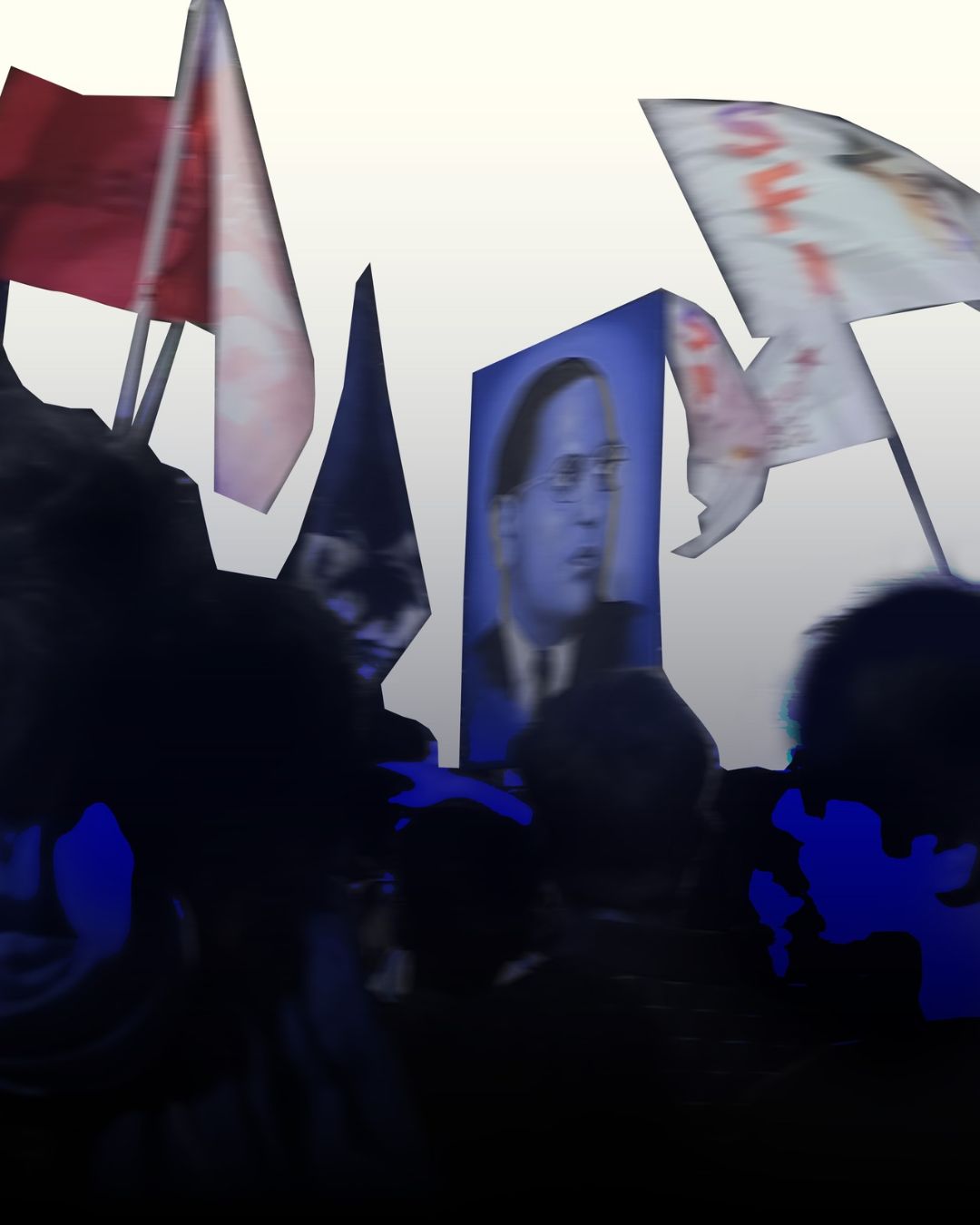
I was attracted to studying at the University of Hyderabad (HCU), partly because of the Rohith Vemula movement in 2016 and the campus student politics, which are completely absent in my state, Tamil Nadu, where I come from. Due to my social circumstances, I was forced to migrate from Tamil Nadu to the nearby state of Kerala, where I witnessed active student politics from the school level through my undergraduate years for more than one and a half decades. After reaching the University of Hyderabad, one of India’s premier higher educational institutions (HEIs), in mid-2023, I was seriously doubtful about the political nature of this campus and the varied demographics of students affiliated with student organisations, both progressive and regressive.
The long-standing partnership between the alliance partners, the Ambedkar Students Association (ASA) and the Students’ Federation of India (SFI), on the University of Hyderabad campus ended with a separation during the 2025-26 Students’ Union Election, soon after they had led a historic land movement while holding power in the 2024-25 Students’ Union through the ASA-BSF-DSU-SFI alliance, to protect the University and fight against the Telangana Congress Government’s land encroachment on the University. This separation made it considerably easier for the Akhil Bharatiya Vidyarthi Parishad (ABVP) and Sevalal Vidyarthi Dal (SLVD) alliance to win the union election last year, after six years. Later, facilitating the functioning of Rashtriya Swayamsevak Sangh (RSS) shakhas inside the University in the name of Ambedkar Shakha, and increased violence became normalised on campus.
Changes in the demographics of students coming to the University have led to shifts in their political affiliations and preferences towards student organisations. Students who were attracted to student political organisations through reading forums and study circles aligned with progressive politics have increasingly been replaced by spectacle-driven cultural events and religious gatherings, such as Ganesh Chaturthi, Holi, Rama Navami, and Krishna Jayanthi, accompanied by DJ performances. Also, the many progressive Left-Ambedkarite and tribal student organisations on the HCU campus, which were meant to consolidate or unify marginalised students and invite them to participate, have become fewer in number, while the norms of political campaigns and discussions, such as reading circles and student initiatives, have diminished. Many of these changes have resulted in a loss of track of progressive politics on campus.
As premier HEIs have increasingly become spaces dominated by elite caste interests, the practice of caste and the normalised symbolic brutality inflicted by dominant upper-caste groups on Dalit Bahujans (Thirumal, 2020; 2021), along with the caste prejudice embedded in the academic and intellectual ambience of HEIs (Thirumal & Christy, 2018), have significantly constrained the space for anti-caste politics and activism at the University of Hyderabad. Even the recent seventh report submitted by the Parliamentary Committee on the Welfare of Scheduled Castes (SCs) and Scheduled Tribes (STs) in March 2026, regarding the implementation of reservation policies at the University of Hyderabad, strongly criticises the University administration for serious lapses, delays in the release and sanctioning of fellowships meant for SC/ST and OBC students, and systemic discrimination in filling faculty posts reserved for marginalised communities, classifying them as “Not Found Suitable” (Ravinder Reddy, 2026)
Continuing campus violence in HCU
The continuing violence on the HCU campus should also be understood within the broader context of conflicts and attacks reported across higher educational institutions in India. HCU is not an isolated case. Several state, central, private, and deemed universities, including Jawaharlal Nehru University, Ambedkar University Delhi, the University of Delhi, Azim Premji University, Christ University, Pondicherry University, Osmania University, English and Foreign Languages University (EFLU), Hyderabad, Jadavpur University, and the Satyajit Ray Film and Television Institute, have witnessed incidents involving right-wing student organisations, including the ABVP. The broader political idea of the right-wing student organisations across educational institutions in the country is to build a saffronised campus environment under the guise of securing Nationalism and promoting the Indian Knowledge System (IKS) in the academic and research domains.
Over the last year, there has been a series of incidents of violence in which ABVP has allegedly used intimidation, mob violence, censorship, and physical attacks to silence dissent and target students and scholars. These incidents range from an attack on a Kashmiri student and forcing another student to chant “Jai Shri Ram” to threatening female students who complained about sexual harassment, attacking the mess secretary and a security officer, and conducting mob trials in hostels. These incidents stand as testaments to continuing violence and attempts to undermine campus freedom and democracy in HCU.
The disruption of the Theatre Arts Department’s final-year examination play, Holi, on 4 May 2026, is another significant instance of ongoing violence on the HCU campus. Written by Marathi playwright Mahesh Elkunchwar in 1969, Holi examines gang politics, caste hierarchies, and the dynamics of power within educational institutions. The production at HCU was part of the academic evaluation of Theatre Arts students. After ABVP members objected to certain dialogues, alleging that they hurt Hindu religious sentiments, tensions escalated during the performance. Around 30-40 ABVP members allegedly attempted to enter the already packed venue and, after being denied entry, resorted to stone-pelting, throwing bottles, and attacking students with wooden sticks. Windows were shattered, and students were injured, while slogans such as “Goli Maro Saalon Ko” (“Shoot those bastards”) were allegedly raised. Two SFI students sustained serious injuries requiring stitches and further medical treatment. The incident demonstrates how objections to an academic and artistic production escalated into physical violence and an attempt to disrupt academic freedom and campus democracy.
The recent victory in the 2026-27 Students’ Union Election at HCU by the historic alliance of All India Students Association (AISA), ASA, Dalit Students Union (DSU), SFI and Tribal Students Forum (TSF) should not be understood merely as an electoral or numerical victory, but as an opportunity to reflect on the changing nature of campus politics. While the growing political engagement of a new generation (Gen Z) of students offers an opportunity to reimagine student politics, the loss of political reading, critical discussion, collective mobilisation, and anti-caste activism over the years raises the larger question of how progressive student politics can be reclaimed on campus. The challenge before progressive, Left, Ambedkarite, and tribal student organisations is therefore not merely to win elections, but to rebuild the political and intellectual culture of the campus by creating spaces for critical engagement, collective action, and democratic participation. Reviving progressive student politics at HCU requires reconnecting electoral politics with students' everyday struggles and restoring anti-caste, democratic, and socially transformative politics to the centre of campus life.
References
Ravinder Reddy, M. (2026, May 19). Parliamentary panel exposes “laxity” in filling SC, ST posts at Hyderabad University. The New Indian Express.
Thirumal, P. (2020, January 20). Dominant bodies and their ethical performances: violence of caste embodiment in higher educational institutions. Economic and Political Weekly.
Thirumal, P. (2021, June 8). Regurgitative violence: the sacred and the profane in higher education institutions in India. Economic and Political Weekly.
Thirumal, P., & Christy, C. (2018, February 2). Why Indian universities are places where Savarnas get affection and Dalit-Bahujans experience distance. Economic and Political Weekly.