
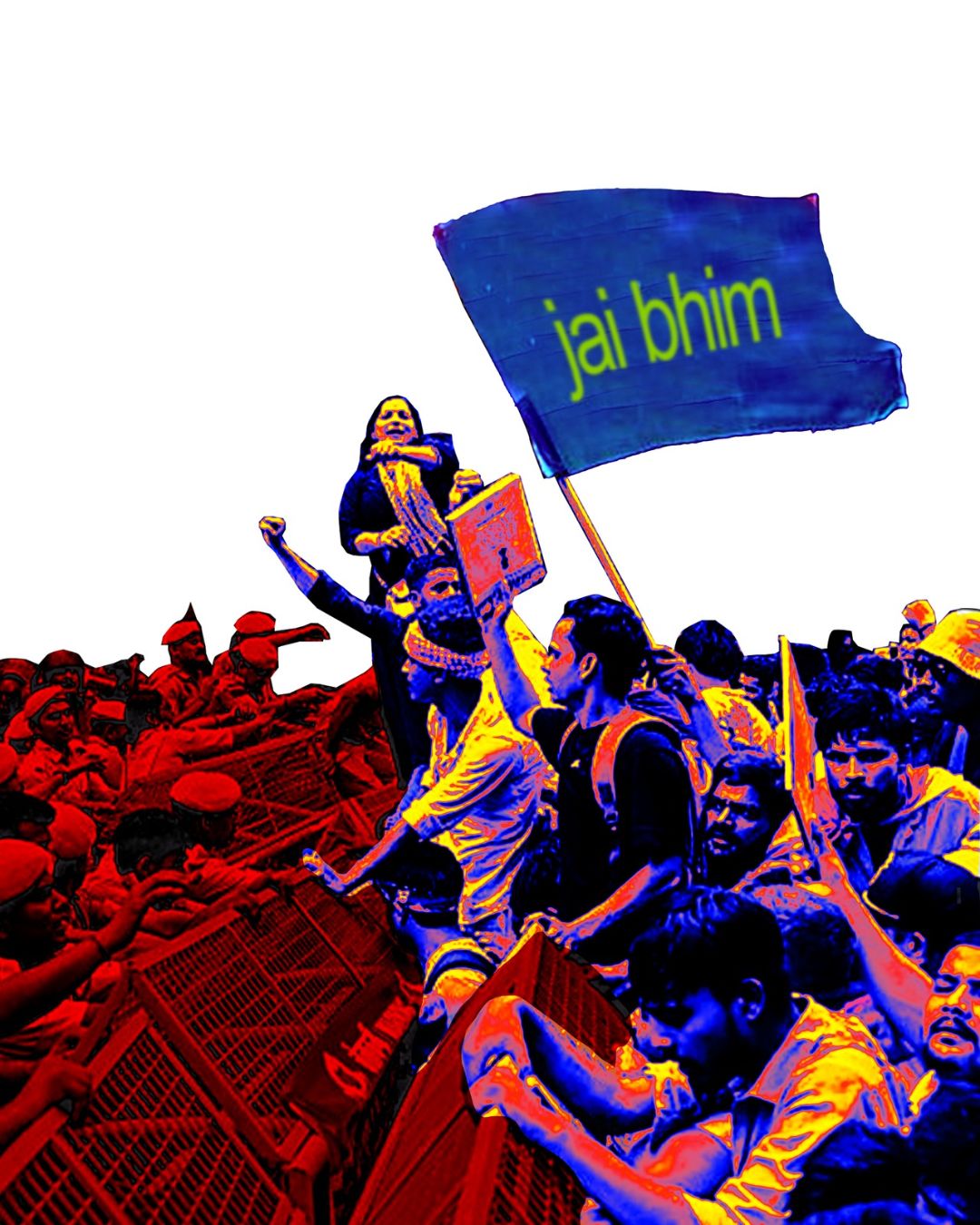
Almost two years back, during a conference on the nature of Indian democracy in contemporary times, leading political theorists expressed their dismay that the fascist influence on the country was here to stay. Speaker after speaker pointed out that irreparable damage has been done to the democratic ethos and that all hope is lost. Every ideology has been sacrificed at the altar of populism. However, my take on the entire scenario was different. I was of the opinion that the ideological battle needs to be fought on the streets rather than in closed-room debates. This was based on an understanding of various student-led civil society movements, as well as those led by farmers, women, Dalits, Tribals, minorities, and ethnic groups. They held up the mirror to reflect that the majoritarian discourse was being challenged. Despite these efforts, the state was successful in co-opting and even suppressing many of these movements. We need to recall that the farm laws and CAA/NRC were shelved due to people’s pressure. Similarly, the roster struggle and the protests to safeguard the provisions of the SC/ST Act exemplified the warning issued by B. R. Ambedkar that unless the socio-economic contradictions are addressed, constitutional democracy will be in deep crisis.
Educate, Organize and Agitate
This slogan once occupied a niche status but in contemporary India resonates everywhere, as reflected in Ambedkar’s posters, blue-coloured flags, and the slogan ‘Jai Bhim’. The domino effect of the Chief Justice of India (CJI)’s remarks about unemployed youth led to massive street protests and the eventual resignation of Union Education Minister Dharmendra Pradhan. When the unemployed youth are likened to cockroaches, it reflects the caste authority embedded in our body politics, which is apt to draw boundaries around the politics of belonging. Historically, education in India was for the privileged few, and it was only after multiple struggles that education became a public good. Unfortunately, this public good has lost its lustre. Despite paying exorbitant fees, decent education is not guaranteed, exam papers are leaked, and for female students, it is a double whammy. Their dreams come with an expiry date, subject to patriarchal norms. Once they lose a chance at gaining a decent job, life becomes more difficult.
No wonder that young people felt humiliated, and a social media campaign led to the emergence of a satirical political movement: the Cockroach Janta Party. Initially, people sniggered that such campaigns die out after a few days. To everyone’s surprise, it gained momentum, and a rudimentary structure appeared; different student groups/organizations started supporting it. Though the initial demand was to curb exam paper leaks, the discourse began to question the entire education apparatus. Many students went on a hunger strike along with Sonam Wangchuk, a noted scientist. When he was forcibly abducted by the state to subdue the movement, there occurred a dramatic change. There was an immediate response from many civil society groups, individuals, celebrities, public intellectuals, gig workers, and ordinary citizens who took to the streets in support of the agitating students.
Suddenly, an entire generation which was supposed to be lethargic, selfish, and devoted to social media found new respect and was recognised as political agents. The CJP leaders asked the participants to bring roses and books, a throwback to the satyagraha model of both Gandhiji and Ambedkar. As Yogendra Yadav pointed out in the Indian Express, “Today’s India is not a normal functioning democracy. We live in times where nearly all channels of democratic accountability and responsiveness are blocked. The rulers are in pursuit of total power, closed to any feedback. The mainstream media is captured, unwilling to carry any negative signal. So are all autonomous institutions, curbing dissenting voices. State power is being used to dismantle opposition parties. Elections are no longer a reflection of popular will because there is no level playing field. The judiciary is unable or unwilling to enforce constitutional provisions and norms. In such a situation, popular mobilization on the street is the only mechanism available for the expression of the will of the people”.
Questioning the Wrongs
For more than a decade, a majoritarian narrative was parroted by the state-sponsored media and the ‘intellectual class’. This was presented as vox populi. Enemies were being constantly manufactured with innovative labels, and ordinary citizens were brainwashed into subservience. For a long time, there was no opposition, political or otherwise, to such storylines and the wrongs were not questioned. Unfortunately, institutions were subverted and never held accountable for their sins of omission and commission. The education system exemplified the rot which had set in the larger framework of democracy. The new nomenclature around constitutional offices suffused with a religious hue failed to guarantee any justice. From Pradhan Sevak to Sangh Sevak, institutions were sabotaged for temporary political gains. No wonder the crucial demand of Gen Z was a fair investigation into the systemic paper leaks, recruitment policies, and the overhaul of the entire education system. They were not part of any organized political party and yet are rewriting the grammar of politics in India.
Reclaiming the Republic
Who needs the constitution? This question might seem laughable for the rich and middle class who were wooed and protected by the state by virtue of their social location. The middle class found itself battling an economic crisis, whereas the rich had the option of migrating to greener pastures. For the middle and lower classes, education was the sole pathway to social mobility. This was being eroded by systemic apathy. The presence of many parents and elderly people at the Gen Z protests in multiple small towns and cities testifies to this concern and a hope that the republic can still be reclaimed. The rising costs of education and the attendant coaching industry have hit the rich and poor alike. State funding for education has been minuscule, fellowships have declined, and a lack of job opportunities reflects the overall financial squeeze, which prompted even hardcore supporters of the regime to speak out. The NITI Aayog report states that 94,000 public schools have shut down or merged across the country over the past decade. There is a gradual increase in income inequality, which is leading to dropouts at different stages of education.
“Hit” the Cockroach
The regime had immense success in fashioning and propagating a narrative wherein every socio-economic and political issue was infused with a religious colour. The various social media platforms helped to further disseminate this propaganda through the virtual WhatsApp university. A sense of hopelessness prevailed that the statist narrative is now too well entrenched to be challenged. Nobody imagined that the entire edifice of half-truths could be diffused through satire, memes, jokes, slogans, reels, posters and poetry. Gen Z used similar platforms that had been the state's monopoly to mock the regime. Gradually, people realized that the leader had been reduced to a ‘joke’, a meme, a figure of ridicule, and suddenly he did not appear to be so threatening. Despite the fact that the protesters were lathi-charged and tear-gassed, the state had lost control over the popular imagination. The icing on the cake was when the leader started making reels to connect with Gen Z, as their voting power suddenly became apparent. As Ambedkar pointed out, a legitimate government derives its authority from the consent of the people, not through brute force or coercion. The gradual decline in this legitimacy was evident when the prime minister and home minister, two of the most powerful offices in the country, did not attend the monsoon session of parliament to deliberate on the protests and their aftermath.
In a country where public education had never been a subject of public debate, Gen Z focused on the rotten education system. Individuals were posting videos and making reels about the condition of their local schools and the administrative apathy towards such vital issues. Small children were also seen demanding that their schools be repaired and that the teaching-learning process needs to be improved. This public outrage exposed the regime's failures, especially in the social sector. Caught on the back foot, a new narrative was sought to discredit such civil society initiatives. Needless to mention, during his Independence Day address, the prime minister coined a new term for such inventiveness. The term ‘Dimagi Naxal’ sought to discredit any intellectual activity the state deemed problematic. This runs counter to Ambedkar’s idea of the cultivation of the mind, which should be the ultimate aim of human existence. Instead of merely surviving and seeking material gains, one needs to develop critical thinking and a scientific temperament. This consciousness was being exhibited by Gen Z, which is now sought to be criminalized by the state.
The Spatiality of Hope
For Ambedkar, democracy is primarily a mode of associated living and a conjoined communicative experience rather than mere rules for running the state. In June-July 2026, Jantar Mantar witnessed a new democratic language. For more than a decade, hate speeches targeted at particular communities, mob lynching, public displays of prejudice, and even public felicitations of those convicted of heinous crimes were the norm. A compliant media parroted the same discourse. Even the opposition parties were unable to break this deadlock. Gen Z and its supporters became the public conscience in upholding constitutional morality. The entire protest was peaceful. It was really heartwarming to witness young girls/women at the protest site without any sense of insecurity or fear. The fact that sanitary napkins were being distributed publicly was an acknowledgement that certain gendered needs exist, which should not be considered taboo. Food was being ordered and delivered by anonymous donors. Attempts were made to sabotage the protest by trolling the women participants, asking the religious identity of the volunteers and the participants, and even the caste of the leaders of the movement was under scrutiny. Despite multiple attempts to tarnish the people thronging the protest venue, it was apparent that a new narrative of democracy was being designed. One that is rooted in an attitude of ‘respect’ and ‘reverence’ towards fellow human beings. The constitution was not a mere legal text but a public document through which Indians can claim their rights and seek accountability of the executive.
The Travesty of Democracy
For the first time in post-independent India, the leader was projected as a non-biological figure beyond earthly scrutiny. The aura of sacrality and righteousness which enveloped the regime made them turn a deaf ear to any demand of accountability. Ambedkar had cautioned against such hero worship, or ‘bhakti’, in a democracy, which would eventually lead to a dictatorship. As he observed, “there is nothing infallible, nothing is binding forever, and everything should be subjected to enquiry and examination. Elected representatives are answerable to the public, and a lack of active scrutiny, transparency and moral responsibility leads directly to authoritarianism”. Gen Z has seized the momentum, and now it needs to be sustained by a strong public conscience.