
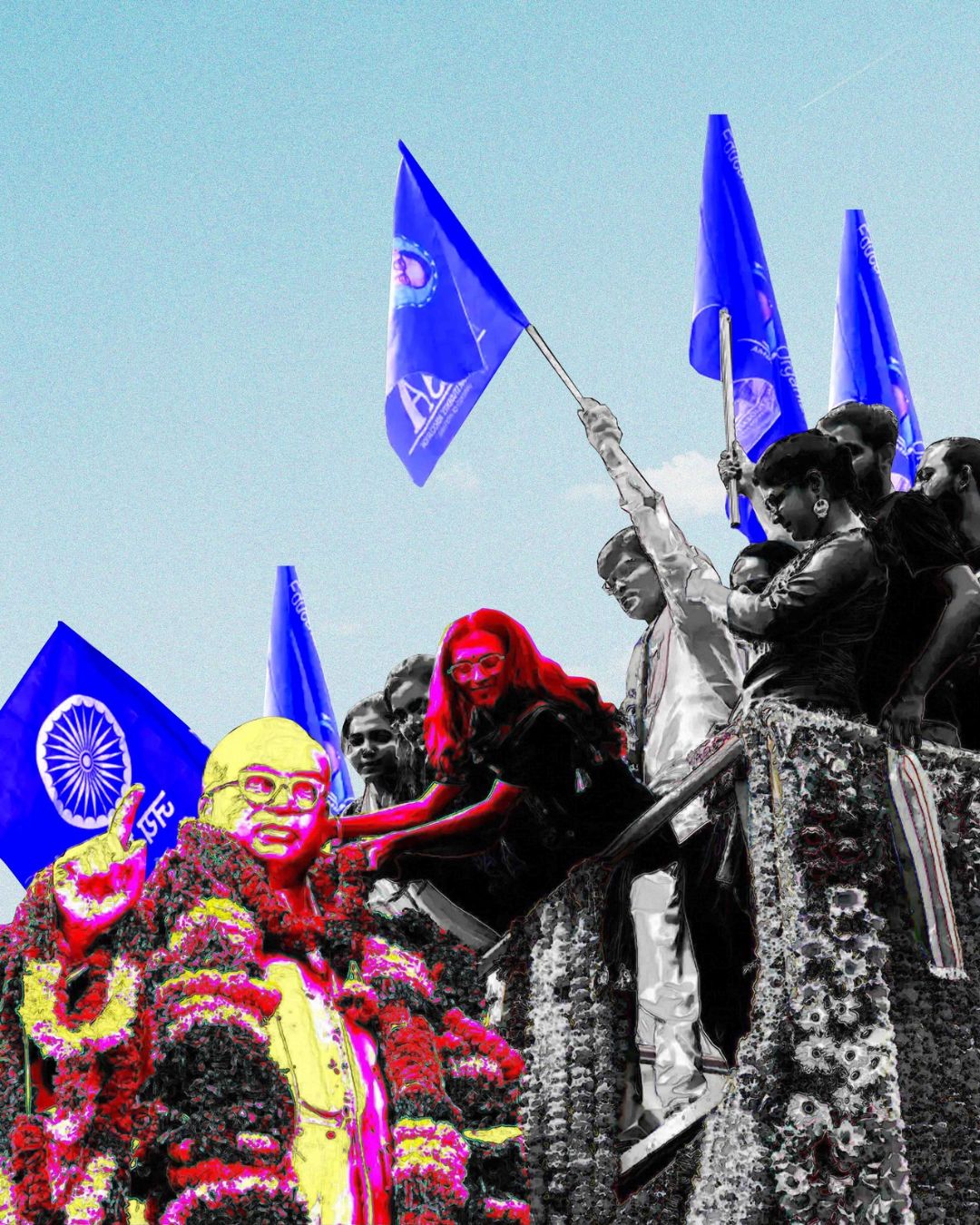
It took us an entire night’s worth of labour to build the artwork featured in the call for TAC’s issue on Caste and Student movements. It was first built by the students of the Ambedkar Students Association at Hyderabad Central University during the Justice for Rohith Vemula movement in 2019. On the 7th Remembrance Day of Rohith, ASA’s 29th committee decided to revive the tradition. I joined three doctoral scholars who were also members of ASA’s working committee at the Annex hostel. Sticks were put together, and a bunch of white cloth was tied around them. I was mostly sitting on the bed. Having spent three months on campus working alongside these young and brave Ambedkarite men, I was aware that our men thought they knew better. Besides, I had no qualms with sexism whenever it worked as a convenient excuse to avoid labour. My joy was short-lived when one of these boys asked me to hold the cloth over the stick structure as he stapled the edges. It was nearly 03:00 AM when we finished making the star. A postgraduate student made a stencil out of old X-rays. Spray-painting the star would require a mask, a towel, or a napkin to protect oneself from chemical toxins, but we were fine. Even though we knew the star was supposed to go over the North Shopping Complex canteen, its exact position was hotly debated.
By the next Shahadat day, the stencils had become rubble, and the stick structure needed repair. The loss of the Star would rehabilitate benign internal dissent back to the surface. We exchanged blame and sought accountability from each other – after all, these objects were an outcome of arduous labour.
In HCU’s student politics, ASA has been particularly characterized by an abundance of internal dissent. The rich multiplicity of internal dissent was most apparent during periods of strenuous labour – especially on days of Shahadat Din, Ambedkar Jayanti, and elections, when everyone was frustrated with everyone else. If you were among the Hindi-speaking Dalits, conversations would begin with ‘Aree’ and fold into them longstanding political disagreements, gossip, news, theory, and history, all in sharp rhetoric. If it were a member of the ongoing committee, they would critique the previous committee, simultaneously burdening their own committee with demands for inventiveness. The new committee would recount the shortcomings of the older leadership. We could spend a couple of hours quibbling about conversion, with the only collective agreement being that annihilation must come now: this very night! We could oppose misguided Ambedkarite projects that subjected our women to docility and domesticity.
There were minor dissents. Most of us did not even agree on how many posters were to be pasted in each hostel. There were urgent dissents. Fierce debates over subcategories and graded hierarchies often revealed that ASA was not isolated from the fraught differences within Dalit politics. Everyday organizing in ASA was rife with dissent. These dissents were as personal as they were political. When dissent became so entangled with our interpersonal relations, we often lost sight of its political and social genealogies. Yet dissent persisted, and none of us ever sought its complete elimination.
A pattern of critique that was persistent, irrespective of factions, was centered around the loss of material objects. Losing pamphlets, tape, pins, and sticks would draw minor attention. If important files, meeting registers, flags, old banners, stencils, or art pieces like the Star went missing, a frustrated conversation among scholars would be fairly justifiable. But if these frustrations ever became ‘issues’ to be raised in General Body meetings, they indexed an unbounding of internal dissent. Frustration over the loss of material objects and aesthetic practices that recycled scrap revealed how political work was carried out within material constraints. We were told that constrained materiality was a condition of ASA’s autonomy.
At a time when HCU’s politics were dominated by student organizations that had the electoral Left for political parentage, ASA sustained itself solely through the efforts of its political organizing within campus. ASA was founded in the aftermath of the Karamchedu and Tsunduru massacres. It braved the social isolation that followed Dalits to the universities. The Mandal debates of the 90s only accentuated the visibility of Dalits. The increasing number of lower-caste students after Mandal meant there was another constituency seeking an anti-caste critique. ASA’s alternative political project provided this constituency with a distinct politics of self-respect and self-determination. This three-decade-old political movement of Dalits imbibed an ethic of autonomy in its everyday organizing. ASA’s insistence on a politics of self-determination and autonomy also provided an avenue for other marginalized subject positions to stake claims on political power. During my two years, I witnessed ASA labouring toward making coalitions with the autonomous Muslim movement, queer collectives, the Left, and other Bahujan fronts. These coalitions, though tenuous, revealed the immense democratising capacity of Dalit politics.
ASA performed the labor of remembering within deep material constraints and amid tremendous loss. Loss was familial, corporal, and relational. When loss was overwhelming, we nested in each other and in politics. ASA’s autonomy was an expression of a deeper yearning for Dalit subjectivity. We were together in our rage and were eager to make it politically expedient. ASA levied an epistemological and aesthetic critique of caste that hearkened back to the history of anti-caste movements. Remembrance was always in response to the demands of preserving these histories.
In remembering Rohith and the many martyrs of caste in universities, we were quite literally waking our dead. Our dead were many, and we often realized that the Dalit movement could not be centered around singular historic figures. In our attempts to expand our canon, we imagined Chokhamela conversing with Ravidas on an intersubjective plane, together recovering emancipatory histories from the rubble of history. Internal dissent meant that we were asked to acknowledge the multiplicity in our political projects of historical recovery. There was no single way of practicing remembrance, and there were many narratives of caste annihilation.
Ambedkarite politics taught me that political work could be carried out through loss—that politics could also help calibrate both material and relational loss. ASA nurtured a political pedagogy that was irreverent, autonomous, and attentive. Whenever I witnessed the graded logic of caste persisting among us, I relied on this learning to conceive of an alternative account of the bitterness and loss of relations that internal dissent often left us with. We were suturing a community while simultaneously learning that Dalits have numerous weaving patterns, all of them clawing at Brahminism. Stressing dignified representation in organizational politics was one crucial way of dealing with our numerousness. But most of us yearn for a politics of mutuality – the starting point of which could be recognizing everyday grief, loss, and autonomy as fundamental to our coming together.