
The engineering and MBA disciplines are bereft of any political organizations and engagement, at least in Mumbai where I studied undergrad. So, towards the completion of my 4-year course in 2018 coinciding with the Bhima Koregaon protest, I wasn’t very sure of the extent to which my involvement as a student could aid the overall impact of what we were trying to do as a community.
It was around the same time that I came across Pinjra Tod, which was still a similar situation to what we faced within our college premises. This case could serve as a microcosm1 of the state of the student movement protests across the country in 2026. While the outburst in 2018 seemed revolutionary at a distance, the statement published in The Round Table India titled “Why we decided to leave Pinjra Tod” by Shradha T K Lama and Sabah Maharaj, explaining why the SC/ST/OBC and Muslim women left this “women’s collective” at LSR and JMI, left a lasting imprint on my young mind. The premise was pretty straightforward. SC/ST/OBC/Muslim women were expected to fight alongside the Ruling Castes for freedom – for the abolition of curfew, for reclaiming the nights – in hostels which they were not even allotted. Reservation was introduced/ accepted much later along the way.
Presently, as I work in a grassroot movement for education at Savitribai Phule Resource Centre (SRC) and look at the ongoing student movements, I see two central notions emerging from on the ground:
1. Unless the student movement mobilizes for the class and caste struggle of the masses, it is but a self-moralist organization that is limited in its impact.
2. The socio-political economics behind the contemporary education system is one in which the State is merely taking responsibility for creating cheap labour in the name of education.
A historically significant student movement, even though it isn’t readily cited as one, was the impact the Osmania University students had on the Telangana separation movement. In 1969, it was they who led the transformation from a localized bureaucratic dispute into a massive civil uprising through a deliberate shifting of demands, strategic alliance building, and mass mobilization. They realized that a demand for strictly bureaucratic fixes within the existing government – Gentleman’s Agreement & Mulki rules – wasn’t effective. During their emergency meeting on January 12, 1969, they shifted the objective entirely – demanding an independent, separate Telangana state – while intentionally expanding the movement beyond the campus walls by forming alliances with government employee unions, labour unions, lawyers, and transport workers. This was complemented by student leaders and university professors who began publishing well-researched papers exposing exactly how Telangana's budget surpluses were being diverted to other regions – providing evidence to change an emotional student protest into an organized political revolution.
In Assam, the student unions AASU & AJYCP, among others, framed their entire narrative around protecting indigenous local identities from illegal migration (from Bangladesh). Towards the end of the 6-year agitation (1979-85), AASU’s executive committee was even intentionally dissolved in September 1985 so its student leaders could transition straight into political leadership. AASU President Prafulla Kumar Mahanta went on to become the youngest CM at 33, representing the Asom Gana Parishad (AGP), shattering the long-standing political monopoly of the Indian National Congress in Assam. Similarly, the JP movement in 1974, led by Jayaprakash Narayan, began in 1973 as a student movement and ended 30 years of continuous Indian National Congress rule at the centre. The Student Nonviolent Coordinating Committee (SNCC) started as a core part of the Civil Rights Movement but later became a driving force in the Black Liberation Movement.
In contrast to this historical evidence, the contemporary student movement largely reflects the popular ruling-class narrative and thus fails to address the broader issues facing the masses. And that is only natural because for the lower classes, education is practically over. The middle class still uses it for mobility through the exams, whose reform is continually sought in contemporary mobilisations. This middle-class anxiety consequently serves as the student movement's mascot, while conveniently sidelining the more material discourse of the larger majority, which is formed by the lower classes. For instance, in 2026, it is very clear that taking the NEET entrance exam is itself a privilege for the larger majority.1
What is a student movement? Is an organization that frequently raises the issues and concerns of students by virtue of becoming a student movement? It could be a part of a larger students’ movement, but then it will be limited in its form, impact, and scholarly discourse as an interest group alone.
Kuffir Nalgundwar, a prominent anti-caste activist, writer, and the founder-editor of Round Table India, tells us, loudly and clearly, the state of the current student protests: “The university is not the place where revolution begins; it is where revolution goes to die.” One of the reasons for this is that we treat the student activist as a morally shielded person, which masks how an undercurrent of the student movement recognizes its own internal limitations. When student figures like Kanhaiya Kumar emerge into national prominence, their speeches and charisma are quickly absorbed into mainstream electoral politics or liberal rhetoric, turning potential systemic critique into a performative spectacle. Conversely, the institutional murder of Rohith Vemula highlights how radical anti-caste voices are branded as mere rabble-rousers and systematically suppressed rather than truly integrated into the movement's leadership.
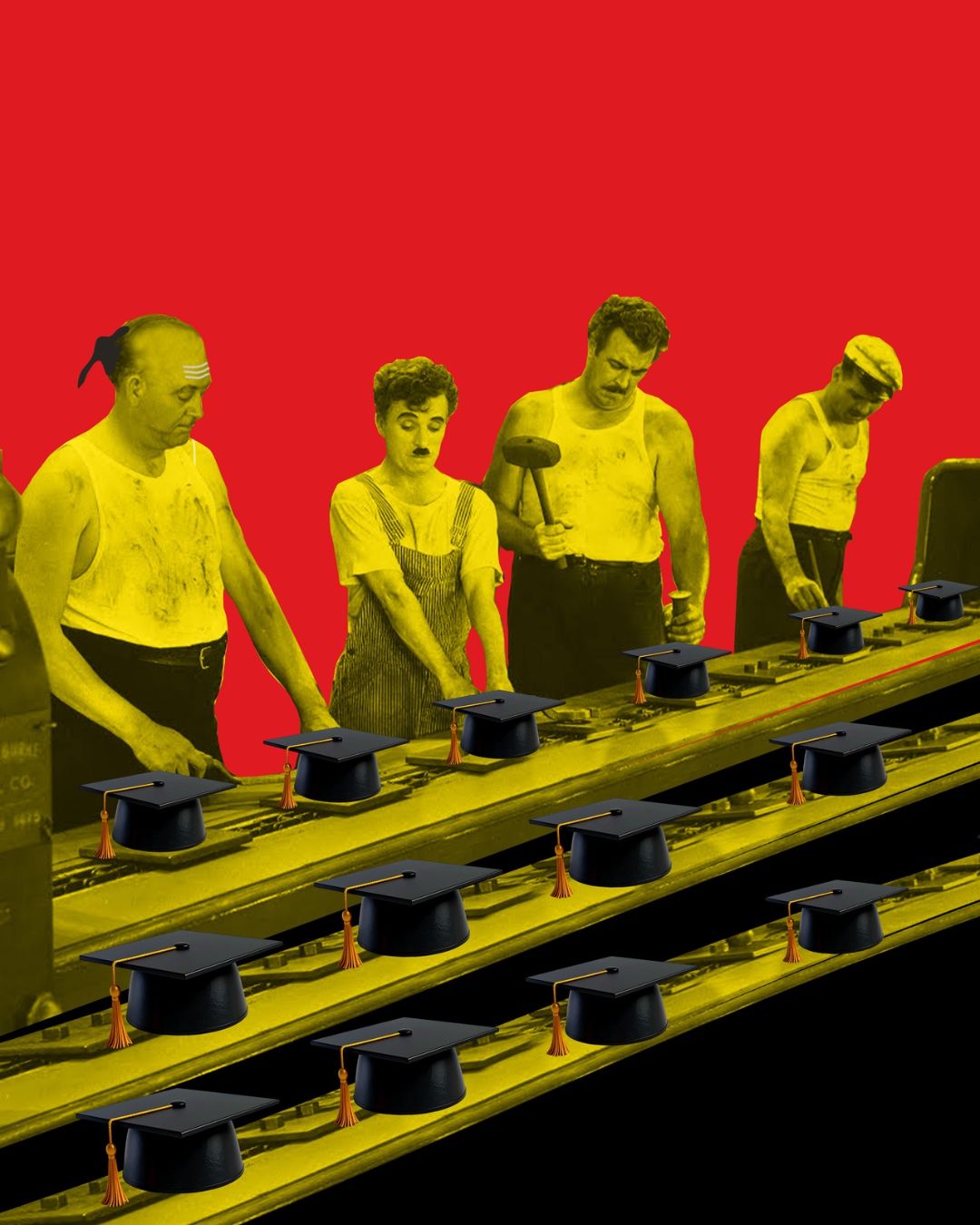
The liberal rhetoric also heavily appreciates the politically correct talk of APU, Ashoka, JNU, among others – very similar to what Lenin would liken to the academics/“uplifters”.3 The seemingly anti-caste narrative rising from these spaces sounds sharp yet ungrounded, distant from the radical politics. This is a consequence of the aggressive privatization of education – that radical thought itself has become a commodity. What are the underlying reasons behind this outcome? What interest does the State have in enabling such a system? In the present context, it no longer serves the traditional role of providing for industrialization either. Then why does the State want to do it? It is very clear that the State’s focus has shifted away from educating the masses for social progress. Its role is now limited to creating cheap labour in the garb of education – and this cheap labour comes from Dalit masses in India. From a sociological angle, it is only natural to conclude that with such institutional withdrawal in the largely privatized education system, normalization of computer-graded exams, we are witnessing the McUniversities of our times, where the students continually consume the pre-packed products of education, turning learning into a standardized, assembly-line commodity rather than an open pursuit of knowledge. And the anti-caste spaces in private universities create the perfect performance space to sell the commodity: radical thought – but within the limits that privatization allows. Alas, the McUniversitification of anti-caste radical thought itself!
How do we build a student movement that defeats the McUniversities in a country where some Dalit and nomadic communities are still celebrating their first graduate individuals? We could start by building a self-sustaining institution that addresses the concerns of the masses. The student movement’s role and strength then lies in mobilizing on the ground for the political concerns representing the majority of the SCs & STs, in building a ground-up organisation that has the potential to change our political authority. Once and for all.
Notes:
1. Vladimir Ilyich Lenin, The Tasks of the Revolutionary Youth
2. In India, fewer than 15% of Indians above the age of 25 have completed a graduate degree. And roughly 15 lakh students took NEET this year. See: What do India's graduates do? and the Annual Report on Periodic Labour Force Survey (PLFS), 2023-24
3. “For “academics” I have here substituted “up lifters”, i.e., believers in law-abiding progress without a political struggle, progress under the autocracy….they confine themselves to the narrow range of professional interests, the improvement of their particular branches of the national economy or of state and local administration.” See1