
It was a rainy day. I was sitting in a rice mill on the outskirts of Gondia city. Gondia is located at the eastern end of Maharashtra, close to the borders of Madhya Pradesh and Chhattisgarh. The city is often called the “Rice City” because of the large number of rice mills in the region. Rice is not simply an agricultural crop here. Over the years, rice milling, trading and transportation have become an important part of the local economy.
The sales manager at the mill was showing me different varieties of rice. Among the wide varieties, one name came up repeatedly: HMT Sona.
After the meeting, I went to a small tea stall nearby. We started talking about different varieties of rice. An elderly man sitting nearby had been quietly listening to our conversation. After some time, he found an opportunity to join us and asked, “Did you see HMT Sona?”
I said yes.
He then said, “It is not just a variety of rice. There is a farmer’s story behind it.”
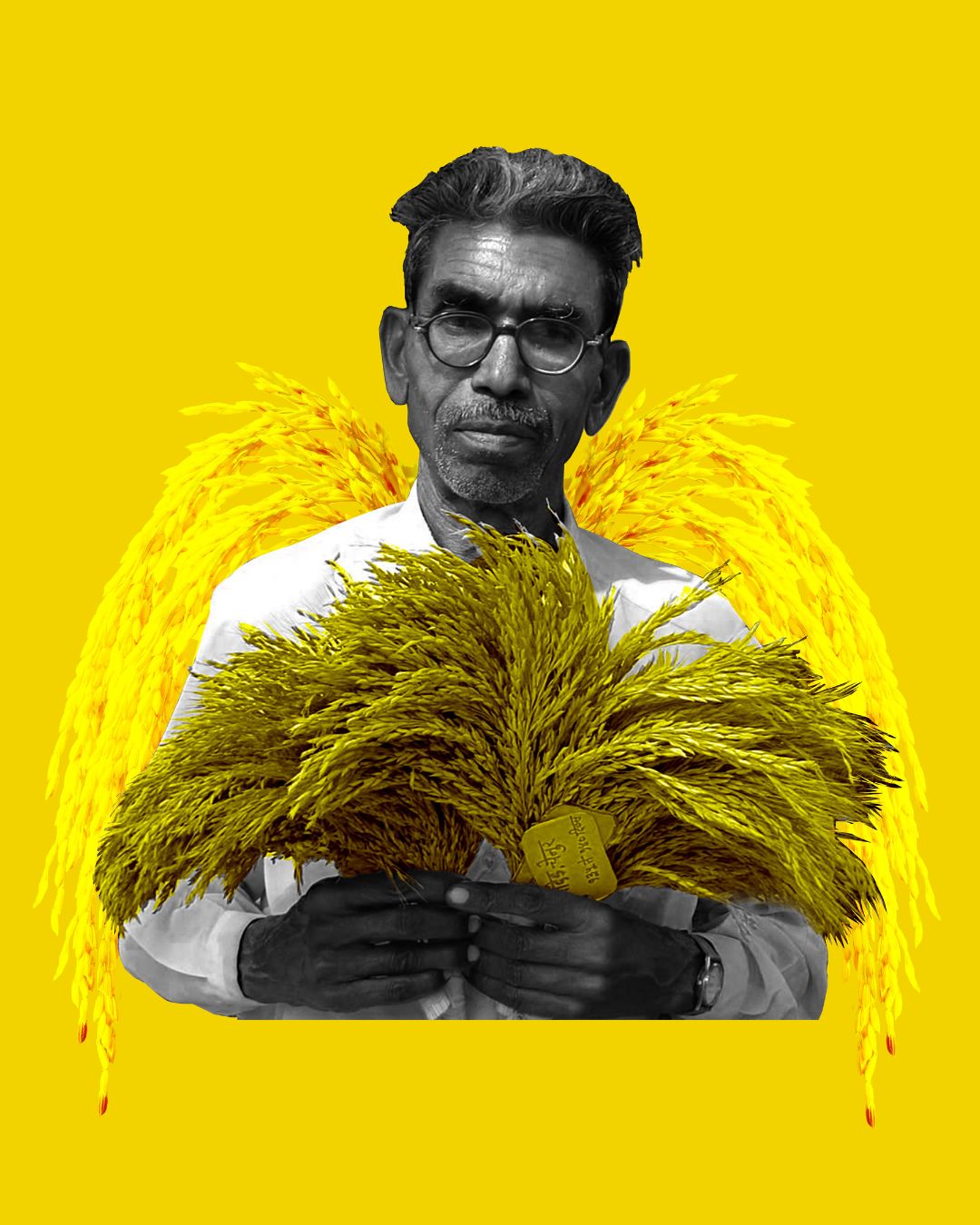
The story he told me was about Dadaji Ramaji Khobragade.
My purpose in this article is not simply to tell the story of Dadaji’s life. Rather, I want to use his work to think about the relationship between farmer knowledge, people’s science, caste, agricultural innovation and recognition. The story of HMT Sona is certainly a story about the development of a new rice variety. But it is also a story about where knowledge is produced, who gets recognition for producing it, and who has the authority to define something as knowledge.
Farmers: Producers or Knowledge Makers?
When we talk about agricultural innovation today, we generally think of agricultural universities, research institutions and scientific laboratories. After the Green Revolution, scientific knowledge and modern technology came to occupy an important place in discussions on Indian agriculture (Shiva, 1991). In this process, farmers were often presented mainly as people who adopted and used new technologies.
But are farmers only users of technology?
Research in agricultural sociology and Science and Technology Studies has questioned this understanding. Michael Warren (1991) and Robert Chambers and his colleagues (1989) have shown that rural communities have their own systems of knowledge. Knowledge about soil, weather, water, crops, pests, diseases and seeds develops through years of experience. Such knowledge may not always be recorded in scientific institutions or academic books, but it is practical and deeply connected to everyday agricultural work.
The work of Dadaji Khobragade is a good example of this kind of knowledge.
Dadaji Ramaji Khobragade was born in 1939 in Nanded village of Nagbhid taluka in Chandrapur district. He grew up in a very modest economic background. His formal education ended after the third standard. But lack of formal education did not mean a lack of knowledge.
He had a close relationship with farming from an early age. He developed the habit of carefully observing his crops. From his father, he learnt how to select and preserve seeds and how to pay attention to plants that looked different from others (National Innovation Foundation, 2005).
Around 1982-83, Dadaji was cultivating a rice variety called Patel-3. Some plants in his field looked different from the others. The size, colour and shape of the grains were different.
Many farmers might have ignored such plants. Dadaji, however, looked at them differently. He kept the seeds from those plants separately. In the following season, he planted them separately and observed what happened. He selected suitable plants and preserved their seeds again.
This was not a one- or two-year experiment. He continued the process of selection, reselection, observation and experimentation for several years. It was through this long process that HMT Sona eventually emerged as a popular rice variety.
Today, such processes are discussed under plant breeding and, more specifically, farmer-led plant breeding. Dadaji, however, did not do this work in a sophisticated laboratory. His laboratory was his own field. He did not have advanced scientific equipment, but he had something equally important – an ability to observe, a willingness to experiment and the patience to continue the process for many years (Chambers, Pacey & Thrupp, 1989).
This raises an important question: Where does science actually begin?
If an experiment is conducted in a laboratory, do we automatically call it science? What about a farmer who observes a crop for years, conducts experiments and develops something new? Can that also be understood as knowledge production?
The story of Dadaji makes us think about these questions.
People’s Science and Knowledge from Experience
Rural India has many forms of knowledge. Farmers know when to sow particular crops, which seeds perform better in particular soils, how to respond to changes in rainfall and how to deal with different crop diseases. Much of this knowledge comes from experience.
Madhav Gadgil and Ramachandra Guha (1992) have drawn attention to the importance of local ecological knowledge in understanding India’s social and environmental history. Vandana Shiva (1993) has also highlighted the role of farming communities in preserving seed diversity.
Dadaji’s work on HMT Sona can be understood in this context. He did not have advanced technology at his disposal. What he had was the habit of observing. He noticed unusual plants, selected them, preserved their seeds and planted them again to see what happened.
Therefore, it would be inadequate to simply dismiss his work as “local knowledge”. There was a process of observation, experimentation, selection and verification behind it. In other words, there was a method of producing knowledge.
This also makes the boundary between science and local knowledge less clear. Bruno Latour (1987) has argued that science is not produced only inside laboratories. Social relations, institutions and processes of recognition also play an important role in determining what comes to be accepted as scientific knowledge.
In Dadaji’s case, knowledge was produced in the field. But getting that knowledge recognised by larger institutions was a different matter.
Caste, Agricultural Innovation and the Question of Recognition
Another important aspect of Dadaji’s story is his social background. He came from a Dalit community. Caste has historically played an important role in the production and recognition of knowledge in India. Who gets access to education, whose knowledge is considered valuable and whose knowledge is ignored are all influenced by social relations of power (Ambedkar, 1936; Guru, 2002).
The story of HMT Sona, therefore, is not only about a seed. It is also about who receives credit and recognition for knowledge.
The relationship between farmers and scientific institutions is not always an equal one. Institutional knowledge is often treated as official knowledge, while farmers’ experience is described as “local” or “informal”.
Gopal Guru (2002) has drawn attention to the unequal relationship between experience and theory. Marginalised communities are often seen as people who possess experience, while the authority to turn that experience into general knowledge or theory remains with others.
Something similar can be seen in Dadaji’s case. He developed the variety through experiments in his own field. But the process through which such knowledge received wider recognition was largely outside his control.
The question, therefore, is not simply “Who developed HMT Sona?” It is also: “How open are our institutions to recognising knowledge produced by farmers?”
The Rice Economy of Vidarbha and the Spread of HMT Sona
The popularity of HMT Sona cannot be explained only by its agricultural qualities. Rice has considerable economic importance in eastern Vidarbha. In districts such as Gondia, Bhandara, Gadchiroli and Chandrapur, rice is an important part of agricultural life and the local economy.
Over time, a wider economy has developed around rice in this region. Farmers, traders, transporters, rice mills and local markets are all connected to this economy.
Karl Polanyi (1944) argued that economic activities are not separate from society. They are embedded in social relationships. The spread of HMT Sona can also be understood in this way.
Farmers shared seeds. Traders began purchasing the variety. Rice mills created demand for it. Consumers developed a preference for its rice. Through these different relationships, the variety gradually spread.
In this sense, the journey of a seed is not simply a journey from the farm to the market. It is also a journey through relationships of trust, exchange, trade and local economic networks.
Dadaji’s Legacy: Beyond the Seed
HMT Sona is Dadaji Khobragade’s most famous creation. But it was not his only contribution. He later developed several other rice varieties, including DRK, Nanded Chinoor, Nanded-92, Vijay Anand, Deepak Ratna and Nanded Hira (National Innovation Foundation, 2005).
His contribution, therefore, cannot be limited to one rice variety. He represents a wider tradition of farmers who experiment, observe and develop new practices based on their own experiences.
But perhaps Dadaji’s most important legacy is not contained in these seeds. It lies in a different way of thinking about knowledge.
When we think of knowledge, we usually think of universities, research institutions and laboratories. Dadaji’s work reminds us that knowledge can also be produced in the field. A farmer who has a close and continuous relationship with land, water, seasons and crops can also become a researcher.
Farmer knowledge, therefore, is not simply an old tradition. It can also be a source of experimentation and innovation (Warren, 1991).
I was reminded of the conversation at the tea stall in Gondia. As our conversation came to an end, the elderly man said: “People eat HMT rice, but very few people know the name of the man who developed it.”
There is a larger social reality contained in this simple statement.
We often remember a product but forget the person who produced it. A seed becomes known in the market, while the farmer behind it becomes invisible. Knowledge may be used by many people, but the person who produced that knowledge may not receive the recognition he deserves.
HMT Sona, therefore, is not simply a variety of rice. It is a reminder of the labour of farmer-researchers. It shows that knowledge and innovation can emerge in rural settings as well.
Contemporary Context: Farmer Rights, Intellectual Property and Participatory Agricultural Research
When we look at Dadaji’s story in the context of contemporary agricultural research, several other questions emerge. Who owns a seed? How should a farmer who develops a new variety receive recognition? And what should the role of farmers be in agricultural research?
After the Green Revolution, universities, research institutions and laboratories became central to agricultural research. This brought many benefits to Indian agriculture. At the same time, however, the fact that farmers themselves experiment and develop new varieties has often received less attention.
This is where the idea of Participatory Plant Breeding (PPB) becomes important. In this approach, farmers are not treated merely as beneficiaries of research. They are considered active participants in the research process. Their experience, knowledge of local environments and observations of crops are included in the development of new varieties (Ceccarelli & Grando, 2007).
Dadaji’s work can be understood in relation to this approach. He was not part of a formal research project. Yet he spent years selecting and experimenting with plants on his own farm and developed a variety that became useful to many farmers. Some of the principles now associated with participatory research can be seen in his work.
His story also raises questions about the ownership of seeds. When a new variety is developed, who should have rights over it? Should those rights belong to a research institution, university or private company? Or should the farmer who spent years developing the variety also have a claim?
India attempted to address some of these questions through the Protection of Plant Varieties and Farmers’ Rights Act, 2001. The Act recognises farmers’ contributions to the conservation and development of plant varieties and provides a legal framework for protecting farmers’ rights. Yet questions remain about how effectively farmer-researchers receive recognition, documentation and protection for their contributions in practice (Sahai, 2003).
Dadaji’s story therefore raises a simple but important question:
Who has the right to knowledge?
Who produces knowledge? Who decides whether that knowledge is valid? And when knowledge produces economic value, does the person who created it receive a fair share of the recognition and benefit?
These questions are not limited to agriculture. They are also questions about the relationship between knowledge, power and social justice.
Dadaji Khobragade’s story, therefore, should not end as a story of an exceptional farmer. It asks us to take rural knowledge production seriously. It asks us to see farmers not merely as producers, but also as researchers, experimenters and knowledge makers.
Today, HMT Sona raises another question for the Indian agricultural system: If knowledge is produced at many different levels of society, are our institutions ready to give that knowledge the recognition, protection and rights it deserves?
Perhaps this is the deeper meaning of Dadaji Khobragade’s life and work.
He did not simply give us a variety of rice. He showed us that a farm can also be a laboratory, and that a farmer can also be a researcher.
References
- Ambedkar, B. R. (1936). Annihilation of Caste. Bombay.
- Ceccarelli, S., & Grando, S. (2007). Decentralized-participatory plant breeding: An example of demand-driven research. Euphytica, 155(3), 349–360.
- Chambers, R., Pacey, A., & Thrupp, L. A. (Eds.). (1989). Farmer First: Farmer Innovation and Agricultural Research. London: Intermediate Technology Publications.
- Deshpande, V. (2018). “Award-winning Dalit Rice Innovator Passes Away at 79.” The Indian Express.
- Gadgil, M., & Guha, R. (1992). This Fissured Land: An Ecological History of India. New Delhi: Oxford University Press.
- Government of India. (2001). The Protection of Plant Varieties and Farmers’ Rights Act, 2001 (Act No. 53 of 2001). New Delhi: Government of India.
- Guru, G. (2002). How egalitarian are the social sciences in India? Economic and Political Weekly, 37(50), 5003–5009.
- Latour, B. (1987). Science in Action: How to Follow Scientists and Engineers Through Society. Cambridge, MA: Harvard University Press.
- Mansata, B. (2018). “Pirating Seeds: The Story of Dadaji Khobragade.” Ecologise.
- Menon, M. (2018). “Dadaji Khobragade: A Lifetime in Rice.” Vikalp Sangam.
- National Innovation Foundation. (2005). HMT: An Improved Paddy Variety. Ahmedabad: National Innovation Foundation.
- Polanyi, K. (1944). The Great Transformation: The Political and Economic Origins of Our Time. Boston: Beacon Press.
- Sahai, S. (2003). India’s Plant Variety Protection and Farmers’ Rights Act, 2001. Current Science, 84(3), 407–411.
- Shiva, V. (1991). The Violence of the Green Revolution: Third World Agriculture, Ecology, and Politics. London: Zed Books.
- Shiva, V. (1993). Monocultures of the Mind: Perspectives on Biodiversity and Biotechnology. London: Zed Books.
- Warren, D. M. (1991). Using Indigenous Knowledge in Agricultural Development. Washington, D.C.: World Bank.