
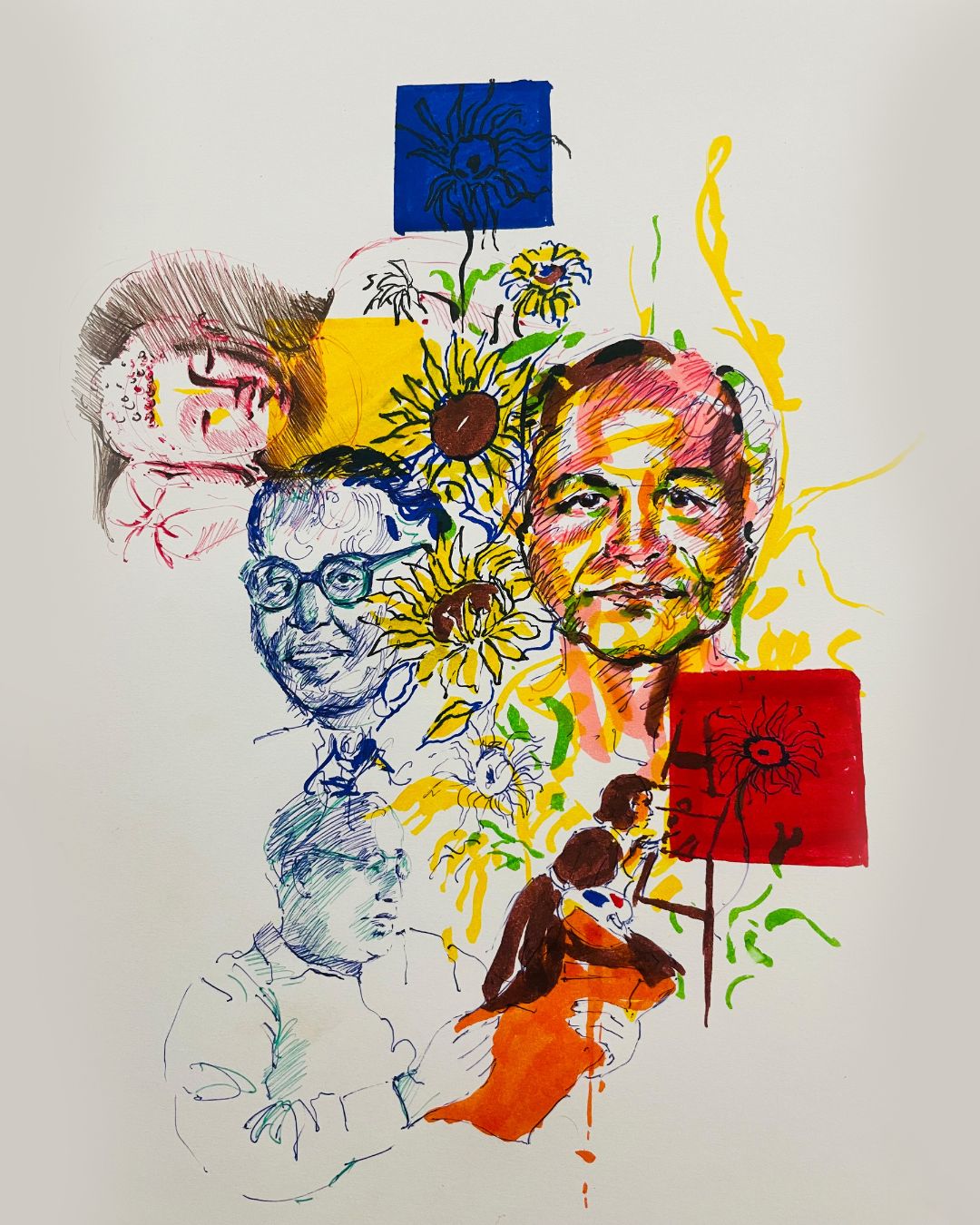
Like the great Buddhist poet Mātṛceṭa, whose hymns were admired throughout Jambudvīpa, the literary masterpiece of Waman Dada Kardak now resounds in the choirs of every sparrow, nightingale, and sunbird that graces the villages and urban spaces inhabited by Ambedkarites; not merely across Maharashtra, but far beyond it.
His words have become the voice of great singers such as Prakashnath Patankar, the Shinde brothers, Shravan Yashwante, and Vitthal Umap. Dada’s soothing verses, praising the deeds, sacrifice, and legacy of the Mahāmanav and his thought, have seeped deep into the consciousness of the Buddhist masses. What began as poetry has become collective memory; what began as song has become a living voice of devotion, remembrance and liberation.
Waman Dada is the mystic whose music became the wind ushering us towards Prabuddha Bharat. His lyricism and melodious voice carry a hidden resonance of Babasaheb himself. In a sense, Dada was a child Babasaheb left behind, a bearer of the echo of an unfinished awakening.
Dada writes:
“पंचशीलाचे घुमवित गाणे,
याच पथाने मजला जाणे.”
“भीमाच्या गुरूंचा जिथे संगम आहे,
तिथेच जगाला तारणारे उत्तर आहे;
वामन, तुझ्या गीतांचा उगम इथेच आहे.”
The meaning this verse carries is profound: where the traditions that shaped Babasaheb converge, there lies an answer capable of liberating the world; and it is from this very confluence that Waman’s songs arise. His poetry does not treat Buddha, Kabir, Phule, and Ambedkar as isolated figures. It discovers within them a continuous current – a subterranean river of ethical, social, political, and spiritual emancipation.
Waman Dada’s songs produced flames that could not be extinguished by the storm. In the aggressive rhythm of his song “आम्ही पँथर” (Amhi Panther), that fire became the language of the Panthers.
Like Kabir, Saraha, Virūpa, Tilopa, and the other adepts who transmuted the Buddha’s doctrine into songs of realization, Waman Dada unknowingly rekindled an ancient current – the tradition of awakened song, when doctrine ceased to remain confined to scripture and entered the bloodstream of ordinary people. The Buddha’s teaching became not merely something to be studied, but something to be sung, remembered, inhabited, and lived.
Waman Dada, like his idol, awakened the memory of a lost civilization and channeled the new zeal that Babasaheb had introduced. He was the herald who filled the silence and sorrow left behind by the Mahāparinirvāṇa. Through the tunes of the Shahirs, spearheaded by Waman Dada, mourning, mobilization, and metamorphosis found their voice. He transmuted the teachings of Babasaheb Ambedkar into melody and carried them into every household, becoming both Mahākavi and Manav Mitra – the great poet and friend of humanity.
His poetic imagination moved across an immense terrain. He could compare Babasaheb’s love and sacrifice to the warmth of a mother and the gentleness of the moon; yet, in the same breath, he could summon military metaphors of storms, revolt, battle, conquest, and the sword of Babasaheb’s sharp wisdom. And finally, he could make the people confront the most painful truth: Babasaheb was gone, and the responsibility had now fallen upon them.
In one of his songs, he writes:
“तुझ्या भाकरीचे तुकडे तू पहावे,
तुझ्या चाकरीचे तुकडे तू पहावे,
हे ज्ञान कोणी पाहणार नाही;
आता भीम नाही, आता भीम नाही,
समस्या आता तू सावरणार नाही.”
[Look upon the fragments of your bread,
Look upon the fragments of your toil.
No one will come to reckon with this knowledge.
Bhima is no more – Bhima is no more;
Now, you must face your problems yourself.]
The lament is simultaneously an admonition. The death of Babasaheb is not merely a moment for grief; it is the moment in which the disciple is forced to become responsible for creating history. In his Hindi song, Dada gives voice to the yearning of Dalit brethren for the emergence of another figure capable of carrying the burden of emancipation: The longing is almost mythical: let another Ambedkar be born. (एक नया आंबेडकर पैदा हो ,पैदा हो तो भीमसा नर पैदा हो))
Today, one encounters a confused academia and a fragmented intellectual tradition in which the lineage of Buddha, Kabir, Phule, and Babasaheb is too often severed into disconnected compartments. Waman Dada, by contrast, bound these figures together as a living genealogy of social, political, ethical, and spiritual thought. He writes, in essence:
“The entire teaching of the Tathāgata Came to be embodied in Kabir; Likewise, the words of Jyotiba Gave courage and strength to the heart. The force of Gautama, The brilliance of Gautama, Reside in the thoughts of Mahatma Phule.”
The Lament of a Broken Movement
Waman Dada watched the deterioration of the Republican party and did not spare its leadership.. In “बारा वाजववले” (Bara Vajavile), he mocks the fragmentation of the movement:
“काल भीमाच्या क्रांतीचे,
गलीगलीच्या कुत्र्यांनी
भांडण सारे माजविले.”
The image is deliberately brutal: yesterday’s revolution of Bhima has been reduced to a quarrel among street dogs. In “बंद आहे” (Band Aahe), the decay of leadership becomes an extended lament:
“गेले बाबा, गेला नेता आमचा,
तारणहार येती येथे;
होते नेते फक्त खिसे भरणार.
आपसात ही दुही माजली,
कुणी करीना एकी;
विस्त तयांवरी असे,
तयांना विस्त नसे कसलीही;
लेक्चर देती दारोदारी.
“तव कैवारी होते बाबा,
सुखी तोवरी होता जो तो.
जो उठतो, सुटतो आजकाल,
पुढारीच तो होतो.
कार्य करीती बिनपगारी –
(पैसा पाशेरी).”
“नेतेगिरीचा छंद आहे,
पण काम भीमाचे बंद आहे.
बसे भीमाच्या गादीवरती,
तोच बिचारा अंध आहे.
इकडे नेता, तिकडे नेता,
शुकशुकाट चालू आहे.
निरखून बघता इकडे तिकडे,
तो पैशातच धुंद आहे.
नेक भीमाचे चेले मेले,
खोटे-खुरटे हे उरले;
एकीमधल्या या बाळांना
बेकीतच आनंद आहे.”
The tragedy Dada identifies here is not simply bad leadership. It is the metamorphosis of a liberatory movement into a marketplace of leadership. The chair remains, the title remains, the speeches remain – but the work of Babasaheb has stopped. The critique reaches its sharpest Ideological expression in:
“वाट फुलेंची सोडून,
आंबेडकरांना तोडून,
चालताच येताच नाय,
तुला चालताच येताच नाय.”
To abandon Phule and sever oneself from Ambedkar is, for Dada, to lose the very road upon which emancipation becomes possible. Dada’s attack extends even to those who cloak caste interests beneath the language of socialism. He writes:
“हा समाजवादी जरी असे ब्राह्मण,
नच शुद्ध जाहले अजून याचे मन;
पाणी निर्मळ नसतं
याच्या झारीमध्ये रे.”
“हा धनचोरांचा नेता आला पुन्हा,
ह्या चोरापासून सारे सावध रहा;
हा खडे मिसळतो आज भाकरीमध्ये रे.”
“हा जाई तेथे काळी करणी करी,
त्या ठायी सारी जातच आपली भरी;
हा खडा नसावा
निर्मळ झऱ्यामध्ये रे.”
Meaning, While the leader may claim to be a socialist, his Brahmin mentality has remained the same; his heart has not yet been washed of its impurities. This man’s offering of water is, therefore, not pure at all. This time around, the chief among the thieves who rob other people’s money has come back once more. Be very wary of this cheat, as he is the one who adulterates even the bread with stones. No matter where he goes, he taints everything with the venom of caste. Such a tainted stone surely does not belong in the crystal-clear spring.
Yet Dada’s poetry was not merely a catalogue of disappointment. Beneath the lament remained an intense yearning for disciplined, principled leadership:
“भीमा तुझ्या मताचे जर पाच लोक असते,
तलवारीचे त्यांच्या न्यारेच टोक असते.”
If even five people had truly remained faithful to Babasaheb’s principles, their collective force would have possessed the sharpness of a sword. Dada remembers a time when there was an army – united in one heart for Babasaheb:
“एक भीमाची, एक दिलाची
होती सेना सारी;
आज बिचारी फुटली सारी,
झाली बारादारी.”
And then comes the tragedy of fragmentation:
“तुकड्यांसाठी केले तुकडे,
गेले इकडे, गेले तिकडे;
तरी न पदरी पडले तुकडे.
किती बिचारे गुलाम झाले,
अन्यायाच्या दारी.”
The movement fragmented itself in pursuit of fragments, and in doing so, lost the very thing it sought. The pieces did not even become possessions; instead, human beings became captives at the gates of injustice. Yet beneath all these laments remains the unextinguished dream of unity – a dream that the Ambedkarite masses continue to carry.
The Making of the Shahir
Waman Kardak was born in Sinnar, Nashik, and grew up listening to songs performed in Tamashas. When he was only seven or eight years old, he would wander through the neighbourhood singing, with a sambal – the traditional percussion instrument – slung around his neck. Around the age of ten or eleven, he heard Shahir Ghegdé’s powada on the Nashik Satyagraha. That encounter planted within him the seed of a music born from struggle. The song was no longer entertainment; it became a vessel carrying the memory of resistance. At a time when Mahars retained a strong tradition of physical culture through akhadas, Waman would visit fairs where wrestling matches were held. The body, the drum, the powada, the public gathering – all these worlds gradually converged in the making of the Shahir.
While working in the Bombay mills, he became associated with the Samata Sainik Dal. It was during this period that he encountered Babasaheb Ambedkar at several places and occasions: at Naigaon, the Nare Park Conference, the Chalisgaon meeting, during the construction of Milind College and Siddharth College, and at Ambedkar Nagar in Nashik.
He remembered his encounters with Babasaheb almost as one remembers following a sacred trail. His words capture the intensity of that devotion: if Babasaheb was at the college, he would follow him there; if Babasaheb was at his bungalow, he would wait for him in the corridor.
Beyond the Banality of Victimhood
Without the academic credentials conventionally associated with intellectual authority, Waman Dada towers over many scholars in one crucial respect: he absorbed, retained, and reproduced the living elements of Dr Ambedkar’s thought.
He understood the importance of education that Dr Ambedkar insisted upon. But unlike the feeble banality of Dalitality, Dada did not allow his poetry to become imprisoned within the vocabulary of victimhood. His poetic imagination transcended the wound without denying it. He embraced the beauty of human existence despite the experience of oppression. He sang of nature, its masterpieces, love, compassion, tenderness, labour, struggle, war, and the innumerable dimensions that fill the human heart.
Like his idol Babasaheb, Dada was also a patron of Indian nationalism and stood against imperial powers that preyed upon the peoples of the Third World. The Vietnam War and the American military-industrial complex found their echo of critique within his poetry. His nationalism was not the nationalism of domination, but a nationalism conscious of exploitation, sovereignty, labour, and human dignity.
The Voice of Labour
Through his song “हमारी है” (Hamari Hai), Waman Dada articulates the very basic truth that those who till the earth, produce, labour, sweat, and make money have a right to the fruits of their labour. Waman Dada takes on the mantle of the laborer whose sweat and blood are robbed by the capitalists and the landlords. The issue of land, division, and labour is powerfully articulated in “भाकरीचा प्रश्न” (Bhakaricha Prashna). As long as land is under the control of parasitic classes, the masses who till the land will not own anything. Dada converts the problem of political economy into the problem of the belly – who owns the bread that we make with our labour? In his most well-known song, he asks, in effect, what share remains with the masses when enormous economic power is concentrated in the hands of figures such as Tata and Birla.
In “सुना है” (Suna Hai), Waman Dada extends this critique beyond domestic exploitation to foreign economic domination. He warns of a foreign capital which arrives carrying machinery, enters the country, transforms its people into servants, extracts its wealth, and carries the profits away.
“सुना है आज भारत में
पराये आनेवाले हैं;
बड़े औजार के ताफे
वहाँ से लानेवाले हैं.”
“तुम्हारे देश में आके तुम्हें नौकर बना करके,
खजाने देश के सारे
वहाँ ले जानेवाले हैं.”
“पसीना तुम बहाओगे,
मगर मालिक होने से
तुम्हारी खून की रोटी
पराये खानेवाले हैं.”
The critique continues through the imagery of cars, scooters, refrigerators, fields, brokers, and profit. Dada understood economic domination not as an abstraction but as something entering the household, the field, the factory, and ultimately the bread of the worker. In all these songs, Waman Dada reiterates the fact that Babasaheb told us: caste and untouchability are an economic system that produces material inequality and creates slaves worse than slavery. Waman Dada’s focus on cheap, hard, and unregulated labour highlights what Babasaheb called the “uncontrolled and unmitigated economic exploitation” of the Scheduled Castes – an exploitation against which there is no public opinion, no administration to restrain it, no judiciary, and no police to correct it. This economic exploitation reproduces itself through the caste system, entering into a grotesque intercourse with post-World War capitalism, where Brahmin-Baniya capital, together with its allied elements, becomes both the priestly and economic exploiting class.
The Buddhist Mystic & Civilizational Grandeur
Underlying all of this, however, is Dada’s profound devotion to Buddha Dhamma. For Dada, the Buddha does not dwell in the distant metaphysical heavens. He dwells where the mind becomes clear:
“जेथे मनाचा सागर निर्मळ आहे, तेथे बुद्ध वसतो.”
The conversion of Babasaheb to Buddhism becomes, in Waman Dada’s poetry, a civilizational turning point – the return of a people to a forgotten ethical inheritance. He celebrates Babasaheb’s deed of turning towards the Buddha and abandoning the old geographies of Pandharpur and Kashi for a new geography of Dhamma. He imagines a Buddhist India in which caste disappears, where the human being is no longer reduced to the status of an animal, and where dignity becomes the foundation of social existence.
In “नवा नूर“ (Nava Noor), the events of 1956, Dhamma Diksha becomes a cosmic rebirth:
“छप्पन्न साली घडलं,
क्रांतीचं वादळ उठलं;
मुक्तीचा मार्ग खुलला,
आई नि लेकरू पुन्हा भेटलं.”
The year 1956 becomes more than a date. It becomes a wave of revolution, a road opened towards liberation, a moment when a people separated from their dignity found one another again.
Ethics, philosophy, transformation, war, exploitation, nationalism, land, agriculture, caste, untouchability, labour, human experience, love, compassion, beauty, aesthetics and transcendence – all these currents run through Waman Dada’s music and pen. Babasaheb formulated the philosophy, articulated the political programme, challenged the social order, and opened the gates of Dhamma. Waman Dada carried that intellectual fire into melody. He transformed doctrine into rhythm, political consciousness into refrain, grief into song, and memory into something that could be carried from one generation to another by the human voice.
This is perhaps why his work cannot be contained within the category of “Dalit poetry” & all such attempts should be vehemently arsoned . As Waman Dada entered the domains of beauty, love, nature, philosophy, rebellion, labour, nation, Dhamma, and the human condition. He was simultaneously a mourner and a mobilizer, a mystic and a revolutionary, a critic and a lover of humanity. Perhaps this is where Waman Dada emerges as the great poet-singer of Buddhist India. In the same way as the ancient Buddhist masters rendered their doctrines into songs of realization, so too Waman Dada rendered the intellectual revolution of Babasaheb Ambedkar into a popular music of awakening. His songs reached where books could not reach. They went to courtyards, factories, chawls, villages, processions, Buddhist viharas, political rallies and the private spaces of common homes. They constituted the oral repertoire of the community. The scholar keeps an idea alive through writing; the Shahir gives it voice. He became Mahākavi because he sang about a people; he became Manav Mitra because under the politics of freedom was always a great kindness toward human beings. Truly there may never be another Waman Dada. For Waman Dada did what the great poets of the land once did: he made Dhamma sing again. He is not merely a poet of the Ambedkarite movement. He is the reincarnated voice of a civilization awakening through song.
To the child whose first elixir of Ambedkarite thought came not through the texts of Babasaheb Ambedkar, but through the music of Waman Dada Kardak brought to me through the lips of my parents and, through the microphone of the Buddha Vihara wrapping the air in the happy voice of the robin that announced the blue dawn. Before I could read Babasaheb I had already heard him in the songs of Waman Dada
For me, Dada belongs to that ancient lineage of poets who made Dhamma heard: Mātṛceṭa, Aśvaghoṣa, and the poet-singers of the Buddhist tradition who transformed awakening into melody. Their verses did not merely describe the path; they became the path carried upon the human voice.
Waman Dada was our robin – the morning singer whose melody awakened people from the long night and announced the coming of a blue dawn.
Today, on his birth anniversary, I pay tribute to the Mahakavi!!!
References
- 1) माझ्या जीवनाचं गाणं (Song of my life), Wamandada Kardak, 1996.
- 2) आंबेडकरवादी महागीतकार वामनदादा कडर्क (The great Ambedkarite lyricist Waman Dada Kardak), Dr Yaswant Manohar, 2005
- 3) मोहळ, Waman Dada Kardak .