
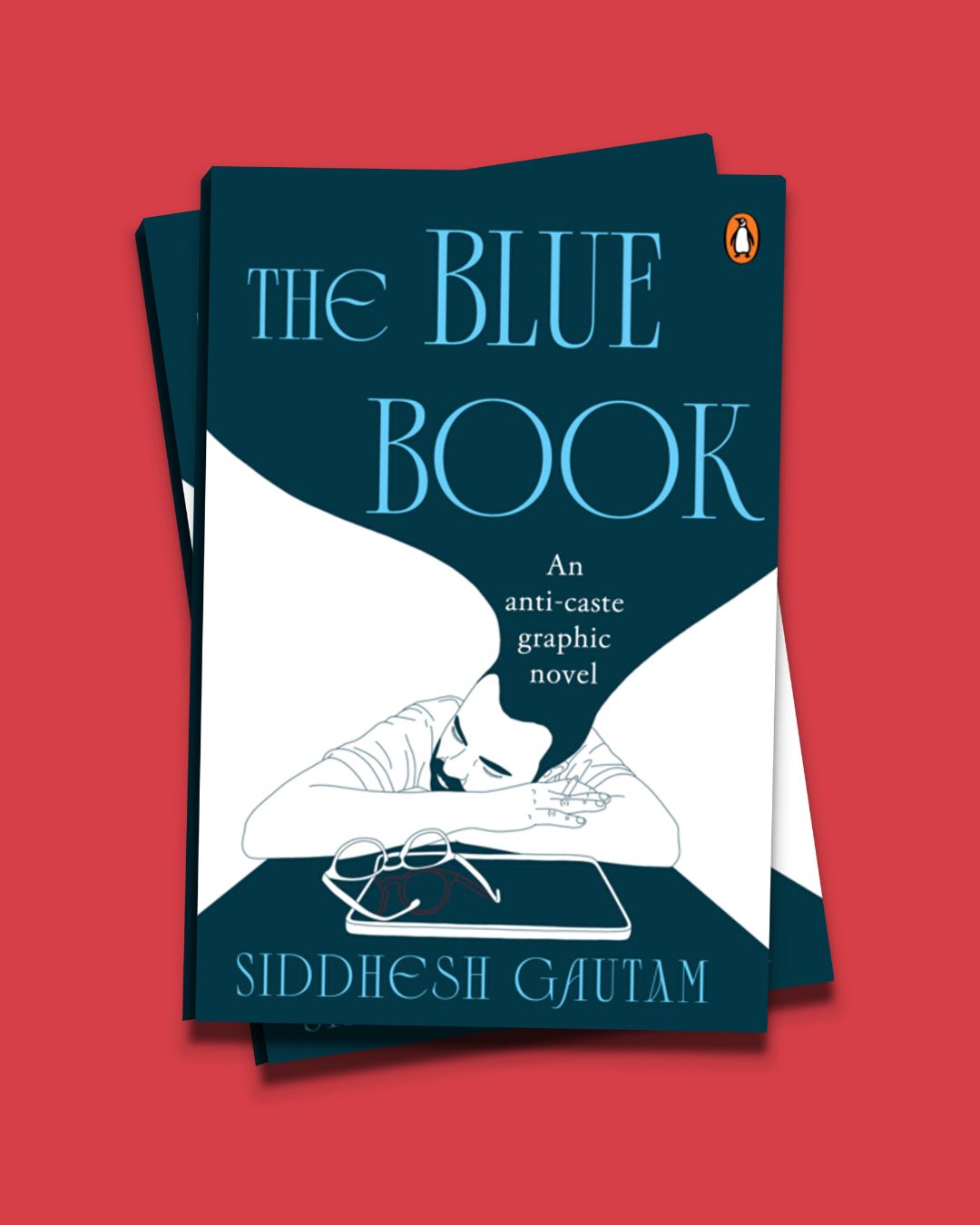
Siddhesh Gautam’s graphic novel is not a novel at all but a series of slides hampered by banal prose.
The central vehicle that sets Siddhesh Gautam’s The Blue Book in motion is the dream. The dream, as Sigmund Freud has taught us, is a complex (indeed, he calls it the ‘dream work’) formation, involving impulses and prohibitions that come into conflict. He speaks of the processes of condensation (in which many ideas or elements combine into a single image) and displacement (where an idea or a person is transferred to another) as parts of the dream work. He also speaks of dreams as “the royal road to the unconscious”, where our desires, often unfulfillable in the day, manifest themselves in sleep, preventing the disruption of our lives because of them. Freud also speaks of the latent (hidden meaning) and manifest content (surface narrative) of dreams.
Gautam’s book explores none of this rich terrain. His dreams are obvious, clear, pedagogical and, quite frankly, banal – involving key figures in the anti-caste movement mostly from India, (even though he claims to be above national borders and speaks of South Asia as a region) and even in India, mostly northern and Western India (South India does not seem to exist for him, barring a one-line reference to Iyothee Thass). Instead, he offers us Class II textbook-suited biographical accounts of most of the figures he encounters – from Savitribai Phule to B. R. Ambedkar, from Ravidas to Fatima Sheikh, from Annabhau Sathe to Kaushalya Baisantri.
Gautam does not explore any of their difficulties, contradictions or limitations, let alone his complex psychic relations with them as manifested in a dream. His narrator changes form, but despite transforming into different animals, birds and insects, the narrative itself remains deathly pedagogical and does not change in perspective; it is the same empty narrative of anti-caste resistance and hope.
Resistance itself is a rich psychoanalytic idea, perhaps especially when it manifests in a dream. Freud himself, and perceptive readers of Freud, like Jacqueline Rose, have shown us that resistance is not just what we commonly think it means, anti-authoritarian protest, but also psychic resistance to change, barriers preventing us from letting go of ideas that damage us but that we might need to liberate us from stuckness. Once again, none of this is in Gautam’s book. For him, resistance is reduced to an empty slogan.
In the few moments when Gautam seems to offer a more complex picture, like in the chapter on Ambedkar, he ends up replicating old asphyxiations. Ramabai and Ambedkar’s relationship was a difficult one, marked by great hardship (endured mostly by Ramabai and her children), and Gautam’s mediation of Ambedkar through her seems to be attempting a half-baked historical redemption of the figure of Ramabai, martyrised out of her suffering by the maternal cult around her in Maharashtra.
However, Gautam does not engage with the difficulties of their relationship and certainly does not enter Ramabai’s subjectivity. Instead, she is silenced once again by the grand gesture of Ambedkar cooking for her and feeding her, in sharp contrast to the years she struggled with no food in the house while Ambedkar was abroad – a predicament Ambedkar himself acknowledged several times in his correspondence with her and others. Gautam silences her once again, and she becomes little more than a sign of Ambedkar’s greatness. What empty, gestural Dalit politics like Gautam’s does not realise is that critique only strengthens Dalit politics; it does not weaken it.
While he wants to make all the right gestures toward feminism, Gautam does little to actually engage with women, or their sexuality or the psychic contradictions of femininity. He acknowledges the abuse Savitribai Phule met with but not her internal struggles; he invokes Meera’s voice but not in the hysterical (in the sense reclaimed by feminists like Juliet Mitchell and Elaine Showalter, as the woman’s voice necessarily thwarted by patriarchy), impassioned songs she sang; instead, she speaks in plangent prose that reduces her to a sloganeerer at Jantar Mantar; he says nothing imaginative to offer about Fatima Sheikh’s life or Kaushalya Baisantri’s autobiography1. These figures only appear to make some profound comments and help him along in his political quest.
With the men, Gautam does no better. He does not engage with Gautam Buddha’s and Buddhism’s deep historical misogyny;2 James Baldwin is one of the figures in the book, but there is no mention of his homosexuality and how it tormented all his work, both in terms of creative writing and politics; Bhagat Singh has never come across as so wooden ever.
All these people become stick figures that one cannot do much with. They are not the flesh-and-blood human beings that led difficult lives, had difficult thoughts and fought difficult systems, let alone had troubled dreams themselves. In interviews, Gautam says he was tired of seeing these figures as just portraits on walls, but that is precisely what they are reduced to in his book.
What saves the book is Gautam’s artwork, which is mesmerising (he has a great sense of line and contour and a vivid pictorial imagination, despite the restricted colour palette), but only when you do not read the accompanying text that the book comes alive. It is the graphic part of the book that allows you to dream. It is in the art that these Dalit figures come alive in your imagination and will haunt your dreams, hopefully in more transformative ways than the boring lessons in ‘Life-story and Basic Teachings’ Gautam offers.
Our deferred dreams dry up, fester, stink, run, crust, sugar over, sag and explode, like in the Langston Hughes poem from which this review takes its title. They are not Siddhesh Gautam’s cardboard cutouts.
Notes:
- Gautam writes about Kaushalya Baisantri in detail elsewhere in The Print article titled Kausalya Baisantri, an early Dalit woman autobiographer, fought a ‘double curse’
- Buddha has a chapter and a larger presence in the book with no mention of women at all. It is commonly known that women monks were not allowed until his nephew Ananda intervened, and even then they were not treated equally. Much else is sexist and misogynistic, like how he perceived women’s bodies or menstruation. I mention gender in light of Gautam’s gestural faux-feminism throughout the book. For more, read: The Rhetoric of Subordination by Bernard Faure.