

Abstract: The recent abeyance of the UGC Guidelines 2026 ordered by the Supreme Court has visibilised the fault lines that the savarna liberal/orthodox ethno-nationalists have been trying to hide. What the case also highlights is a facet of judicial functioning, which this article conceptualises as Judicial Haste. Antagonistic to the principles of jurisprudence, judicial haste obstructs and destructs the due course of justice based on the convenience of the bench succumbing to non-legal pressures and affinities to pronounce hasty and counter-intuitive judicial instruments, in the form of judgments, verdicts, interim stays or interlocutory orders. The article also illuminates the inherent incoherence and inconsistencies within this mode of functioning, using the 29th January order as symptomatic of systemic failures rather than isolated incidents. The article ends on a hopeful note, since the Supreme Court can still seek better, more mature alternatives rather than resorting to judicial haste.
“This will create further divisions in society.”
— Vishnu Shankar Jain, Counsel for the Petitioners, (Supreme Court Observer)
“...this will have very sweeping consequences. It will divide the society, it will lead to very dangerous impact.”
— Chief Justice Surya Kant, (Live Law.)
““society” never existed except as an unexamined assumption, because these segmented sociabilities cannot be totalized into “society”, while keeping the lines of segmentation intact and mostly visible.”
— Aniket Jaaware (Practicing Caste: On Touching and Not Touching., p. 181)
The rhetoric of indivisibility and integrity of ‘society’ echoed again, and this time in the Chief Justice’s Court in the Supreme Court of India. The rhythmic and cyclical invocation of this rhetoric against the demands for social reform, grievance redressal, and justice has now become symptomatic of Indian polity and politics. However, the 29th January order staying the application of UGC (Promotion of Equity in Higher Education Institutions) Regulations, 2026, by a bench of Chief Justice Surya Kant and Justice Joymala Bagchi illuminates a rather rare spectacle of juridical order at work. Not only did the bench allow an urgent listing, but it also stayed the application of the guidelines, alongside raising certain questions. This fast, rather hasty, display of judicial functioning is a spectacle worth examining.
The story of this case doesn’t begin on 29th January, as some might believe. Rather, to attribute any single date as a starting point of this story will amount to sanitising the historic caste-induced oppression. However, for the sake of concentrating on the judiciary’s (in)comprehensibility of caste-as-a-social-issue, the story can be said to have begun with the suicide (a euphemism for institutional murder) of Rohith Vemula in 2016, and Payal Tadvi in 2019. While the political combustion around the issue has been highlighted by various journalists, commentators and academicians, this article focuses on the entry of this issue into the Supreme Court of India. In a writ petition filed by the kins of Rohith Vemula and Payal Tadvi in 2019 (WP (C) 1149 of 2019), the Supreme Court through a bench of Justice Surya Kant and Justice Ujjal Bhuyan, in an order dated 3rd January 2025, ordered UGC to present within 6 weeks new regulations “to combat caste-based discrimination and suicides in higher education institutions, clarifying that the fresh norms cannot be a mere “ream of white paper” but must be effective” (Hindustan Times., 2025). The UGC finally notified the release of these regulations on 13th January 2026, about which the Supreme Court took note in its hearing on the 15th of January. While the bench of Chief Justice Surya Kant, Justice Joymala Bagchi and Justice Vijay Bishnoi ordered the matter to be listed on 19th March next, approximately 2 months later, three other petitions were filed against the aforementioned regulations, separately. Listening to the counsel of the petitioner, the CJI was reportedly heard saying, “We know what is happening. Make sure defects are cured. We will list it”, and the matter was listed the next day, i.e. 29th of January (The Economic Times., 2026). Not only did the bench hear this matter, but it also ordered an immediate stay on these regulations while continuing the application of the 2012 regulations against which the bench had previously ordered UGC to prepare and notify new regulations. Once these events are considered, the internal incoherencies and inconsistencies become clearly visible. What was ordered, was later stayed, in haste, even when a future date was assigned for arguments on the regulations. The haste begs a question: who did this guideline threaten so strongly that the only way through was to oppose and obstruct it unequivocally?
This case, thus, highlights a paradox within the functioning of the Indian juridical order, which we signify as ‘Judicial-Haste’. In cases of judicial-haste, the judiciary, owing to various reasons, succumbs to non-legal pressures and affinities to pronounce hasty and counter-intuitive judicial instruments, in the form of judgments, verdicts, interim stays or interlocutory orders. Thus, not only is the pace of the judicial functioning central to our paradox, but also the entanglements within which the Indian judiciary is situated in contemporary times. We signify these cases as paradoxes to highlight the intrinsic antagony between judicial and haste. The term ‘Judicial-Haste’. has an antithetical meaning, since to be judicial requires considering due facts, both legal and non-legal, merits of the argument, interests of the contending parties, adherence to principles of natural justice, etc.; haste, on the other hand, overrules these underlying principles and safeguards. Therefore, giving birth to our paradox and the question couplet - can it be judicial if it is hasty? If it has to be judicial, can it be hasty? This is also to mind the reader, that haste is also antagonistic to efficient justice, which seeks to avoid judicial delays and unreasonable temporal delinquencies. By temporal delinquency, we refer not to delay per se, but to culpable institutional failures that allow time itself to become a mechanism of injustice.
Furthermore, the 29th January order, through which the Court forwarded four questions, mandates a critical reading. If these ‘substantial questions of law’ provoked such a stern measure of judicial stay, the nature of these questions must be inquisitorial and explorative rather than rhetorical and leading. However, a prima facie reading of the questions in consonance with previous orders (delivered by the same bench) shows a different case.
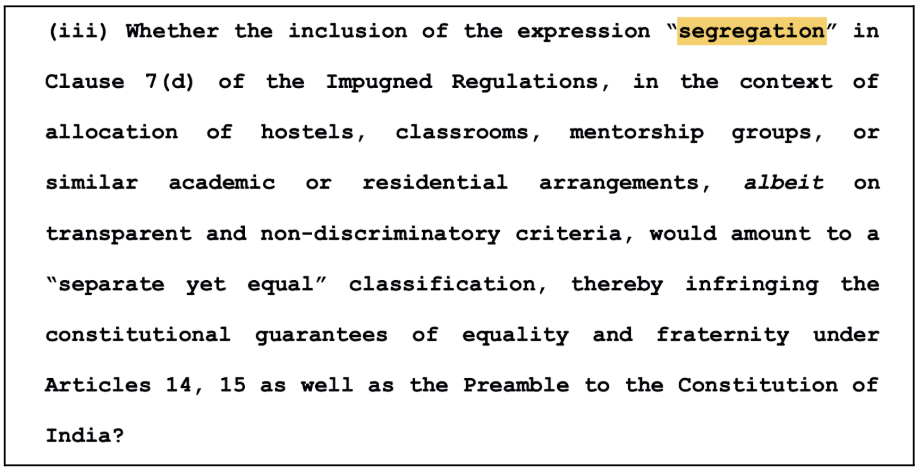
Image 1. Question no. (iii) in the 29th January order
For instance, the third question problematises the expression ‘segregation’ in Section 7(d) of the regulations (Image 1). While the contention appears genuine when read alongside the bench’s order dated 15th September 2025 (Image 2), it is revealed to be repetitive.
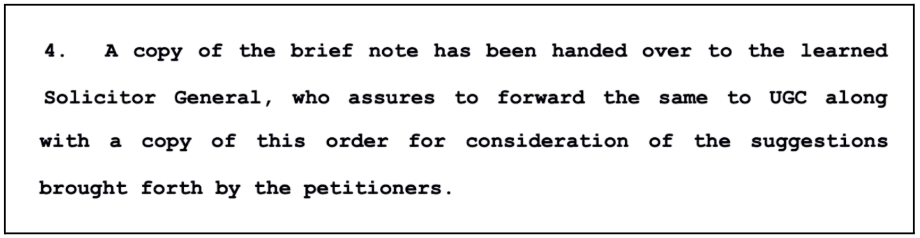
Image 2. Indira Jaising’s suggestion against segregation
The bench had already asked the Solicitor General to submit Indira Jaisingh’s ‘brief note’ which unequivocally opposed segregation by mentioning that “there must be a strict prohibition on allocating hostels, classrooms, or practical batches based on entrance rank or academic performance” (p. 2). Thus, Indira Jaisingh had previously highlighted the point, the bench had accepted the contention, and it was forwarded to UGC (Image 3).

Image 3. Bench forwarded the brief note to UGC through the Solicitor General
Presenting this as a ‘substantial question of law’ when it has already been recognised as such in determining the content of the regulations is unwarranted, making it rhetorical rather than exploratory. This is not to say that the question raised on 29th January was invalid, but the nature of the question runs counter to the bona fide intent that should have informed the proceedings.
Secondly, the 29th January order not only goes against the directions issued in Abeda Salim Tadvi, but also alters the due course of justice destined in and through Amit Kumar & Ors. Justice Pardiwala and Justice Mahadevan, in a judgment dated 24th March 2025, over and above the directions of the court in Abeda Salim Tadvi, recorded:
“...we intend to take a step further towards creating an institutionalised mechanism for ensuring the mental well-being of students studying in Higher Educational Institutions so as to mitigate the instances of commission of suicides by students owing to discrimination, academic pressure, harassment, or any other concern affecting the mental well-being of students.” (p. 75)
In the judgment, the bench explicated how suicides are not one-off occurrences but part of a larger constellation of cases where students had committed suicide “owing to a multitude of reasons like ragging, academic pressure, caste-based discrimination, sexual harassment, etc” (p. 71). This explicit mention of caste-based discrimination, coupled with the fact that most of these suicides have been committed by students of scheduled caste and scheduled tribe groups, tells something that the bench on 29th January chose to ignore, heeding the petitioner’s argument that the regulations assume caste-discrimination is ‘unidirectional’. Thus, the Court has once again chosen to ignore statistical evidence in favour of pure rhetoric.
“The totality called “society” never existed except as an unexamined assumption, because these segmented sociabilities cannot be totalized into “society” while keeping the lines of segmentation intact and mostly visible.”
— Aniket Jaaware, Practicing Caste: On Touching and Not Touching.
It is not as if these regulations would have uprooted the systemic and casteist institutional structures, but the hue and cry against these regulations, along with the subsequent and hasty stay awarded by the Supreme Court, tells us more about the judiciary’s understanding of caste. In October 2024, the then Chief Justice DY Chandrachud authored a judgment in a petition filed by Sukanya Shantha, which came to be widely known as the Caste in Prison judgment. The judgment was immediately regarded as ‘landmark’, but it made visible a rather deeper issue. The problem in the court’s comprehensibility of caste as a social institution is epistemic in nature; thus, the court’s proposed solution - removing ‘caste column’ from prison registers does way less than the court expects. The Court must now come to terms with the fact that caste-discrimination is not an issue that must, and can, be resolved through surface-level — ‘altering the columns of register’ – measures. Caste as an organising axis of segmented sociabilities must be understood as a systemic and epistemic anomaly rather than an administrative issue.
Furthermore, this event is not isolated; rather forms a part of various other cases in which the Court has succumbed to public pressure and ‘uproar’. Because of public protests against the Aravali and the Stray Dogs order, the Court took suo moto cognisance or relisted the matter, respectively, to refer the matters to larger three-judge benches. Succumbing to political and public pressure, while it may sound beneficial for democracy, defeats the principles and purpose of justice when carried out in the chambers of law. In an alternative set of events, the court could have handled the issue with maturity and in accordance with due process. When the matter was decided to be heard on 19th March, the court could have taken due time to understand the multiple rationalities that UGC had considered in formulating the regulations and adhered to judicial maturity rather than its present stance of judicial-haste.
From another angle, the composition of the bar and the bench at the Supreme Court aggravates the crisis. While CJI Surya Kant, as the head of the judicial seat of power, commented on the possible repercussions of the regulation, he chose to remain oblivious to the fact that advocates in the Supreme Court organise themselves on the lines of caste on social media platforms such as WhatsApp, even though it is common knowledge within the premises. The paradox thus begins, not in the courtroom but in the demographic composition, with a convenient ignorance of the division and its clear fault lines. The myth of an integrated society is busted right within his arm’s reach, where even the office bearers, namely the Secretary of SCBA, are members of such caste-based WhatsApp groups. Furthermore, the comment (“It will divide the society”) coming from the bench, which is itself constituted majorly by upper-caste judges, is another point to be concerned about.
Circling back to Jaaware’s dictum, while the totality of society can’t be assumed to exist by ‘keeping the lines of segmentation intact and mostly visible’, an integrated society can neither be forced into existence by trying to hide, or worse, ignore these lines of segmentation.. The defensive rhetoric of unity and fraternity must give way to concrete policy-based solutions that reflect the bona fide intent of the legislature and the executive, with the courts serving as conscience keepers of constitutional promises. The Ambedkarite ideal of fraternity must not be turned into a regressive weapon against the efforts of social reform and justice. The bench must stand up to its own observations and judicial wisdom invoked in previous hearings, and abide by the principles of justice. The court must show that it doesn’t succumb to social media pressure and uphold the constitutional principles of protective discrimination. Finally, the Supreme Court has historically stood the tests of social reform while laying out a principled stance and enhancing the reach of social justice. Like in the Indira Sawhney case, where the court pronounced a verdict, via intelligent and meticulous judicial reasoning, in favour of according 27% reservation to Other Backward Classes as recommended by the Mandal Commission. The Supreme Court has thus historically withstood socio-political pressures, and it must continue to do so.