
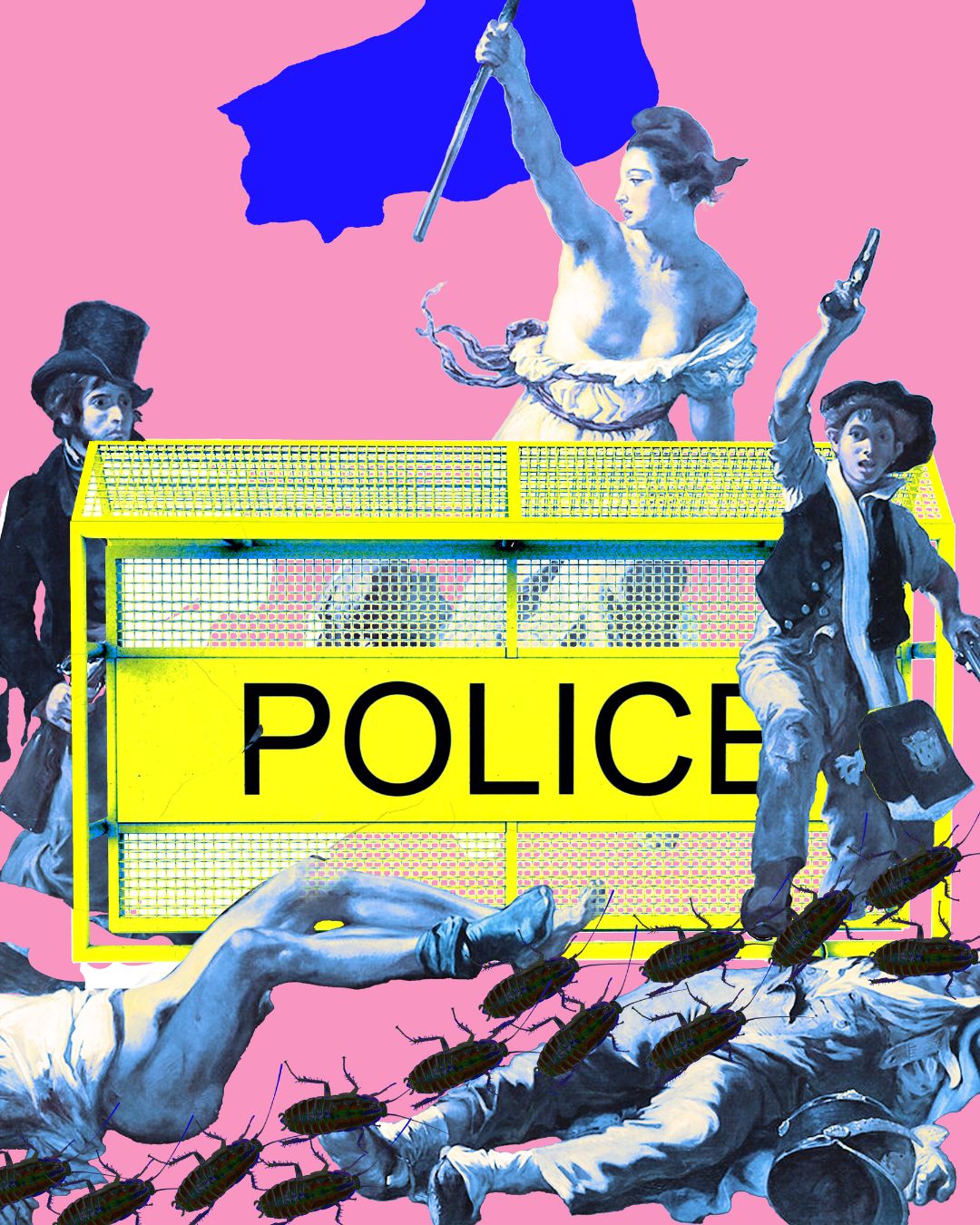
[ Chief Justice refers to unemployed youth as “cockroaches” and “parasites” ]
[ a young man turns the insult into Cockroach Janata Party(CJP) ]
[ The joke acquires a manifesto, a support, a crowd ]
In humor, we feel united.
[ the crowd begins questioning NEET paper leak ]
[ Education Minister’s resignation is demanded ]
[ the protest moves to Jantar Mantar ]
[ Sonam Wangchuk goes on hunger strike ]
In dissent, we feel united.
[ “Anti-Mandal Commission protests were inspiring” ]
[ “Why are we talking about Umar Khalid here?” ]
In politics, we feel apolitical.
[ Wangchuk is moved to hospital ]
[ We march to the Parliament ]
[ state sponsored laathis, tear gas, pellet guns, assault] [ People detained, injured, assaulted ]
Against state violence, we feel united.
but this time
violence feels shocking / everyday / generational.
it depends
[ Protest continues ]
[ Government begins to talk ]
[ Wangchuk breaks his fast ]
[ The Prime Minister responds ]
[ Government asks for time ]
time
whose is it?
[ Protest continues ]
[ resignation arrives ]
[ we rejoice ]
[ phone chimes repeatedly ]
[ Prahlad Joshi takes charge ]
[ … ]
Perhaps this is what they call the power of the youth which has been able to bring together lakhs of people – online and offline – across the country in demanding accountability from the government, in a way as never before. Over the last two months, headlines have shifted dramatically, uncountable reels have been scrolled past, a wide range of emotions have been felt and un-felt in what many have described as Gen Z uniting against “the system.” This “system,” that we collectively appeared to be up against, seemed to be a giant bloc in front of us – something we could be angry at, something we must repair. But then, also, questions do keep emerging, time and again, and naturally so. Questions on the institutional murders of SC (Scheduled Caste) students, questions on caste based reservations, questions on students like Sharjeel Imam and Umar Khalid taken as political prisoners, questions – old and new – reveal limitations to our understandings of our unity against this system as a whole. And so, in the face of these questions, the so-called system ceases to appear like a solid bloc (and so do we). It is then no longer a single enemy ‘out there,’ and starts taking the shape of a layered reality, something that we are all in. Nevertheless, we currently see a historical phenomena taking shape, appearing as though not only a number of people, peoples and ideologies but also temporalities have been converging. One is, thus, driven to ask – in digging through these layers, what would we possibly encounter?
Channelising immediate anger
The CJP was practically born out of social media. It started with a tweet by its founder Abhijit Dipke referencing the term ‘Cockroaches’ used by CJI Surya Kant referring to unemployed youth. It soon turned into a website calling itself the ‘Voice of the Lazy & Unemployed,’ and a simple registration form that garnered lakhs of supporters in a few days' time. The website adopts satirical eligibility criteria and a manifesto touching upon some ‘real’ issues, i.e., judicial independence, vote deletion, women reservation in parliament, media independence, and party defection. This is how the momentum was built on the world wide web eventually moving to the ground (and how!), mobilising lakhs of people across the country, particularly around Delhi’s Jantar Mantar.
The CJP’s stand from the very beginning has been one without an ideology. It has raised governance issues without appearing to be politicized, and mobilized protests around an immediate problem: NEET paper leak causing student deaths, while demanding an immediate solution: resignation of Dharmendra Pradhan. Through this strategy, CJP has been successful in channelising the frustrations and anger of a very large youth force facing issues like unemployment, corruption, and recurring leaked papers and cancellation of examinations into a platform where a large number of them could stand together in demanding accountability from the government, irrespective of positionalities. Its “independent, youth-driven” and ideology-less positioning to overhaul issues with India’s education system has been instrumental in making this a reality, leading to the government finally confronting, and accepting their demands.
The question remains though, what does a resignation even do? What does a demand as symbolic as that could concretely offer to the students navigating asymmetrical systems that affect people disproportionately? Perhaps nothing. Perhaps symbols too offer some significance. Like Sonam Wangchuk says, “A resignation, or accountability, is merely the starting point. The door must then open to determine the right course of action.” [1].
We can borrow optimism, the course of action is ours to chart! Without ideological engagement, especially in a country like ours, any movement will remain short-term and surface-level. This, I think, is evident from the fact that the many questions that we talked about – from reservations to institutional violence to political prisoners – keep emerging. And no matter if only certain slogans and issues are ‘allowed’ to be raised [2], the voices of the marginalized and the organised, voices of the students that have been here long before CJP and will have to remain after – engaging, educating, resisting, fighting – will rise. After all, it is not the slogans and questions that reinforce divisions based on ideologies and identities, systems and structures do. How long can we sustain a fight for the education system without addressing those?
Encountering Systems of Violence & Structures of Hierarchy
If one walked through the Jantar Mantar protest site or scrolled through viral reels on these events, on looking closely, you would see ideologies all around. There is ideology in the shock that many participants felt on hearing Umar Khalid’s name in the protest site. It is there in the questions on institutional murders of SC-ST students that continue to happen, and also obviously there in some trending Reservation Hatao Andolan (remove reservation movement) on Instagram with over 5 million followers. You see, politics often arrives before we begin to even demand something like “Let us keep this protest focused on the main issues. Don’t politicize it ya!” Truth is, students are not a united bloc, nor does the state respond equally to all students. This is evident from the treatment students like Sharjeel Imam, Umar Khalid, and many of Jamia Milia Islamia have received from the state much before today / for years – in brute violence and carceral repression – without receiving widespread support. So is also evident from the deaths of Scheduled Caste students in (or, because of) examination / university systems, and whose families and communities continue to await justice.
How can we then talk about meaningfully overhauling an education system that is so deeply entangled within systems of hierarchy?
Long before we gathered in Jantar Mantar to protest the NEET paper leak, S. Anitha fought against the examination itself which was mandatorily implemented in Tamil Nadu in 2017 for admission to medical colleges. She had scored 1,176 out of 1,200 marks in class 12th and would have gone on to become a Doctor if not for NEET which, as she argued in her petition, favoured students in CBSE curriculum. The Supreme Court did not grant the exemption, ordering medical admissions to be based strictly on NEET scores. At the age of 17, she died by suicide fighting an examination system that placed students from rural and marginalised backgrounds, who could not afford private coaching, at a structural disadvantage.
While the current protests focus on the immediate problem of paper leak and envision solution in minister resignation and compensation, S. Anitha’s fight exposed how these very examination systems are designed to exclude marginalised students. This exclusion has also been evident from official statistics and government data which, for one, suggest that 94,000 government schools shut down in India in the last 10 years, about 25 closing every day [3]. A recent exclusive report by Bahujan Lives Matter that analysed UDISE + 2024-25 microdata revealed a deep social divide in the access to classrooms itself with 62.4% of SC students relying on state government run schools [4]. While the government schools are closing down, this report suggests that the number of private unaided recognised schools have increased rapidly in the last five years where General Category students are almost twice as likely to enrol as SC students and three times as ST students. Moreover, it found that SC-ST students are virtually absent from the elite schools in India that ‘manufacture India’s ruling class’ [5].
We must, thus, look beyond the immediate issues to envision an education system that does not discriminate from the outset. One that is equal, universal, and for everyone – one envisioned by Dr. B.R Ambedkar. “While going through archives [for PhD research], I found Babasaheb [Ambedkar] to be so grounded. In continuation to Phule’s recommendation to the Hunter Commission in 1882, Babasaheb continued to advocate for universalisation of education, right from 1918 till his last speech in 1956 at Milind college. What I see in him is more and more clarity, independent thinking, in-depth analysis and ideological grounding, and most importantly, moral consistency in all the educational debates he led.” notes Dnyaneshwar Shejwal, PhD Scholar in Education at Tata Institute of Social Sciences, Mumbai.
Engaging the Masterminds
My birth is my fatal accident.
There is something revealing about Rohith’s words that he left us with before dying. If accountability is justice, then whose hands have Rohith’s blood on them? And countless others whose causes of death lay not only in leaked papers but also in institutional failures. Not only in institutional failures, but institutions themselves. Institutions – engulfed and entangled in systems of hierarchies. Systems of hierarchy operating within religious-philosophical frameworks, caging the mind, handing it a mirror, controlling what it sees: a caste, an immediate identity and nearest possibility. Reduced – to a vote. To a number. To a thing. Crushing, our very capacities to treat a person as a mind. A free mind. A glorious thing made up of star dust.
Whose resignation ensures “accountability” for this loss? Perhaps we are asking the wrong questions here.
There is often deeper politics that exists within, engulfs even, the politics that gets to meet the eye. This politics that continuously meets the eye – in the incoming headlines and the shifting narratives, reel after reel; party roadshows and changing governments; the announcements, the sloganeering, and the uproar – have a certain kind of loud visibility, fleeting temporality, and fast pace to it. On the other hand, the politics that unfolds as you go deeper into its historical layers is structurally embedded and mentally enrooted. What seems to be fundamentally oppositional on the surface – like the priestly and the secular [6], the Left, Right, and the Centre – may also even begin to dissolve into one as you go deeper. This politics that unfolds as we move deeper is also changing, but often moves at a pace that may seem [relatively] much slower. As if, it is something that forms a core but one that is processual. It is the way all wikipedia pages, if you go on clicking the first link on each of them, will eventually lead to Philosophy. We keep living with philosophies that are neither laying in dusty hardcovers nor divided in neat demographics, but those that are embedded and alive in our religion, politics, state, society, communities, home, body, and mind. It is these philosophical frameworks that are also embedded in our “Education System” that produces and reproduces the dominant worldviews.
And yet, who could stop knowledge from passing through lived reality?
And so, we also kept building our mirrors as we built our institutions and worked with state systems. To think of examples,
Babasaheb Ambedkar did not stop after establishing schools, colleges, and even Constitutional safeguards. He also saw the structured systems for what they were – rooted in religious and philosophical frameworks that control mind [7], amid a long history of a mortal conflict waged on this land [8]. In October 1956, with lakhs of his followers, he left such a framework to take refuge in the Buddha Dhamma Sangha. Buddha…Dhamma…Sangha that did not teach division, hierarchization, and reduction…of beings and becomings …to merely a category, a vote, a number. To him, it meant Liberty, Equality, and Fraternity [9].
The way Saheb Kanshiram’s movement engaged deeply with ideology, and philosophy that called us Bahujans – giving us not only our political representation but also a way to claim power, dignity, and a dignified way to look at the world and ourselves. The way, amid changing electoral politics and shifting narratives, Behenji Mayawati made sure that the road from Delhi to Uttar Pradesh passes through the Gautam Buddha Gate. And as we walk through the lanes of Lucknow parks lined with stupa structures and Buddhist iconography, the colossal statues of our Bahujan leaders through the history greet us with open hands. They represent long-term, gradual, and deeply historical processes.
These are processes that emerged within their historical contexts and give direction(s) to our ongoing path(s). To see these processes only in the superficial layer of politics without their longue durée of past-present-futures is to see them only partially. We think of them as slow, losing sight of even their movement at times. But do the revolving earth and expanding universe move slowly? We may not feel them immediately in our body, but look at how the sky changes and life evolves!
To reiterate,
The purpose of writing this is not to undermine protests, short-term issues, or the role of social media, but to offer a point-of-view which sees also a layered reality moving through systems and history. It is to recognise us as agents of change shaping the direction towards our futures
... before we stop feeling.
Endnotes
- Sonam Wangchuk to Express: CJP protest has no political colour, PM should be sensitive
- 4 slogans cleared by CJP for protesters to chant at Jantar Mantar
- School Education System in India: Temporal Analysis and Policy Roadmap for Quality Enhancement, NITI Ayog (2026)
- Exclusive Report: 62.4% of Dalit Students rely onState Govt. Schools, Bahujan Lives Matter (2026)
- Exclusive Report: India’s Elite Schools with Zero Dalit Adivasi Students, Bahujan Lives Matter (2026)
- This does not refer directly to the concept of secularism, but is in reference to its usage in Dr. Ambedkar’s speech, Annihilation of Caste (1936), in which he notes – “In my judgment, it is useless to make a distinction between the secular Brahmins and priestly Brahmins. Both are kith and kin. They are two arms of the same body, and one is bound to fight for the existence of the other.”
- B.R Ambedkar, “What Path to Salvation,” Columbia University Website.
- This is in reference to Dr. Ambedkar’s analyses of Indian history as “a mortal conflict between Buddhism and Brahmanism.” See B.R Ambedkar, “Revolution and Counter-Revolution” in BAWS Vol. 3, 267; and also see B.R Ambedkar, “The Untouchables: Who were they and why they became Untouchables?” in BAWS Vol. 7, ed. Vasant Moon (New Delhi: Govt. of Maharashtra, 1990)
- B.R Ambedkar, BAWS Vol 17, III, ed. Vasant Moon (New Delhi, Govt. of India, 2014), p. 503