
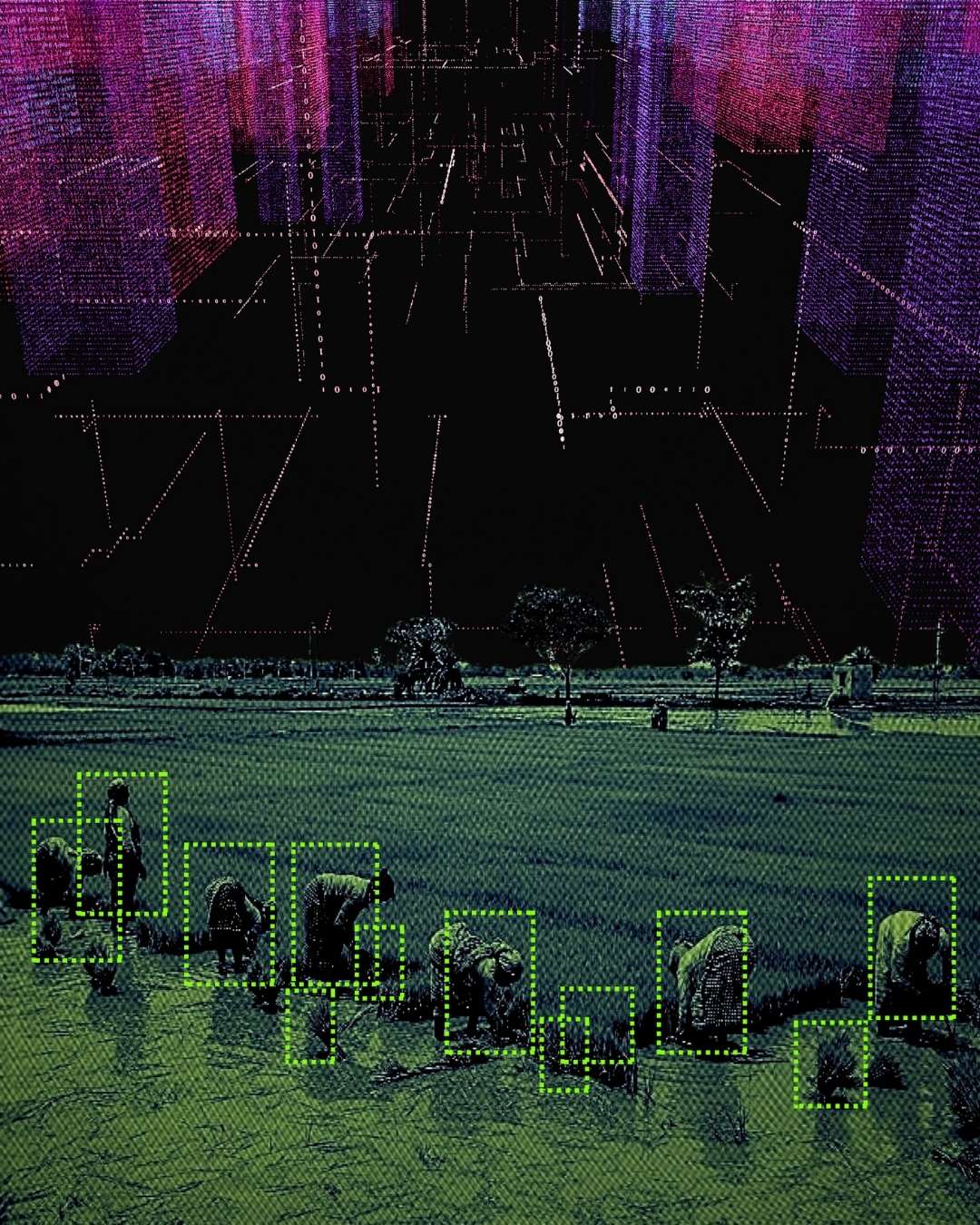
In Humans in the Loop (2024), a caterpillar exposes the folly of machine intelligence. When presented with its image, the system only needs to know whether it is a pest or not. It has no language for the plant it feeds on, the season it signals, or the relations it keeps alive in the forest. With no concern for its surrounding ecology, it sees only a label waiting to be assigned.
Nehma, the film’s protagonist, knows that the caterpillar cannot be reduced so easily. An Oraon woman returning to her village in Jharkhand after the breakdown of her marriage, she takes up work as a data labeller: one of the thousands of invisible human workers who teach artificial intelligence to see. She is told, in effect, to raise the machine like a child. The metaphor is central to the film - AI learns from what it is given, inheriting the prejudice, carelessness, and violence of its trainers.
The film’s most elegant inversion lies here. Nehma is not just a subject being introduced to the digital future. She becomes, briefly, its moral instructor. Her knowledge of land, insects, seasons, animals, and relations becomes a corrective to the poverty of machine classification. Against the arrogance of artificial intelligence, the film places an Adivasi epistemology, one that is embodied, relational, and non-binary.
This is what gives Humans in the Loop its force. It refuses to reiterate the usual spectacle of AI and instead turns towards the communities whose labor makes machine intelligence possible. But the film’s force is also the place where its political ambiguity begins.
The story it offers is too attentive to be called naïve. It understands that AI is biased, that annotation is labor, and that the machine’s intelligence is parasitic on human judgment. It understands that indigenous knowledge systems are not residues of the past but living systems of observation and survival. And yet the film remains attached to a reparative possibility: that participation might bend the digital future toward plurality and that those historically excluded from digital economies should enter them and alter their terms.
When Nehma is shown an AI image generator and asked to imagine a “beautiful woman,” the machine returns an all-too familiar violence: fair-skinned, blue eyes, western clothing. So she begins feeding the machine images and videos of her world: her people, her family, her village, and the faces that have been missing from its archive. Ultimately, the machine produces an image of a brown, sari-wearing woman. It is an affecting scene because it offers correction as recognition; Nehma teaches the machine that “beauty” exists where it had failed to look. It's moving because Nehma wins a small representational victory. It is troubling because the victory takes the form that capital most easily absorbs: affect.
This is precisely why the film has traveled so well. Its reception belongs to the present moment of ethical AI, impact cinema, and developmental optimism. It is critical enough to diagnose the problem but not so hostile that it threatens the premise of the technological project itself, allowing audiences to decry exclusion while preserving faith in eventual inclusion.
This is the liberal desire the film both reveals and inhabits: that capital can be made ethical at the level of representation while remaining untouched at the level of ownership, extraction, and control.
The Human in the Loop
That desire has become one of the most powerful stories of our time. It appears in the language of “AI for all,” “digital inclusion,” “skilling,” “participation,” “responsible innovation,” and “last-mile access.” It tells us that the future is coming, and justice lies in being prepared and trained for it. It invites Dalit, Bahujan, Adivasi, rural, and working-class people into the digital economy as annotators, content moderators, gig workers, platform sellers, data subjects, beneficiaries, and proof of inclusion. It asks them to enter the loop.
However, the “human in the loop” is not an abstract human. She is often a low-paid worker in a small town, a first-generation woman employee, a rural graduate, or a person from a caste-oppressed or economically marginalized community. Her work is repetitive and interpretive at once: drawing boxes around objects, identifying crops and weeds, tagging limbs, transcribing speech, sorting violent content, and cleaning datasets. She may be training agricultural AI, autonomous vehicles, surgical tools, surveillance systems, financial models, or content filters without ever being told where her labor will travel.
The reportage that inspired Humans in the Loop makes this economy visible. By 2021, India’s data annotation sector employed roughly 70,000 people and was valued at about $250 million. Around 60% of revenue came from the United States, while only about 10% of demand came from within India. More than 80% of annotation workers came from rural, semi-rural, and underserved backgrounds; and more than 90% of firms operated in Tier II and Tier III cities. A computer job in Ranchi, Gumla, Shillong, Hosur, or Yemmiganur carries dignity in places where caste and gender narrow the field of possible labour. It offers wages, mobility, a delay in marriage, support for a sibling’s education, and a path to upward mobility. To dismiss this hope would be dishonest, but the hope arrives inside a structure that knows how to use and exploit it.
The old division of labour is reorganised at the back end of computation. The interpretive, repetitive, intimate, and often traumatic work of making the world machine-readable is pushed outwards. In Jharkhand for example, women working from rural homes have described watching hundreds of violent or abusive images and videos in a day so that automated systems can learn what to filter. Their labour is often hidden behind ambiguous job descriptions, non-disclosure agreements, weak mental-health support, and the respectable language of “flexible” digital work.
This matters because AI is often sold as an equalising force. But if its labour markets, datasets, ownership structures, and infrastructures are already caste-marked, then participation only serves to deepen that inequality. To enter the loop does not necessarily transform it. Numbers boasting participation and inclusion become a moral alibi for extraction.
The Land Beneath the Cloud
Artificial intelligence relies on land, water, electricity, cooling, fibre-optic cables, substations, diesel backups, transmission lines, environmental clearances, police orders, and property records. It has a sizable cadastral map.
India’s data-centre capacity has grown from about 0.4 GW in 2020 to roughly 1.5 GW by 2025, with projections of several more gigawatts by 2030. Civil society estimates warn that a single 1 GW data centre could require hundreds of acres of land, billions of litres of water annually, and electricity on the scale of a small city. If India approaches 17 GW of data-centre capacity by 2030, the cumulative demand could consume enormous quantities of electricity and water while displacing tens of thousands of farmers.
Google’s proposed 1 GW AI data-centre campus in Andhra Pradesh has been announced as a transformative investment. It is meant to make Visakhapatnam a “global AI hub”, connected through subsea and fibre-optic cables to Singapore, South Africa, Australia, and the United States. The project is large enough to sound inevitable.
Tarluvada village is known for marigolds, jasmine, roses, cashew, and teak. Seemingly overnight, it was renamed “Tarluvada IT Hub and Data Center Hub” on Google Maps. The land earmarked for the project reportedly includes about 200 acres belonging to Dalit families, many of whom received land in the 1970s under state programmes for the landless. The acquisition therefore enters a historical wound; land granted as partial repair for caste exclusion is now sought for the infrastructure of artificial intelligence. Some villagers have alleged that dominant-caste land is being spared while Dalit land is targeted. A former village council head, Pyla Kondamma, has said she will not give up her land even if threatened.
The promise of jobs in the region sings its tired tune. But the truth is that data centres require enormous capital, and once built, are not labour absorbers in proportion to the land, water, and power they consume. Construction, security, maintenance may offer temporary work. The core value, however, lies elsewhere: servers, connectivity, tax incentives, cloud contracts, and corporate control over computation. The village bears the cost of siting, while the value travels outward.
In Mekaguda, Telangana, Microsoft’s data-centre project entered a village economy of dairy, farming, cattle movement, and small livelihoods. The village milk collection centre reportedly gathers thousands of litres each morning. In 2023, local residents filed a petition against Microsoft and several companies and government bodies in the Telangana High Court. They alleged encroachment beyond property boundaries, dumping of industrial waste into Tungakunta Lake, groundwater pollution in nearby villages, and obstruction of common cartways used for farming, grazing, and water access. Microsoft denied the allegations and refused to engage.
In Ennore, near Chennai, fishing communities have lived for decades beside coal-fired power plants, hot water discharge, chemical waste, declining fish catch, respiratory illness, and fear of cancer and infertility. When an ageing plant was shut in 2017, residents experienced a brief reprieve. In 2025, plans for a new plant on the same grounds were announced to serve power-hungry industries, including data centres and electric vehicles.
When the Environmental Reporting Collective published a short investigative video on the Google data-centre project and its impact on Dalit lands in Visakhapatnam, it crossed more than 2.6 million views on Instagram before Meta restricted it in India following a government-linked notice under the Information Technology Act.
AI Governance in True Form
Herein lies an important lesson that AI and the tech industry repeatedly ignore. Knowledge systems are not content or data. They are relations. Ecological knowledge is not a database of plant names, animal behaviours, and seasonal observations waiting to be digitised. It is inseparable from land, language, ritual, labour, kinship, memory, and collective use. Knowledge of water, sanitation, labour, urban survival, law, and state violence is knowledge formed through generational struggle. To extract these knowledge systems as data while undermining the communities and ecologies that produce them is an elite capture.
It is no surprise, therefore, that the usual language of AI ethics (bias, transparency, inclusion, privacy, accountability) is too small for this landscape. These matter. But in India, it demands speaking of land titles, water allocation, coal dependence, caste-marked labour, environmental clearances, platform takedowns, and the right to refuse.
The language of participation does not answer this. Participation asks: Are marginalized people present in the digital economy? Anti-caste politics has taught us to go deeper: under what terms are they present? Who called them in? What can they refuse? What do they own? What happens to their land? Who controls the data? What is the wage? Is there a contract? What is the environmental cost? What is the exit route? Who audits the system? Who benefits when their knowledge is converted into machine intelligence?
At the end of Humans in the Loop, what lingers isn’t the novelty of AI but the oldness of the bargain being offered. Enter the system and trust that participation will eventually become power. But the history of caste teaches us to distrust invitations that do not alter ownership; the history of “development” warns against promises that begin with land and end with displacement.
The film’s techno-optimism is therefore not crude. It is tender, careful, and politically aware. That is what makes it powerful and successful; it belongs to a cultural moment that prefers reform to rupture. It wants AI to be saved from its own violence by the ethical presence of those it marginalizes, presenting her as a corrective witness and teacher. What it cannot fully confront is that the system does not want her knowledge in order to honor it in the slightest.
This is the core of my argument: AI “governance” in India is already being produced from the grassroots up and demands attention from the top. It is present in mass protest, litigation, documentation, local testimony, and ongoing environmental struggles. The problem is that these forms of AI governance are rarely recognized as such because they do not speak in the language of innovation policy. Yet, they offer the only real glimmer of hope in India’s AI future because they return it to the questions it tries to outrun. Who owns the land? Who controls the water? Who is paid for the invisible labor? Through these demands, the fight against the rise of AI becomes a fight for life itself.