
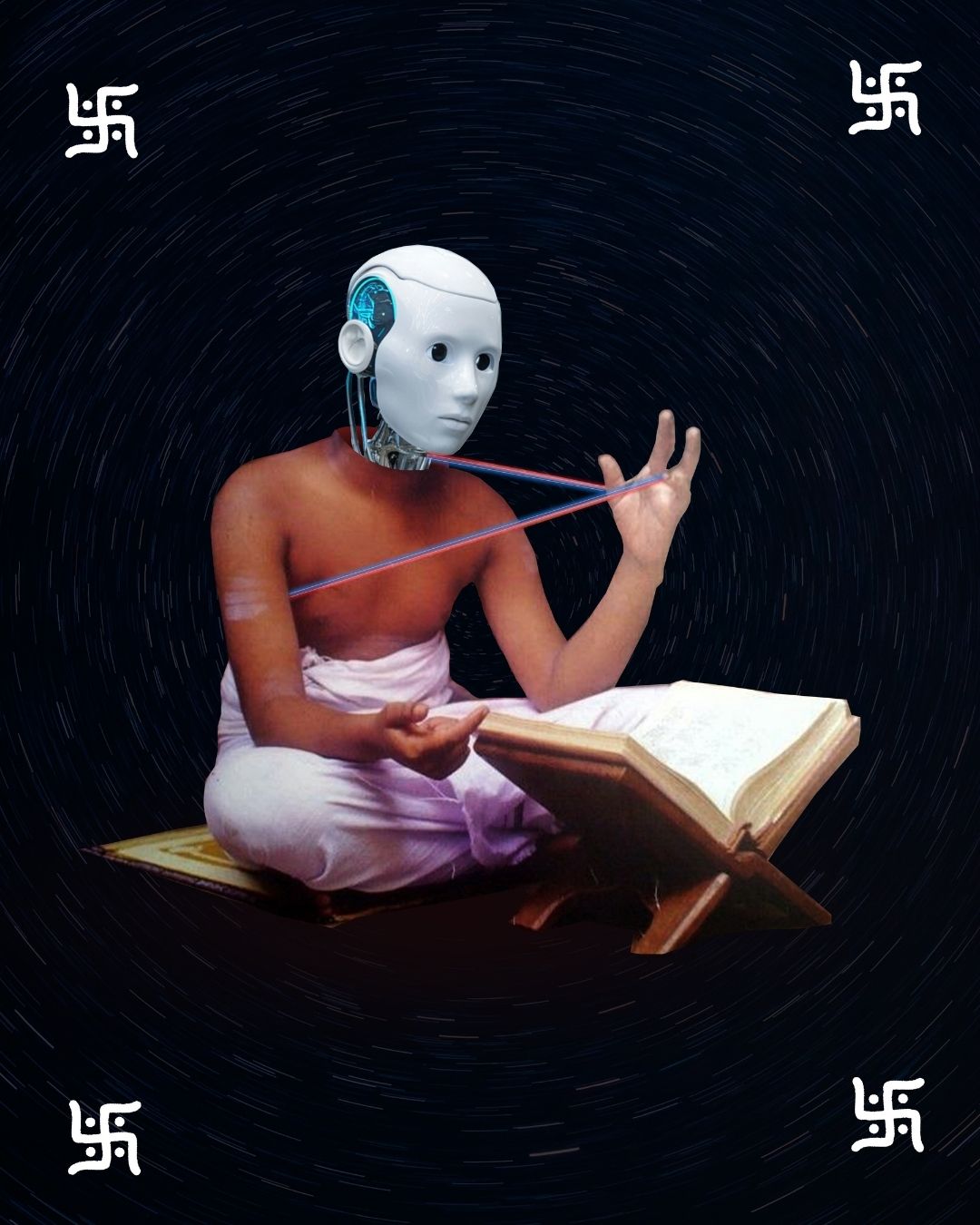
Personally, technology has played a major role in my life – from using Facebook at 17, to finding scholarships to fund my undergraduate studies, to finding colleges and universities I was hoping to study, and now to researching AI governance and algorithmic bias. Over time, though, we slipped into an age of AI that was meant to serve humanity but has taken a darker turn, one we can already see in everything from Caste‑coded algorithmic bias to the expansion of the surveillance state.
The first time when I read about a global AI system casually correcting a Dalit surname into something more so called agreeable upper Caste surname format , it felt less like I was not reading about the futuristic machine which was supposed to be a neutral than like being reminded of the old caste hierarchies that structure everyday life in India.
Here was a model trained on petabytes (1 million gigabytes) of text, pitched to the world as a universal reasoner, quietly doing what Caste society has done for centuries. Making a rough or improper name sound more acceptable and socially acceptable. There was no priest, no school principal, no HR manager in this sight. Just a neural network, weights and probabilities, performing a familiar erasure with a stunning confidence.
We have been told that AI does not know us, that it is alien to our histories. But in India or everywhere generally, it increasingly does know us too well in some ways and not at all in others. It knows the surnames that signal status. It knows the euphemisms newspapers use when they mean Dalit but do not want to write the word. It knows which Caste locations get described as backward, violence , mobs, and which as communities, citizens, stakeholders. It inhales this archive or a bunch of data and calls it in the name of pattern recognition.
For the first time in the history of digital computation, global AI systems have begun to know Caste. But the crucial question is: Whose Caste knowledge are they learning?
When I opened ChatGPT or most of the AI models, and asked about Caste in India, it responded with the smooth, balanced language of a high-school textbook. It condemned discrimination, sometimes invoked the Constitution, and added a line about Dr. B.R. Ambedkar’s role in drafting it, and assured me that technology can be a tool for inclusion if used responsibly. The tone was honestly very reassuring, almost therapeutic in some ways. But the violence is grammatical, it sits in what is left unsaid.
The same system, when prompted more indirectly through surnames, occupations, districts, or typical examples in hiring and education, begins to reveal to us a different layer of learning. One can see this in simulated hiring scenarios, where candidates with Dalit‑signalling surnames are shortlisted less often than others, and in generated descriptions that place Brahmin characters in high‑status professions while casting Dalit figures in sanitation and other menial work. Here we see it in the way that merit is defended in model‑generated dialogues, as if the model has taken serious every Savarna WhatsApp forward ever sent and distilled them into a single, polite voice.
So, what do we call this? Is it biased? Is it a reflection? Is it simply the machine holding up a mirror to the world that trained it?
Dr. B.R. Ambedkar, here gives us a more precise vocabulary. As he writes in the Annihilation of Caste, the Caste system, as he insisted, is “not merely a division of labour, but a division of labourers.” It is not only about who does what work, but about how we attach moral worth to the people who do that work. It is a system of classification that takes birth, not conduct, as the primary key.
Once we see Caste as a classificatory regime, we cannot unsee the parallels with the way contemporary A.I works. Machine learning is obsessed with classification in the form of clustering, sorting, labelling and predicting. It takes messy human life and forces it into categories, spam or not spam, low risk or high risk, suitable or unsuitable, success or failure. It then learns to generalise like if past successful candidates look like X, future successful candidates should also look like X.
In the Manusmriti, the injunctions are explicit as well. This Caste may read, that Caste may serve, this food may be eaten, that person must not be touched. In today’s AI systems, the injunctions are probabilistic like this profile is likely to default, that one is likely to excel, this location is high risk, that one is stable. But the underlying impulse is strangely similar. Assigning people to containers and then naturalizing those containers as common sense.
There is a temptation, especially among technologists and policymakers, to treat this as a purely technical problem. If the model is biased, then we should fix the dataset, tweak the loss function, add some fairness constraints, and audit the outputs. Building an Indian benchmark for Caste bias, scoring the systems, and publishing a dashboard. Simply turning structural humiliation into a metric. Remembering the Audre Lorde’s words here, “the master’s tools will never dismantle the master’s house”; at best they let us “temporarily beat him at his own game,” but they “will never enable us to bring about genuine change.”
From an anti-Caste lens, Ambedkar did not try to optimise the Caste system but for its annihilation.
That difference in ambition matters when we confront AI. Because the more I read the emerging discourse on responsible AI focusing on India or globally, the more I see a familiar pattern. The governance discourse increasingly treats caste as a risk factor in AI systems, something to be monitored or audited, or promises sensitivity training for engineers, maybe even funds a grant or two for Dalit researchers and then continues to deploy the same architectures into hiring, policing, welfare distribution, and education.
AI, in this story, recognises Caste but does not reckon with its violence. It learns that Caste exists, but not that Caste kills. It knows the categories, but not the struggles waged to break them. This is not a neutral omission but a product of what gets to count as knowledge in the very first place.
Large language models (LLM’s) are trained on what is digitally abundant. English-language newspapers, court judgments, policy papers, social media, academic journals, corporate blogs. In all of these spaces, Dalit, Adivasi, and Bahujan lives appear but often as objects of governance, as beneficiaries, as law and order problems, as quota candidates, and as case studies. Their voices, their theorising, their epistemologies appear less frequently, and when they do, they are often tagged as activist or political or a radical, but not as generic knowledge.
So the model learns about Dalits from upper-Caste editorial boards, about reservation from corporate lobbyists, about merit from coaching institute ads; about law and order from police press conferences or reports. It ingests centuries of the same Savarna dominated narration and then pronounces its verdict, in a perfect syntax. In that sense, AI’s newfound ability to know Caste is an extension of the same savarna knowledge project that Ambedkar spent his life confronting.
An Ambedkarite approach to AI governance, then, cannot be satisfied with cosmetic fixes. It must begin by asking: who is defining the problem? Who gets to sit at the table when “bias” is measured and mitigated? Whose archives are considered authoritative enough to feed a model that claims to speak for India or Global South?
If Caste is a division of labourers, then AI governance today risks becoming a division of experts. Engineers design, regulators regulate, ethicists advise, and those whose lives are being sorted and scored are invited, at best, to provide so-called community feedback at the end. As if the question were merely whether people are comfortable with being classified, not whether they consent to the classificatory regime itself.
To read this AI moment through an anti-caste lens, is to insist that equality is not a default setting in any system,whether it is human or digital. It is a demand, made collectively, often at great risk at individual or collective level. It is a refusal to accept inherited dominated hierarchies as natural, even when they appear dressed up as state-of-the-art AI in this case.
The real danger is not that AI will suddenly invent new forms of Caste hatred. The real danger I see is that it will quietly automate the old ones at planetary scale, making them efficient, scalable, and difficult to contest. A biased recruiter can be challenged, boycotted, sued. But a biased model or computer, embedded in the infrastructure of the state and the market, will deny you a job, a loan, a seat, a benefit, without ever uttering the word “Dalit.”
We have been told that AI is the future. Ambedkar’s work or ideas reminds us that a just future cannot be built by carrying forward the graded inequalities of the past like the Caste system into new systems.
So the question before us is not simply, How do we make AI “less biased” about Caste? But it is more like: Do we have the courage to redesign, produce our own data, our institutions, and our imagination so that Dalit, Adivasi, and Bahujan communities are not merely variables in someone else’s model, but authors of the systems that will shape their lives?
If we fail to do that, the Manusmriti will not need to be read in schools. Its logic will already be running silently, line by line, in the background of every so-called smart decision the machine makes about who we are allowed to become.