
Experiencing the societal presence of caste in the form of symbols, during my schooling, was seeing peers using wristbands showing caste affiliation through the associated political parties’ colours, which is being transposed to everyday occurrences. It was evident in my doctoral research and field visits, during which I documented the colours of associated castes still present in the material reality of spatial boundaries, commemorations, and visual markers in Tamil Nadu. These colours now also extend to the online presence of caste across various social media platforms, Instagram, X, Facebook, and WhatsApp, to encoded emojis, icons, and socio-political signifiers. Herby, solely to situate the relevant political parties in relation to the encoded colours and symbols, such as emojis, and reflect on their circulation, as they are associated with caste majorities in public spaces. Emojis, hashtags and metonyms across platforms show symbolic patterns, and this extends digitally to typefaces, fonts, posters, icons, covers, bios, flags, and colour-coded instances. Thus, these occurrences, icons and emojis matter in different terms of identity, as decoding such discourses and representations requires a more detailed analysis of the state’s complex socio-political phenomenon than provided here.
Digitalising Icons, Emojis and Hero-worship
Dr Ambedkar’s argument on idolatry and hero-worship in India, as elaborated in the 1943 speech Ranade, Gandhi, and Jinnah, highlights the inextricable connection to current politics. The social and political forms of heroic engagement in this connection, on a digital level, are prevalent in the foremost caste Hindu practice of worshipping deities, which is also extended to these select figures. Earlier research by Karthikeyan Damodaran and Hugo Gorringe (2017) highlights contentious spaces, especially during commemorative events such as Guru Puja, when regionally celebrated historical and heroic icons are invoked alongside their caste-affiliated identities. This practice brought widespread masculine iconography, namely among intermediate castes, such as Thevar, who used these symbols to depict dominance, prompting Dalits like the Devendra Kula Velalar (formerly Pallar) to respond with their own assertive political imagery. Over time, this cultural focus on intermediate caste dominance resulted in “Madurai formula films”, which were heavily influenced by the same phenomenon. However, contemporary discourses significantly changed the iconisations. As a contemporary genre, the Dalit heroic films rework melodrama into a hyperrealist form that disrupts caste ideology through counter-memory (Leonard 2026). This shift in Tamil cinema’s narrative can also be extrapolated to situate selective iconography publicly within the state’s caste and socio-political discourse.
Digital spaces are now interconnected through encoded caste markers on these select icons and related parties, such as hearts, flags, and emotive objects, notably through associated colours. Digital ethnography outlines how evolving contexts transform research, where media presence reconfigures methods, practices, and theoretical perspectives (Pink et al. 2016). Utilising these mediated aspects briefly in digital spaces – such as emojis and colour-coded presence to political parties – connects to caste affiliations being shown algorithmically, consolidating caste hierarchies into the platforms. Reception of hoardings is shaped by an individual’s social positions and mediated by class, caste, and the male gaze, producing modes of engagement and appropriation (Geetha et al. 2007). The reception in film hoardings and political posters, here by extension, in colour-coded emojis depicting influential figures linked to caste, becomes a major factor in their online occurrences.
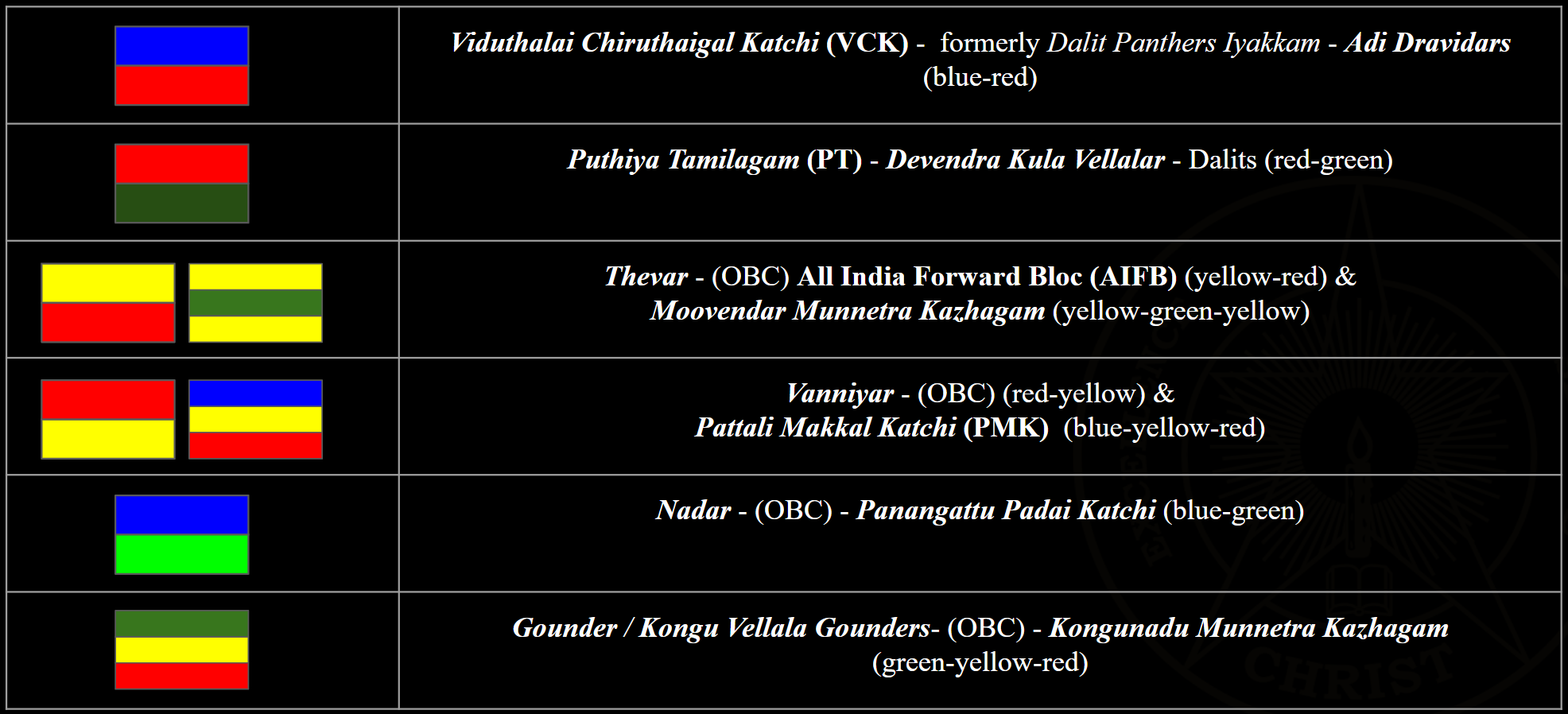
Select political parties' flags, colours and affiliations. Source: Author.
In this way, emojis, as visual signs, are encoded to the caste-affiliated colour for referential understanding, rather than to their Unicode designations in databases. For example, Thevar/Mukkulathor instead of the Japan beginner driver sticker/North Macedonia country flag; Devendrar instead of Burkina Faso country flag and Vanniyar instead of Romania/Chad/Andorra country flags used to communicate caste affiliation, and association with the posts and discussions in social media platforms. The visual sign also operates connotatively, embedding cultural references and ideological dimensions within communicative practice (Hall 1973). Correspondingly, the discursive and encoded emojis for the state’s select OBC (Other Backward Castes) subcastes, such as Tamil Nadu’s northern majority Vanniyar and the southern majority Thevar, as swords, crowns, shields, and fiery symbols, to hypermasculinise influential caste iconisation. Clearly communicate the affiliated colours, formulaic heteronormative, dominant-caste, and moustache-twitching heroic archetypes from films to reality. Now, in the digital sphere, all their corresponding emojis are available in some online databases and can be searched with hashtags. Selectively, the contrasting emoji representations of Dalits and Brahmins can also be seen in the blue symbols and elephant parallel to the trident, and Hindu metonyms; especially striking occurrences such as Jai Bhim, contrasting with related emojis along Ram.
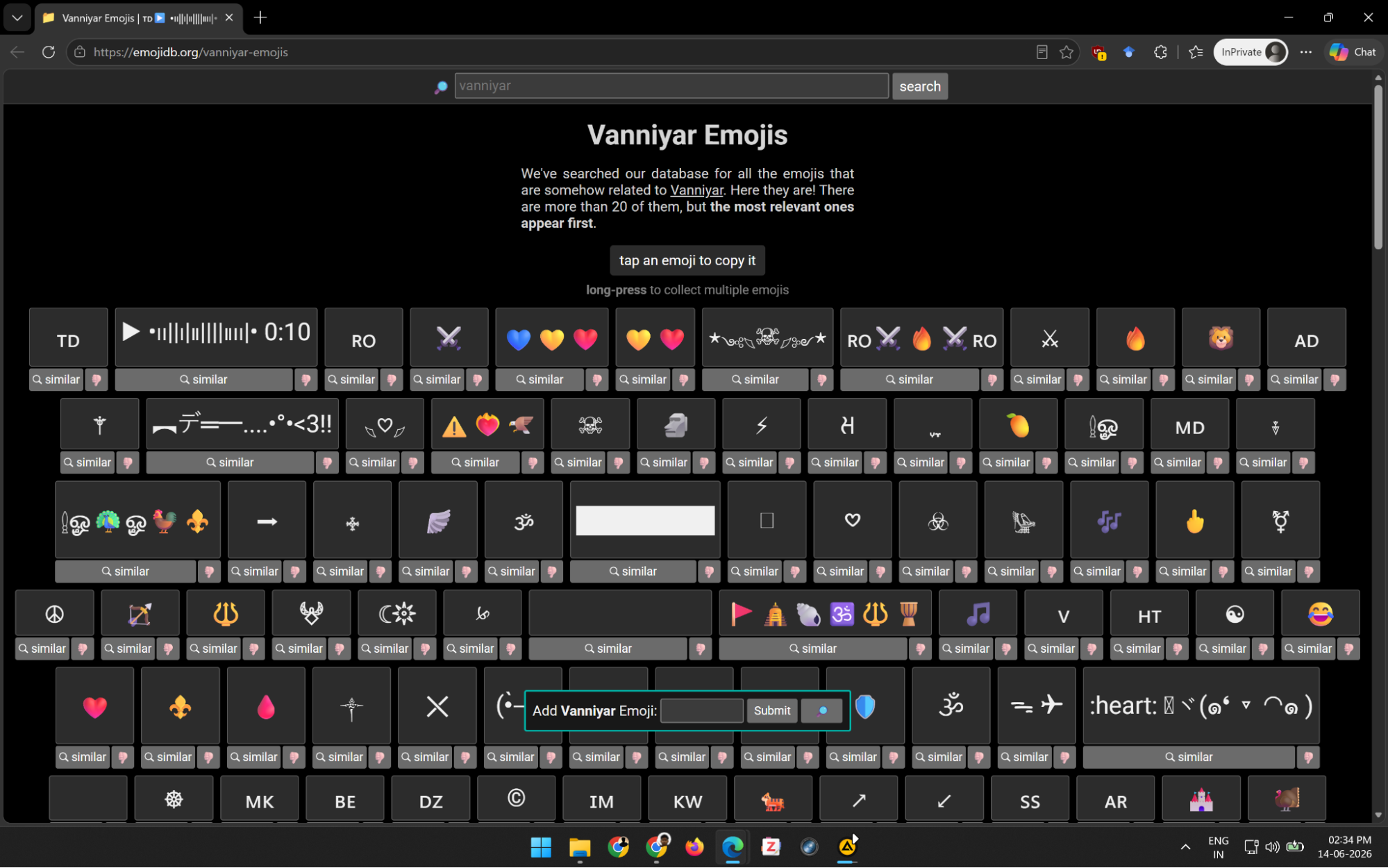
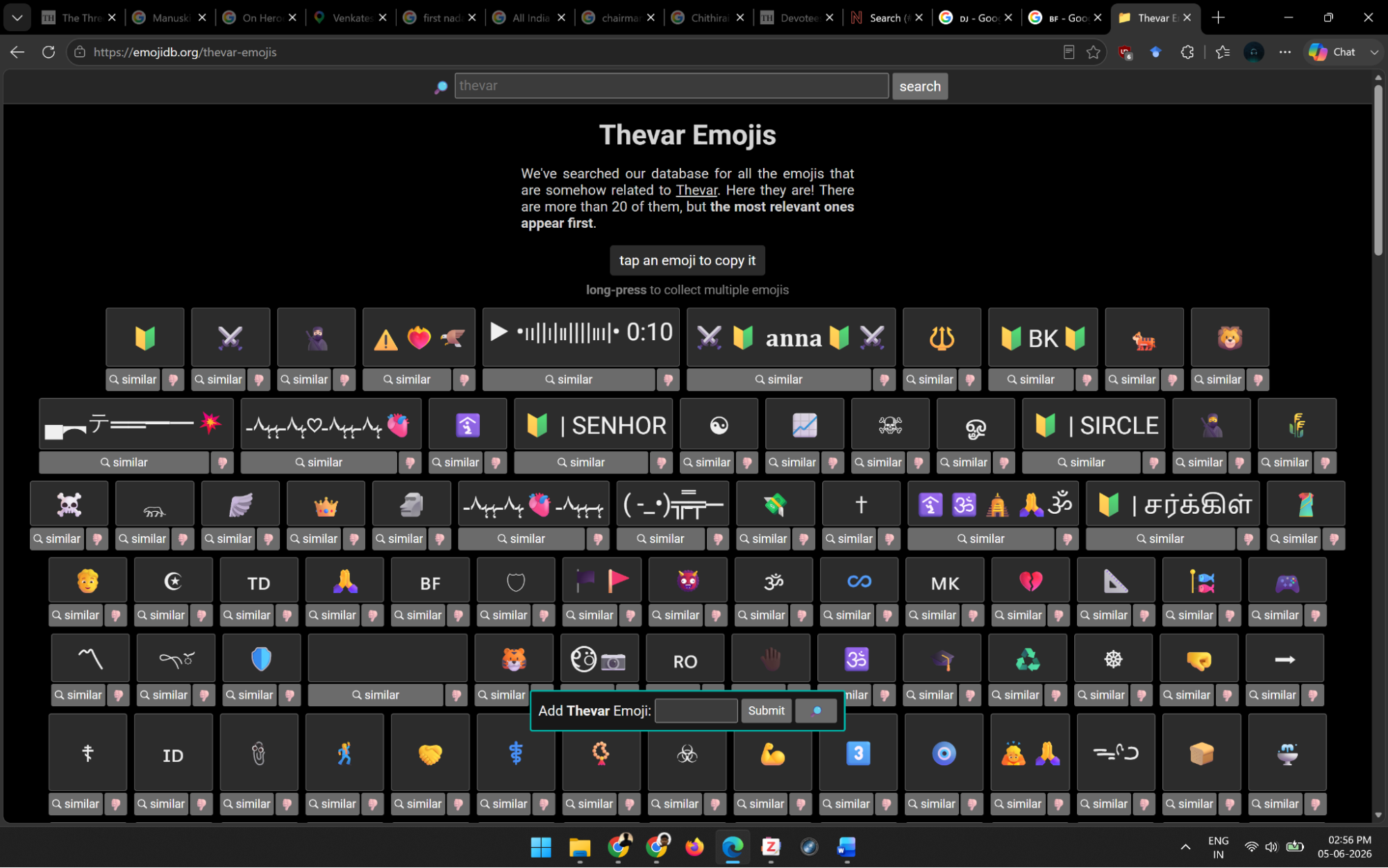
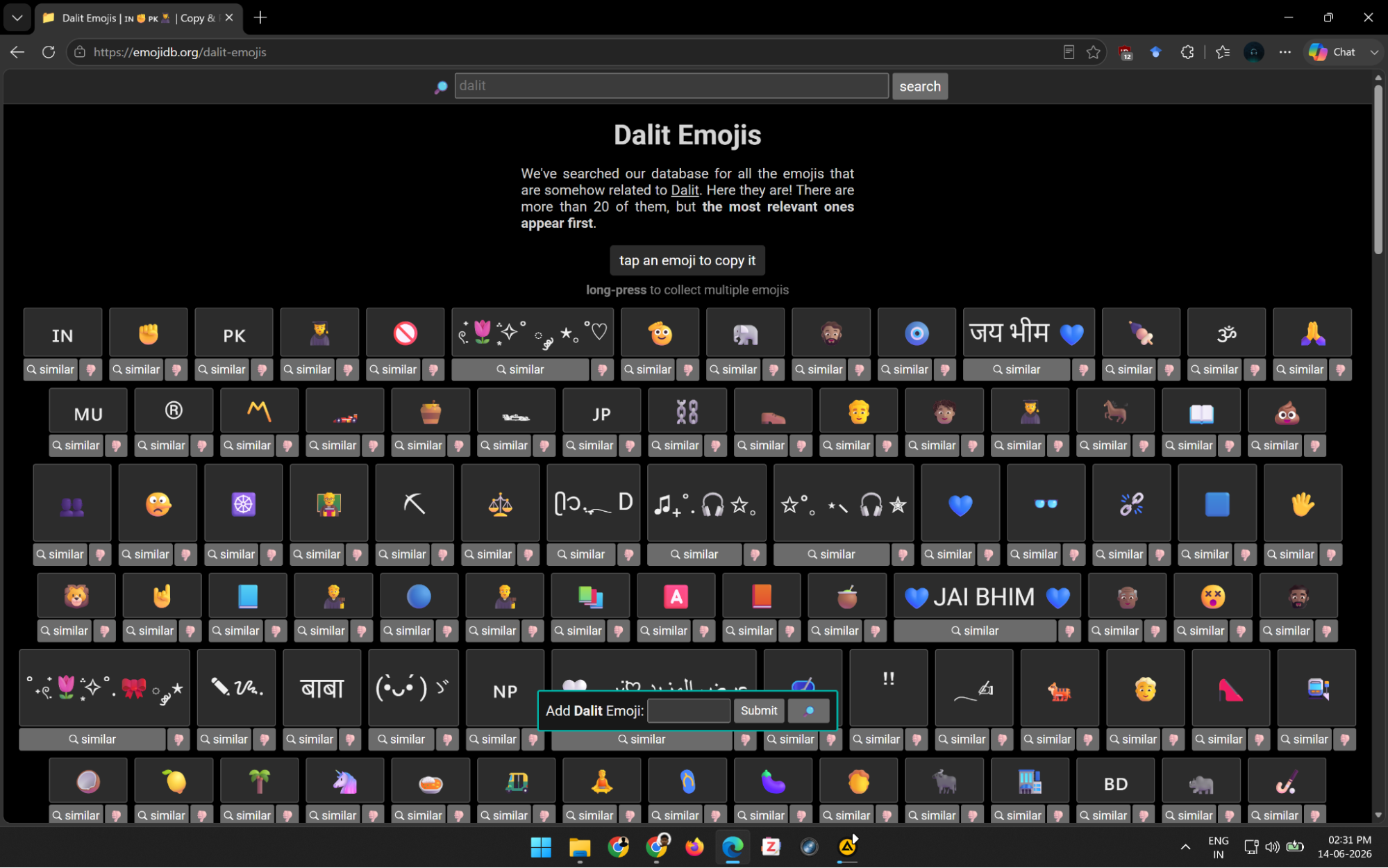
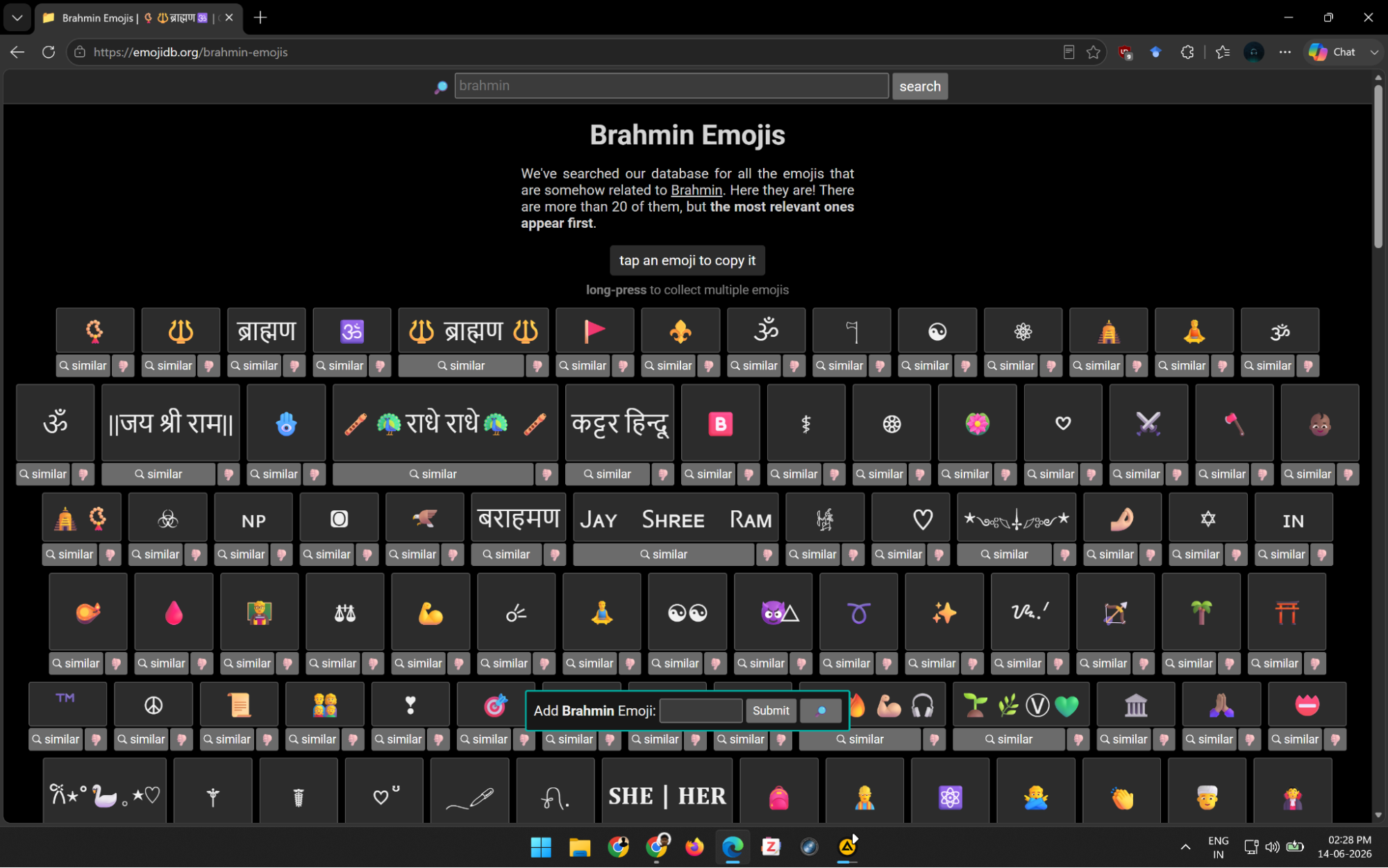
Vanniyar, Thevar, Dalit and Brahmin related emojis. Source: EmojiDB.
The term ‘Tambrahm’, originating from Tamil-Brahmin, is also encoded as a popular hashtag. This distinctive, so-called quirky moniker, along with elements of their religious customs and traditional ‘way of life’, including weddings, cooking, and food, is mainly posted.
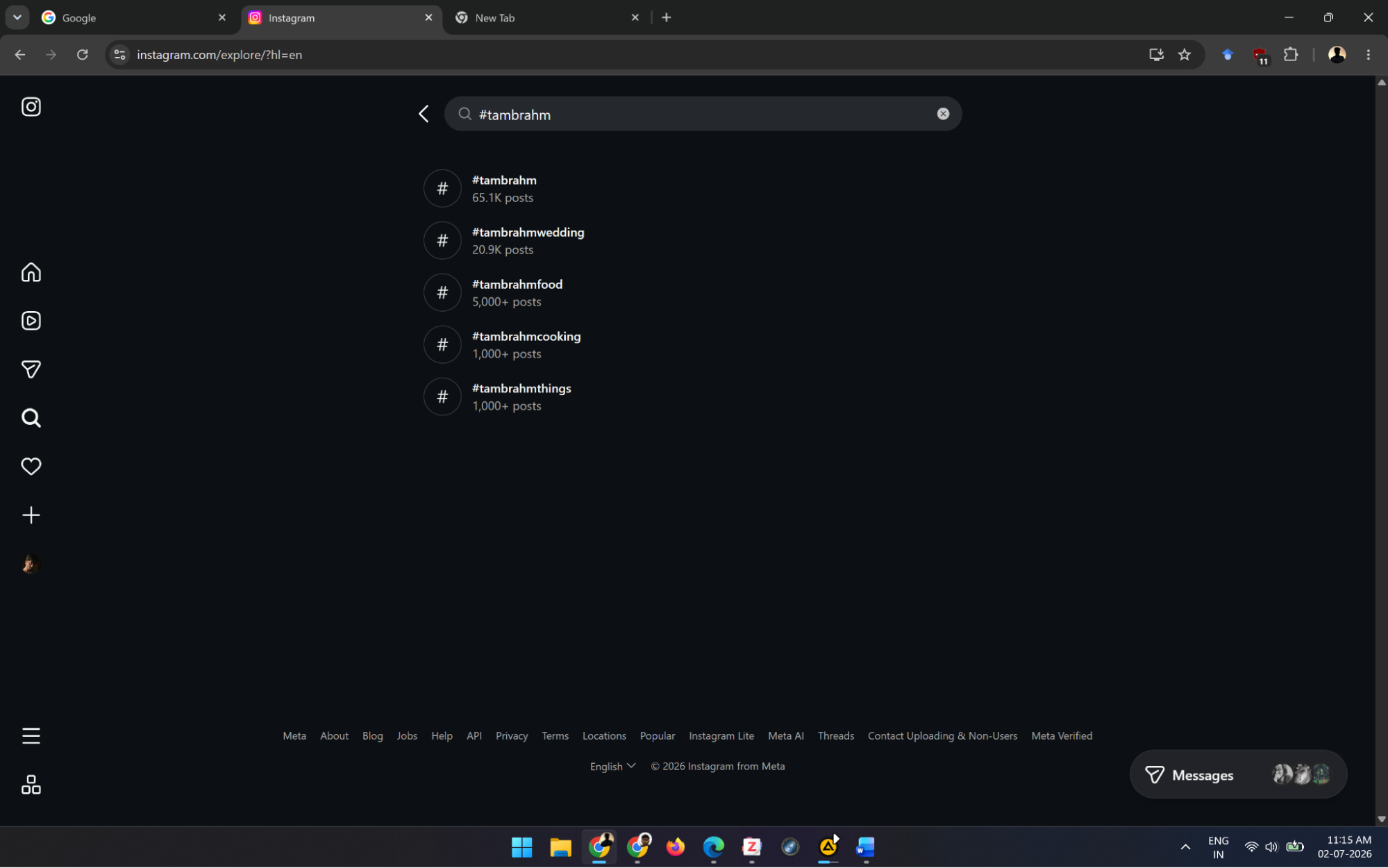
The hashtags searching for Tambrahm. Source: Instagram.
To see clearly how this encoded trend and hashtags play out in Tamil Nadu, focusing on a few key historical figures and related events to show their interconnection with commemorative masculine iconography of non-Brahmin castes. 1) Immanuel Sekaran, a Dalit activist and former soldier, who came from the Devendra Kula Velalar/Devendrar background. 2) Pasumpon Muthuramalinga Thevar, an influential figure from the Thevar dominant intermediate caste and affiliated with the All India Forward Bloc party. 3) K. Kamaraj, a former Chief Minister from the Congress party, who belonged to the Nadar intermediate caste. The 1957 Mudukulathur Riots, following Sekaran’s murder and Thevar’s subsequent arrest, highlight the regional socio-economic mobility of Dalits and also electoral rivalries between Kamaraj and Thevar factions (Manikumar 2017). These contested events, such as the Paramakudi riots in 2011, resulting in Dalits being killed in police firing, highlight historical sensitivities around counter-memory, caste mobility, and regional commemorative anniversaries. Situating these three masculine icons along their caste affiliations, digitally through the interlinks of emojis and social media’s role, further encodes them within caste discourse and socio-political relevance. This can be seen when searching descriptively for the hashtags associated with them, and the related heroic icons along the colours are auto-completed terms and suggested based on their online occurrence count. Words such as ‘ayya’ (honorific term for older men), ‘vamsam’ (lineage), ‘pasanga’ (boys), ‘sangam’ (association), ‘statue,’ and ‘birthday’ are also auto-filled with related hashtags and along the colour-coded heart emojis.
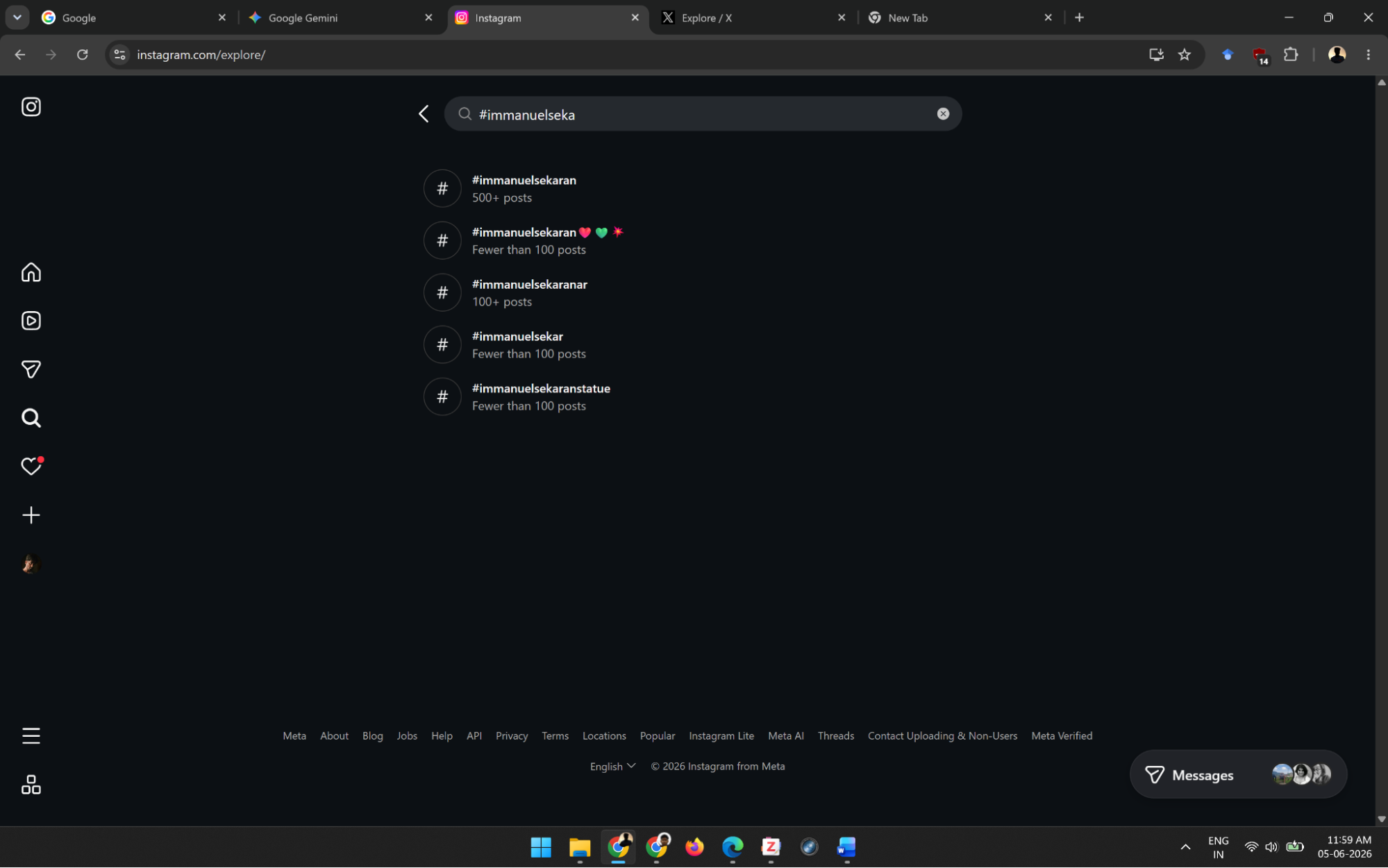
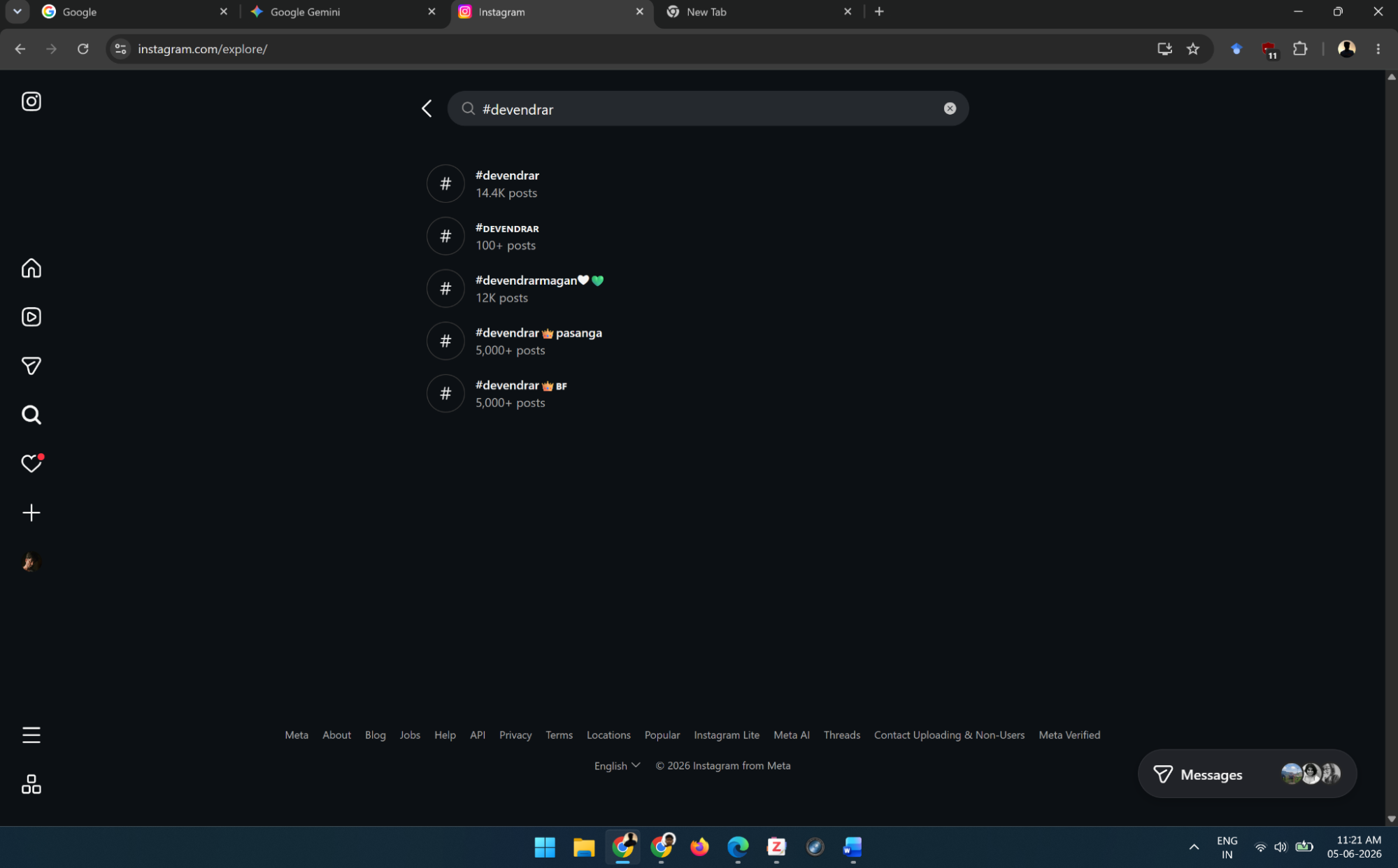
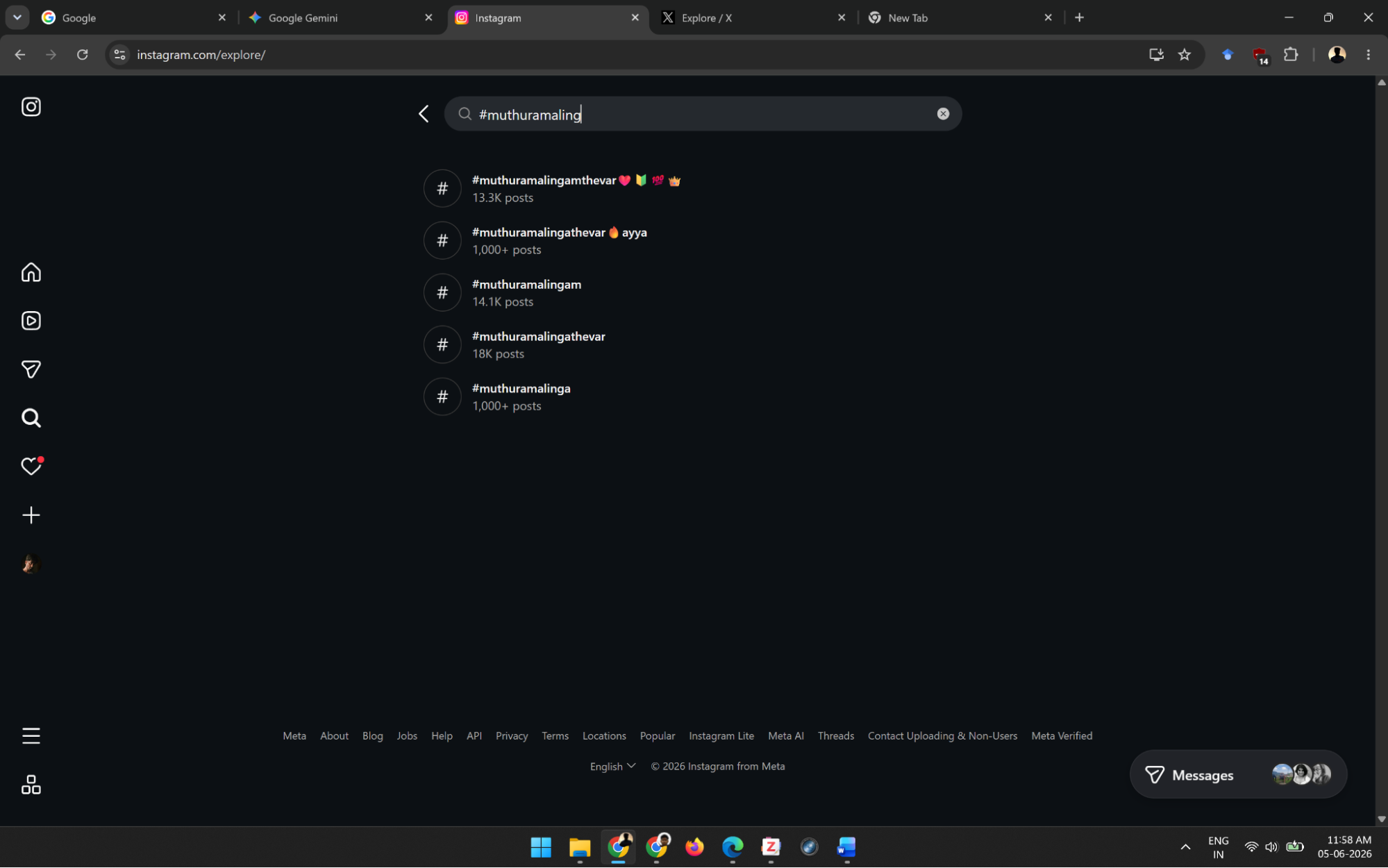
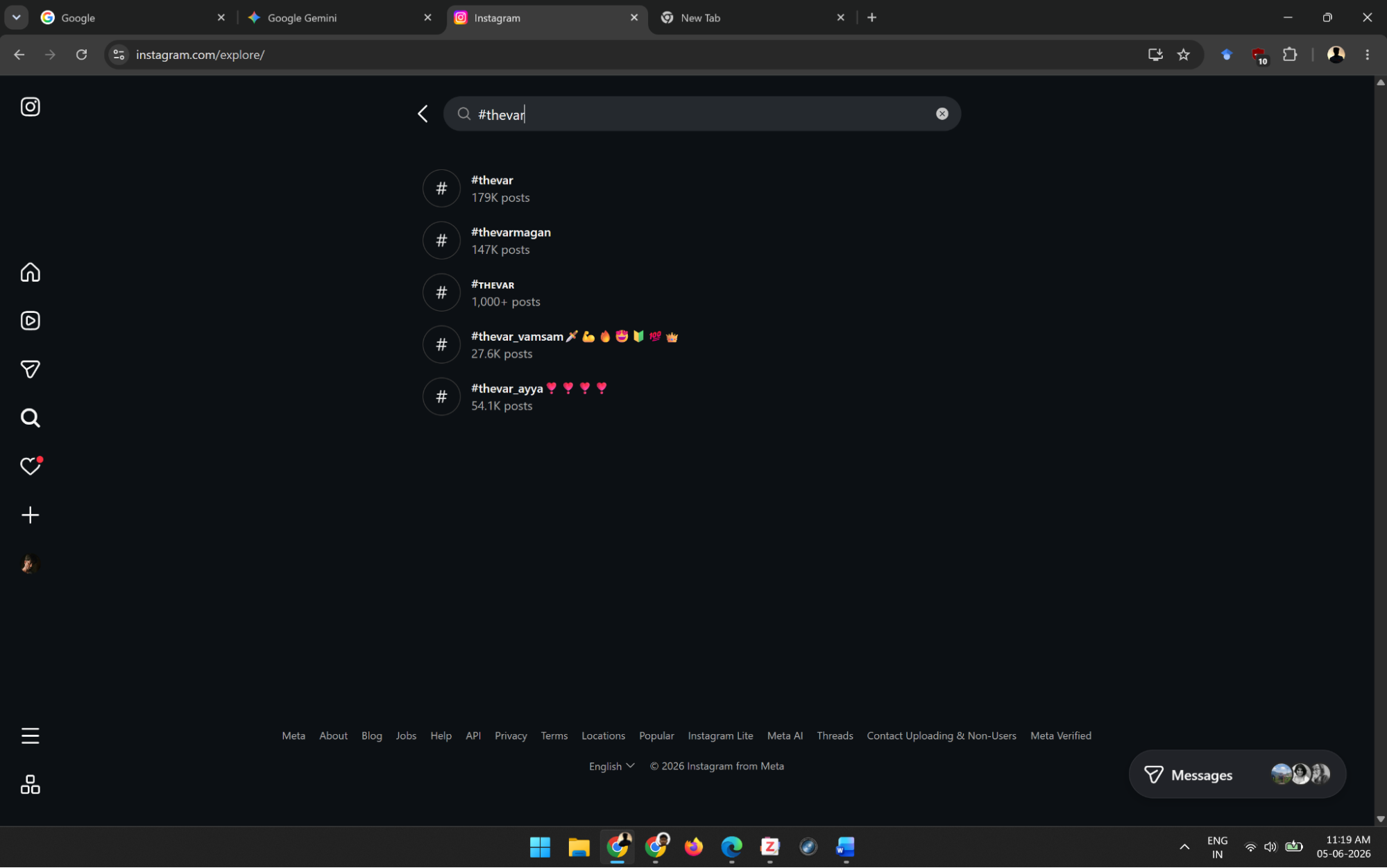
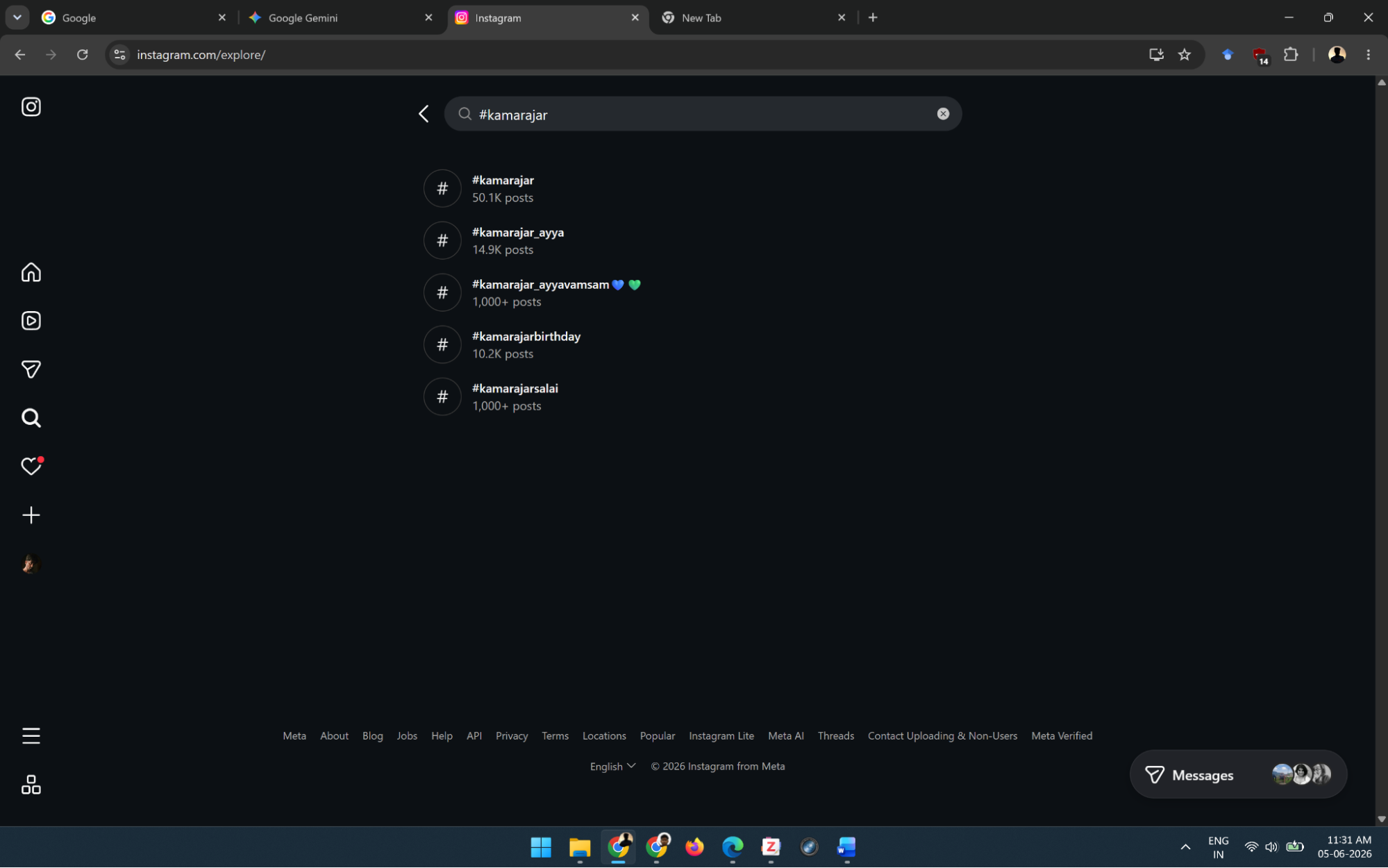
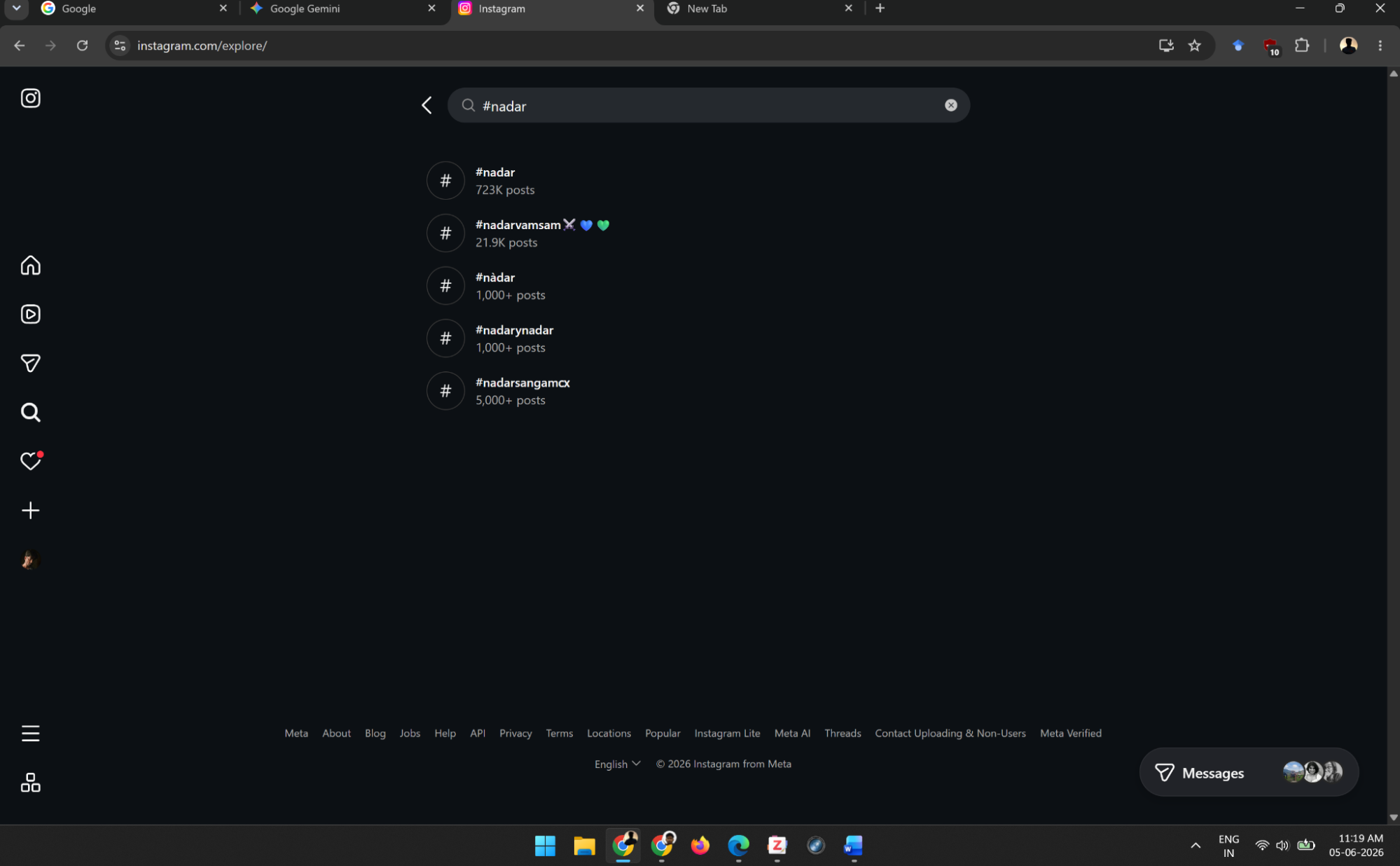
The hashtags searching Immanuel Sekaran-Devendrar, Muthuramalingam - Thevar & Kamarajar - Nadar. Source: Instagram.
Symbolically, the film Bison Kaalamaadan (2025) by Mari Selvaraj, highlights the significance of the colours associated with caste in institutional spaces, such as schools, through a short montage of the teacher cutting the students’ wristbands. The film also draws inspiration from the Pasupathy Pandian, from a Devendrar caste and Venkatesh Pannaiyar, a Nadar, clash with their iconographic representations which can also still be searched online under hashtags associated with their caste-affiliated heart colours.
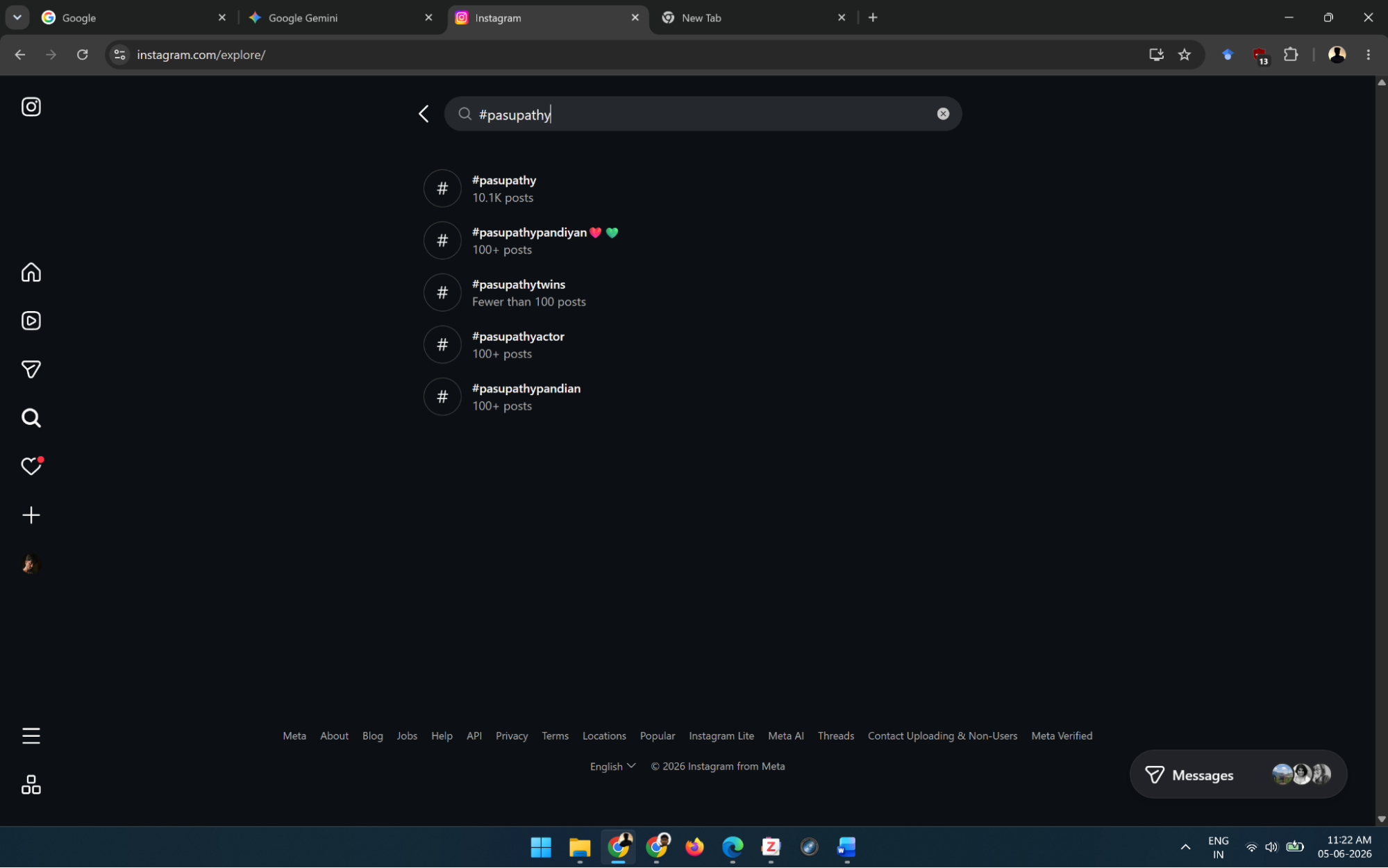
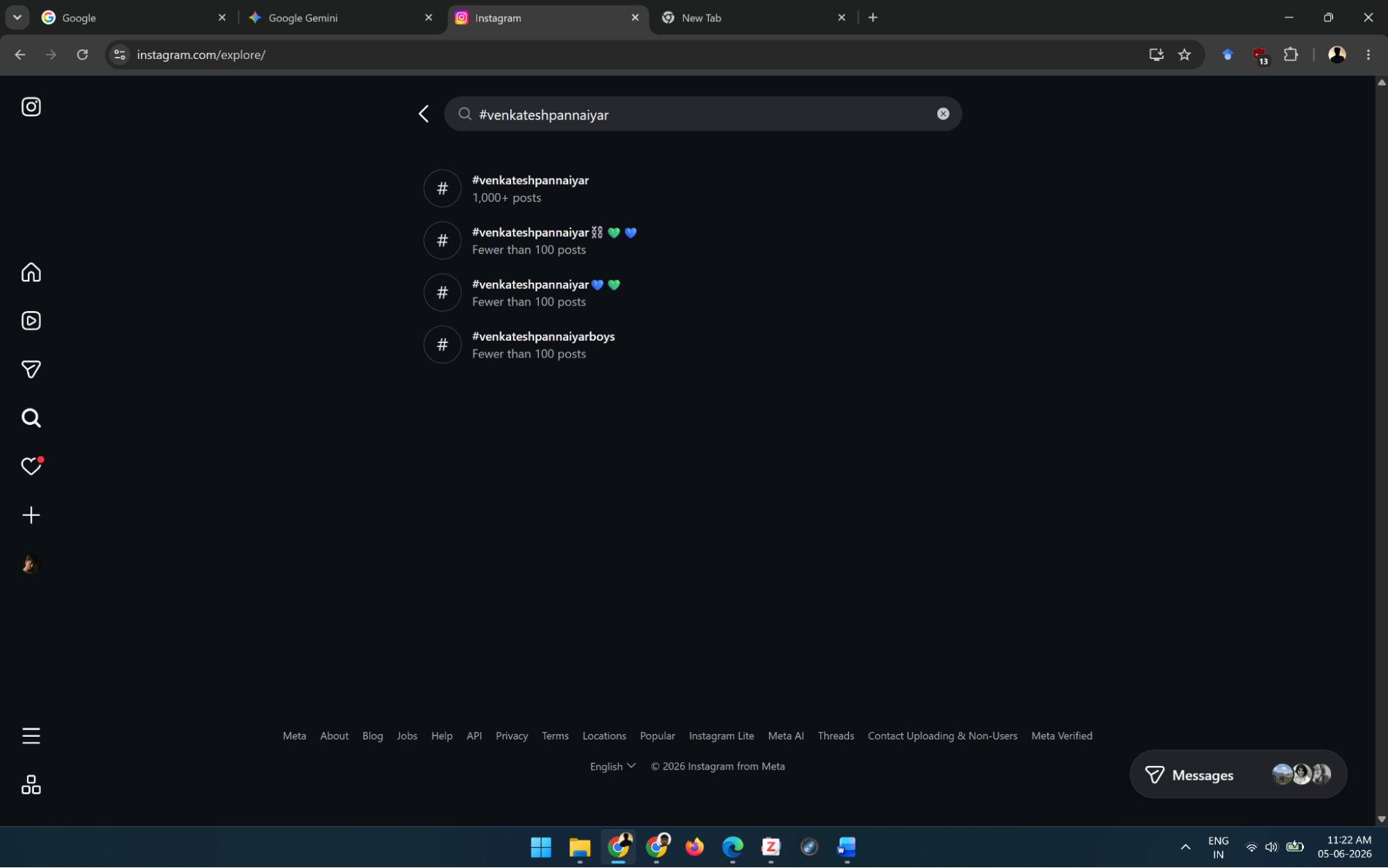
The hashtags searching for Pasupathy Pandian-Devendrar and Venkatesh Pannaiyar-Nadar. Source: Instagram.
Along with caste-encoded emojis and icons when displayed publicly in online accounts, updates followers on politics, commentaries, news, regional caste-associated temple festivals, murals, and posters. Select social media handles rarely feature related women icons on their covers; here, the colonial Sivaganga estate queen Velu Nachiyar, alongside still-towering, predominant Thevar male figures, is featured.
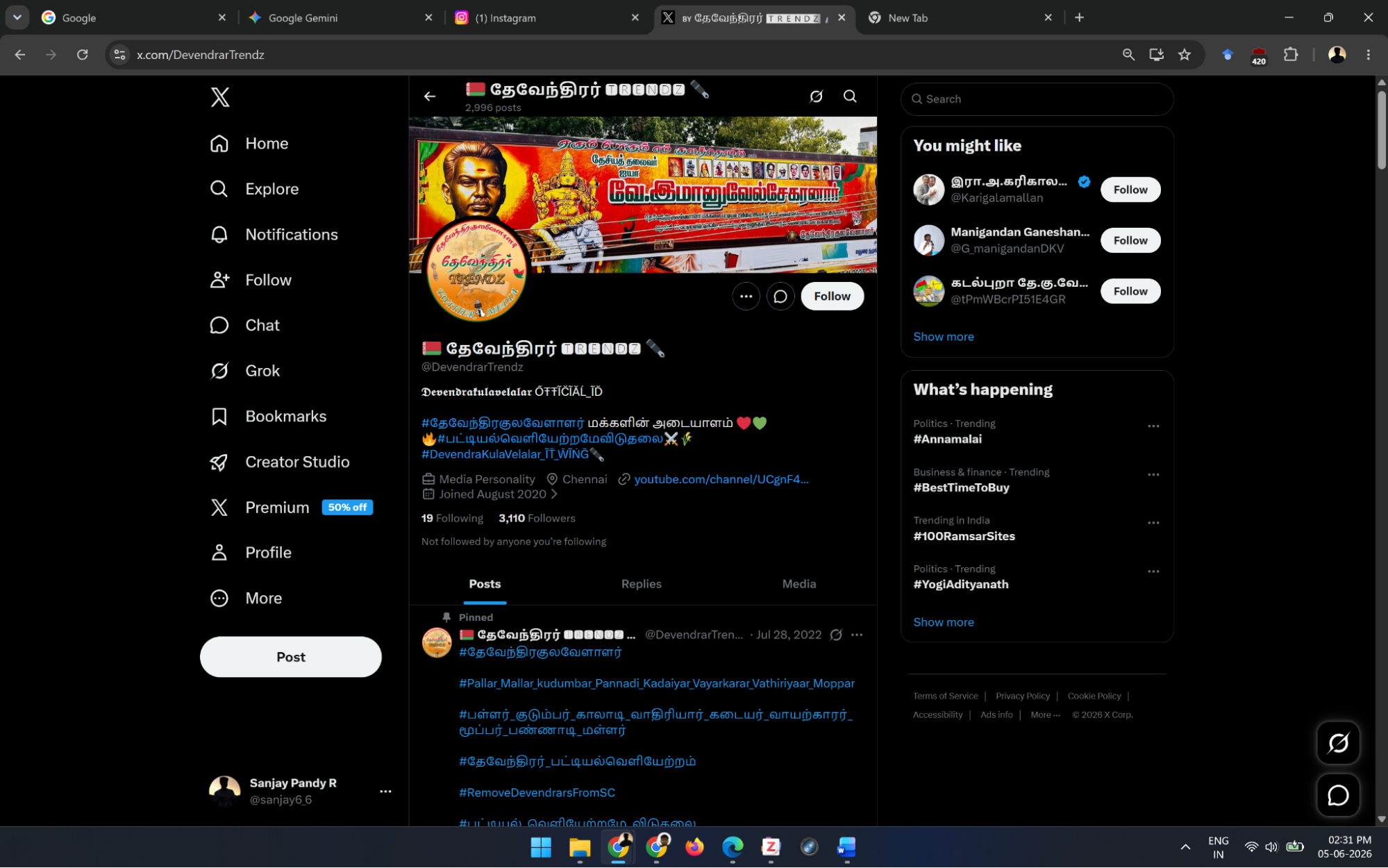
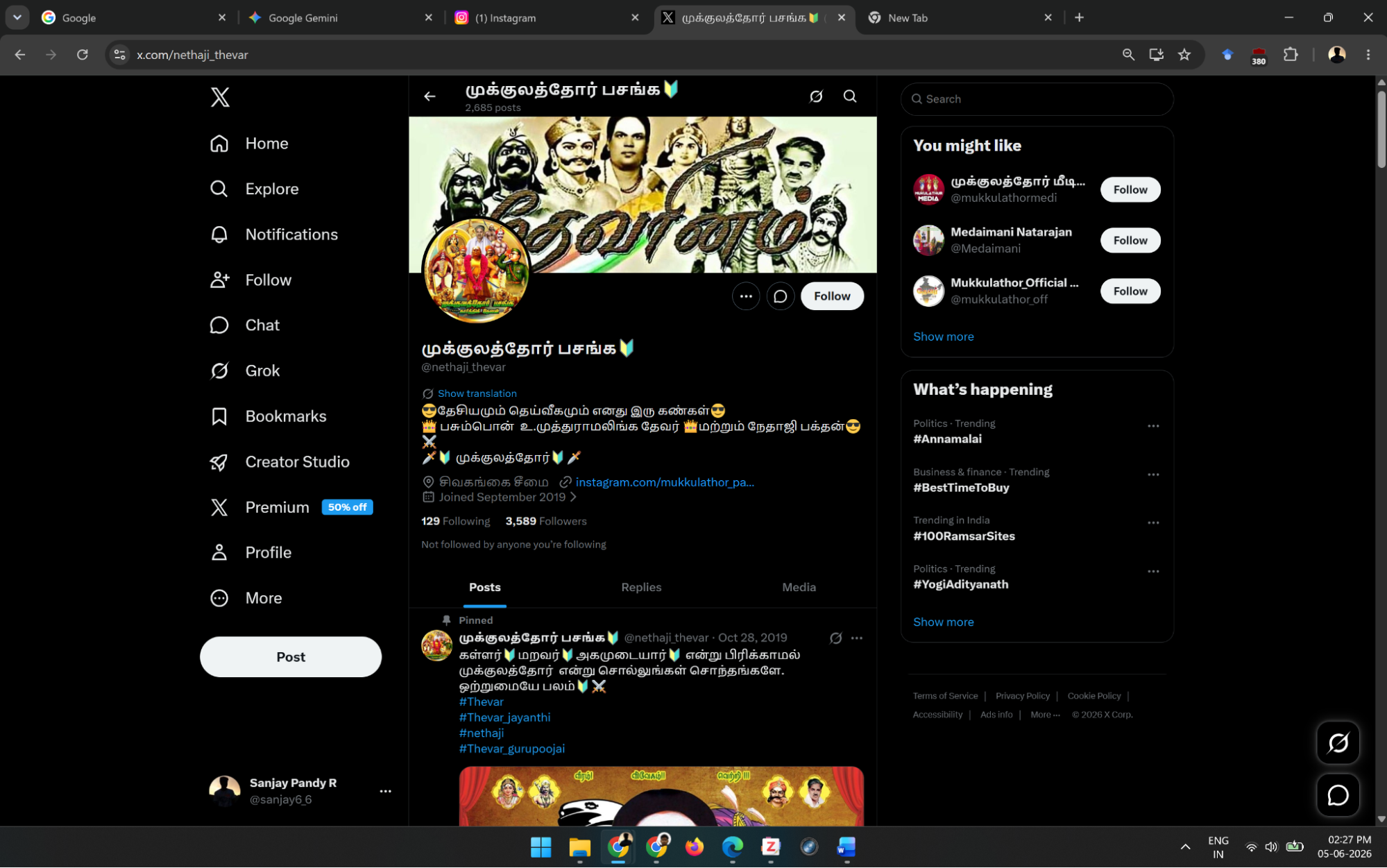
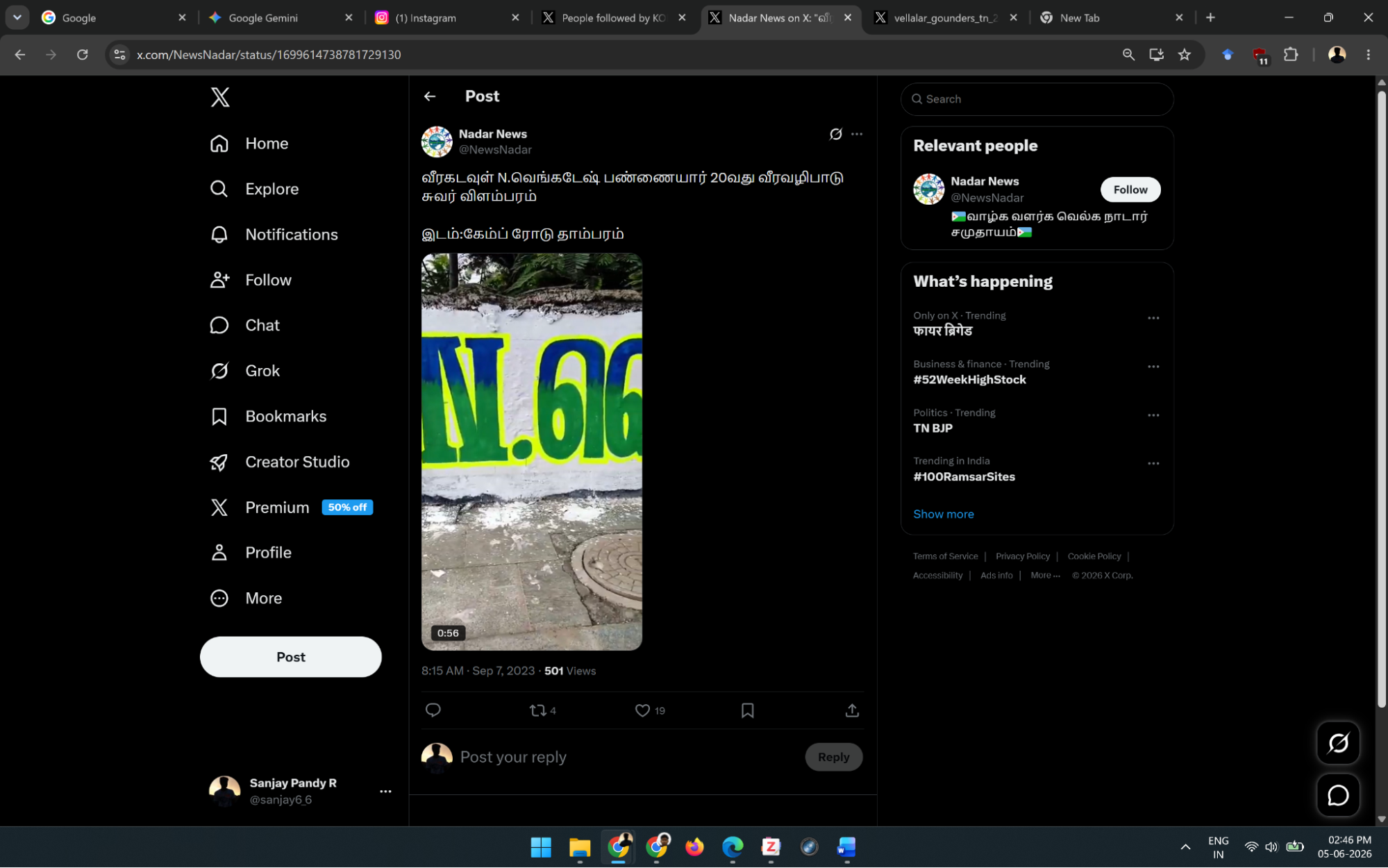
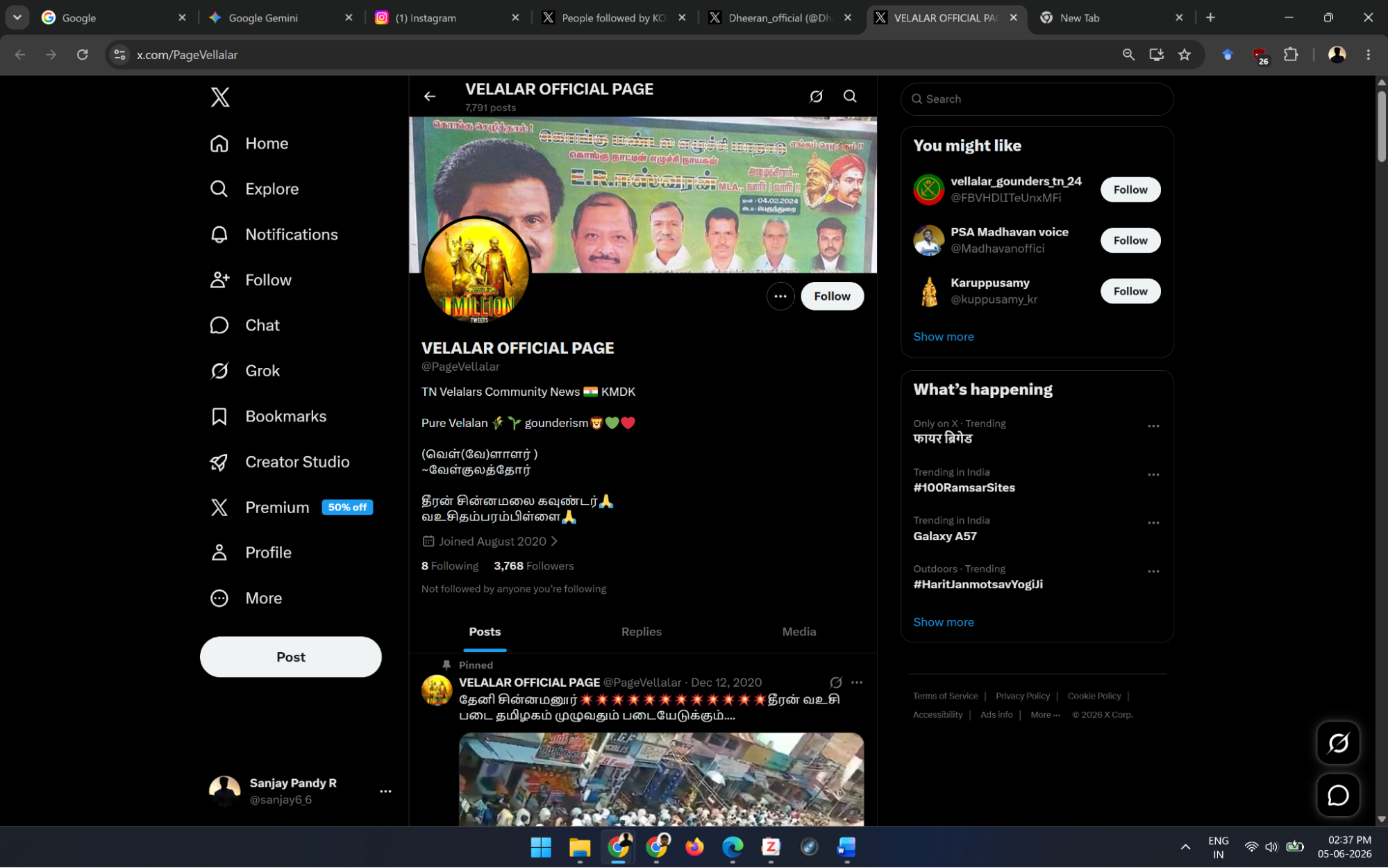
Devendrar, Thevar, Nadar and Gounder related pages. Source: X (formerly Twitter).
These select pages also feature colour-coded typefaces, memes, political campaigns, and familial announcements such as marriages, death anniversaries, and even puberty ceremonies; they cater to an endogamous patriarchal tradition and celebrate the privileged caste identity. Also, the memes, videos and photos on these pages reveal a lot about their political leanings. For instance, users often use symbolism, associated clothing, and emoji colours to show which political factions they support and to satirise the opposition. These spaces presumably speak to specific castes and subcastes in their very names, and they intentionally match the colours and symbols of allied political parties in their fonts, emojis, and flags. By pairing these colours primarily with masculine icons, they again collectively reinforce their political connections and caste affiliations, thereby driving broader online discourse.
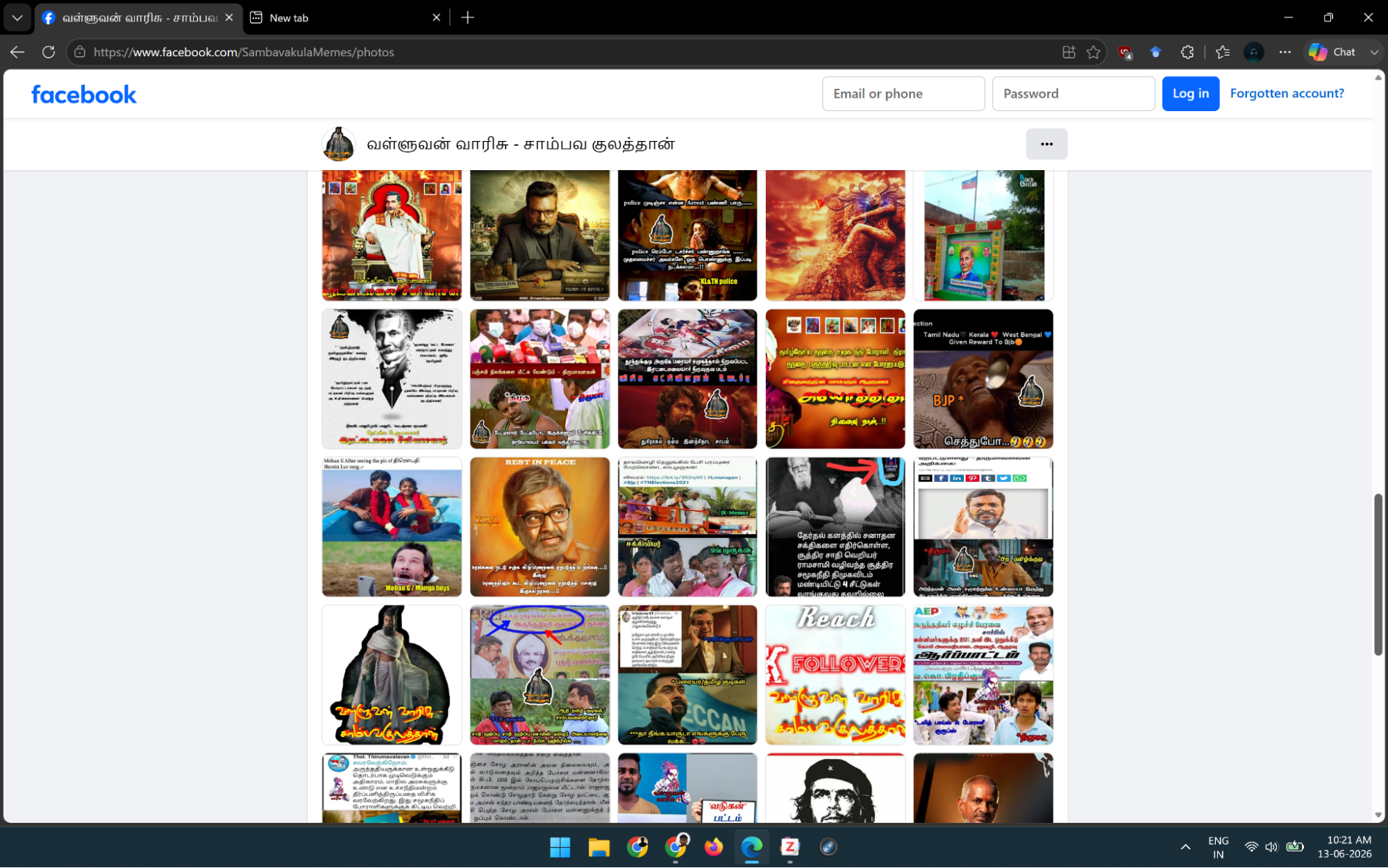
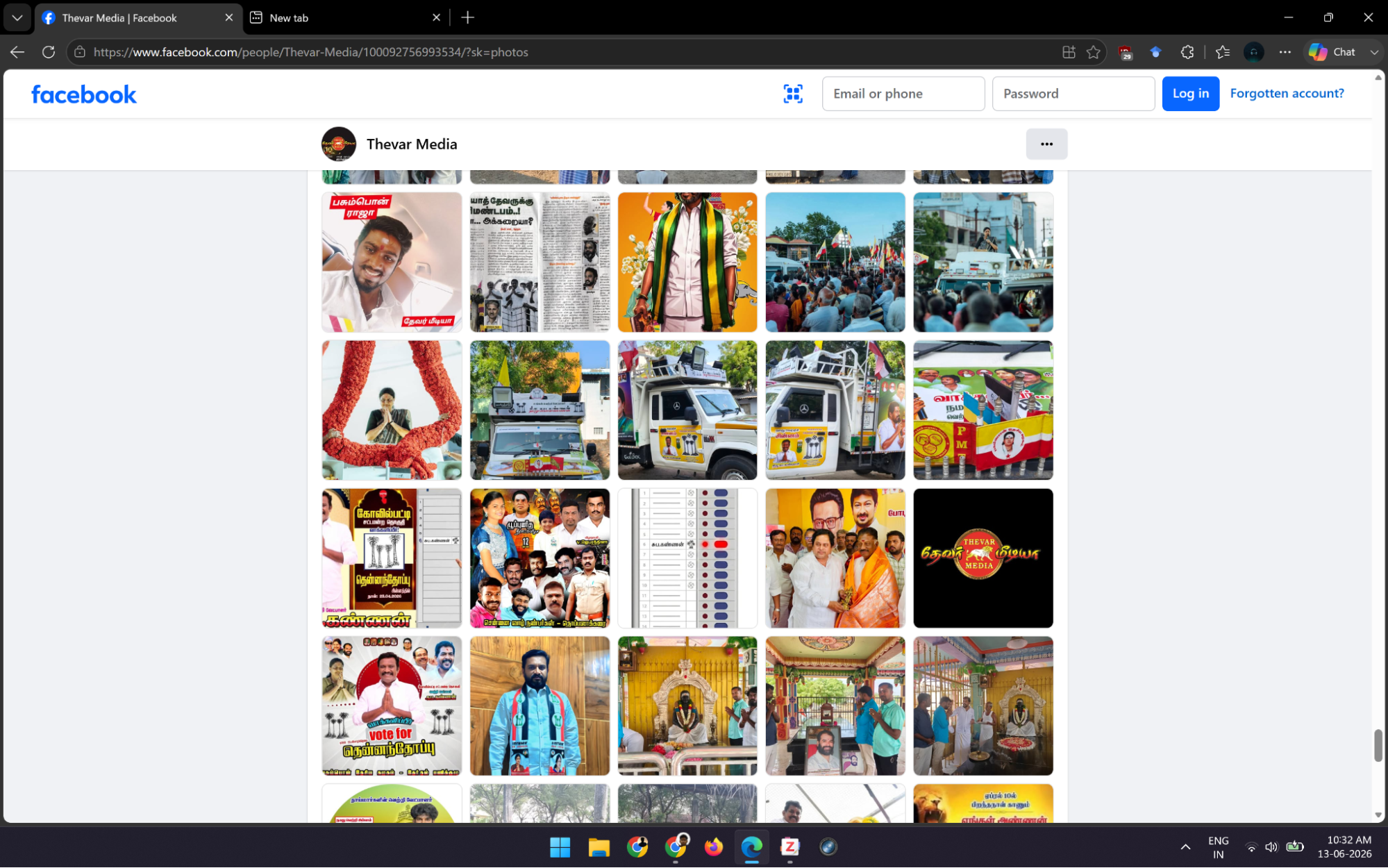
Sambavar and Thevar related pages and posts. Source: Facebook.
From Streets to Screens in Mediating Masculine Icons
The use of prints and films has now seeped into screen time mutating our attention through caste and masculine iconography. The hoardings and posters I witnessed in person on streets, barricades, and highways are more pronounced in digital discussions and internet forums. In 2024, Justice K. Chandru’s state committee published an extensive report looking into the school environment following an attack on Dalit students by their dominant-caste peers in Nanguneri. The investigation took a detailed analysis of how caste dynamics affect educational spaces. Specifically, the report examined visual markers, names and religious symbols used to display caste identity. However, there are more pervasive, multisensorial, and beyond spatialised operations of caste pride that are bound as everyday visual markers in settlements, towns, villages’ entries and even cities; which are now widely found in online discussions.
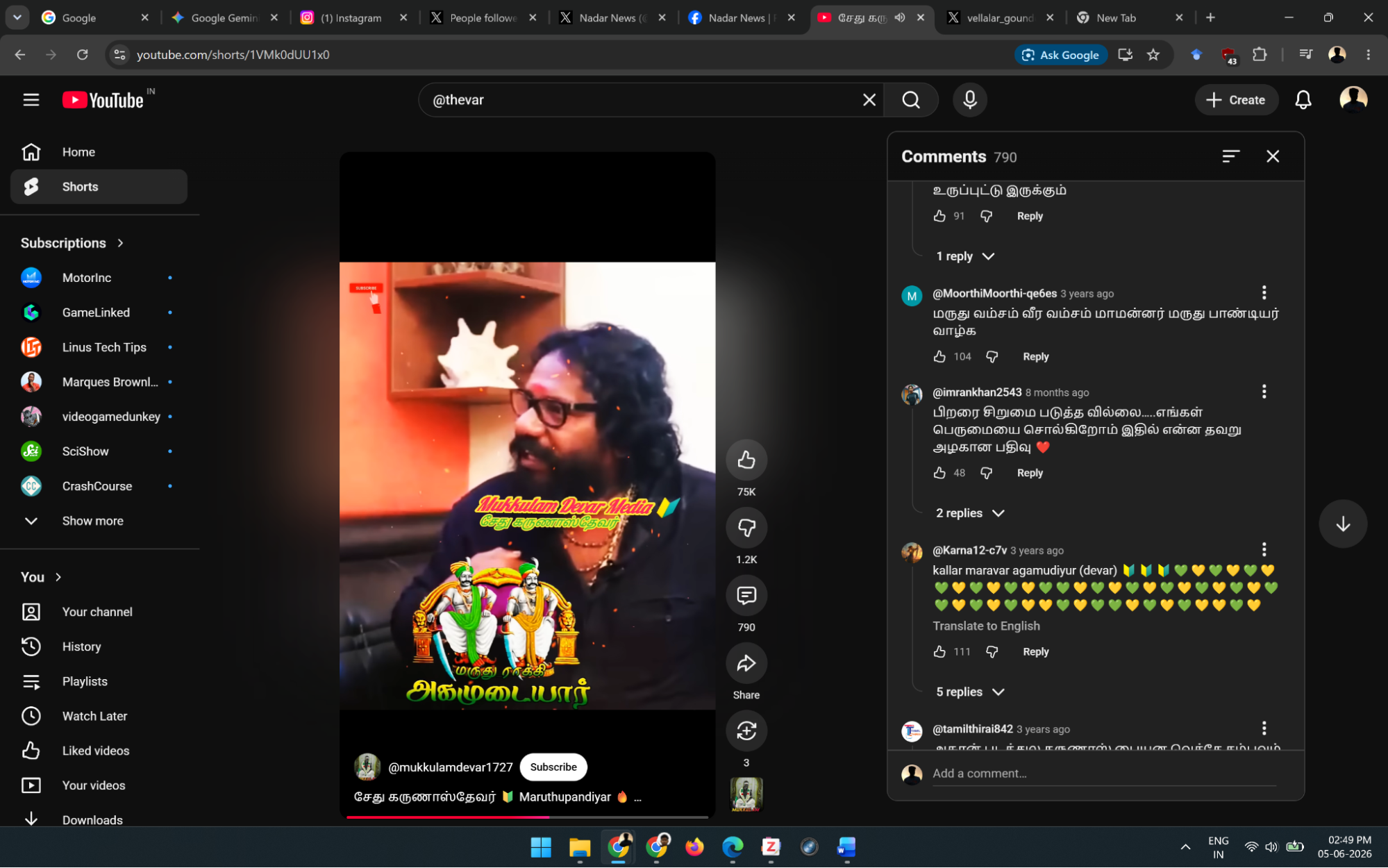
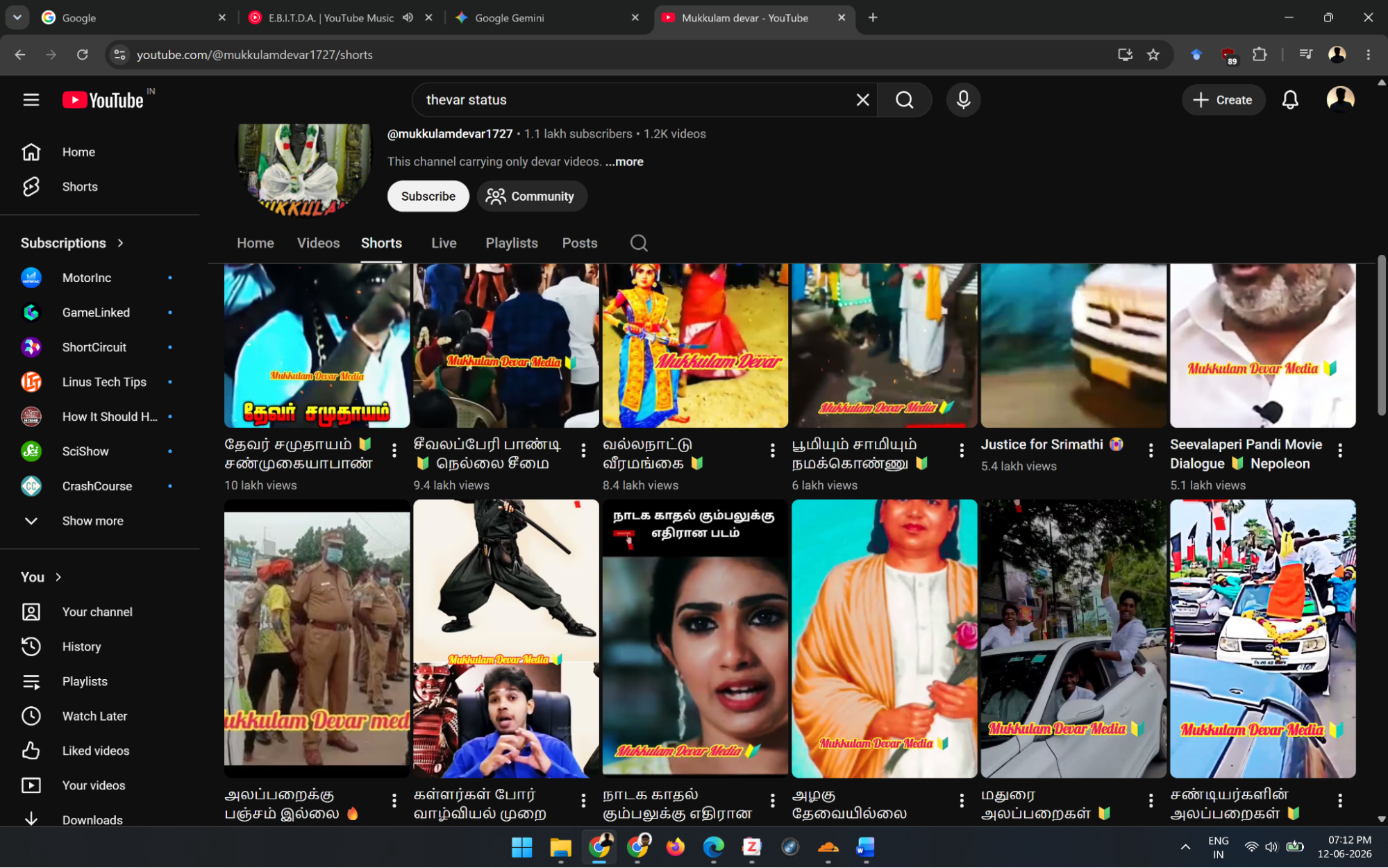
Thevar/Mukkulathor related videos, comments, and account. Source: YouTube.
Online caste-positive networks reproduce exclusion by weaving cultural, spatial, and discursive strategies that glorify dominant, hierarchical castes and further disparage marginalised castes (Kirasur and Jhaver 2025). Whereas mainly OBCs, as an extension of Hindu orientalist views beyond mind and the consequential caste’s societal presence online, in abusive tone terms about intercaste relationships as Naadaga Kaathal (faked love), akin to Hindutva’s Islamophobic term Love Jihad, on interfaith relationships and thereby marginalising Dalits online beyond visual divisions in reality. Some online accounts often celebrate caste pride, mirroring deep-rooted societal hierarchies. This digital space is filled with symbolism that supports casteist arguments flourishing, even as tragic dishonour killings still occur and, rarely, take a stance against this endogamic discourse. The problematic stereotypes here show the consequences of valorising icons, referencing films, encoding casteism, symbols and using related colour occurrences as emojis across various platforms. Evidently, caste pride in films such as Kaaduvetty (2024), the iconisation of influential figures such as Kaduvetti Guru, especially among Vanniyar, and referential responses from Dalits against hegemony. Highlighting caste dynamics and endogamy in relation to Dalit assertion and failing intermediate dominance, particularly in videos and posts on problematising intercaste relationships. For instance, account names, hypermasculine symbols, video titles, comments, and short-form videos featuring the encoded emojis are pulling in lakhs of views across Dalit and OBC social media handles.
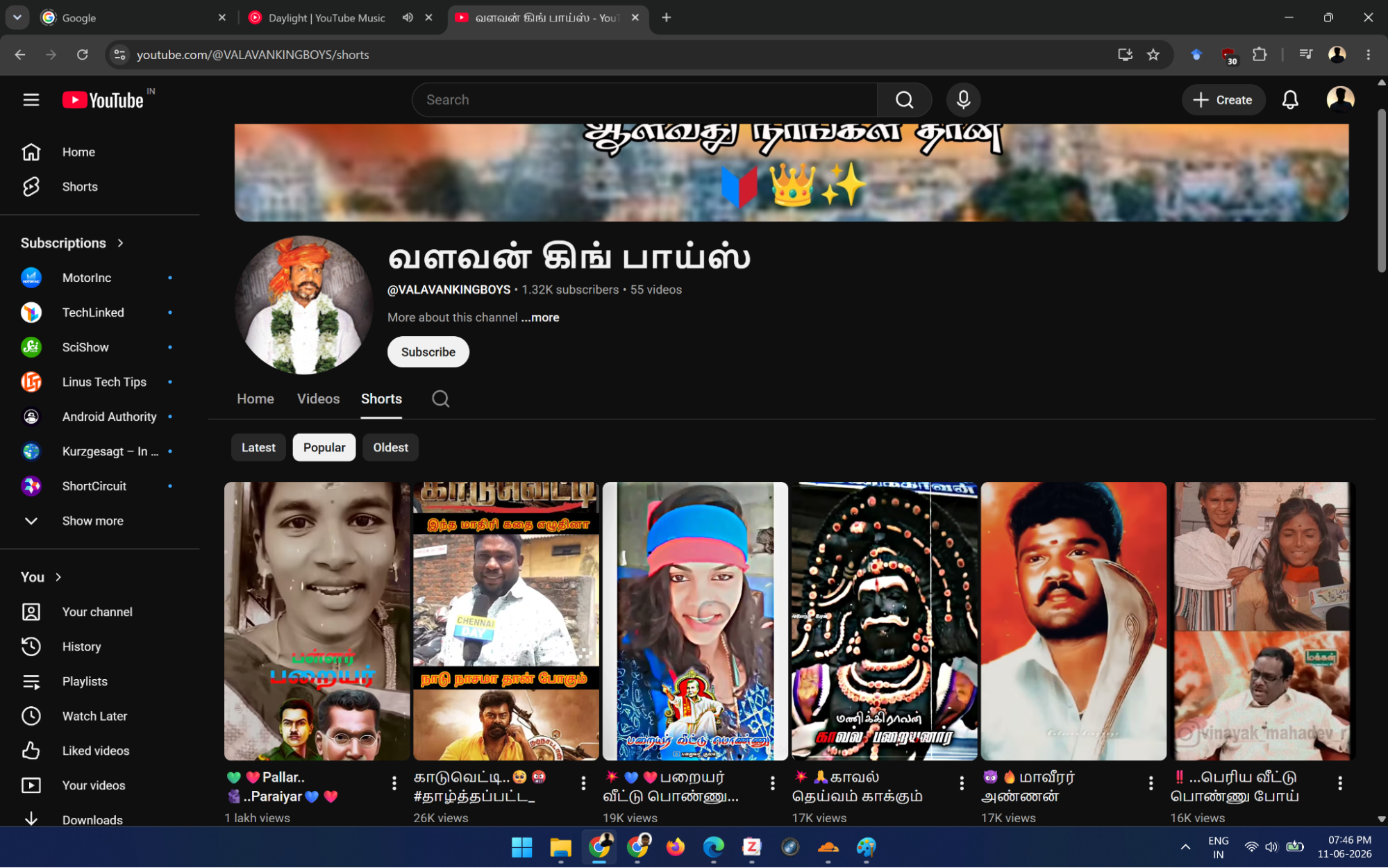
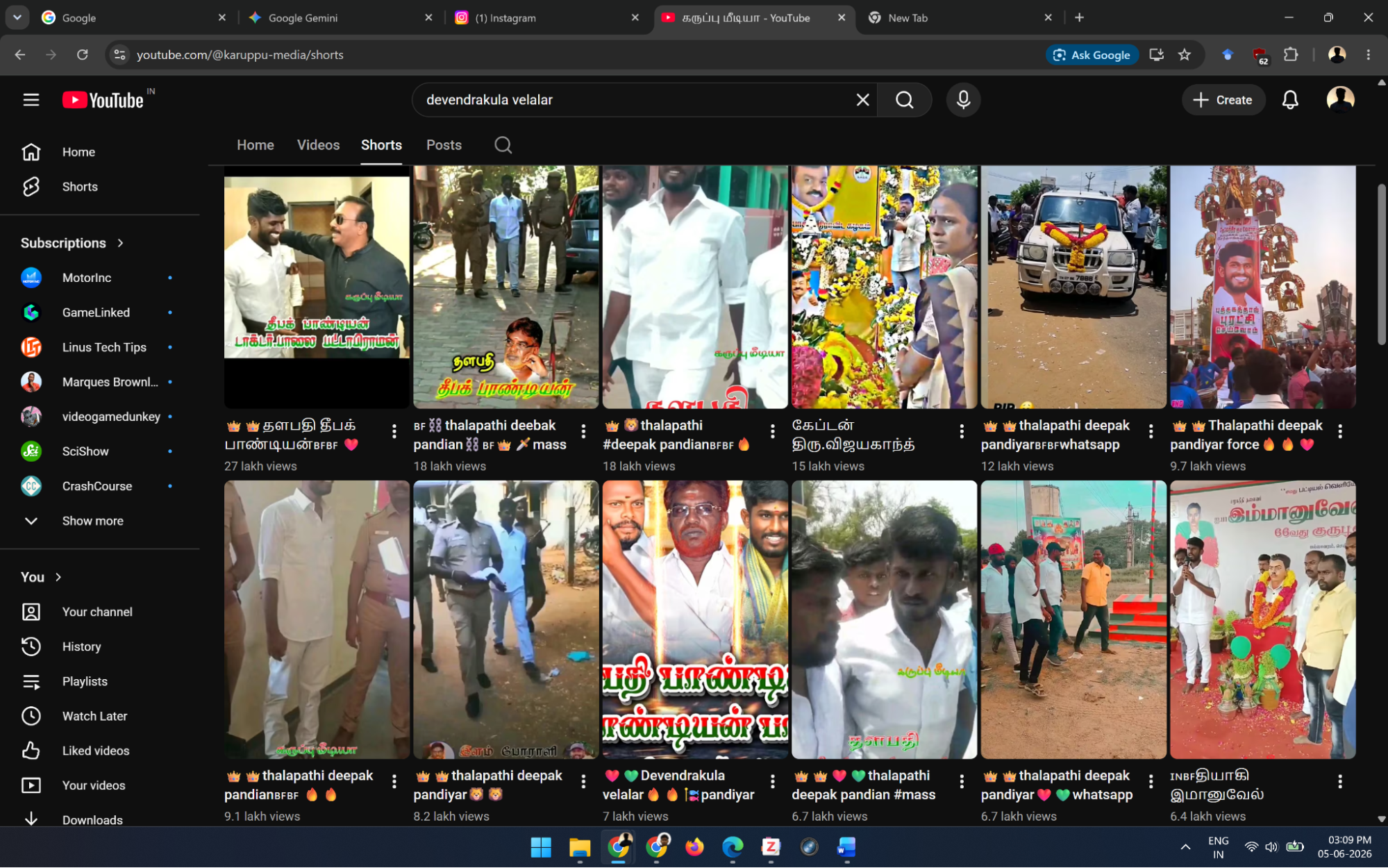
Adi Dravidar and Devendrar related accounts and videos. Source: YouTube.
Here, only a brief collection of pictures from the vast Tamil socio-political landscape on the internet and the caste discourse shows how emojis serve as emotive, colour-coded digital markers. Elaborating on Ambedkar’s view, digital media's synesthetic nature shows that caste's affective power deeply influences online kitchen spaces, mapping visceral histories of touch and taste onto virtual bodies (Kanjilal 2024). The digital experiences here are virtually extrapolated onto deific iconisations, Guru Puja celebrations, largely stereotypical OBC film scenes featuring encoded emojis, icons, fonts, and moral-policing videos. They become discursive content to protect the so-called patriarchal virility of the said castes, martiality, and endogamy. Drawing momentarily in parallel with ethnographic insights, the socio-political form of hero-worship becomes interconnected to related caste affiliations. In doing so, as digitally encoded through symbols, regional icons, and chieftains, mainly men, are adopted into a religiously deified form.
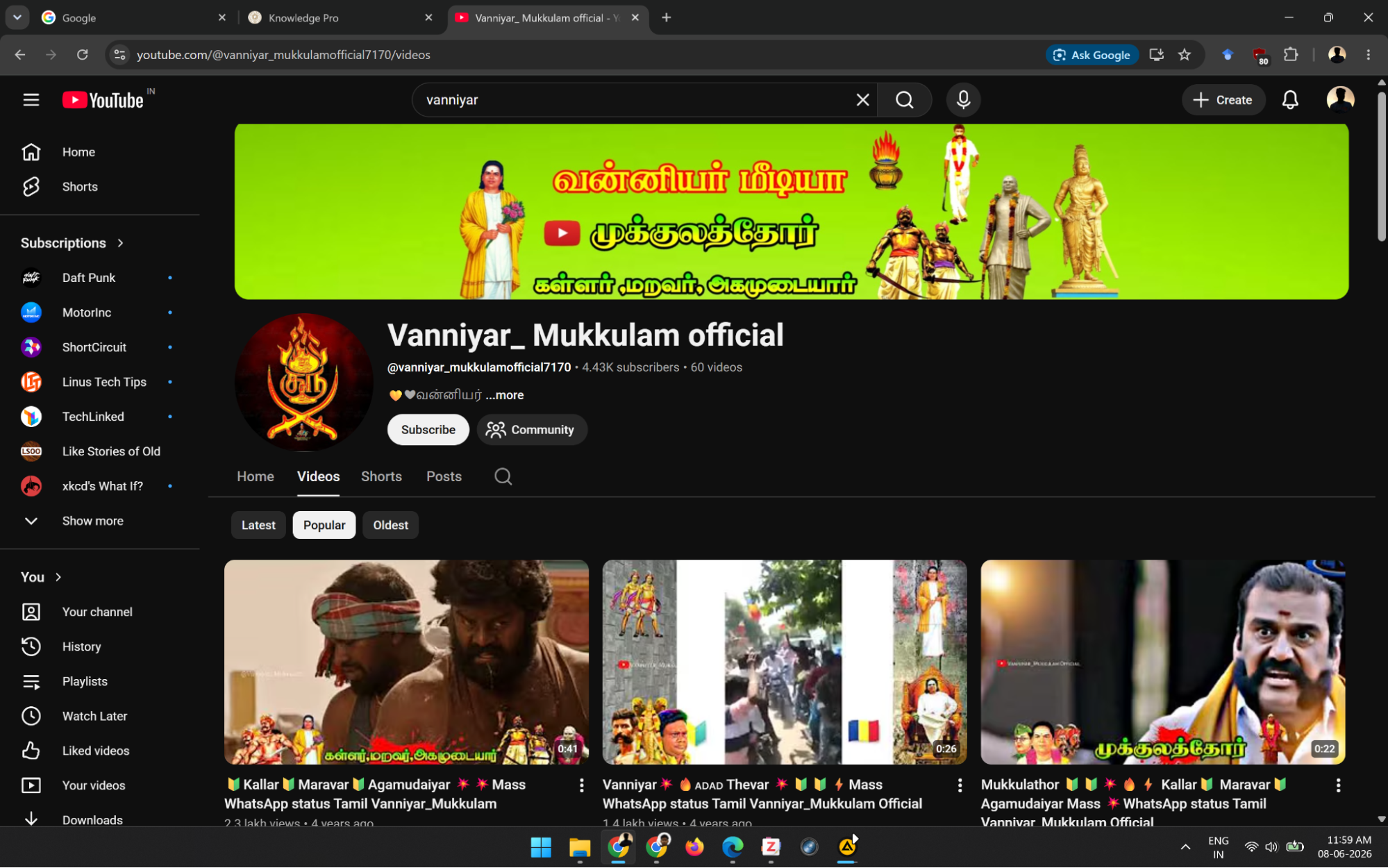
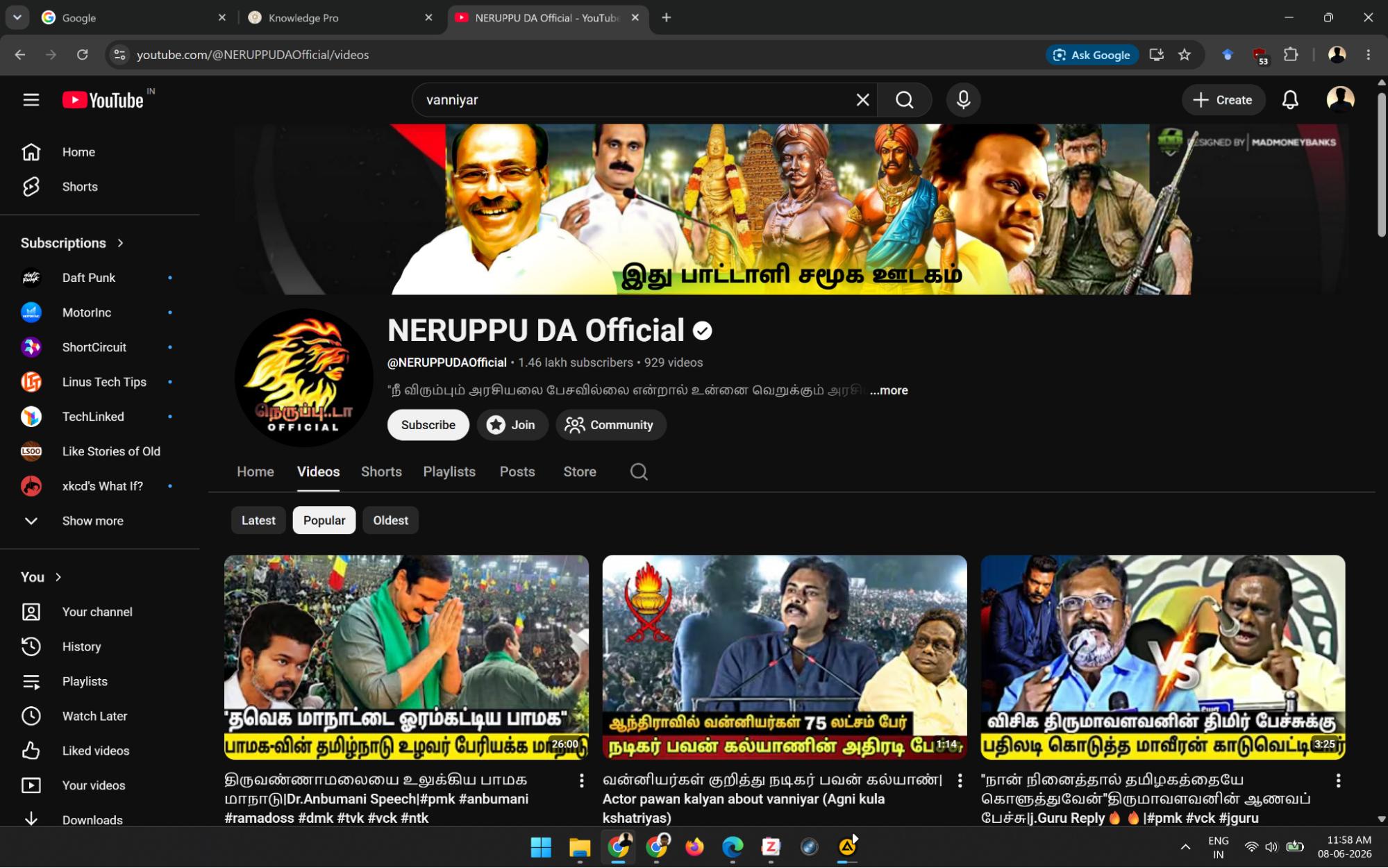
Vanniyar and Thevar/Mukkulathor related pages and videos. Source: YouTube.
Caste bias is also heavily driven by skin colour, but here digitally encoded colours are becoming a significant source of division. These specific colours appear on social media handle covers, titles, and bio pages to visually match different castes with their corresponding political parties. This symbolism shapes what the select accounts with caste supremacist intent shared online. Ranging from edited WhatsApp status videos and music playlists celebrating caste-affiliated figures to political speeches and openly biased interviews. They are distinctly symbolised to foreground the masculine icons and to substantiate their majority presence in both reality and digital spaces. From the so-called sacred thread in exclusionary temple precincts by Brahmins, to colour-coded plastic and threaded wristband differentiations in classrooms in the name of religion. Now to binary data and hashtags encoding colours as terms, covers and emojis on the internet, the casteism intertwined with everyday religiosity is moving beyond the medium.
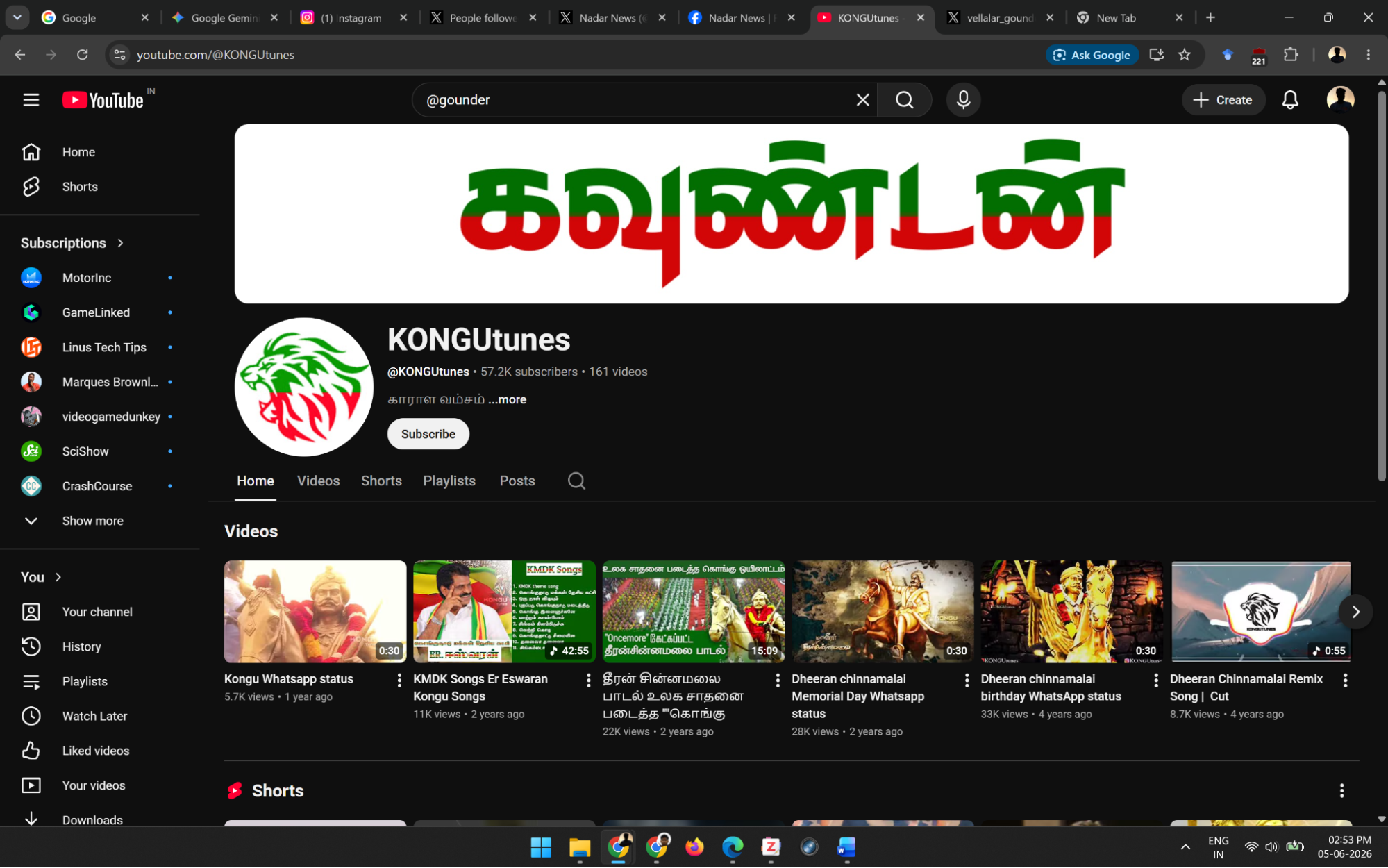
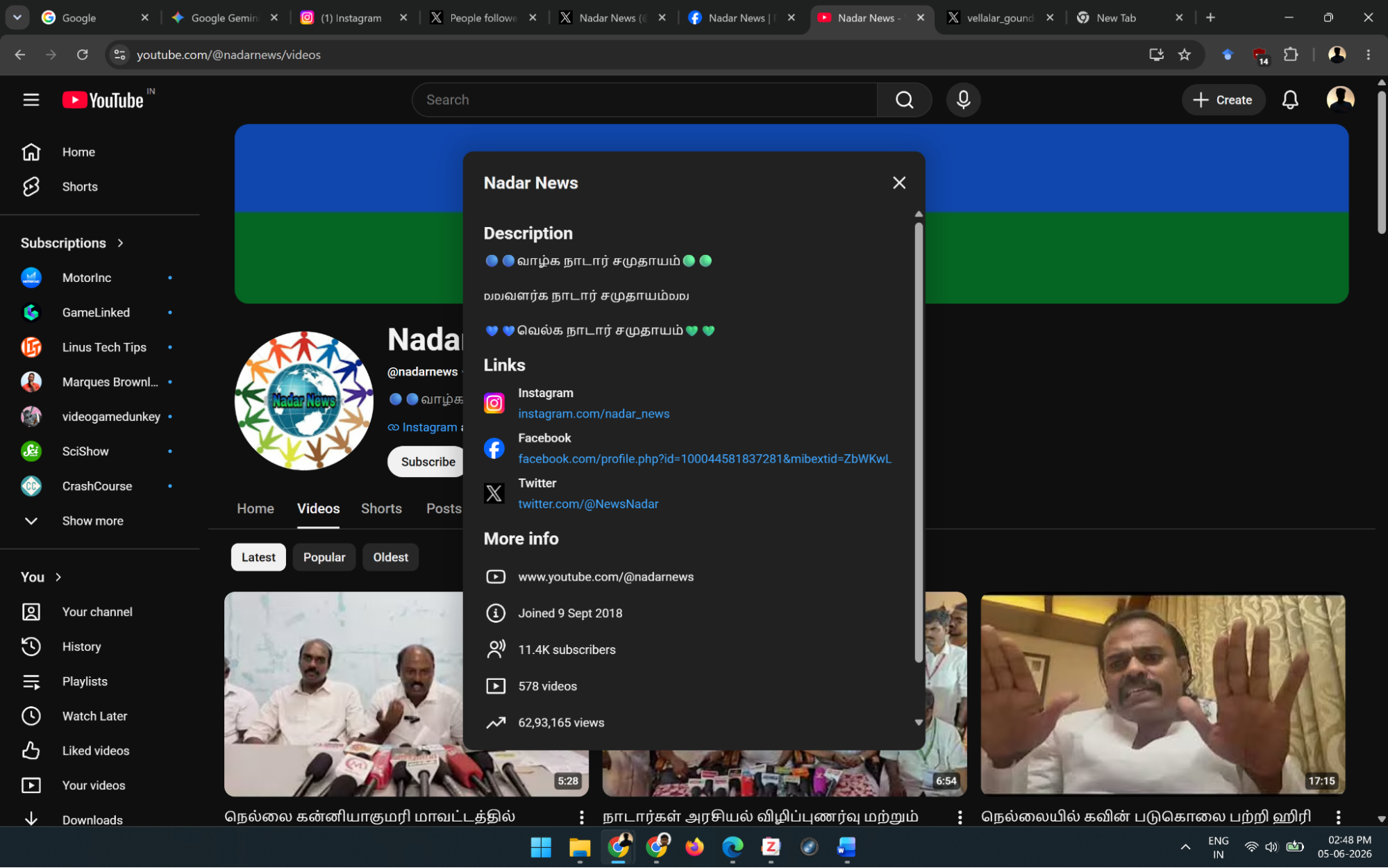
Gounder and Nadar related videos, pages, covers and the about section. Source: YouTube.
Paradox of Populism in Past and Present
The political history of Tamil Nadu highlights a constantly changing landscape of democratic alliances formed against cultural elites. Dravidian politics historically developed through social justice movements, grassroots-level welfare promises, populist appeals, the influence of cinema, and anti-caste resistance, which helped maintain electoral dominance. Since the early 1900s, the Self-Respect movement in 1925, alongside various radical reformers, created a strong non-Brahmin momentum and rationalist movement that challenged dominant power structures. The state’s prominent Dalit Panthers movement in the 1980s situated the caste question more assertively. From 1967 onward, the state's politics were heavily dominated by two major Dravidian parties, the Dravida Munnetra Kazhagam (DMK) and the All India Anna Dravida Munnetra Kazhagam (AIADMK), which took turns in power until quite recently. Hence, populist rhetoric surfaces from the past to the present in democracy, as a response to exclusion, embodying the people’s claim to recognition and authority. They are still entrenched in the paradoxes of religious iconisation, caste-exclusionary alignments, polarisations, and, finally, electoral appeal over ideological clarity in theory and practice.
While Dravidian parties like the DMK and AIADMK redefined Tamil politics through anti-caste and Tamil nationalist ideals, they gradually sidelined Dalits and came to be dominated by intermediate castes such as the Thevars, Nadars, and Gounders, leading to the rise of caste-based parties, including those led by Dalits, as a challenge to this consolidation of power since the 1980s (Carswell and De Neve 2015). In the 1990s, a series of reservation policies, the Mandal Commission, and legal subclassifications gave intermediate-caste associations immense power relative to various groups, as they constitute the state’s majority population. They gradually became the dominant forces, taking control of earlier landowning castes. Ironically, these select OBCs were still considered Shudras even as they began to identify socially as Kshatriyas, invoking a heroic past emulating Brahminism and later, in regional proximity, discriminating against Dalits. This ongoing power struggle over cultural capital triggers dehumanisation, local conflicts and prohibition in entering temple festivals, worsening cases of public pathway access, dishonour killings and police brutality. Also, commemorations, such as the ritualised Guru Puja, show how tightly caste, gender, religion, and hero-worship are bound together in iconography and exhibit power in public spaces. Alongside earlier Dalit mobilisation, anti-caste movements, fraternal intersections and political histories continue to question the symbolic hegemony. Further emphasising the government's need to deliver deep social reforms to annihilate caste, institutionalised inequality and pave the way for a casteless society.
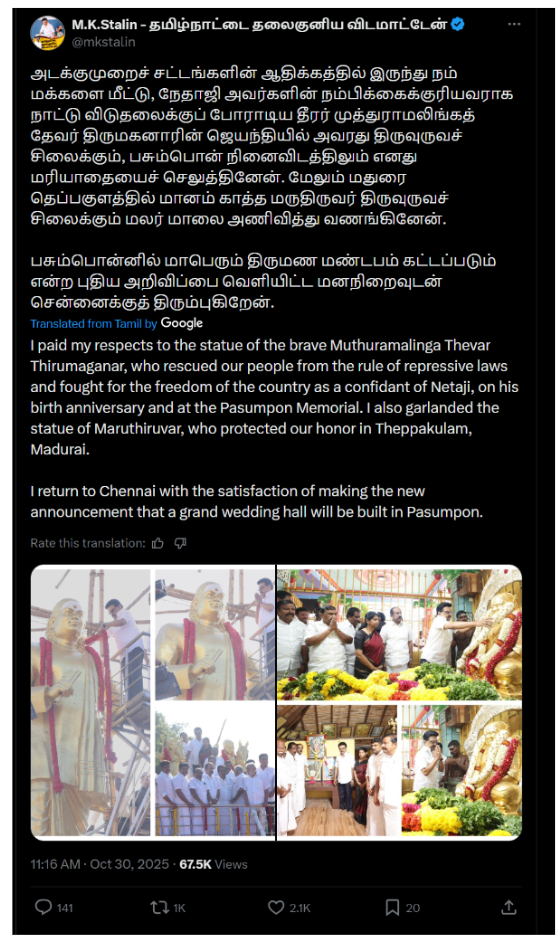
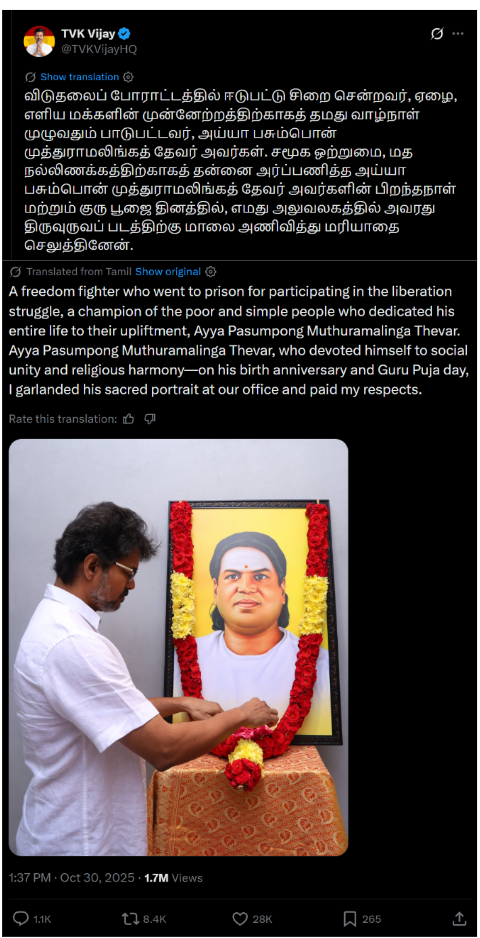
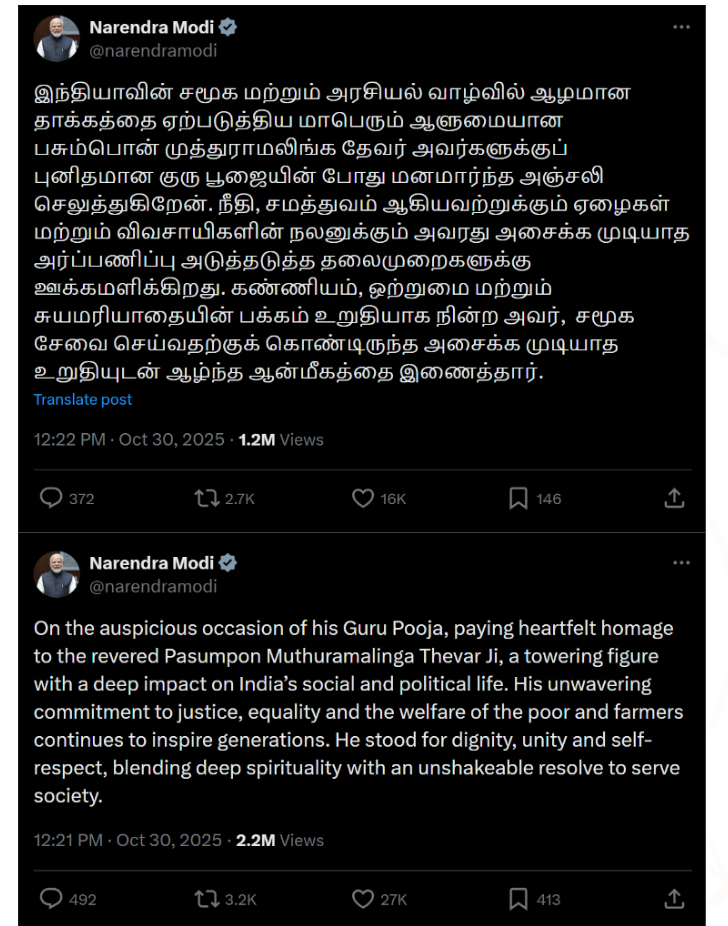
Thevar Guru Puja homage posts by the former & current Chief Ministers and the Prime Minister. Source: X (formerly Twitter).
To conclude, the strange contradictions of populist politics are presently unfolding online during the recent state elections, where iconisation is used to divide and appeal to the public in the campaign. A clear example occurred during the tragic Karur stampede in September, 2025, at least 41 people were killed, and over 100 were injured. At the height of public criticism, the event quickly became a political tool and a vehicle for a manipulative blame game rather than accountability. The actor-politician and party founder C. Joseph Vijay uploaded a viral online video in which he heroically challenged the authorities, the then-ruling DMK government, and the establishment on alleged foul play against one man. Now, having risen to become the ruling party, Tamilaga Vettri Kazhagam (TVK) is still refining its public relations to gain mass appeal for the populace. They firmly quote ‘Secular Social Justice’ and Tamil nationalism as ideologies, deliberately distance themselves from atheism while engaging in ideological irony in quoting Periyar in speeches and muddying their stance against Brahminism. Additionally, the current coalition assembly is criticised for alleged political opportunism, media censorship after taking office, and evading accountability in the state.
Given how socio-political influence is shaped online and in public discourses, religious iconisation has become increasingly prominent in the nation-state. Relating to the growing appeal of Hindutva majoritarianism, the questioning of federalism, state-appointed astrologer(s), and the use of the sceptre symbols, Vel or Sengol, to project a divine right to rule during elections, while reiterating secularism and within parliament. Open dialogue at the press conference is completely gone. It has been replaced by structured image-building, mediatisation strategies, and scripted speeches to foster a sense of frustrated commonality. Mainly directed against former governments as corrupt, which persists even after the parties take national and state political power. At the state level, the TVK government adapted to this climate instantly, whistling and drawing massive attention from the very moment it was founded. Notably, amid ambiguity about a third choice for change away from the earlier duopoly of Dravidian politics, populism, dynastic and star politics. While former governments foregrounded anti-Brahminism, which was also faulted for not fully addressing the hegemony of intermediate castes over Dalits, and since the 1990s, they have been curbing student politics. The hero-worship, rooted in symbolic appeal and interconnected with politics, persists through religiosity and iconisation.
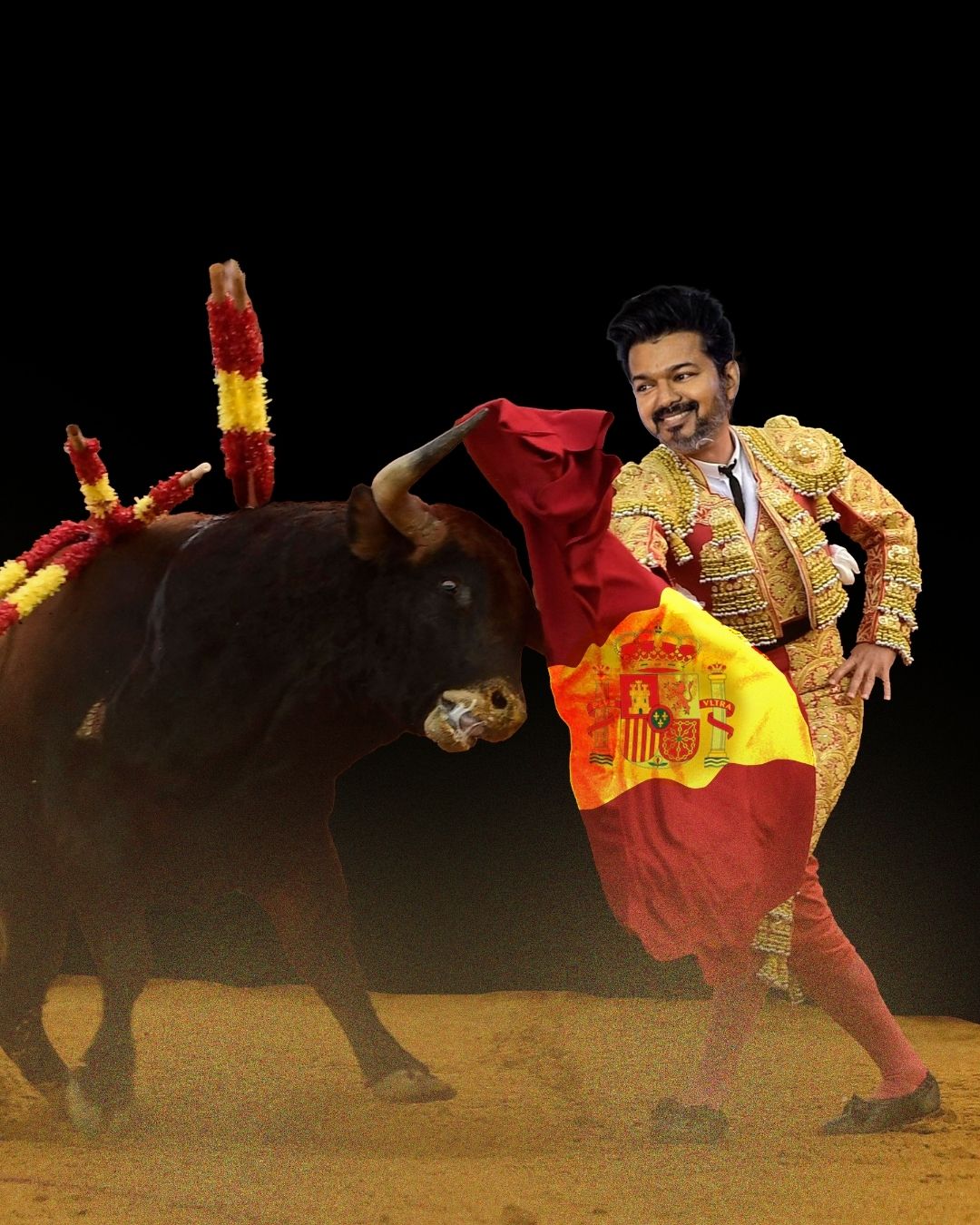
Now, the select iconoclasts as ideological figures, such as Ambedkar and Periyar, are in the background of the singularly iconised TVK party founder Vijay. Also, backgrounding more ideological figures, such as K. Kamaraj, Velu Nachiyar, and Anjalai Ammal, might suggest that, beyond their social importance and gender inclusivity, they were selected to satisfy political representation by appealing to the dominant constituencies of the Nadar, Thevar, and Vanniyar castes. They also chose select caste-aligned candidates in general constituencies, as the Dravidian parties did before, prioritising electoral majority over ideological appeal. Consequently, some peers from both Dalit and OBC backgrounds wore divisive colour-coded wristbands in the name of religion during schooling. Later used emoji-coded WhatsApp statuses, featuring casteified and deified icons. Instead, they now use the Spanish flag emoji to support the TVK-flagged populist saviour and appealing charismatic hero, ultimately influencing the socio-political staging, masculine iconography & digital realm into public reality.
References
- Ambedkar BR (2019) Dr. Babasaheb Ambedkar: Writings and Speeches. Vol. 1. New Delhi: Dr. Ambedkar Foundation, Ministry of Social Justice & Empowerment, Govt. of India.
- Carswell G and De Neve G (2015) Litigation against Political Organization? The Politics of
Dalit Mobilization in Tamil Nadu, India: Litigation, Political Organization and Dalit
Mobilization. Development and Change 46(5): 1106–1132. - Damodaran K and Gorringe H (2017) Madurai Formula Films: Caste Pride and Politics in Tamil Cinema. South Asia Multidisciplinary Academic Journal. Epub ahead of print 22 June 2017. DOI: 10.4000/samaj.4359.
- Geetha V, Rao S and Dhakshna MP (2007) The 9 Emotions of Indian Cinema Hoardings: The
Erotic, the Valorous, the Furious, the Terror-Stricken, the Pathetic, the Comic, the
Disgusting, the Marvellous, the Peaceful. Chennai: Tara Publ. - Hall S (1973) Encoding and decoding in the television discourse. Birmingham: Centre for
Contemporary Cultural Studies, University of Birmingham. - Kanjilal S (2024) The digital life of caste: affect, synesthesia and the social body online.
Feminist Media Studies 24(5): 1112–1127. - Kirasur N and Jhaver S (2025) Understanding the Prevalence of Caste: A Critical Discourse
Analysis of Caste-based Marginalization on X. Proceedings of the ACM on
Human-Computer Interaction 9(7): 1–35. - Leonard D (2026) Casting the Historical: The Dalit Heroic in Contemporary Tamil Cinema.
South Asian Review: 1–18. - Manikumar KA (2017) Murder in Mudukulathur: Caste and Electoral Politics in Tamil Nadu.
New Delhi, India: LeftWord. - Pink S, Horst HA, Postill J, et al. (2016) Digital Ethnography: Principles and Practice. Los
Angeles London New Delhi Singapore Washington DC: SAGE. - Selvaraj M (dir.) (2025) Bison Kaalamaadan. [Film] Chennai: Applause Entertainment / Neelam
Studios.