
Tac Logo
The Problem of Transcendence of Caste in the film Vanaprastham

The Problem of Transcendence of Caste in the film Vanaprastham

By Anagha Rajesh

Vanaprastham, a 1999 Malayalam film set in the 1950s, starring Suhasini Maniratnam and Mohanlal, tells the story of a Kathakali artist, Kunhikuttan (played by Mohanlal), and his struggles as a lower caste person. Dwelling on the existentialism that arises from being a Kathakali artist of that time, this essay looks at how Kunhikuttan navigates his caste identity and personal relationships, as he performs an art form that was exclusive to higher castes. The story is focused on the protagonist Kunhikuttan’s idea of Vanaprastham, a concept that involves transcending worldly life and transferring responsibilities to the next generation to focus on spiritual pursuits, share wisdom, and prepare for eventual renunciation.

On a Google search for the film Vanaprastham, you would see the brief:

“An illicit relationship between a Kathakali dancer and a young woman from an upper caste family results in an illegitimate child. He faces hardships when she refuses to let him see their child”.

People who watched the movie would tell you that's not the case; this movie is about a man who yearns to be seen for who he is, but is rejected because of his caste and appreciated for his talent, both of which interchangeably mellows and dissonates him. Kathakali, the art form he practices, is a means of escapism from the affliction, a means of expressing resilience to the caste system, and a source of livelihood. All while the caste system becomes an antagonist that follows, lurks around, and does not seem to leave him.

Poothana and the effects of caste on a child

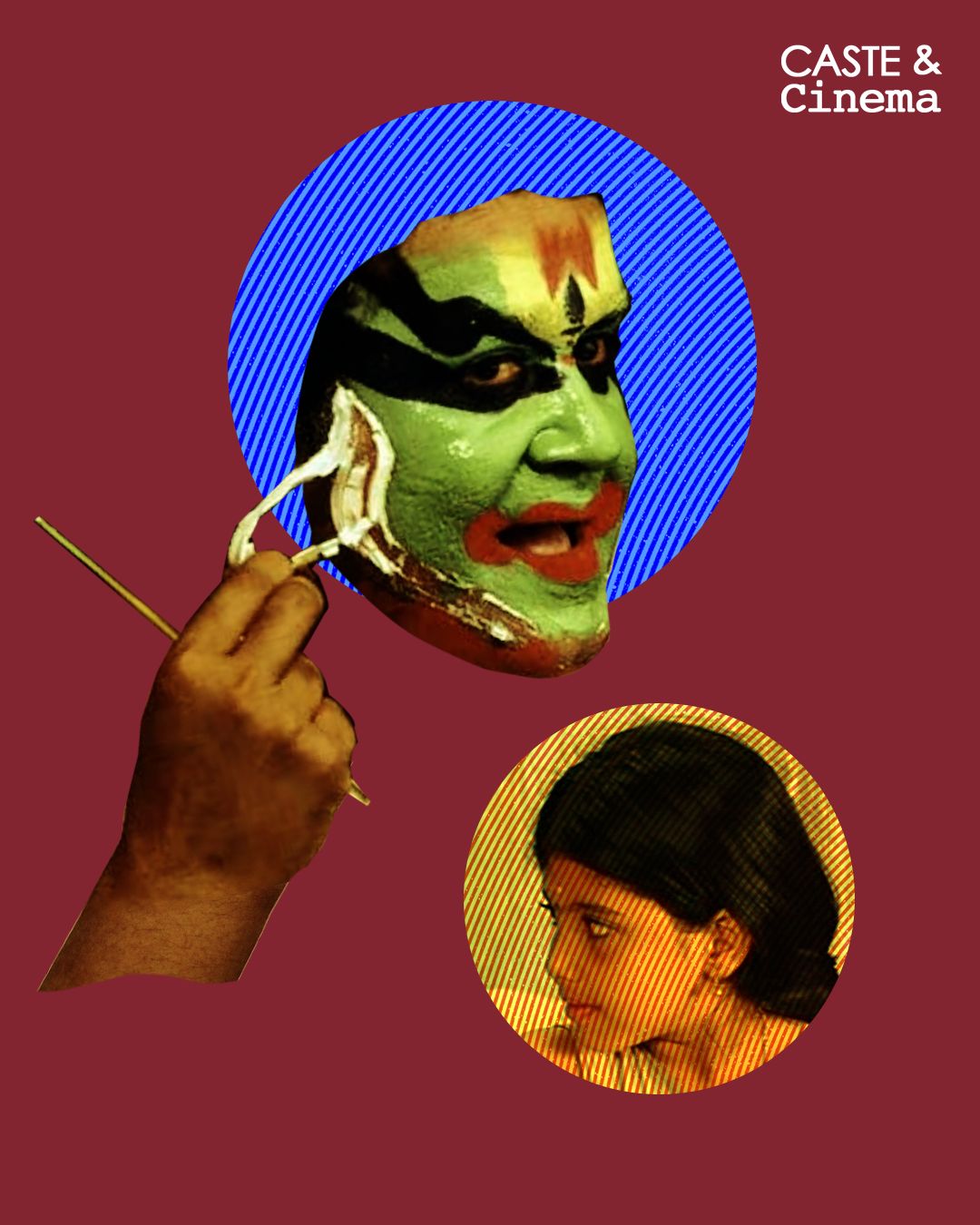
The movie begins with a Kathakali act, ‘Poothana Moksham’, an act in which Poothana, the demoness, is portrayed attaining Moksha (Liberation) from Krishna. Kunhikuttan plays Poothana, a character praised and known for his portrayal of layered emotions. He is also being considered to play ‘Raavana’, the demon king, as he is ideal for portraying complex characters. With occasional flashbacks of childhood, the movie reveals memories that haunt him, his father not accepting him as his son, as his mother Bhageerathi was a lower-caste woman, while the father, a brahmin.
A young Kunhikuttan is shown to be shunned from the Kathakali learning class, as he does not belong to the upper caste, unlike the other disciples. He runs crying, and Pisharidi – a savarna temple assistant, confronts Thirumeni – the priest who runs the classes. With Pisharidi's conviction, he is taken into class accordingly, as he is extremely poor but very talented. Regardless of Kunhikuttan’s talent or Pisharidi taking responsibility for looking after him, his teacher whipped his leg, so that he would not take pride in his talent, as a reminder that his ability to perform is a mercy of the upper caste and not based on his talent. Something that is established throughout his childhood.
As a husband, Kunhikuttan is absent, absorbed in his own world of noise from the past and present, trying to muffle everything with alcohol – a habit which his wife, Savitri, disapproves of. Though alcohol or other souvenirs were the payment higher caste people offered after the performance – 2 annas was the standard payment, not enough to sustain a family, adding to Savitri’s disapproval and disdain towards Kunhikuttan and Kathakali as an art. As a father, he maintains a composed relationship with occasional playfulness and taunts with his daughter, Saradha. Saradha is more inquisitive about Kathakali, always inquiring about the performance and demeanor.

Subhadraharnam

The act Subhadraharnam is a story from the Mahabharat that narrates of Krishna’s younger sister Subhadra’s elopement with and marriage to the warrior prince Arjuna. Kunhikuttan is set to take on roles other than playing Poothana, until he was relentlessly pursued to play Poothana Moksham for an aristocratic family. Also, he meets an upper-caste woman named Subhadra (the same name as the Mahabharat character, played by Suhasini Maniratnam), an exceptional writer, but she is primarily known as the divan's daughter-in-law. Her husband is said to be out of the station. As Kunhikuttan performs Poothana Moksham for one last time, the character trembles to death in the act, Subhadra is enchanted.
And thus, Kunhikuttan becomes a part of Subhadra’s world and requests to play the role of Arjuna from the Mahabharat. He, impressed by her writing skills and knowledge on Kathakali, is honored to play the role of Arjuna. The act, Subhadraharnam, is one of his first plays for the aristocratic woman. Years have passed since Kunhikuttan has portrayed various stories of Arjuna, parts of Bhagavat Gita, and other stories like Santhagopalan. Kunhikuttan had become the usual artist for Subhadra’s scripts. Even though, admittedly, the character of Arjuna is unknown to him and does not relate to any of the character’s rationale.
Around the same time, Kunhikuttan’s father rewards a piece of land, an appreciation of his talent for the outside world, and a request for forgiveness for not accepting Kunhikuttan as his son. Kunhikuttan renounces this gesture and burns the land transaction document, as a piece of land cannot compensate for the pain inflicted by his father.
On the other hand, Subhadra, the aristocrat, envisages herself as the character of Subhadra from the Mahabharat. Kunhikuttan frolicked along with this notion, as for once he was being loved and appreciated. For once, he thought he was seen for who he is. Between them, the boundaries of fiction and real life blur, leading to the conception of a child together in the movie. Abhimanyu, a son, is born. And her husband was met with an accident, passed away, leaving her as a widow. Kunhikuttan, who wants to meet his son, is persistently avoided by Subhadra; there is a tangent fear that he will only be accepted in his Kathakali costumes and not as himself. This gets confirmed, Subhadra confronts Kunhikuttan, introducing the newborn to him as first and last. She insists on not writing letters, nor trying to meet her again, as this child will be addressed as Arjun’s son, never Kunikuttan’s, and that he has no son as such, and not to consider Abhimanyu as his own. That he will not be addressed as the father due to his lowered caste position.
Hurt by Subhadra’s shame, Kunhikuttan says, “I am no human being, just a disguise, a mere disguise, here let me serve my head, and from now I will not perform calm characters.” With this, he begins his journey, playing Roudra vesham (ferocious or angry characters in Kathakali, conveying intense emotions) and giving up other characters.

The daughter who aids

Almost a decade later, in the movie, his colleague, also the lead singer of the Kathakali team, starts losing his voice. This distresses Kunhikuttan extensively and affects his performance, as he is accustomed to performing to his voice. He would request some of the aristocrats to support his colleague's aid. On the contrary, the people Kunhikuttan performed for began to remark that he had lost his voice as a result of alcoholism. Kunhikuttan looks for consolation, decides to go to Pisharidi mash – the one who looked after him in his childhood, but turns out he has gone on a pilgrimage to Kashi.
On such an anguished day, his father passes away.
Leads Kunhikuttan to Kashi to meet Pisharidi Maash, and share his current state of mind. And where he was not able to perform funeral rites as he is not an upper caste. Still, Kunhikuttan performed the final rites in Kashi: “As long as human beings are alive, they are bound by caste and religion. Once they are dead, the soul is free from all such differences, so I’ll perform.”
This denouncement of caste precedes his decision to make his daughter, Saradha, take over Kathakali. He prepares her for Subhadraharnam, the same act which Subhadra wrote for him as Arjun, where his daughter will play the role of Subhadra, while he resumes his role as Arjuna. This becomes controversial as a father romances the daughter on stage, to be played in the same place where he saw his son once and for last. This was looked down upon by Savitri, his wife, due to it being inappropriate, and she accused his performance as just a revenge on Subhadra for not letting him see his son again. Why use his own daughter for this act?
As the father-daughter duo act on stage, ironically proving to Subhadra that people can distinguish between an act and the reality with his daughter, who wouldn't cross boundaries in real life. With guilt of both the act and not having shown his son, Subhadra leaves the performance. The next day, as she prepares to write a letter to Kunhikuttan, about the play, she wears a saree and kumkum on her forehead (marker of marital status). The news of Kunhikuttan dying in the hands of his daughter on his way back home is what we hear. Subhadra reads a letter that she received from Kunhikuttan days before the performance, which says he has been “denial (of my existence) by my father and by my son. I can’t take rejection anymore. I thought the only person who would give happiness was my daughter, and that is the reason why I wanted to dance with her”. And that his son would never know his father belonged to lower caste.
Saving the embarrassment for Subhadra.
Alas, Kunhikuttan is set for Vanaprastham through his daughter, the only person who loved him for who he was. “I will always be indebted to my daughter, who gave me salvation after years of sorrow throughout life”. In many ways, continuing the art form, his legacy, and existence through her. Kunhikuttan lives through Saradha, whose heart would never deny him, and has enough space for him to live on.

Anagha Rajesh

Anagha is a researcher whose work explores cities, environment, development, and heritage, with a focus on social justice and questions of identity and belonging.

Enjoyed this article?

Share it with your friends and colleagues!