
Tac Logo
Fields of Domination: Education, Media, and Justice in Jana Gana Mana

Fields of Domination: Education, Media, and Justice in Jana Gana Mana

By Vimala Reddypogu

Cinema in general was once viewed as a means of entertainment, but in recent times, movies like Asuran (2019), Periyerum Perumal (2018), Kabali (2016), Kaala (2018), Thangalan (2024), Ambajipeta Marriage Band (2025), Palasa (2020), Jai Bhim (2021), Article 15 (2019) and Colour Photo (2020) have attempted to bring social realities onto the screen in South Indian cinema. By doing so, these movies aimed to highlight the social tensions and challenges of domination, which are entrenched in traditions of social inequality, including caste, class, and gender. These movies demonstrate that the marginalised are not mere spectators, but have agency and are self-conscious agents of social change, resisting through various means.
In this vein, Dijo Jose Antony’s Jana Gana Mana explores social issues, starring Prithviraj Sukumaran and Suraj Venjaramoodu as lead actors. The film is a political thriller that revolves around a murder investigation of a socially responsible female professor who belongs to a religious minority background. The film tries to expose the dark realities of fake encounters by the police and the political manipulation of sensitive issues to cover up extra illegal crimes done by the state. Through court drama, it poses relevant questions about society and politics. The movie will be greatly appreciated as it clearly showed how political parties usually use police vigilantism as a tool to manipulate people's emotions and bank on them to gain votes.

The Illusion of Justice

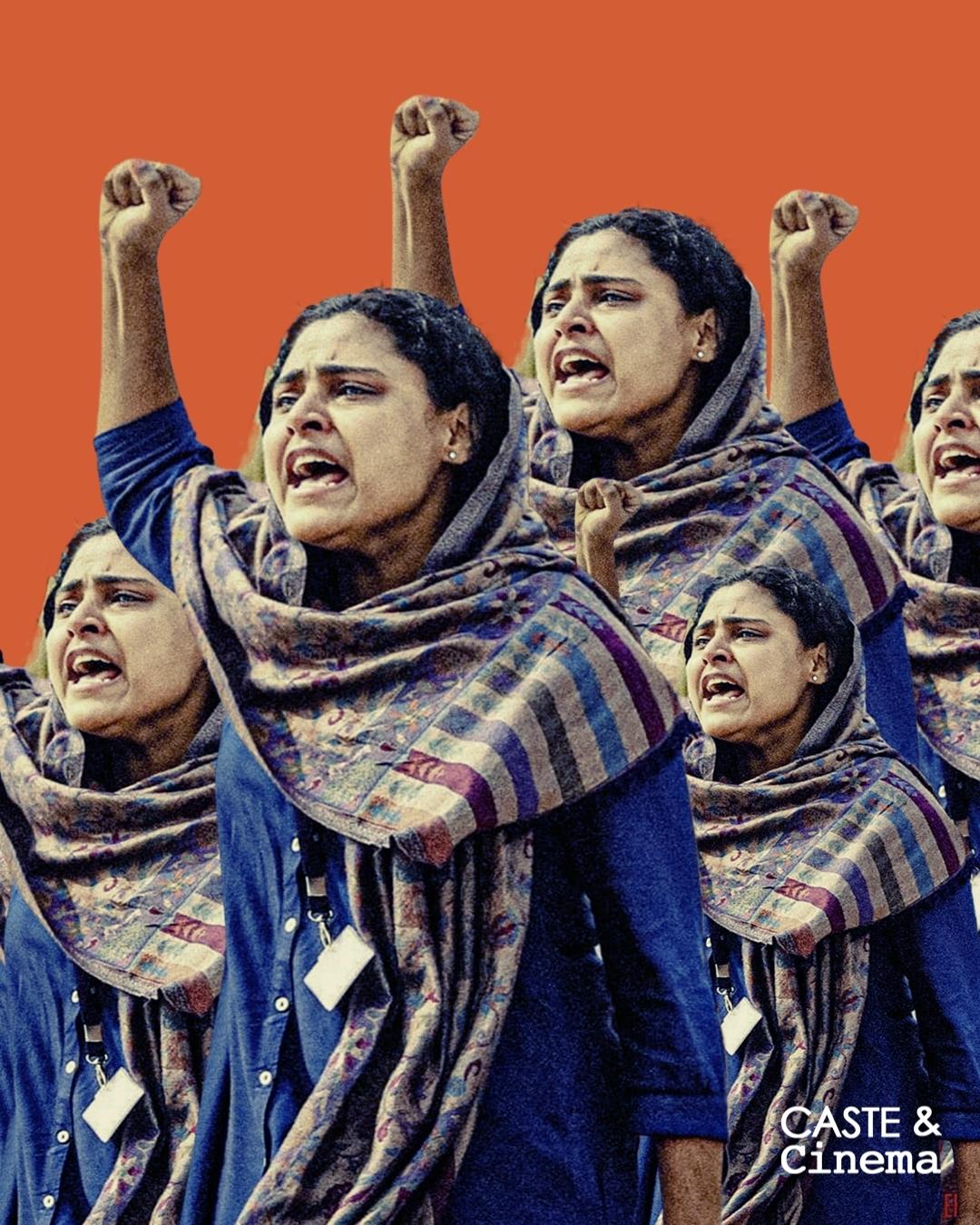
To move into the movie, it began when Professor Saba Mariam (Mamta Mohandas) was found dead, and the news showed that her body was burnt after rape. Police officer Sajjan Kumar (Suraj Venjaramoodu) was in charge of the investigation. Sajjan’s acts of investigation and the decisions he takes while investigating with political alignment different turns it takes in terms of media response, public response, university students' protests and how their voices were suppressed by police are all about the film. While investigating, Sajjan finds that four people had burnt her to death and arrests them. Instead of presenting these four people to the court, Sajjan kills them to death, as these four people have political connections with strong leaders, they might escape from judicial punishment. But when human rights activists filed a complaint against the encounter, it led to a court case.
Lawyer Aravind Swaminathan (Prithviraj Sukumaran) led the defence, exposing various aspects of the judicial system, including its treatment of the common man, the type of justice it delivers based on physical appearance, and the judgments it renders based on social status. He rightly asks, “If rape happens every 15 minutes and people react only to a few of them, who is to be blamed? Why does someone’s death matter more than someone else’s”? The movie effectively explains why we react the way we do and the hypocrisy behind it. After exposing various factors behind the case, Aravind finally reveals to the court and the entire country that this entire case was a master plan by the Karnataka government to retain its position in the forthcoming elections, and the mastermind behind the plan was Sajjan.

Institutional Murder and Symbolic Power

What exactly has happened is that Saba was killed by a colleague, Vyadarshan, against whom she had filed a case for discriminating against a Dalit research scholar, Vidya, badly because of her caste. He has not allowed her to submit her thesis by asking her to make multiple changes, without even reading her thesis. By pointing out to a sanitation worker, he reminded Vidya that “your position should be like hers, and you people are unworthy to enter into educational institutions.” Vidya, with this emotional turmoil, as she is first generation Dalit research scholar from a rural background she committed suicide. When Saba confronted Vyadarshan, He killed Saba by running his car over her. The very next day, this incident made national headlines. When Home Minister Nageshwar Rao learned about this, he was advised by Sajjan to use it as an opportunity to gain popular support in the forthcoming elections, as the public response indicated that Nageshwar Rao’s party would lose power.
Overall, the film conveys a powerful message, highlighting how laws related to women's security are being misused and how some individuals are exploiting laws meant to protect women against crime to extort innocent people. The film conveys a powerful message that the law and society should treat everyone equally. The first half of the film is engaging, thanks to its non-linear screenplay, but the second half wavers in its storytelling coherence. When Sajjan and Prithviraj appear on screen, they steal the show with a bang. The second half of the film is fascinating with enormous twists and turns. In brief, it examines the current political landscape in India, and many events depicted in the movie are based on real-life incidents.

"The film also resonates with Pierre Bourdieu’s concept of field and Symbolic power, as it clearly reveals how domination is sustained not merely by coercion, but through the subtle production of legitimacy, authority and consent."

As Bourdieu says field is a structured social space where institutions like education, politics, or law exist, in which individuals or social groups struggle for dominance using various forms of capital (economic, social, cultural and symbolic). In the film, the university emerges as a powerful field where hierarchies of caste and class are reproduced under the guise of merit and professionalism. The institutional murder of a Dalit research scholar is not just a personal tragedy but a reflection of symbolic power. The media holds symbolic power by framing narratives that align with dominant ideology, turning dissenters into “anti-nationals” and transforming justice into spectacle. Similarly, the judiciary, veiled in the language of neutrality, legitimises existing power structures while concealing systemic inequality.
To conclude, the movie clearly reflects the harsh realities within many higher educational institutions, especially the experiences of Dalit scholars who are often forced to work under casteist supervisors. It portrays the mistreatment, humiliation, and derogatory remarks these scholars face in academic spaces. The film also highlights the power and unity of organised student communities, showing how, when students come together to demand justice, they are quickly labelled as “urban Naxals” or “anti-nationals”. It powerfully exposes how the state tries to suppress dissent, how justice is shaped by social prejudice and hierarchy, and how the state, law, and elites often respond to such incidents for their own benefit rather than to uphold truth and equality.

Vimala Reddypogu

R. Vimala is a PhD Scholar in Sociology at the University of Hyderabad.

Enjoyed this article?

Share it with your friends and colleagues!