
Tac Logo
Erased from memory: How Kammas whitewashed Caste in Telugu cinema

Erased from memory: How Kammas whitewashed Caste in Telugu cinema

By Sri Harsha Sai Matta

In Andhra, Politics and Cinema are intertwined to give Telugu cinema heroes double career prospects. While going about their career in films as usual, they also occasionally make cameo appearances in question hours of legislative assemblies, giving their two cents on things like welfare and administration. These heroes do not have much change of character outside films. They infuse threats in their punch dialogues in cinema aimed at their political rivals in real life and the line keeps getting blurred. Similarly, little difference remains between caste and cinema in Andhranadu. The Green Revolution has enabled the capitalist accumulation of agricultural gains of rich dominant caste landlords and powered the rise of political parties like the Telugu Desam Party in the 1980s. The party was founded by N.T. Rama Rao who was the first matinee idol of Telugu cinema and hails from the dominant landed caste called the Kammas. Simultaneously, the Kammas have also been the kingpins of Telugu commercial cinema for over half a century and most of the production houses, studios and film cities are in their name, suggesting cinema as nearly a caste dominant business in the region. Thus, the Kammas are both the ruling class elite as well as the cinema elite and have all the political, social and economic capital to manufacture narratives and images that disseminate the ruling class/caste ideology.

The Karamchedu Massacre

In 1985, Madigas were attacked in a village called Karamchedu by the Kamma Caste landlords following a string of incidents from a Kamma boy washing his buffalo in a tank used by Dalits for drinking water to the latter’s resistance to it which enraged the caste arrogance of the Kammas. In an organised massacre by the Kamma landlords, six Madiga men were killed, three Madiga women were raped and several ran for their life after getting beaten up. This massacre remained one of the bloody memories of many caste atrocities in the state and has ignited the Dalit movement to wage social and political struggles against the caste badlands in the region. The prime accused in the massacre Daggubati Chenchu Ramaiah also turned out to be a close relative of the Chief Minister N.T. Rama Rao, visibly highlighting the close collusion between caste and political power as enablers of dominant caste terrorism against Dalits. While this remained as one of the violent memories of caste aggression in the region, the Telugu cinema industry also dominated by the Kammas tried their best to revive their image from oppressors to noble people seeking equality across all castes and communities through the medium of cinema.

Rewriting History on Screen

Jayam Manadera, a movie released in 2000, featured a star hero named Daggubati Venkatesh from the same Daggubati family and he was portrayed ironically as the saviour of the Dalits from the very same Karamchedu village, where the hero’s caste members in real life massacred Madigas. In the film, his role is that of a benevolent feudal lord who wishes to redistribute land to Dalits and allow them to contest for Panchayat elections. The only oppressors are his relatives, more like caricature villains who want to show Dalits their place and kill the hero for not abiding by the caste norms. Throughout the movie Dalits are simply reduced to being recipients of the protagonist’s caste reform. They organise against the villains but only as a preparation for the protagonist’s foreign returned son to avenge his father’s death.

"Either painting their heroes as saviours of Dalits or making their protagonist an impoverished man devoid of other social contexts of caste or religion... were one of the many tropes in the Kamma filmlords’ playbook to revise any public memory of them as oppressors."

Ten years later, another movie titled Leader, a political drama, also portrayed another hero from the Kamma Daggubati family, Rana Daggubati, who is also a nephew of Daggubati Venkatesh. The movie has an undercurrent subtext of the ruling class-caste members retrospectively looking at their own complicity in the oppression and violence against Dalits in the State over the decades. The opening scene of the movie has the hero’s father, who is the chief minister, being reprimanded by his elder brother for not ‘covering up’ the massacre after burning down the entire Dalit hamlet. He affirms that this (violence) is a necessary precaution to keep a check on Dalits rising against them. The hero who becomes chief minister after his father’s death is shown to be guilty of the massacre his uncle and other caste members have committed. He often visits the hamlet of the Dalit families, much to their angry resistance. But whatever effort the filmmaker brought to the film in showing the trajectory of caste oppressors' dynamics from unabashed casteist brutality to portrayal of guilt, which is immediately tossed aside when the hero resigned from the chief minister post and the political party. In the climax scene, he is welcomed by the Dalits, garlanding him as their leader, as if his mere resignation has completely eradicated his caste entitlement and enabled him to become the saviour of Dalits.

The Erasure of Caste in Remakes

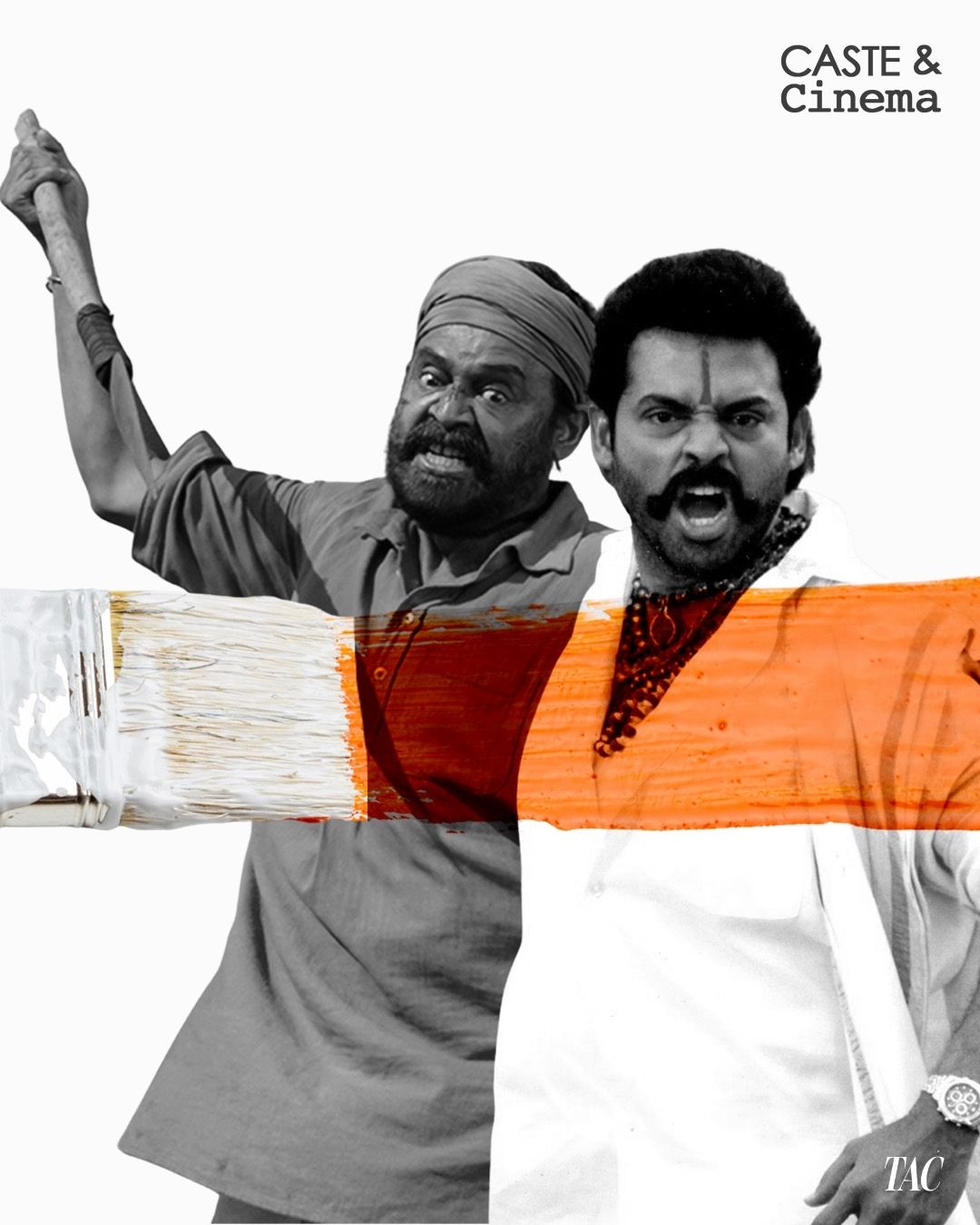
A decade later, another movie called Narappa featured the same Daggubati Venkatesh from Jayam Manadera and is an official remake of the Tamil movie ‘Asuran’. The Tamil original depicts the authority of the dominant castes by staging elaborate sequences of degrading humilation and violence faced by Dalits, like prostrating completely before upper caste peoples (from older men to even children), getting beaten up and paraded with chappals on head and so on. But the Telugu remake strips the caste angle of the original by making it about a conflict between the rich landlords and small-scale peasants. The film’s opening voiceover underlines that the poor have no caste or religion. While the Tamil original draws from the Keezhavenmani massacre in 1968 and the inciting incident in the movie does resemble the trigger of the conflict at the public well, like in the Karamchedu incident. The Telugu remake, while milking from the issues of caste based violence and Dalit survival for its own masala cinema needs, has the audacity to reduce the caste struggles of the protagonist’s family to class disparity. Either painting their heroes as saviours of Dalits or making their protagonist an impoverished man devoid of other social contexts of caste or religion as in the case of Narappa were one of the many tropes in the Kamma filmlords’ playbook to revise any public memory of them as oppressors. Many similar films from big production houses run by the Kammas continue to whitewash their oppressor histories and manipulate public memories of caste and violence against Dalits.

The Need for Alternate Public Memories

Telugu cinema with its all-consuming caste-value erased any narratives of Dalit violence or, for worse, packaged it in the trope of saviourhood. In the guise of entertainment, this Dalit self faced denial, and the saying goes cinema is an escape, it actually became an escape from dehumanising memories of caste and self-erasure, for Dalits across the Telugu states. The spectacle of mass cinema in Telugu over the decades indeed became an escape for Dalit youth like me until Pa Ranjith’s Kabali, starring Rajnikanth, came out in 2016 which asserted Ambedkarism by depicting personality as self-design and to dress up well and sit equally face to face with the oppressors as resistance in itself. Along with Kaala the very image of the biggest superstar like Rajnikanth representing the oppressed felt like a radical image that rehumanised Dalit representation in glorious strokes. Mari Selvaraj’s movies from Pariyerum Perumal (2018) to Karnan (2021) to Bison (2025) even more deeply sang the memories and resistance of the oppressed with teeming grief and rage. Like in Mari’s movies, to powerfully assert that memory is not a past, but an untouchable spring, in the words of the writer Kalyan Rao, will take light years for Telugu cinema to reach.
But Karuna Kumar’s 2020 film Palasa 1978 released a year before Narappa is a rare exception and a gem of a film depicting Dalit resistance and struggles for liberation. It shows Dalit women questioning the dominant caste men’s arrogance when they deny them drinking water from the public well, “You’re reminded of untouchability when we ask for water, but there is no untouchability when you make sexual advances towards us”. The movie maturely depicts the diversity of Dalit communities by showing an educated police officer called Sebastian who is from manual scavenger community, telling the protagonist Mohan Rao, another Dalit, to fight for the solidarity of Dalits oppressed like him across the country by getting educated, and further on agitate and organise – the clarion call of Babasaheb Ambedkar. After ruminating all this while about erasure and appropriation of Dalit narratives and memories of caste oppression by those in power, one must ask what is public memory in a casteist-communal society? Cinema and Politics continue to dominate the narrative of public memory. Referencing continuous casteist violence on Dalits and asserting the ever-emergent need for resistance, telugu movies like Palasa 1978 are those rare alternate public memories we need to feverishly seek that offer to rewrite histories that are erased.

Sri Harsha Sai Matta

Harsha is a PhD scholar from Ambedkar University, Delhi. He meditates on histories of Dalit and Dalit Christian identities, social movements and cultural politick in the Telugu speaking regions. Besides historical thinking he indulges in film, dreams and memory.

Enjoyed this article?

Share it with your friends and colleagues!