
Tac Logo
Constructing selective nostalgia in Tamil cinema while ignoring the caste realities in villages

Constructing selective nostalgia in Tamil cinema while ignoring the caste realities in villages

By Sangeetha R

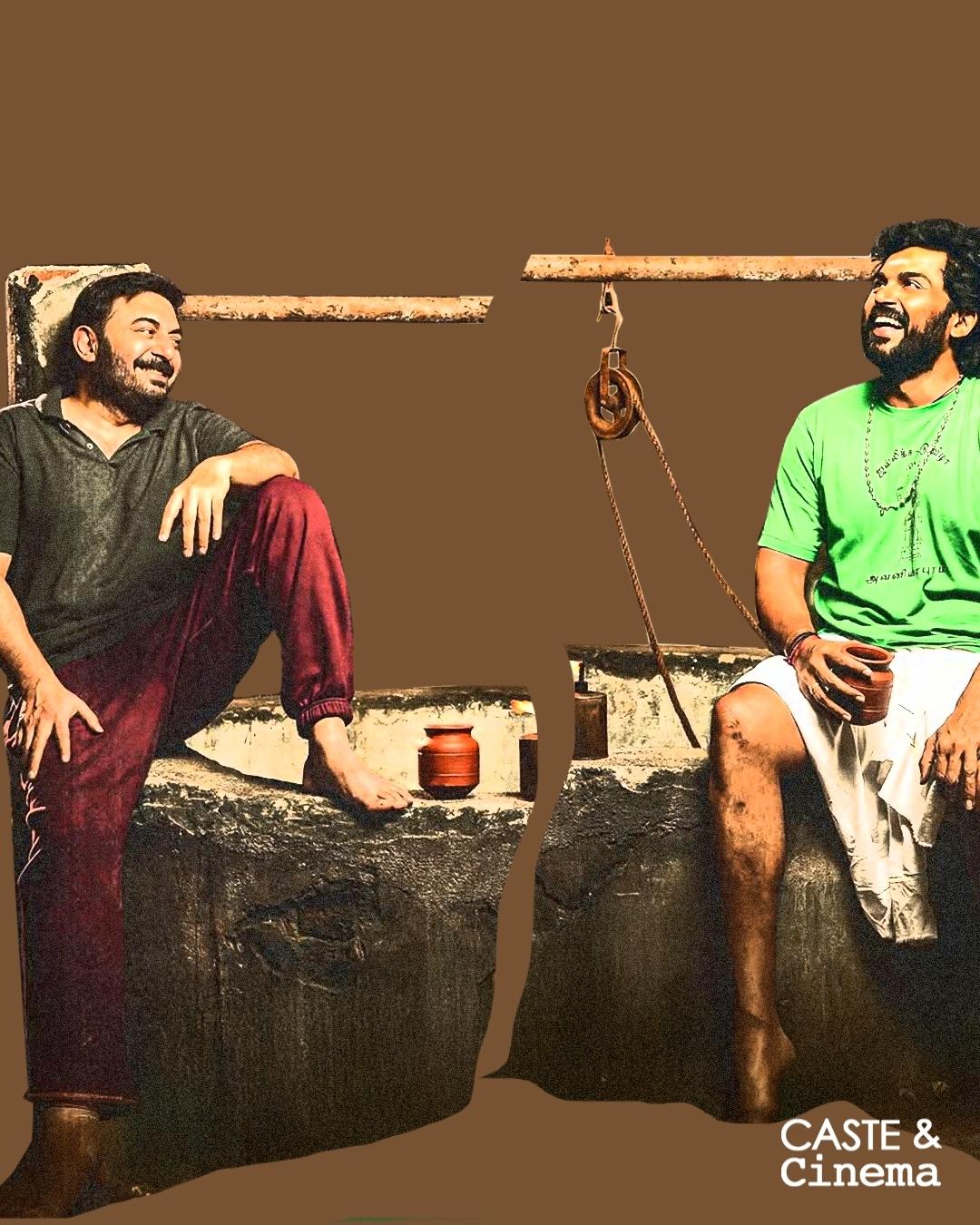
Meiyazhagan (2024), starring Aravind Swamy as Arulmozhi and Karthi as Meiyazhagan, portrays the Tamil village through a lens of nostalgia that quietly overlooks the deep-rooted caste hierarchies shaping rural life. I was immediately drawn to the film’s soundtrack and decided to watch it on the first day itself, without reading any reviews. By the time it ended, I was left with a set of questions and unease that lingered long after the credits rolled.
Set in Thanjavur, the film evokes emotional highs as Arulmozhi, a middle-aged man from Chennai, returns to his homeland for his cousin sister’s wedding, hoping to relive his childhood memories. From avoiding his village because of a painful past to rediscovering his affection for it, his transformation unfolds through carefully constructed sentimentality.
The narrative moves through encounters heavy with nostalgia. Arulmozhi meets a bus conductor who fondly recalls being his father’s student and insists on taking him home. He reconnects with an old lover trapped in an unhappy marriage, and finally meets Meiyazhagan, the embodiment of virundhombal, the Tamil virtue of hospitality, whose generosity verges on the unreal. Meiyazhagan becomes the moral centre of the movie, offering unconditional love and even a willingness to sell his wife’s jewellery to help Arulmozhi. His exaggerated kindness transforms the life of Arulmozhi which leads to emotional healing and change in his perspective about his village and the people.

Patriarchy and Property

Arulmozhi’s family history starts with a conflict over an ancestral house. Years earlier, they had left the village after a property dispute, and his ancestral home, now taken over by his father’s two sisters who listened to their husbands, becomes the emotional pivot of the story. The women are portrayed as deceitful and greedy, the only villains in an otherwise benevolent world. Yet the film never reflects on the larger question of women’s rights to property, which were legally recognized only in 1989. Instead, the private drama in one family tries to reinforce the moral coding of women as disruptors in patriarchal inheritance systems, reducing a structural issue to a story of personal betrayal.
Throughout the film, land and property become metaphors for belonging. Arulmozhi’s father relinquishes his ancestral land, Meiyazhagan buys his wife’s ancestral house for her, and later, Arulmozhi tries to purchase the house he lives in. When Arulmozhi returns to Thanjavur, the villagers pity him because his family owns no land. The story shows how his father loses all rights to property, but it never asks what happened to Arulmozhi’s mother’s share. Did she have no claim at all? Meanwhile, Arulmozhi’s maternal uncle, Sokku Mama, played by Rajkiran, is portrayed as a farmer comfortably living because of his agricultural land. The film does not question this imbalance. While Sokku Mama thrives on his land, Arulmozhi’s mother’s absence from the inheritance narrative remains unspoken. We are not shown what the women are going through because of the conflicts. There is one shot for Arulmozhi’s mother in the very beginning of the movie and we see her nowhere after it. Women were married off with gold and dowry while men got to inherit the property. It lets us infer that Arulmozhi’s mother was married off with dowry and never inherited any kind of land in her village in Thanjavur. Tamil OBC caste-hindu communities have been patriarchal for the longest time and female infanticide was a common practice because families couldn’t afford the gold for the girl’s wedding.
Going back to the song which is sung by Vijay Narain and Kamal Haasan, ‘poren naa poren’ devices the audience with the beautifully composed tune evoking grief about leaving your roots. A particular line, Paal Tharum Thaai Madiyaa, Pangida Alaiyum Sonthangal meaning "The mother’s breast which feeds milk is being divided by relatives because of greed" is very problematic because, here inheritance is a man’s issue. Arulmozhi’s father, grandfather and Arulmozhi himself are the central characters of the property issue. But they go ahead to compare the house with the mother's breast as a metaphor which relatives want to divide. Isn’t the mother the same to all children? Shouldn’t the house also be shared with the women too?

The Land Question and Caste History

The eastern parts of Thanjavur and the Nagapattinam district carry a distinct history of land redistribution from Zamindars, pannaiyar, mirasdars to Dalits. The delta region, known as the rice bowl of Tamil Nadu, became a fertile ground not just for agriculture but also for political movements. Communist parties are deeply rooted here, actively organizing and fighting for the rights of agricultural labourers who sustained the region’s prosperity. The peasant movement and Dalit rights movement started in the 1940s. It was the time when feudalism was soaring. The landholding of each landlord family would be in thousands of acres. The Dalit agricultural labourers were called ‘pannaiyals’ and it was outright slavery. It was because of the continuous protests by the CPIM party, there was regulation of agricultural wages. In 1968, the Kizhvenmani massacre happened because the Dalit labourers asserted that they wanted a hike in their wage, otherwise they would boycott work. Following all these atrocities by casteist landlords, during the 1970s, as part of this land redistribution reform, every Dalit woman who headed a household was allotted one acre of land.
And this is not a yesteryear's problem, but still very relevant today. During my field work in 2019 at Nagapattinam, I was shocked to see Pannaiyar families were still there and the Dalit labourers are on an unsaid bond with each Pannaiyar because the Dalit labourers have taken loans from the Pannaiyar. They have to work and pay the capital and the interest through their labour.

Selective Tamil Pride

While the film turns away from the region’s violent caste history, such as the Kizhvenmani massacre, it momentarily gestures toward Tamil nationalism through references to the Eelam genocide, the Jallikattu ban, and the grandeur of Karikala Chozhan when Meiyazhagan opens up to Arulmozhi. The scenes were later chopped because of the length of the film but released on YouTube. Meiyazhagan proudly claims that they are descendants of the Cholas, carrying veeram (valour) in their blood. Yet Jallikattu itself is a game where caste plays a defining role, and Dalits are often excluded from participating. When Meiyazhagan celebrates Jallikattu, his pride comes from a place of caste privilege.
Reality tells a different story. In September 2025, a group of Dalit students from a village in Thanjavur were beaten with sticks and stopped from walking on a mud road in a caste Hindu settlement on their way to a government school.
"Meiyazhagan’s political empathy stretches across the sea to Eelam but stops short on its own soil. The sentimentality of belonging, in this sense, becomes a quiet act of erasure."
During the 1990s, Tamil cinema was filled with films like Nattamai, Yajaman, and Chinna Gounder, which popularised the trope of the benevolent OBC landlord, a generous patriarch who “gives” to the poor and the labourers. It took years for the industry to move beyond these romanticised portrayals. Yet even today, in 2025, caste hierarchies remain visibly intact. At Thiruvizha (annual temple festivals) in rural Tamil Nadu, caste Hindus still lead the processions, occupy the front rows, and enjoy the first privileges.
Films like Meiyazhagan and Idli Kadai starring Dhanush continue this dangerous attempt to portray villages as pure, innocent spaces, reviving the narrative of “returning to one’s roots” while ignoring the deep systemic inequalities that shape those very roots. These stories, wrapped in nostalgia, use music, cinematography and sentiment to conceal violence and exclusion. Even temples, shown as spaces of refuge and redemption for the protagonists, are not neutral spaces in real villages. Segregation remains clear and persistent, and not everyone receives the same treatment within temple walls.

The Reality of "Returning to Roots"

This selective invocation of Tamil pride, without confronting the violence and caste oppression embedded within it, reveals a troubling contradiction. Meanwhile Bison, a movie based on real life incidents reveals how violent caste is in rural Tamil Nadu. The lead character keeps fighting every battle because he cannot afford to go back to his casteist village. Meiyazhagan’s political empathy stretches across the sea to Eelam but stops short on its own soil. The sentimentality of belonging, in this sense, becomes a quiet act of erasure. This selective nostalgia did not resonate with me because I am well aware of the caste reality the film chooses to ignore. Being an OBC woman, when I went back to my father's village as an adult, the first thing I noticed was the Oor (Caste Hindu settlement) and colony (Dalit settlement) separation. Though Dravidian politics is firmly grounded in anti-Brahminical resistance, our critique often ended with Brahminism alone. As a result, Brahminical practices are now being reproduced within OBC groups. OBC men in Tamil Nadu still get addressed by caste name, Gounder ayya, Mudhaliyare, Chettiyaru. The movie also mirrors the reality of our patriarchal society, where any decision involving land is treated as a man’s domain.
For a caste hindu who is ignorant of these social hierarchies, the film easily slips into a mode of romanticisation. Portrayal of Meiyazhagan as a person and movie, can be seen as an innocent attempt at going back to roots, but can anyone who migrated from villages, especially the oppressed dream of going back to these villages?

Sangeetha R

Sangeetha Rajapandian is a transciplinary research practitioner specializing in qualitative research methodologies. A Periyarist and Tamilian, she works with Aruvu Collaboratory and explores the world through her Pentax film camera.

Enjoyed this article?

Share it with your friends and colleagues!