
Tac Logo
An anti-caste reclamation of the ‘animal lover’ identity through Mari Selvaraj’s films

An anti-caste reclamation of the ‘animal lover’ identity through Mari Selvaraj’s films

By Pritika M

The first time I met a horse, I was a child looking up at a soft nosed animal in Marina beach, Chennai. Going to the beach to see horses has been one of my favourite memories as a child and one of the few times I’ve been able to connect with my father. He and I belonged to a house where so much of ourselves were made invisible by my grandfather, the chief patriarch. To be seen and spoken to by the many riders who made a living taking people on horse joyrides across the beach, and to be witnessed by the presence of their horses, made a huge difference. A large part of my life learning to work with and care for horses as an adult, is thanks to the horse owners and their horses in Marina beach. They taught me so much and offered so many like me an accessibility to the horse world I would otherwise have never had.
Like anyone who loves animals, I invariably found myself in animal welfare spaces in the city. It was here that I noticed how these spaces have an immediate revulsion to people who have a working class relationship with their animals. I witnessed the ire reserved for horse owners and riders in Marina beach which wasn’t present for horse owners and riders in posh places like riding schools and race clubs. The bashing of beach horse owners and riders for being cruel and abusive to their animals but not batting an eyelid to the same treatment of horses in rich places. There was no question of dialogue, of a sharing of resources to address what the horses needed in their working environments. There was only dispossession, displacement and rehabilitation of the animal to generously funded shelters.
It was here that I was introduced to a Brahminical bigotry whose casteism cloaked itself with a love of animals.
Who gets to ride a horse?
Who gets to care for an animal?
What should this care look like?
Who gets to rescue animals?
Which animals are getting rescued from whom?
All of these questions dictated and answered from a casteist standpoint. Following tradition to the t, a Brahmanical animal welfare system writes the rules with casteist perspectives and expects everyone else to follow it or be punished. It is no wonder it itches for blood to see horses under the ownership of historically marginalised communities. It has no qualms though in using the same people to do its labour.
In his book The Oppressed Hindus, M.C.Rajah writes,
“You may touch your horse, you may pat your dog, you may stroke your cat, but you may not touch an Adi Dravida or Adi Andhra.”

“You may breed cows and dogs in your houses, you may drink the urine of cows and swallow cow dung to expiate your sins but you shall not even approach an Adi Dravida.”
For me, these lines are the very embodiment of the narrative identity of the Brahmanical ‘animal lover’. It is no small coincidence that the sheer number of animal welfare centres and shelters are majorly owned, controlled and led by practising Hindu Brahmin groups. Gaushalas or ‘cow shelters’ alone number in the thousands. The concepts of ‘seva’ or ‘service’ towards animals, practice of not eating meat and choosing vegetarianism as a practice of Brahminical ‘sanatana dharma’ or ‘way of life’, are used to paint a picture of the Hindu Brahmin as being the embodiment of what it means to care for and have compassion for animals. When I read M.C.Rajah’s book, it had been close to fifteen years of finding myself struggling to enter or remain in what was considered the city’s mainstream animal welfare and environmentalist spaces, only to repeatedly find myself ignored or made to feel small. My knowledge, skillset, experience and heart, unseen. It is hard to explain what it feels like when you are looked at like a stranger, a “sorry I don’t remember your name” thrown in your face as you introduce yourself for what feels like the hundredth time. Anything you say passed over and forgotten in a minute. Your work, disregarded by the people working in the same field as you.
Back then, I was co-running an environmental education organisation and working with a team of educators across three schools. Previously, I had spent years learning and practicing permaculture farming to understand what sustainability could look like when it came to food systems, raised cows, goats, chickens, dogs, cats and horses, learned how to work with and care for horses by studying their behaviour and body language in my training of natural horsemanship, and had countless hours spent volunteering at animal adoption drives, shelters and local conservation activities. I really liked learning and working in these fields but I was made to realise that I was never going to find my place within the narrow confines of the Brahmanically gatekept narrative identity of the ‘animal lover’ or ‘environmentalist’. A narrative which dangerously positions and equates caring for animals as valid only when following the Brahmanical script, excluding all other communities and all other ways of caring and living with animals.
What does this Brahmanical script look like?
In the interest of not nauseating both reader and myself, I want to show what this script isn’t by contrasting it with the fluid expanse of anti-caste realities and relationships centred around animals, beautifully and immersively represented in Tamil cinema by directors like Director Mari Selvaraj and produced by Director Pa.Ranjith in recent times. Their films offer an anti-caste liberation from the suffocating hold of Brahmanical hegemony and I have returned to them many times for the catharsis they offer.

Kinship

In 2018, when I watched Mari Selvaraj’s Pariyerum Perumal BA.BL (2018), I and the entire theatre wept with the people grieving onscreen. We were seeing the death of a dog named Karuppi, be mourned as the death of kin. Her funeral, the funeral of a family member. A village assembled, an oppari sung, her body wrapped in white cloth carried on a wooden bier on the shoulders of her family. She is lifted and placed on a funeral pyre by Pariyan, the protagonist, which he sets on fire, as one's family would. You are left with no question on the relationship of Karuppi with her humans, her village. She is kin. Director Mari Selvaraj also shows us how Karuppi isn’t just kin, she is Pariyan’s peer. She both represents and is interchangeable with the people and community she belongs to. An interchangeability used to inflict Brahmanically mandated oppressor caste violence. This isn’t only symbolism, this is a reality. We see this in his film Maamannan (2023) as well, where Athiveeran, one of the protagonists, cares for and raises pigs who are killed by the directives of an oppressor caste antagonist. A surviving piglet, looked after like a child by Athiveeran’s family is also both kin and peer.

Breaking the bigoted binary

Brahmanism’s relationship to animals is the same as its association with people. It situates itself on a hierarchy of oppression, discrimination and isolating exclusion through assigned caste identities it creates and dictates. For a ‘way of life’ which claims a ‘love of animals’, its dissonance shows when it labels some animals as filthy or polluting and some as sacred or pure. This biased binary of Brahmanical disgust and Brahmanical reverence extends to the people who look after or are associated with the respective animals. Their sense of ‘status’ accordingly determined. Ever since Pariyerum Perumal BA.BL, I have loved seeing the casteist and bigoted perspectives towards animals and those raising them being dismantled by Mari Selvaraj through his films.
Pigs are seen as inferior in the lens of Brahmanism and as a result, the people who rear them are equally seen as inferior and shameful. He addresses what this shame looks like and breaks it. In Maamannan, the casteist dominant narrative is flipped by centering Athiveeran’s love for pigs through his care for them. Their importance to him, tattooed across his skin. He paints them, collects poetry about them, frames a picture of them in his room next to a picture of Dr. Babasaheb Ambedkar. An Ambedkarite philosophy of subverting and rejecting Brahmanical narratives of who or what is unworthy of love, is embodied by Athiveeran and his family. In a scene at the beginning of the film, Athiveeran’s father Maamannan who becomes an MLA (Member of the Legislative Assembly) is told by a member of his party that it is shameful that his son is still rearing pigs. Maamannan does not take this with embarrassment or resentment. Instead he plainly and sarcastically repartees by asking the person to buy his son ten lions instead to rear. He emphasises that his son is doing what he loves by raising pigs and questions why it should bother anyone. The assertion against shame, and the sarcasm infused reference to ‘raising lions’, underlines an anti-caste sentiment through the film, especially in a geography where oppressor caste Vanniyar politics valorises the lion.
The donkey is another animal whose casteist narrative of inferiority and submission is broken by Mari Selvaraj through his film Karnan (2021). The donkey here is both a metaphor to the film’s protagonist Karnan as well as its own being. Both characters are hobbled both literally and socially to bring them into submission, to restrict their growth and to stop their resistance and challenge of assigned caste identity constraints. Through the film, both of their liberation unfolds through the push and shattering of the roles they are prescribed. An anti-caste assertion through and through.

Film language of fraternity

Mari Selvaraj’s movies breathe a film language of fraternity and coexistence with animals, insects, birds, rivers and the land. They aren’t separated or isolated from their relationship to humans. Beings like insects aren’t viewed as inferior. In Karnan, I loved seeing this in the frames dedicated to millipedes you see in his film Vaazhai (2024) as well. In almost every frame, song and chapter, he shows animal kin as present and central to our stories and our being. He foregrounds them. There is no binaried ‘higher’ or ‘lower’ sense of who is included in life and story, and who isn’t. In his most recent film Bison (2025), every song weaves together poetry and nature, every other shot focussing on an animal’s presence.
Each film by Director Mari Selvaraj situates the animal alongside the human, as mundane and important as the very air we breathe. But he does not romanticise or sanitize this. A greenery rooted in casteist labour, the sting of a thorn, the death of a family from a snakebite, the violent dissonance of casteism in being assigned and associated with certain animals while at the same time being punished for it, are equally portrayed.
In his films, the language of care by humans is seen in small, everyday acts like the bathing of animals. We see it in the bathing of the horse in Karnan by the boy Kittan who looks after him, in the bathing of Karuppi and her counterparts in Pariyerum Perumal by Pariyan and his friends, in Vaazhai where Sivanaindhan and his family bathe their cow. This care isn’t one sided. Director Mari equally shows us the care the animals have for us humans. A care which saves us. He shows us this with the horse in Karnan racing to bring Karnan back to his village, in Bison Kaalamaadan when the dogs are the first to know when Kittan gets injured and surrounds him in what is a witnessing embrace. The blue Karuppi who saves Pariyan in Pariyerum Perumal, symbolic of an Ambedkarite assertion that liberates.
Mari Selvaraj breaks the Brahmanical notion of painting an animal as ‘holy’ in order for them to be cared for. Animal worship in his films are not associated with pedestalising an animal at the cost of violence and oppression towards others. I loved how his film Bison Kaalamaadan shows the local deity as a bull almost as a subversion to cow worship and a reclamation of the bovine from Brahmanism.

Subverting the saviour complex

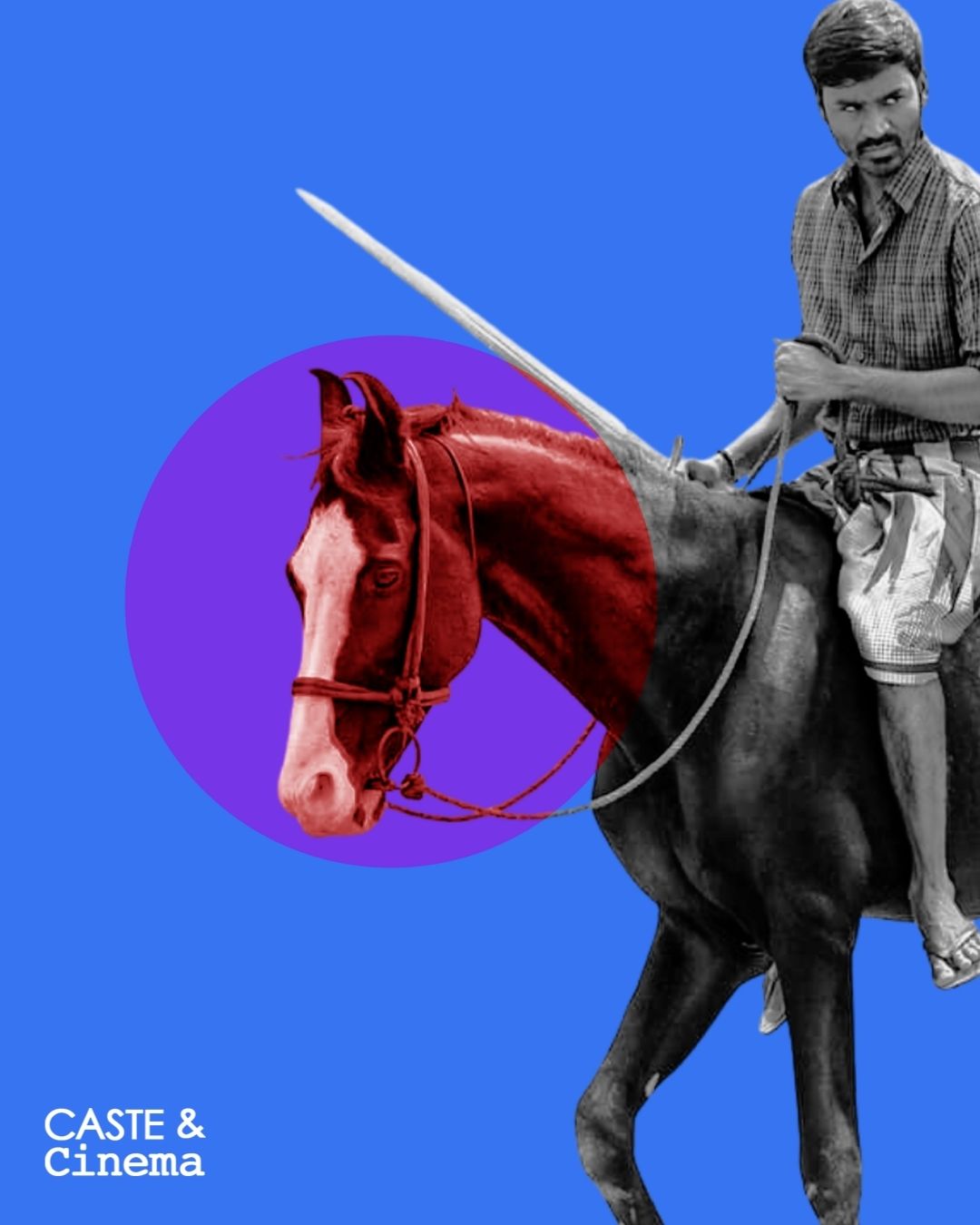
If you are a Hindu Brahmin, usually a straight male associated with the rescue and welfare of animals, you are seen as some kind of benevolent hero doing charitable work. There is no ostracization here, no violence meted out for being associated with animals. There is instead praise. There is especially State sanctioned power in dictating what animal welfare looks like alongside who and what doesn’t fall within these dictates. In all of Mari Selvaraj’s films, the relationship between human and animal is never that of saviour and saved. There equally isn’t an exclusion of who gets to look after an animal and who doesn’t. In his film Karnan, the horse is cared for by the lead characters Karnan, Draupathi and Thatha, and is a companion to a boy named Kittan in the village, who brings the horse home. Kittan walks the horse from place to place for the most part and there is the sense of the fraternal ‘side-by-side’ versus the binary of ‘above’ and ‘beneath’. In Karnan, the moment the horse is ridden is at a critical point in the film and it feels and unfolds like the horse is actively participating in this act of accepting a rider and charging into battle. This space for participation by animals in relationship to humans, further breaks the Brahmanical script set down for them.
In so many different ways, through all of his films, Mari Selvaraj has created a space for the cultural reclamation and expansion of the ‘animal lover’ identity and what it means to coexist, care for and love an animal through anti-caste practice and perspective.

I recently found a picture of myself as a child standing next to a black horse with a white blaze on his face, whose name I remembered was Alex. He was from the stables of T.Govindarajan, a stunt horse trainer for movies whom my father had met and took me to see his horses. When I rewatched Karnan, I stayed through the credits and felt very emotional to see ‘Horse Owners and Trainers’ with ‘T.Govindarajan, G.Tamilarasan, Elavarasan, Alex (Horse)’ being listed. Searching for T.Govindarajan online, I watched an interview where G.Tamilarasan, his son, speaks about how his family have been raising and training horses for three generations and how they’ve had four to five horses named Alex for sentiment reasons over the years.
While writing this essay and tracing my story, these lines penned by Mari Selvaraj in the opening credits of the song Cheenikkallu felt fitting,
“My father who never even knew how to swim,
Was the one who taught me to surf the waves.
My father, who never even looked up at the sky,
Was the one who taught me how to fly.
Gathering molten splashes of wild fire that day,
My father rolled it and gave it to me,
And that’s the cool sun, always with me”.
My father, who never even rode horses, opened an entire world of them to me.

References:

Pritika M

Pritika M. is an educator, writer and musician from Chennai. Her experiences in permaculture farming, natural horsemanship training, art based environmental education and anti-caste mental health practices has anchored her personal writing this past decade in questioning mainstream narratives and resourcing resistance to oppressive practices. She enjoys playing Tamil film songs on the piano and spotting birds whose names she is learning. Contributor Instagram handle: ink_penn

Enjoyed this article?

Share it with your friends and colleagues!