
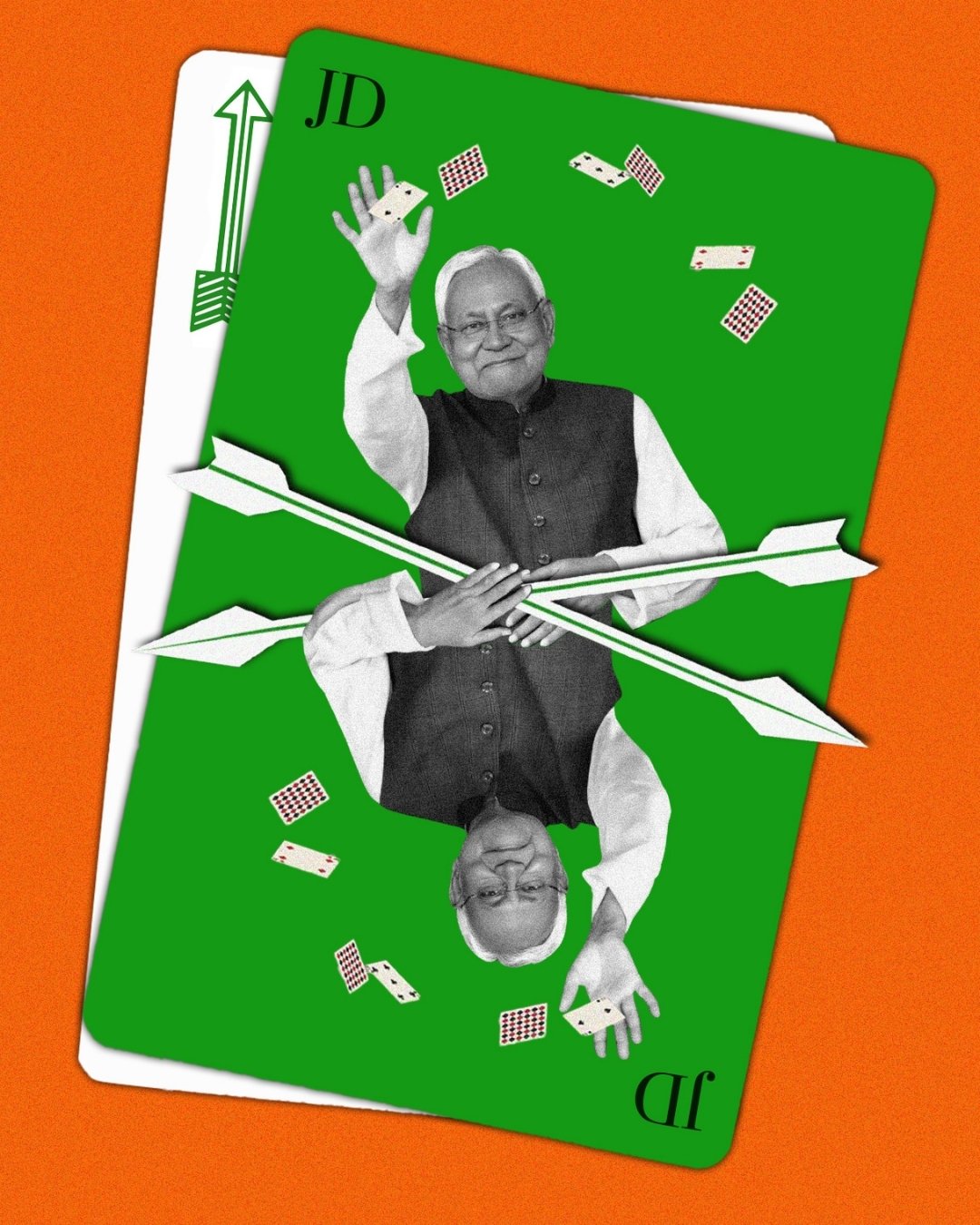
“For anybody who changes his principles depending on whom he is dealing with, that is not a man who can lead a nation”, said Mandela, but there is a man who “led” Bihar, changing his principles and contradicting his own ideas, resembling a weathercock, turning whichever way the political wind blew.
Born in Bakhtiarpur to Ram Lakhan Singh and Parmeshwari Devi in 1951, married to Manju Sinha, father of Nishant Kumar, and the current chief minister of Bihar, Nitish Kumar is a man who has led the state for more than two decades. From being elected to state assembly for the first time from Harnauth as Lok dal candidate in 1985, to becoming railway and transport Minister in Vajpai Government from becoming a chief minister for seven days on 3 March 2000 to then becoming chief minister in 2005 Nitish had a long and turbulent political journey as he never won Bihar singly in fact, never won without a significant bankable ally.
Alliances and alignments are surely among the most central phenomena in politics, be it local or international. With alliances, parallel travels the question “ who will support whom and who will resist whom to what extent and in what contingencies?" Alliances oscillate between power and interdependence. How "allies" and "adversaries" are defined changes over time. Allies are no longer united by a common ideology or a common threat, but are often defined situationally in terms of opportunity. Adversaries, as well, are less likely to be defined in terms of competing ideologies and more likely to be defined situationally. Situationality and opportunism have defined the politics of the longest-serving CM of Bihar as well. The story starts somewhere in the socialist history of Bihar.
Socialism, Bihar, and the compasses who lost North
The history of Bihar is marked with assertion by oppressed castes and socialist politics, an exception in the Hindi heartland, where the BJP still had a marginal presence, the source of strength for Janata Dal, contributing to 31 of 59 seats for the party in the 1991 general elections. It was the land of Karpuri Thakur who laid the stone of Mungerilal Commission and ensured social justice, land of JP movement, and the Land where Lalu Prasad as a CM in 1990 became shield of marginalized, the same land which was fertilised for the BJP’s expansion of its social and political base in Bihar by Nitish with an alliance between the Samta party and the BJP. Before ploughing the ground for the BJP, Nitish had already tied up with CPIML in 1995 and attempted to throw Lalu Prasad Yadav out, but he was tossed out by the Bihar electorate, which was humongously in favour of Lalu Prasad Yadav, and he got only 7 seats in the Bihar assembly. It was not until he tied up again, hands from far left to far right, and finally was able to expel Lalu Prasad Yadav from power and become chief minister in 2005.
Nitish did not just betray George Fernandes, the founder member of the Samta Party and his political master, but also left him behind as he climbed to the CM's chair. In the words of George Fernandes, he became the Judas of politics. In a letter to old socialist associate Kumar Aurangabadkar in 2009, George Fernandes hit out at Nitish Kumar, saying, “What you mention about Nitish is correct. I brought that fellow, but he went on to see that I am sidelined”. George Fernandes suffered humiliation when his rightful candidature for his beloved constituency of Muzaffarpur was rejected, a rejection that later led to his silence. For his political convenience Nitish had turned away from his Guru, and meanwhile, the alliance between JDU and BJP amounted to a betrayal of socialist roots.
Kicking the ladder: BJP
“I cannot work with this man” was Kumar's statement for months before and after the breakup from the NDA in 2014. This “Man” was none other than current Prime Minister Narendra Modi. He had issued a deadline to the BJP to name a secular, acceptable candidate for Prime Minister by December 2013. He was the one always stressing, “Everything cannot be measured in terms of electoral gain or loss; the battle against Modi goes beyond an electoral battle. It is a battle of ideas.” Over the Narendra Modi issue in 2014, the JDU split from the NDA when Gujarat chief minister Modi was named the BJP’s Prime Minister candidate for the 2014 Lok Sabha elections.
This was the same Nitish who, in 2003, while inaugurating a railway project in Kutch, stated: “I hope Narendra Modi won’t be confined to Gujarat for long and the nation will get his services.” In June 2013, a week after the BJP‘s national Executive meeting, when Modi was chosen to lead the BJP‘s campaign for the next general election, his “hopes” had come true.
In the continuum, he had several heart changes in the coming decade, depending on which way the wind of political power was blowing. He choreographed his frequent jumps between alliances very well. Each time, he managed to get himself sworn in as chief minister, wafting between sides till today. He even ditched his own choice, i.e., Jitan Ram Manjhi. Since JDU’s disastrous performance in 2014, he has fought four of the next five elections in alliance with the BJP under Modi and has remained the chief minister of Bihar throughout this period. He held on to power for two decades, avoiding being turfed out by the BJP.
An apostate of his own beliefs
In 2017, Lalu Prasad named Nitish “Paltu Ram”. Paltu, not just for his alliance partners but for his own values and principles, which he “once upon a time” professed. Before joining the Vajpayee government in 1998, he clearly said, “We set the condition that there would be no communal politics and controversial issues would be kept aside. There would be no talk of removing Article 370. There would be no talk of imposing a uniform civil code.” Still, when the Modi government abrogated Article 370 and split the state of Jammu and Kashmir into two union territories in 2019, he looked the other way. However, JDU had a strong bargaining position, holding 16 Lok Sabha seats and 71 seats in the state assembly.
A few months later, Nitish didn’t even talk about the issue; JDU voted for CAA, and Nitish even praised the Citizenship Amendment Act. This behaviour breached the conditions he himself laid down in 1998 before joining the Vajpayee government. The man who resigned as a railway minister in 1999, after two trains collided in West Bengal, did not repeat his one moral position in 2002, while Ram Vilas Paswan resigned over an anti-Muslim program in which thousands of people were killed. He didn’t even demand that Vajpayee remove Narendra Modi, as Ram Vilas Paswan did, although both were alliance partners.
Over the two decades, Nitish appears to have set aside secularism. His party leaders, like Lalan Singh, have been speaking publicly, “the truth is that no matter how much development is done for the minorities, they never vote in our favour”. His MP, Devesh Chandra Thakur, said “We won’t work for the Muslims as they don’t vote for us”. From hostility towards Modi to standing together in the 2024 campaign on a truck, where Nitish Kumar was holding the BJP symbol, the Lotus, in his hand, it appears that Nitish not only bamboozled his ideology and political alliance partners but himself as well.
Withering of Power and Boomerang Fate
Sign of cognitive decline in his late 70s have already appeared in public spaces from touching feet of Modi publicly, who is just six months older than him, thrice to shouting at women to stand for Prime Minister or pulling down Burkha of a Muslim doctor or using informal pronounce for first and only women chief minister of Bihar Rabri Devi or making derogatory remarks at Rekha Paswan MLA hailing from dalit community by saying “mahila ho; kuch aata hai, tumhe ham banaye”, he doesn’t appear to be in his senses. Waiving hands and clapping at the same time national anthem was being played, pulling the arm of a woman who was being felicitated to get her to pose for a photograph, putting a flower pot on a bureaucrat's head, it appears that due to deteriorating health, he is no longer fit to run Bihar, said Tejaswi Yadav. That could be one reason why his public appearances have been restricted to short addresses in controlled settings or party events.
Kabir wrote
“कबीरा आप ठगाइये, और न ठगिये कोय।
आप ठगे सुख उपजे, और ठगे दुःख ।"
Betrayal, once the long-controlled weapon of kumar became a boomerang. Dukh (Betrayal) is knocking on his door. Nitish's move to the Rajya Sabha signals that the BJP has become a bitter bedfellow, and mistrust has crept between the two parties. Vijay Kumar Chaudhary, Lalan Singh, and Sanjay Jha (Ex. BJP member and currently National Working President, JDU) always stand around him and, as JDU supporters criticize this trio for controlling him while slogannering “Amit Shah murdabad, Sanjay Jha Murdabad, Lalan Singh Murdabad”. According to Tejaswi Yadav's allegations, these three leaders have sold JDU to the BJP and destroyed Mr. Kumar.
Three years back, Nitish hugged Tejaswi Yadav for several minutes on his 33rd birthday, appealed to the crowd to cheer for him, and publicly said bye, putting his arm on Tejaswi's shoulder, “It is time to promote him”, and he began telling the Journalist that he would lead the Mahagathbandhan campaign in the 2025 assembly elections. He often used to tell him, “You are like my son”, but he betrayed his “son”. Nitish became the serial Judas by ditching Janata Dal in 1994, betraying NDA and BJP in 2014, stabbing Mahagathbandhan and Lalu Prasad in 2017. Counter-betrayed by the BJP in 2022 for his own survival, Nitish Kumar walked to Rabri Awas, where he apologized with folded hands for his past betrayals. Lalu Prasad forgave him for the sake of the fight against the BJP. But Nitish Kumar betrayed the Mahagathbandhan once again. Kumar’s ultimate betrayal was abandoning the INDIA alliance and crawling back to the NDA in 2024.
“Politicians who shape the imagination and reality of politics will always be remembered, and those who chose to flow with whichever current looked strongest, history will reduce them to a footnote.”
Nitish had built an image for himself, but it was not strong enough. He never had his boots strong in the ground. Allies were necessary for him, but betrayals became his mirror image. Who knows, Bibhishan has a replica in the world for politics! Politicians who shape the imagination and reality of politics will always be remembered, and those who chose to flow with whichever current looked strongest, history will reduce them to a footnote. It’s on the leaders to choose between being a shaper of history or shrinking into a footnote. Nitish chose one for himself, the latter!