
Tac Logo
“We are at the Parliament Street!”: From Liminality to Centrality via Insurgent Constitutionalism

“We are at the Parliament Street!”: From Liminality to Centrality via Insurgent Constitutionalism

By Shubham Yadav

Published on 04/14/2026

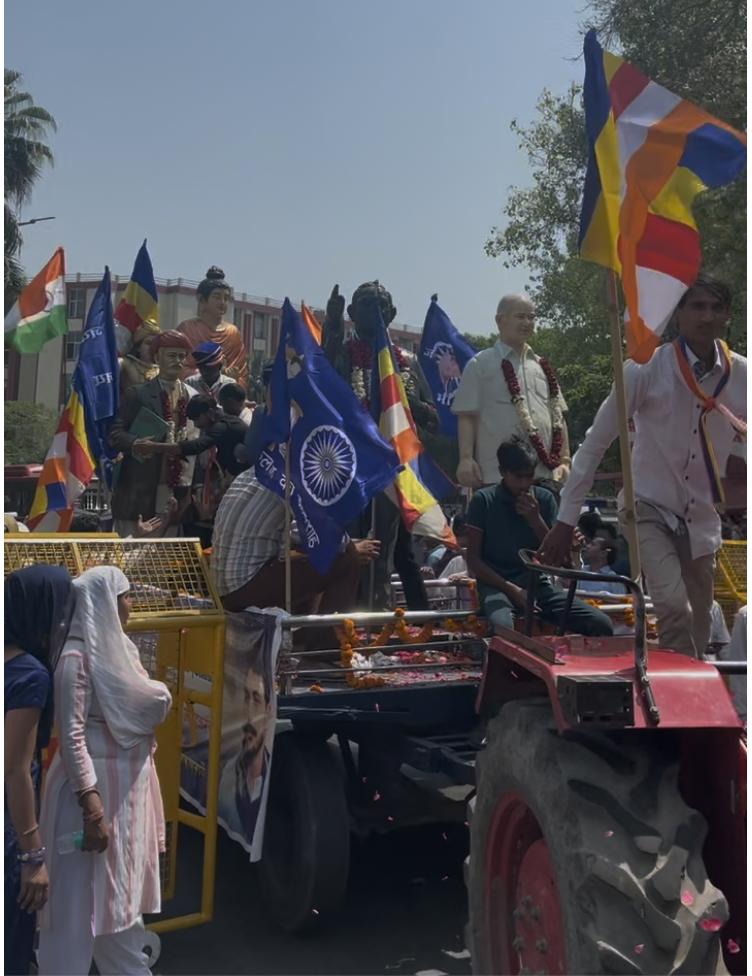
A tractor, with statues of Buddha, Ashoka, Mahatma Phule, Babasaheb Ambedkar, Manyavar Kanshiram, ‘insurging’ its way into Parliament Street
In Picture: A tractor, with statues of Buddha, Ashoka, Mahatma Phule, Babasaheb Ambedkar, Manyavar Kanshiram, ‘insurging’ its way into Parliament Street through Delhi Police barricades. Flags, as insignia of mutual existence, assertion and harmony in a post-colonial state, are carried by the Ambedkarites.
On the occasion of Dr Bhimrao Ramji Ambedkar’s birth anniversary, i.e., 14th April every year, a large number of processions, fairs, celebratory gatherings, and commemorations are organised country-wide. One such commemoration/fair is organised in the heart, both metonymically and metaphorically, of New Delhi at Parliament Street. For this particular day, the exclusionary and alien nature of Lutyens is transformed into a welcoming, warm, and inclusive one. The exclusionary and alienating nature is not just symptomatic of the spatiality referred to as Lutyens, but also of the social schema that upper-caste groups co-create and live with. Thus, Lutyens refers not only to the geographical but also to the social, creating a situation of liminality along two primary axes: geographical and social. Socially, the alienation and exclusion which crystallises in its most vulgar form into caste, co-constructs and infuses with the effects of the geographical to create liminal citizens. Referred to as ‘hashiya’ in Hindustani, this liminality is more complex than marginality. Secondly, geographically, the liminal are generally workers who sustain the city but are relegated to exclaves, urban villages, and ghettos. The social and geographical are not exclusive but work in affinity to exclude and regulate the urban.
However, if urban is the site of alienation, exclusion, and liminality, it is also the site of resistance, assertion, and insurgency. In the case of social, especially caste, the political consciousness and mobilisation become tools of confronting this liminality. This confrontation is well represented in the literature on Babasaheb as the Chairman of the Drafting Committee. However, the geographical imposes material (resource) and temporal (leisure time) constraints which are overcome in and through efforts such as the Parliament Street Ambedkar Jayanti commemoration. Therefore, this commemoration has been seen as a celebration of Babasaheb’s life and legacy in terms of its aesthetic and festive value. Over and above that, this essay advances an affective-yet-assertive perspective on the attempts of Dalits and, by extension, Bahujans and Adivasis, along with other marginalised groups, to occupy the spaces designed by and for elites.
This assertion, as the essay argues, is not merely moral, festive, or aesthetic, but also insurgent. Insurgent, or insurgency, as colloquially understood by State institutions and caste elites, travels with a negative connotation. This essay, based on the theoretical conception of ‘Insurgent Constitutionalism’ (Menon, 2024), first reclaims the term and then situates the commemoration and various other attempts as an act, routinised by yearly repetition, meant to trespass the liminality accorded to Dalits by Indian law, politics, and society (or sociability). The commemoration then does not remain ‘yet another procession in the city of protests’ but becomes a crucial site of transforming this liminal zone into a central position– geographical, social, and epistemic – through insurgent constitutionalism, culminating in a native example of insurgent citizenship. Furthermore, this essay uses the Parliament Street commemoration to re-theorise constitutionalism from the viewpoint of ‘constitutional public(s)’. This essay, therefore, abandons the traditional theoretical, normative, and hegemonic lenses through which constitution and constitutionalism have hitherto been understood by extending an inverted approach of conceptualising insurgent constitutionalism.
The various dimensions of the commemoration – copies of constitutions, food, anti-caste pamphlets, bhim geet, etc. – complement historic anti-caste efforts and coalesce into an anti-hegemonic social force that, even when co-opted by elites, extends the legitimacy of Ambedkarite thought and the Constitution, simultaneously.

Locating the euphoria as ‘excitation’

Some dates in the Gregorian calendar, such as 14th April, 6th December, and 25th December, among others, mark the crests of Ambedkarite mobilisation, struggles, and festivities. The Ambedkarite excitation on these dates renders expanded or hyper-visibility to the marginalised, mainly Dalits, in the discourse manipulated by upper-caste populated media outlets. Ambedkar Jayanti, then, becomes an occasion where these outlets recast Dalits in a refurbished image of Dalit existence. What Rahul Sonpimple sarcastically refers to as “gulping the coffee with guilt” by commemorating April as Dalit History Month, the hyper-visibility signifies the spectacle that glosses over the ability of the marginalised to be happy, celebratory and expressive. Since on other days, the mobilisation, of and by Dalits, is projected as either an aggrieved or a beneficiary kind.

Liminality and the convenient ‘Inclusion through Exclusion’

Since the marginalisation is real, both in terms of ideological oppression and material deprivation, when studied through the lens of liminality, this segregation works through suspending the bodies, and lives [of Dalits], into a space of nothingness (by denying dignity, rights and customs essential for a complete existence). At the same time, this segregation is fundamentally, and conveniently, coupled with hyper-inclusion in the established order for functional, occupational or sanitary reasons. This hyper-inclusion, or ‘inclusion in the order through exclusion’ (Agamben, 1998), has historically been crucial for the sustenance and continued operations of variegated sociabilities and the established order. The segregation and convenient inclusion are common knowledge. Nevertheless, for accounts on segregation and - functional inclusion, see Rao (2009); for occupational inclusion, see Risley (1915); for sanitary inclusion, see Shahani (2025); and for aesthetic inclusion, see Paik (2022).
While this liminality conscripts the lives of Dalits into an oppressive politico-juridical matrix characterised by over-representation in carcerality and under-representation in dignified spaces – accounts of resistance and assertion against this liminality are equally voluminous. The resistance and assertion are not only a response to the oppression and marginalisation that seeks to escape the matrix but also an insurgent effort that transforms the liminal/peripheral into the central. The case of Delhi’s Parliament Street Ambedkar Jayanti commemoration is one such insurgent effort which pushes and locates the liminal/peripheral into the centre of discourse and power. So, even though the institutions might continue to be constituted mainly by elite groups, the discourse and power relations are tampered in favour of the marginalised through commemoration.

Locating Parliament Street Ambedkar Jayanti Commemoration as ‘Constitutional’

The Parliament Street, which signifies the locus of institutional power, is decorated and populated by Ambedkarite symbols, food, public(s) and music. Covering the ocular, olfactory and aural triad. The pamphlets that visitors collect from the beginning of the street to its end inform them about the state of the world and methods of (de)construction of self, nature, nation and the universe. This pedagogical experience, however, is not just visceral or somatic in nature, but essentially ‘constitutional’, which acts as the transformative force accelerating towards centrality.
‘Constitution-al’, in theory and practice, is generally understood to stem from the provisions, values or the text of the Constitution; however, I methodically invert the definition and ascription of constitutionalism, from being too dependent on its root word ‘constitution’ towards an expansive understanding centred on the constitutional public(s) and their acts/routines. Therefore, ‘constitution-al’ does not merely remain restricted to a set of methods, practices and values as forwarded by the document but incorporates and is defined by the acts and routines performed by its constitutional public(s). The core question of constitutionalism then transforms from ‘What does the text say?’ to ‘Who constitutes these constitutional public(s)?’
I argue that non-state communities and identities accorded special recognition and protection by the text of the constitution through articles such as 15, 16, 17, 21-A, 23, 24, 25, 26, 28, 29, 341, 342 are those that can be categorised as ‘constitutional public(s)’. When seen this way, the constitution, while acknowledging the history of Indian law, politics and sociabilities, accords due care in constituting a republic by creating a set of constitutional public(s). These constitutional public(s) then act as the non-state guardians and heirs of constitutional thought, defining the ambit and nature of constitutionalism. This way, constitutionalism is not limited to the body of the constitution but is expanded to locate the acts and routines – of resistance, assertion and mobilisation – performed by the constitutional public(s) within its ambit. By this constitutional logic, the Parliament Street commemoration can be termed as constitutional, not because Dalits, Bahujans, Adivasis, along with other marginalised sections, pursue their demands through constitutional means or invoke constitutional ideals. Rather, their acts and routines, as constitutional public(s), take the constitution away from hegemonic and ‘authoritative interpretive communities’ into the lives of ‘non-authoritative interpretive communities’ (Baxi, 2009) situated on the streets, in slums, in university campuses and breathe life into the constitution.

(Re)defining Constitutionalism

Constitutionalism then becomes the force that animates and popularises the document intended to serve as the apparatus for fixing power relations among the constitution, the state, and the citizens. Therefore, rather than Menon’s (2024) constitutionalism as “a specific method adopted by modern democracies for safeguarding the autonomy of individual self” (p. 317), our strand of constitutionalism can be defined as the ‘breathing force that pumps life in the inanimate constitution and the language with which the constitutional public(s) converse with each other, hegemonic elites and the state’.
These constitutional publics, by resisting and asserting, and by making their presence duly felt by occupying Parliament Street, transmute liminality and peripherality into centrality. The atrocities continue; however, the collective celebration and a “direct performative challenge” (Menon, 2024, p. 325) in the central fortresses of power fractures the aggrieved-or-beneficiary mould in which the elite discourse tries to fit the marginalised.

Pedagogical as ‘Constitutional’

Along with acts and routines, the pedagogical enterprise unleashed through Ambedkarite literature and book stalls further weakens the Brahmanic project of epistemic marginalisation. This weakening does not take place through fancy or heavily marketed, so-called ‘best-selling’ literature but through works on social justice, affirmative action, oral histories, legends, utopias, collectivisation and also the Constitution.
Designed, illustrated, decorated, and vernacularised versions of the Constitution of India adorning the stalls
Designed, illustrated, decorated, and vernacularised versions of the Constitution of India adorn the stalls alongside other works, resonating with and substantiating the constitutional nature of the commemoration.
This placement, spatial and metaphorical, of the Constitution as a people’s document, combined with the excitation and collectivised efforts of the constitutional public(s) and occupation of Parliament Street, turns the ‘liberal project of constitutionalism’ upside down into a project of ‘insurgent constitutionalism’.

Decentring Constitution, Centring Public(s)

Therefore, while Menon’s conceptualisation of insurgent constitutionalism keeps the constitution at its centre, relegating the public(s) to subordinate innovators who use techniques to unleash the potential stored in the constitution. I argue that “constitutions” do “tend to be documents about open futures based on both democracy and social justice” (Menon, 2024, p. 319), but not because of some inherent potential of the constitution. Instead, it is the efforts of public(s)-as-insurgent, who collectivise, mobilise and raise the constitution to the level of transformative (Vilhena et al, 2013; Bhatia, 2021) or transformational (Dasgupta, 2024). There is thus a symbiotic relationship between these constitutional public(s) and the Constitution.
The constitutional public(s) lay a claim on and thus, take the constitution away from hegemonic elites to transmute their liminality into centrality (I), meanwhile, according - ‘legitimacy to the Constitution’ (II), and ‘a higher status of being a transformative Constitution’ (III). Therefore, what Menon calls “an expansion of the idea of citizenship” (p. 317) is instead mutation, rather ‘transmutation’ – from liminality to centrality, where the structure of liminality collapses into itself and re-fashions, or reconfigures, as a fluid that flows into the streets that lead to central junctions of power. This reconfiguration not only transforms the status of the subjects but also reconstitutes liminal into an insurgent citizenship (Holston, 2021). The occupants at Parliament Street might adhere to the order as prescribed and disciplined by the bureaucracy, but the assertion of rights, recognition and belonging by these public(s), is a model of insurgent citizenship. A citizenship that is not legally granted but performed and claimed through spatial occupation and an annual commemoration.
Thus, what might seem like a blue congregation organised for remembrance is but a dent in the hegemonic power structure, a direct performative challenge, a denial of inclusion at convenience and a transmutation of liminality to centrality via insurgent constitutionalism.

References:

  • Agamben, G. (1998). Homo Sacer: Sovereign Power and Bare Life. Stanford University Press.
  • Baxi, U. (2009). Outline of a “Theory of Practice” of Indian Constitutionalism. In Politics and Ethics of the Indian Constitution (pp. 92–118). Oxford University Press.
  • Bhatia, G. (2021). The Transformative Constitution: A Radical Biography in Nine Acts.
  • Dasgupta, S. (2024). Legalizing the Revolution. Cambridge University Press.
  • Holston, J. (2021). Insurgent Citizenship: Disjunctions of Democracy and Modernity in Brazil. Princeton University Press.
  • Jaaware, Aniket, 'Society, Sociality, Sociability', Practicing Caste: On Touching and Not Touching (New York, NY, 2018; online edn, Fordham Scholarship Online, 19 Sept. 2019), https://doi.org/10.5422/fordham/9780823282265.003.0008, accessed 12 Apr. 2026.
  • Menon, N. (2024). Secularism as Misdirection: Critical Thought from the Global South.
  • National Law School of India University. (2024, August 7). “The Indian Constitution is a remarkable achievement of anti-colonial thought.” - Prof. Sudipta Kaviraj, while delivering the M.K. Nambyar Annual Lecture 2023 - National Law School of India University. Retrieved March 26, 2026, from https://www.nls.ac.in/news-events/the-indian-constitution-is-a-remarkable-achievement-of-anti-colonial-thought-prof-sudipta-kaviraj-while-delivering-the-m-k-nambyar-annual-lecture-2023/
  • NLSIU Official. (2023, November 24). NLSIU’s M K Nambyar Annual Lecture 2023 | Prof. Sudipta Kaviraj [Video]. YouTube. https://www.youtube.com/watch?v=7iXEjnWdRgE
  • Paik, S. (2022). The Vulgarity of Caste: Dalits, Sexuality, and Humanity in Modern India. Stanford University Press.
  • Rao, A. (2009). The Caste Question: Dalits and the Politics of Modern India. Univ of California Press.
  • Risley, H. H. (1915). The People of India.
  • Shahani, U. (2025). Bonded citizenship: Caste, Partition, and the prevention of exit. Modern Asian Studies, 59(2), 427–454. https://doi.org/10.1017/s0026749x25000034
  • Vilhena, O., Baxi, U., & Viljoen, F. (2013). Transformative Constitutionalism: Comparing the Apex Courts of Brazil, India and South Africa.

Notes:

  1. Shubham Yadav is a Doctoral Candidate at Jawaharlal Nehru University.
  2. metonymically because of its geographical location, and metaphorically because of the Parliament, which is located at the centre of a sovereign constitutional power apparatus.
  3. While marginality works on the principle of a continual centrifugal force that keeps people at the margins; liminality works on a combination of opposing forces, an inclusion at convenience and exclusion as the norm.
  4. Jaaware signifies the “unexamined assumption called society” as sociability, which depicts the capability of strangers to respond to others in unfamiliar or new settings. In Jaaware’s words, sociability is a matter of how one relates to “others” – those persons and things that one does not know at all (2019, p. 170).
  5. In a lecture delivered at UnLecture Delhi on “The Cognitive Structures of Caste-based Contempt” (5 April 2026).
  6. I use the difference between junction and terminal (in railway parlance) to understand and explain what happens when marginalised occupy such sites of power. The terminal is the end, the junction is multi-directional. Ambedkar Jayanti makes Lutyens a junction which is otherwise a constitutional terminal. The commuters who have to pass the Parliament Street on a day to day basis, know how the road is barricaded as fancied by the bureaucracy. Even on days with no barricades, the surveillant apparatus of state restricts a free movement on the street which leads to the Parliament via Niti Aayog. However, on Ambedkar Jayanti the road is not just occupied spatially but affectively, the “mind is without fear and the head is held high”. The metaphors ‘bottom-up’ or ‘top-down’ not only display the two-dimensional structure of power that upper caste/class theorists envision but also the inability to comprehend a system that creates space for more participation rather than narrowing on the top (around 545 Parliamentarians for 140 crore people). Thus, the insurgent fervour of constitutionalism trespasses and transforms this two-dimensionality into a fluid which does not restrict participation but flourishes better with more people. This metaphor of power, junction, not only postulates a new power theorem but also makes more space in centres of power for participation of hitherto outcastes.

Shubham Yadav

Shubham Yadav is a Senior Research Fellow at Jawaharlal Nehru University.

Enjoyed this article?

Share it with your friends and colleagues!