
Tac Logo
Jayanti, Leisure and the Antilibrary

Jayanti, Leisure and the Antilibrary

By Apurv Tagade

Published on 04/14/2026

I find books to be the most interesting feature of Babasaheb’s iconography. Everyone is familiar with his statues carrying a book, the Constitution of India, in his hands of which he was the chief architect. A more recent development would be the fusion of the book into the architecture of buildings associated with him. The Dr Ambedkar National Memorial inaugurated in New Delhi in 2018 is a massive structure designed to look like an open book, to highlight his role in drafting the Constitution. The Dr Babasaheb Ambedkar Memorial Bhavan in Navi Mumbai, inaugurated in 2021, features a large doorway in the shape of an open book as entrance into a building in the complex. The Open Book doorway is surrounded by a facade of large, vertically arranged book spines of nondescript books, making entering the building feel like entering a giant bookshelf. Not only does the book feature on Babasaheb’s person in his statues in the form of the Constitution, it also becomes an architectural encasement for the museum exhibitions of his life at the memorials.
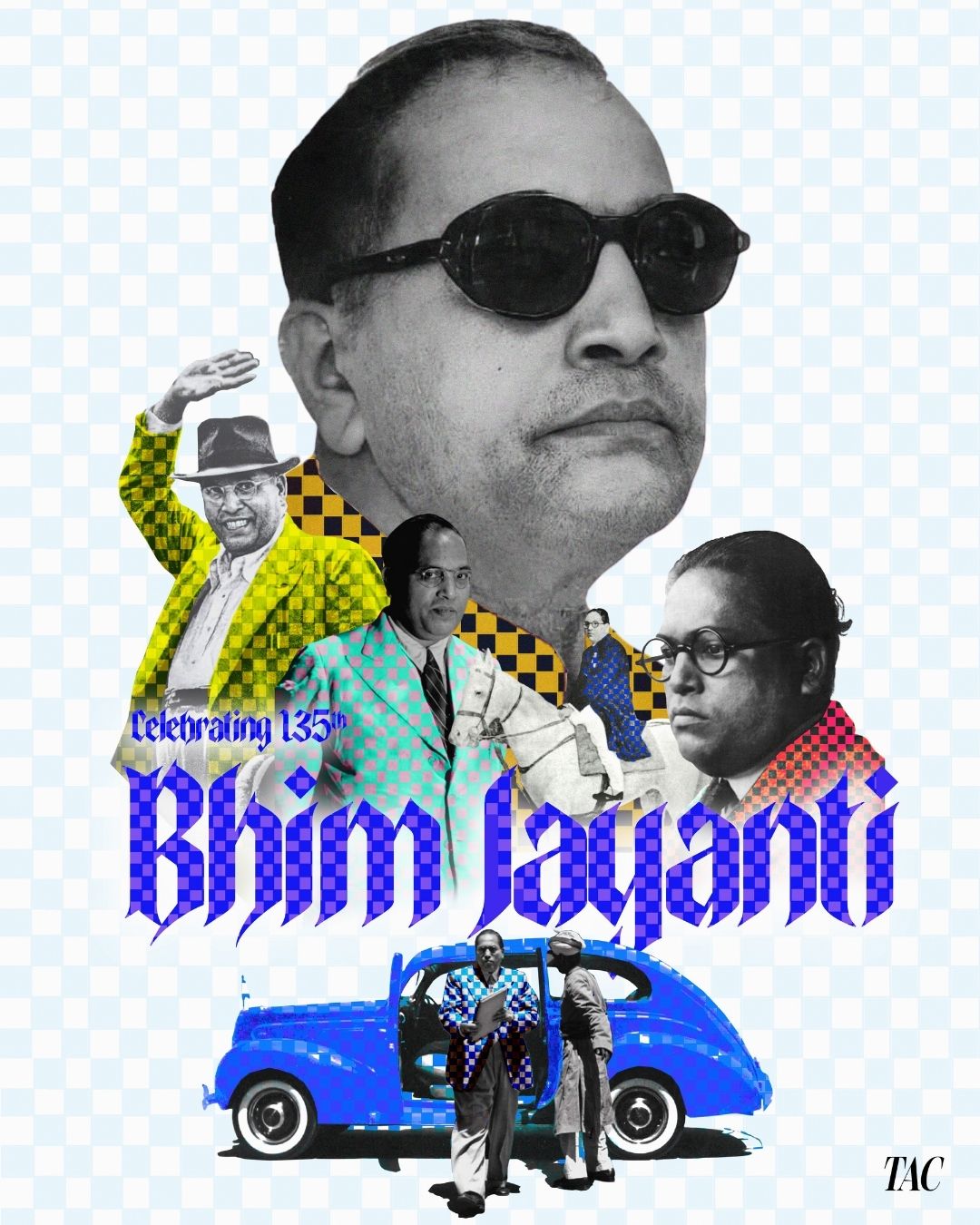
The deep association of Babasaheb with books is not limited to his engagement with the Constitution. It also extends to his corpus of writings and speeches, and highlights, in general, his deep love of books. He had a library of 50,000 books at his Dadar residence, Rajgriha. I first came across this information as an 8 or 9 year old boy browsing through the Amar Chitra Katha comic on his life in one of the many pop-up bookstalls which sprout up to commemorate the special events of Babasaheb’s life. Be it Jayanti on 14th April celebrating his birth anniversary, his embrace of Buddhism on Vijayadashami in October or observing his death anniversary on December 6, public spaces where Ambedkarites congregate to mark these events feature many bookstalls setup by various publishers and bookstores from across the country.
Some newspaper articles over the years illuminate the central position of the bookstalls in Ambedkarite celebrations, offering a glimpse into their scale and ethos. An article titled “Ambedkar Books are hot at Dhammachakra fest” published in The Times of India in 2015 quotes Arun Joseph, registrar of Ambedkar College in Nagpur talking about the 85 bookstalls setup there, “These are stalls within the Deekshabhoomi premises. How many more would be put up on the pavements would be anybody’s guess. Last year sales from books alone was over Rs 2 crore.” Sultan Singh Gautam, a stall owner from Delhi states, “It would be correct to say this event has also become the biggest fair of Buddha and Ambedkar literature. The most unique feature of this event is that even an illiterate woman goads her child to buy a book. There is always some hope in her heart that her child may follow in the footstep of the great leader.”
Another 2018 The Times of India article notes an increase in the number of stalls from 85 to 325 at the Deekshabhoomi grounds. It also quotes Vilas Gajghate talking about the increasing value of book sales, “Last year just the book sales were around Rs 5 crore.” Another article written by Tejas Harad in 2023 titled “How Babasaheb Ambedkar’s Followers Are Keeping His Love for Books Alive”, claims the monetary value of books sold at Deekshabhoomi to be around 6.5 crore rupees, with the number “expected to go up to 10 crore at Chaityabhoomi.” But the focus is not profit. Gautam Sangle, a book seller emphasises, “When someone comes to my stall to buy a book but doesn’t have enough money, I readily forgo my margin and sell it to them at buying cost because I want them to have the book.” Thus, the spirit of the bookstall enterprise is not purely economic. It does not represent the marketplace in the conventional sense. The value of the book lies less in its price and more on its potential to transform the reader’s life here.
The evolution of the celebratory culture of Jayanti then, can best be appreciated through the Ambedkarite book stall. The roots of it can be found in Babasaheb’s writings. In his book What Congress and Gandhi Have Done to the Untouchables, Babasaheb highlights the importance of leisure in the development of culture to lead a dignified life. He writes, “Both for society and as well as for the individual there is always a gulf between merely living and living worthily. In order that one may live worthily one must first live. The time and energy spent upon mere life, upon gaining of subsistence detracts from that available for activities of a distinctively human nature and which go to make up a life of culture. How then can a life of culture be made possible ? It is not possible unless there is sufficient leisure. For it is only when there is leisure that a person is free to devote himself to a life of culture.” (Page 284, BAWS Vol. 9)
Furthermore, in A Social Centre for the Untouchables in Bombay, an appeal for funds, Babasaheb writes, “Library and Reading Room – It is necessary to provide the Untouchables with facilities for the cultivation of their minds with a view to creating among them a sense of appreciation of ideas, art and broad human interests. It is also necessary to provide them with means of engaging their attention during leisure hours to something higher and nobler than is to be found in their drab, dreary life. For this nothing can be more efficacious to serve this objective than the institution of libraries in Untouchable quarters. This will be one of most important activities of the Centre.” (Page 449, BAWS Vol. 17 Part II)
Jayanti actualises this vision in a uniquely collective form. It becomes a day where celebrations can be expressed as leisure conditioned towards a specific corpus of Ambedkarite books at these bookstalls. Together these bookstalls, comprising rows of texts, Babasaheb’s writings, biographies, political tracts, Buddhist literature, poetry, picture books, comic books etc, setup at different locations throughout the country on the same day, create a dense and dynamic intellectual landscape. Superimposed upon each other, the bookstalls evoke one large metaphysical library, or rather an antilibrary.
The antilibrary is a term used by Umberto Eco to signify the value of unread books as intellectual potential. It is finding value in the knowledge that there are always unread books that will expand upon your understanding of a subject. The Ambedkarite bookstall is a place where new textual sources connected to anti-caste struggle enter consciousness. It is not limited to the books available for sale. Sometimes you stumble upon new sources randomly. I recall overhearing a conversation in Marathi at a bookstall at Chaityabhoomi a year ago which demonstrates this:

Person #1 (browsing through a copy of Namdeo Dhasal’s poetry collection “Golpitha”): Hmm…

Person #2 (noticing his interest in the book) : You like Dhasal?

Person #1: Yes. I’ve read a few of his poems.

Person #2: Then you should check out the works of his wife. She is better than him!

Person #1: Oh. (Asking the stall owner) Do you have any books by Dhasal’s wife?

Stall Owner: No. But you can check at… (pointing to another stall) or you can go to….
(mentions a book shop)

As an admirer of Dhasal’s poetry, I paid close attention to their conversation and was rewarded with a new poet. I looked up some of Malika Amar Sheikh’s poetry (“Venus”, “A Poem for a Dali Painting” etc) online on my way back home. It made me appreciate an intersectional dimension present in contemporary Ambedkarite culture.
The community curation of books makes the antilibrary possible. Everyone at the bookstall, from the owner to the patron, is an anti-librarian, carrying and developing their own corpus of books and is willing to swap it amongst themselves. The books one buys, browses or even merely encounters here become part of an expanding horizon of possibility. They become tools for locating and developing one’s personhood rather than mere trophies to post on social media to prove one’s social justice credentials.
This vibrant bookstall culture exists alongside a broader global conversation about performative readership. Books are increasingly appearing as aesthetic accessories in high fashion and celebrity PR management. For example, the designer fashion brand Coach, in light of the viral Labubu bag charm trend, has released a collection of book bag charms. These are miniature leather-bound copies of books like Maya Angelou’s I Know Why the Caged Bird Sings and Celeste Ng’s Little Fires Everywhere amongst other classics. It raises an important question. When does the book shift from being a tool of engagement to a totemic object? The sheer visibility of books during Jayanti may invite similar critiques.
But, to me, the Ambedkarite book culture offers a grounded counterpoint. The annual rite of grandparents buying books for their grandchildren, the aspiration to gradually accumulate a personal library like Babasaheb or even the memory of your first encounter with Ambedkarite literature, anchors Ambedkarite books within a lived, intergenerational experience. The emphasis is less on individual display and more on a collective continuity; a persistent circulation of books to move the culture forward. Jayanti, in this light, can be seen as a carnival of books. Once denied access to the word because of caste, the Ambedkarite book stall is a testament of the long journey we have made. It carries forward a historical struggle for social justice and simultaneously creates a festive, immersive space for intellectual engagement in the form of the humble pop-up bookstall.

Works Consulted

  • Ambedkar, B.R. (1945). What Congress and Gandhi Have Done to the Untouchables. In Dr. Babasaheb Ambedkar Writing Speeches Vol. 9. Dr. Ambedkar Foundation.
  • Ambedkar, B.R. (1949). A Social Centre for the Untouchable in Bombay. In Dr. Babasaheb Ambedkar Writing Speeches Vol. 17 Part 2. Dr. Ambedkar Foundation.
  • Taleb, N.N. (2007). The Black Swan: The Impact of the Highly Improbable. Random House.
  • Mathur, B. (2015, October 20). Ambedkar books are hot at Dhammachakra fest. The Times of India. Link
  • Mathur, B. (2018, October 17). City a melange of festivities & gatherings on Vijayadashami. The Times of India. Link
  • Harad, T. (2023, April 14). How Babasaheb Ambedkar’s followers are keeping his love for books alive. TheQuint. Link
  • Hennes, M. (2026, February 20). Coach’s Book Bag Charms Are the Latest Chapter in a Fashion-Wide Literary Takeover. Marie Claire. Link

Apurv Tagade

Apurv Tagade is an Ambedkarite from Nagpur.

Enjoyed this article?

Share it with your friends and colleagues!