
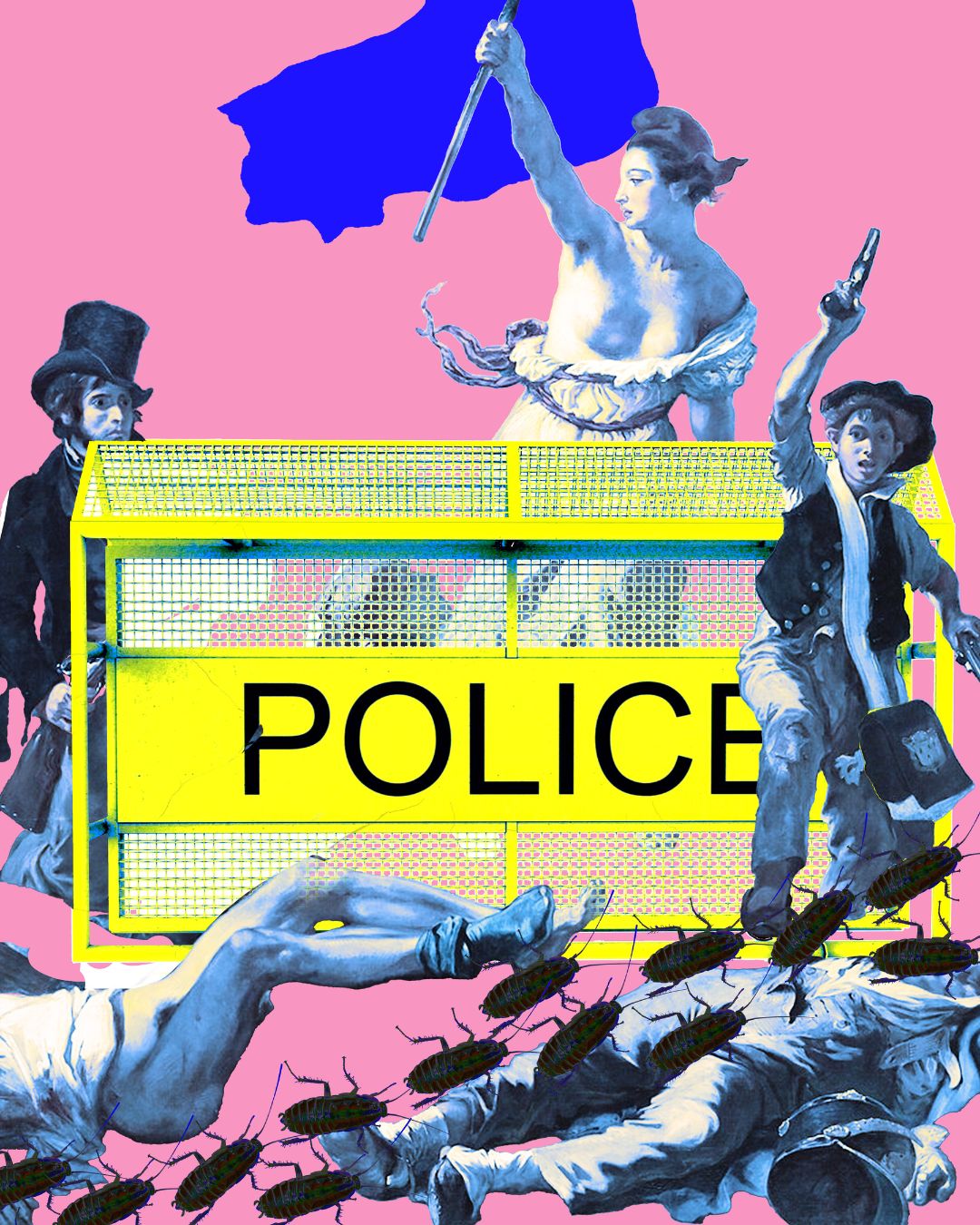
Multiple events from the Chief Justice of India Surya Kant’s mockery of ‘lazy’ unemployed Indian youth to a satirical Cockroach Janata Party (CJP) stunt as an outcome of the NEET exam paper leak united and brought students and youth across classes, castes, and genders onto a common ground. This chapter of Indian youth, protesting and fighting, will be remembered, though not always for the reasons they intend.
Yet his words raise a harder question now: what happens when those revolting are temporarily forced to assume a homogeneous identity just for the sake of a revolt, even though, in reality, they remain intrinsically divided?
Will such a revolt ever bear fruit? It might, in certain cases, but in the long run it would ultimately fail to yield a judicious solution.
The identity ‘Indian student or Indian youth-protester’, in an Indian society, is anything but a homogeneous or egalitarian group. This identity functions as an empty signifier of unification that temporarily sutures differences, with internal differences suppressed rather than resolved.
The protest against the leak of the NEET exam and the demand for the resignation of the Union education minister Dharmendra Pradhan shows Indian youth united against NEET paper leak, but beneath that unity lies a harsh reality: most protesters, once the immediate demands are negotiated or exhausted, will not see each other as equals, their permanent social (caste) identities will invariably outweigh their ‘temporarily-held’ student/protester identity.
The ongoing protest might have created a scenario in which the educational system, despite being in a corrupt state, has caused collateral damage that, surprisingly, served as an ultimate equaliser for the otherwise divided students on the issues of caste, reservation and merit. To avoid the appearances of such divisions and ensure collectivism, the protesters have intelligently designed the rhetorical demands of this movement by limiting the ‘content’ of their protest.
But the same education system, against which the Indian youth (the protester) is fighting, is built on the foundation of exclusionary practices, erasure of histories and marginalisation as well as dehumanisation of identities.
For the current, so-called GenZ generation, these ‘contents’ might appear as the things of the past and ‘too old-fashioned’ to fight for. But the present modern education system, which includes international boards, techno-savvy classrooms, refurbished syllabi, rewritten histories, the dominant language of instruction and the restructured patterns of examinations, has become the most active breeding ground for the growth of caste-infused concepts such as merit, grades, scores, all-India ranking and intelligence alongside the concepts of reservation and quota. Thus, the modern Indian education system has succeeded in reinventing polite, seemingly secular substitutes for caste-coded exclusionary practices that could never become the ‘content’ or ‘argument’ of such nationwide protests. So, the question still remains: how does a protester who is, externally, neutral but, internally, a strong believer and active proponent of an ideology that stands for ‘birth-based intelligence’ protest for democratic reforms in the education system?
What if the NEET exam paper had never leaked?
The leak of the national-level medical entrance exam has stirred the whole nation, but what if it was never leaked, or the news of its leak never reached the common public?
NEET would have been the same exam that would have produced future medical students and practitioners from Indian society. A typical NEET coaching classroom would still have seen conversations among aspirants that often revolved around rank, score, and caste category. Questions such as: ‘What is your score?’ ‘Are you a general or a quota student?’ would still be asked. Some NEET-cleared upper-caste medical college students would still be worried and ask, “If these lower-caste people come to medical college, who would clean our toilets?”
The protest is heavily supported and participated in by the students' parents, but a section of those same parents would insist on changing their son's or daughter's hostel room if they learn that their roommate belongs to the Scheduled Castes category. They are often the same people who never stood against the educational system's failure to provide inexpensive, affordable, non-exclusionary schooling through government institutions. Rarely have students or their parents taken to the streets or fasted unto death against the ever-growing privatisation and commercialisation of their fundamental right. Seldom have they objected to the seamless transition of schools and colleges into collaborators and mechanisms for ‘student-supply’ to the profit-driven NEET/JEE coaching industries. For, exclusion is a characteristic feature of Indian society, and education has always been one of the most crucial machinery through which it operated. The expensive education and exclusionary syllabi have long worked in tandem with and not in opposition to the caste structure of Indian society; the same systems that are protested against for their corruptive practices are accepted at the level of merit ideology and hierarchy.
Despite many discrepancies, the most important takeaway from the current protest is that the students became aware of the significance of the slogan Educate, Agitate, Organise and, hopefully, understood that certain rights require a long fight against the system and structure.
Protests are an inevitable and imperative part of sustaining a healthy democracy, provided the content of protests is democratic and non-exclusionary. Protests indeed help generate a shared narrative and emotional solidarity, but why do only certain protests attract national and global attention? Is it necessary that a protest must be called out on an issue of national interest to garner such national attention?
If that is so, it is worth noting that over the last decade, India has seen repeated test cancellations, exam paper leaks, re-examinations, and irregularities in various other national-level exams such as UGC-NET, Staff Selection Commission (SSC), and Railways. Yet the loudest protests emerge only when the futures of relatively privileged aspirants are at stake. The 2026 UGC regulation on the promotion of equity in higher education institutions led to nationwide demonstrations by people from privileged castes. The year 2006 Anti-reservation agitation or the year 2013 Compulsory Rural posting policy for MBBS doctors led to intense nationwide protests. In India, the protesters' issue must be of interest to the dominant castes if it is to garner national attention and global support. But the problem with such protests is that they claimed to be unbiased, non-divisive, and opposed to administrative injustice, even though the reality has always been different.
In the nationwide farmers’ movement – which claims to stand for every Indian farmer – the voice of Dalit farmers is lost; the national-level protesters in the case of Nirbhaya would fail to lend their support to the case of caste-based sexual atrocity on Priyanka Bhotmange. The Youth for Equality’s nationwide protesters that opposed the implementation of the 27% quota for OBCs in central educational bodies, claiming that reservations deepen societal divides, had never lent their nationwide support to bridge the caste divide on university campuses or support Rohith Act Campaign to prevent caste discrimination against SC/ST students or their caste-based institutional murders in universities and colleges.
A genuinely democratic student’s protest cannot stop at condemning administrative corruption; it must also confront the deeper social order that makes the language of ‘merit’ appear neutral while it continues to privilege some sections and silence/erase others. In the education system, the language of rank, score, intelligence, and opportunity is never free from caste, because even access to schools, coaching, institutions, and universities is influenced by the caste structure.
The question is no longer whether Indian students can protest together. It is whether they can protest as equals against the leak, against the coaching economy, and also against the caste logic that still decides who is presumed intelligent, who is presumed meritless, and whose future is treated as a national asset. Anything less is not a democratic student movement but just a brief holding pattern.