
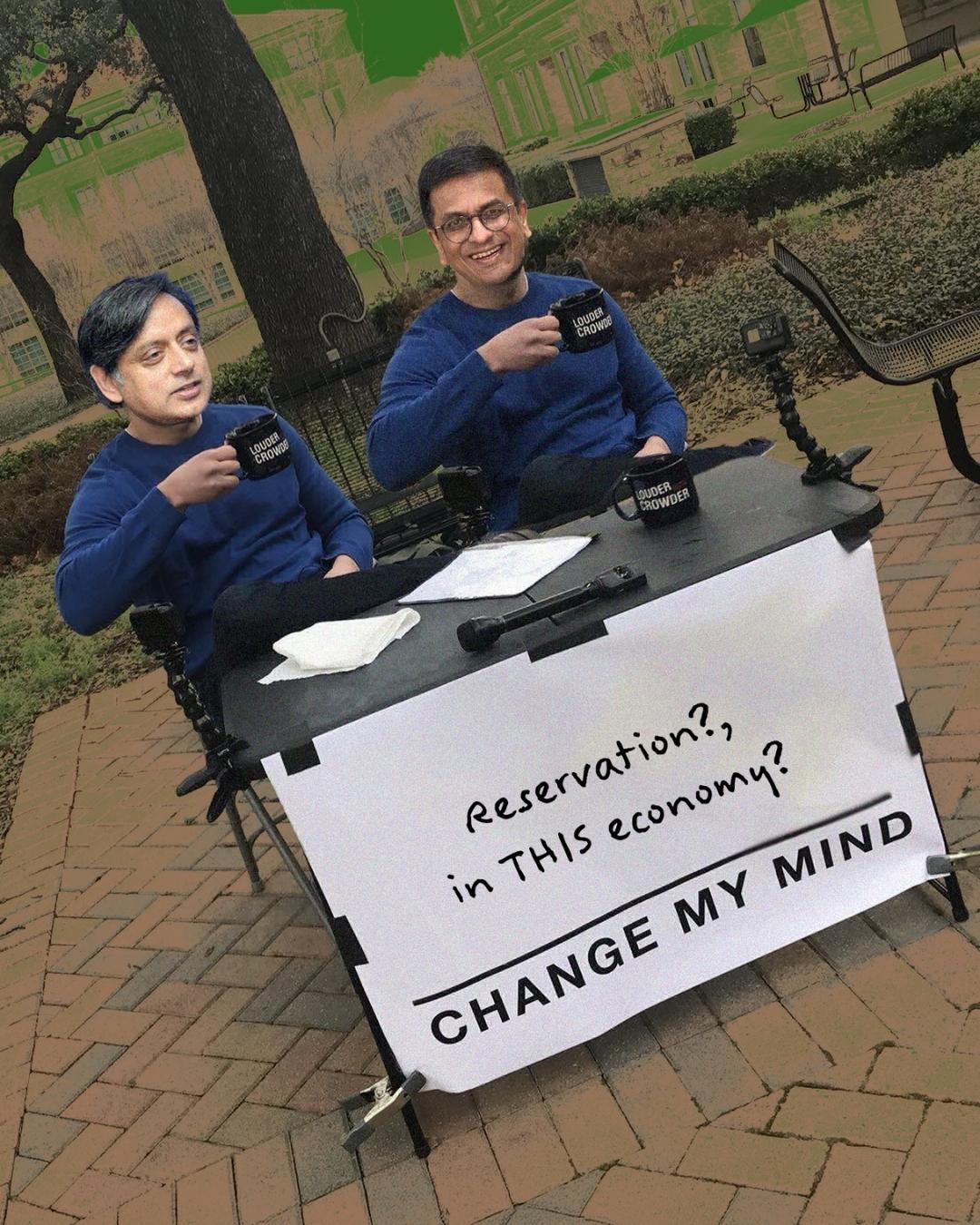
There is something profoundly obscene about watching two of India’s most privileged public intellectuals, a former diplomat educated at St. Stephen’s and Tufts, and a former Chief Justice of India who is the son of a former Chief Justice of India, sit on a stage and deliberate, with performative gravitas, whether reservations are still necessary. This panel discussion, which circulates now yet another viral clip in the endless content economy of “balanced debate,” is not a contribution to public discourse. It is a symptom of the disease. The very existence of such a debate, its framing, its participants, its audience’s nodding heads, is an exercise in epistemic violence dressed in the garb of liberal civility, and it should not be treated as anything else. The question of whether India “needs” reservations is not an open question, and has not been for decades. The evidence is overwhelming, the constitutional mandate is clear, and the sociological reality is unambiguous. Every single year, data from the National Crime Records Bureau documents thousands of registered atrocities against Scheduled Castes and Scheduled Tribes under the Prevention of Atrocities Act. Every single year, Dalit students take their own lives in institutions of so-called excellence, the IITs, the AIIMS, the central universities, not because they lack “merit” but because those institutions remain, in their social architecture, hostile territories. Justice Chandrachud himself acknowledges this in the panel. He says, plainly, that “the time when you can say that discrimination against a scheduled caste has ended has still not arrived in India.” And yet the discussion continues as though the matter is up for adjudication. If the former Chief Justice of India can state this on record, why are we still holding this trial?
Before we go any further, we must understand that reservations are not reparations for the past, but rather are a mechanism to address, to an extent, what happens in the ‘now.’ This is perhaps the most pernicious misconception that haunts every iteration of this debate, and one that neither Tharoor nor Chandrachud adequately dismantles: the notion that reservations are a form of historical compensation, a debt being paid for wrongs committed in some distant, pre-modern past. This framing, “your ancestors were oppressed, so you get a seat,” is a deliberate distortion. It allows the possibly Savarna interlocutor to position themselves as magnanimous, tolerating an inconvenience imposed by history, while implicitly suggesting that the inconvenience has an expiry date. After all, how long must we pay for what happened centuries ago? But reservations are not about the past. They are about right now. They are about the Dalit student in 2025 who is made to sit separately in a classroom in rural Rajasthan. They are about the Scheduled Tribe family in 2024 whose land was seized with impunity in Jharkhand. They are about the sanitation worker, overwhelmingly Dalit, who died cleaning a sewer in 2026 in a country that has supposedly outlawed manual scavenging, but is celebrating missions to the moon. They are about the matrimonial advertisements that still, in this very year, specify caste as a prerequisite for human intimacy. They are about the Dalit groom who cannot ride a horse at his own wedding without risking a lynching. Caste has unfortunately been akin to a Hydra, the Greek monster that would grow two heads when one would be cut down. breathing. And, thus, affirmative action exists not to remedy a past injustice but to counteract an ongoing one, a machine of exclusion that runs every single day, in every village, every institution, every hiring committee, every courtroom, every newsroom, every dinner table in this country. The temporal distortion, casting reservations as backwards-looking, serves a specific ideological function. It allows privileged India to treat caste as a relic, an embarrassment from a less enlightened era, rather than what it is: the organising principle of Indian social, economic, and political life. Marx, as well as many who identified themselves with Marxism, understood that the ruling ideas of any epoch are the ideas of the ruling class. In India, the ruling caste has successfully propagated the idea that caste is dying, that modernity and urbanisation and liberalisation have eroded its grip, that the real axis of disadvantage is now class alone, such as the renowed Sociologist Andre Beteille in his book ‘the Other Backward Classes,’ where he suggested that caste may no longer determine one’s life chances, but economic status, even with overwhelming evidence suggesting otherwise. It is a lie contradicted by every dataset on landholding, every study on hiring discrimination, every audit of surnames on rental applications in metropolitan cities, and every suicide note left by a Bahujan student in an elite institution.
The most glaring contradiction in Dr Tharoor's intellectual project, one that I have waited years for someone on a public stage to name, and one that this discussion, predictably, leaves unexposed. Shashi Tharoor has built an entire second career, books, Oxford Union speeches with millions of views, lecture circuits across the globe, on the argument that Britain owes India reparations for two hundred years of colonial exploitation, and rightfully so. His book An Era of Darkness meticulously documents the economic drain, the famines engineered by imperial policy, the deindustrialisation of the Indian economy, and the deliberate destruction of indigenous knowledge systems. He argues, passionately and correctly, that a mere apology is insufficient, that the structural consequences of colonialism persist and demand material redress. I agree with every word of that argument. But I want to ask Dr Tharoor a question he has never been asked, or at least has never answered: If two hundred years of British colonial rule demand reparations, what do two thousand years of Brahminical caste oppression demand? If the economic drain theory applies to the East India Company's extraction of Indian wealth, does it not apply, with considerably more force and duration, to the extraction of Bahujan labour, land, dignity, and life by the caste system? The Dalits, who were denied property rights for millennia. The Shudras, whose surplus labour built the temples and palaces that are now the heritage sites of a civilisation that refused to count them as fully human. Where is Tharoor's Oxford Union speech on that? Where is his bestselling book on the economic drain imposed by caste? Where is his demand for reparations, not from a distant colonial power, but from the social order that he himself, as a Nair, benefits from? The silence is deafening, and it is not accidental. It is structurally produced. Colonial reparations are safe politics for the Indian elite; they direct moral outrage outward, at a foreign oppressor, and unite all of India as the victim. What then, about the elite Indians who collaborated with the colonial powers for status, bestowed upon them monetarily or by giving Zamindars titles of ‘Raja’? Caste reparations would direct that outrage inward, at the Indian elite itself, and fracture the comfortable nationalist consensus that allows a Tharoor to be both a progressive icon and a beneficiary of caste privilege simultaneously. Furthermore, Tharoor speaks of reservations being untouchable in Indian politics while representing Thiruvananthapuram by giving the example of the New York subway rail—a beautiful metaphor. But how many cases of caste discrimination in Thiruvananthapuram has Tharoor personally championed in Parliament? How many times has he raised the issue of caste atrocities in Kerala, a state where caste operates with vicious subtlety beneath the veneer of Communist egalitarianism, where Dalit colonies still exist, where land reform bypassed the most marginalised, where the practice of untouchability persists in temples and teashops in ways that polite Malayali society refuses to acknowledge? If reservations are the third rail, caste violence is apparently not even on the tracks. It is easy to declare reservations untouchable as a rhetorical flourish. It is harder to make caste atrocities untouchable, to make them so politically charged that no elected representative could afford to ignore them.
“If two hundred years of British colonial rule demand reparations, what do two thousand years of Brahminical caste oppression demand?”
The answer, of course, is that the “reservation debate” is not really about reservations. It is about something far more insidious: the reproduction of savarna comfort. These discussions exist so that a particular class of Indians, English-speaking, institutionally embedded, generationally privileged, can feel that they have “engaged” with the question, that they have been “fair-minded,” that they have “heard both sides.” The moderator’s framing is revealing. She opens by noting that she is from Government Law College, Mumbai, where “more than 50% of seats are reserved,” and that “there is a growing concern that merit is often being compromised in the name of reservation.” Note the passive construction: merit is “being compromised.” By whom? By what? The sentence is structured to avoid naming the agent, which is, of course, Bahujan students daring to occupy seats that the general category has been socialised to believe belong to them by natural right. This is the crux of the fraud. When forward-caste students and their parents express anguish at not securing admission, they never, not once, direct their anger at the state for failing to increase the number of seats. I wrote about this in Economic and Political Weekly while I was still an undergraduate, and I want to linger on this point because it exposes the hollowness of the “merit” argument more completely than any theoretical framework could. The ratio of applicants to available seats in Indian higher education is catastrophically skewed. For the NEET examination, lakhs upon lakhs of students compete for several seats that have not expanded in proportion to demand for decades. The bottleneck is not reservations. The bottleneck is chronic underinvestment in public education, the deliberate strangulation of public university funding, and the state's preference for privatisation, which, it should be noted, disproportionately benefits those with existing economic and cultural capital. If you are truly “meritorious,” if your analytical faculties are as sharp as your examination scores suggest, why can you not see this? Why do the so-called meritorious students pride themselves on getting into an institution with limited seats rather than questioning why the seats are limited in the first place? The fact that a non-savarna first-generation learner as me could write this as an undergraduate, and could identify this structural argument and publish it in one of India’s foremost social science journals, while the panellists on that stage, with their combined centuries of institutional privilege, did not think to raise it, tells you everything you need to know about what “merit” actually means in this country. Either their ‘merit’ stops them from thinking about this, or perhaps even worse, teaches them not to bring it up, or as I put in my article years ago, ‘it signals a bankruptcy, intellectual or moral.’ The answer, again, is that the meritorious student is not actually committed to merit. They are committed to scarcity because scarcity is the mechanism through which inherited privilege reproduces itself as earned distinction. Pierre Bourdieu understood this half a century ago. The education system does not discover talent; it consecrates the cultural capital that dominant groups already possess and relabels it as individual achievement. Justice Chandrachud gestures towards this when he notes that the students who score highest on the NEET or CLAT are “those who have access to coaching classes, who have command over English,” and that raw scores are “themselves the product of your cultural and social capital.” This is correct as far as it goes. But I want to push further: it is not merely that coaching classes produce higher scores. It is that the entire apparatus of examinations, the language, the format, the content, the cultural assumptions embedded in every question, is a technology designed by and for communities that have had uninterrupted access to formal education for generations. When a Bahujan student enters this apparatus, they are not competing on a level playing field with a handicap. They are competing on a field that was constructed, historically and deliberately, to exclude them.
Tharoor’s proposed solution, “remedial instruction,” “extra coaching,” “a leg up,” is the quintessential liberal palliative. It locates the deficiency in the Bahujan student rather than in the structure. It says: the system is fine; we just need to help these people catch up. This is the logic of assimilation, not transformation. It asks the oppressed to become legible to the oppressor’s institutions on the oppressor’s terms, rather than interrogating why those institutions are structured the way they are. It is, to use Ambedkar's framework, the difference between social reform and social revolution. Tharoor is offering reform. The Constitution, as Justice Chandrachud correctly notes, was designed as an instrument of social transformation. These are not the same project. What galls me most about this discussion, however, is what it reveals about who is authorised to speak about reservations and who is not. The panel features a Brahmin former Chief Justice and a Nair former diplomat. The moderator is from an elite law college. The audience, one presumes from the setting, is composed largely of those who have never had to check a box on a form that marks them for social stigma. What should then Bahujan students, those who lack even what I have, supposed to do? Sit behind and watch this unfold as we are talked about, with a bucket of popcorn? Where are the Bahujan voices? Where are the Adivasi scholars, the Dalit academics, the OBC intellectuals who have spent their careers producing rigorous, empirical work on affirmative action, Sukhadeo Thorat, Satish Deshpande, Gopal Guru, Kancha Ilaiah Shepherd? This is not an accidental absence. It is a structural one. The ‘reservation debate’ in India's public sphere is overwhelmingly a conversation about marginalised communities conducted without them. It is a court in which the accused are tried in absentia, while the prosecution and the judge belong to the same caste network, however well-intentioned they may individually be.
I want to end with a materialist observation that cuts through the liberal fog of this entire discussion. India does not have a reservation problem. India has a public goods crisis. The reason reservations generate such intense affect is that the state has systematically failed to invest in public infrastructure, schools, colleges, hospitals, courts at a scale commensurate with its population. When there are 50,000 medical seats for 20 lakh aspirants, the fight over who gets in becomes existential. But that scarcity is a political choice, not a natural fact. It is the result of decades of neoliberal austerity, privatisation, and the deliberate defunding of public education, a defunding, it must be said, that has been overseen by governments of every ideological stripe, including the Congress governments in which Dr Tharoor served as a minister. If India had invested in expanding its public university system, as I argued as an undergraduate, and as any honest analysis of the data would demand, the so-called ‘general category grievance’ would evaporate overnight. The fact that this obvious solution is never discussed in these panels, while the “fairness” of reservations is endlessly relitigated, tells you everything about whose interests these debates serve. The man who demands reparations from Britain but will not confront the reparative logic of reservations within his own society. The judge who correctly identifies the persistence of caste discrimination but frames reservations as a matter of “social equilibrium,” as though justice were a balancing act rather than a non-negotiable entitlement. The moderator who invokes “merit” without once asking what a country that spends less than 3% of its GDP on education has done to create the conditions in which merit can flourish for all. These are not villains. They are, in many ways, well-meaning people. But well-meaning people who operate within a framework that refuses to name caste as a present atrocity, not a historical debt but a living, breathing, killing apparatus, are not allies. They are bystanders with eloquent vocabularies, some of which I have managed to acquire myself, thanks to the sacrifices of my parents and those who came before.
We do not need another panel. We do not need another “nuanced take.” We do not need Shashi Tharoor’s metaphors or even Justice Chandrachud’s judicious balancing. We need the Indian state to build more schools, more colleges, and more hospitals, and to fund them adequately. We need reparations, not merely from the British, but from the caste order itself, in the form of land redistribution, wealth transfers, and the radical restructuring of institutions that continue to function as instruments of Brahminical reproduction. We need the privileged to stop treating scarcity as a proving ground for their inherited advantages. And above all, we need to stop dignifying the question of whether reservations are necessary with the pretence that it is still open. It is not. It was answered in 1950. The only reason we keep asking it is that some people cannot accept the answer, and that their discomfort, unlike the suffering of Bahujans, is treated as a legitimate basis for national debate.