
The Deletion
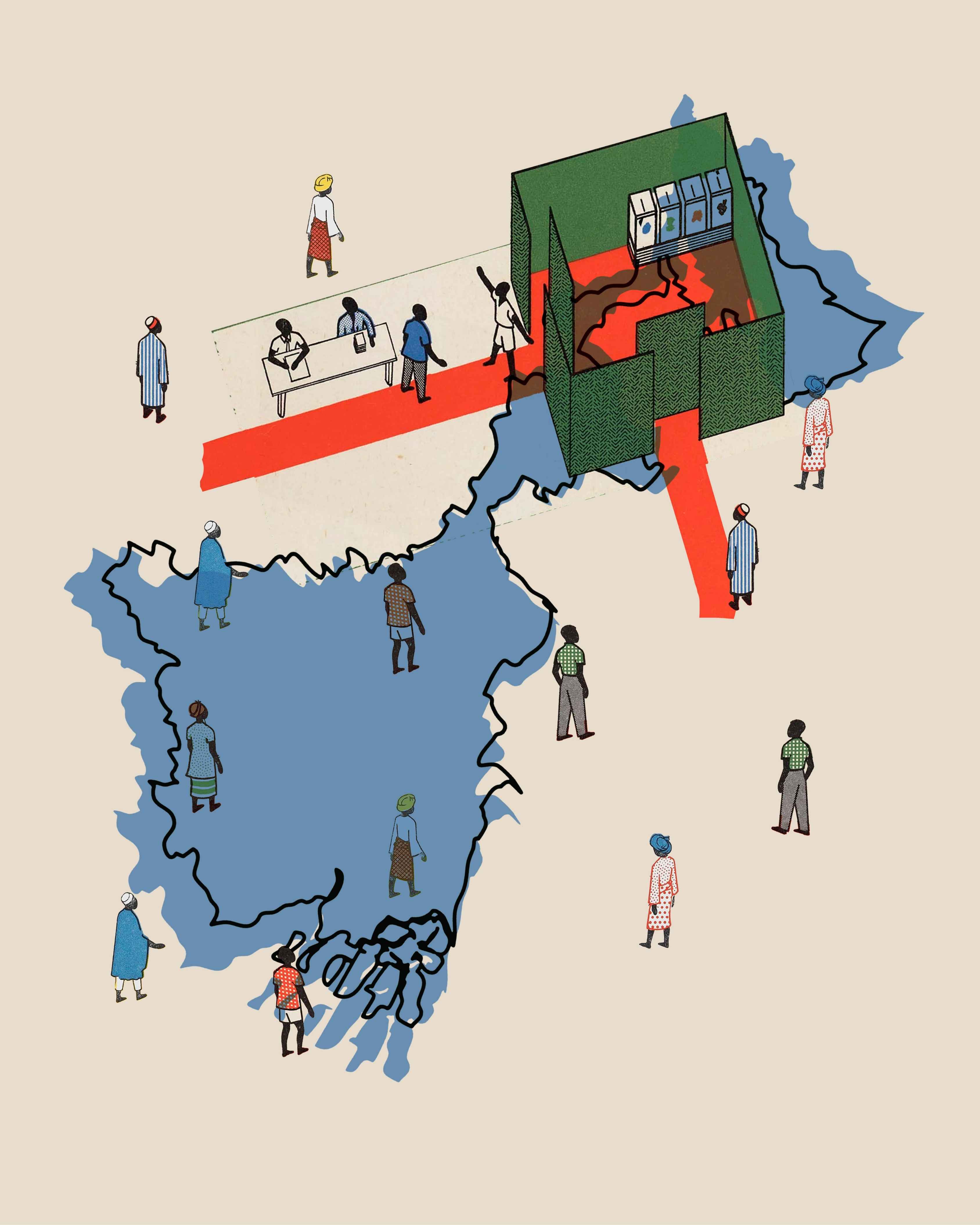
My relative is a sixty-four year old, living in a village in Nadia district, West Bengal. Being a widow from Dalit community of Namasudra caste, she has deep roots in this region. But she carries a bitter irony of today’s political system. Her name is deleted in the recently conducted Special Intensive Revision of electoral rolls. She was not allowed to vote. She had her Aadhaar card and old voter ID. These documents were not sufficient to protect her from the revision process. She doesn't know what should be her next legal remedy or which office to approach. The state had her documents but they removed her name anyway.
The Namasudra community, a large section of them called Matua predominantly lives in the district of Nadia, North 24 Pargana and other South Bengal districts. They are mainly migrated from Bangladesh. In the last few elections, they mostly casted their votes for BJP. The reason was not abstract ideology. One of the reasons was the question of their citizenship. BJP promised The Citizenship Amendment Act will solve the issue of citizenship permanently. The act carried a promise to Hindu migrants from Bangladesh – many of them are from Dalit communities like the Namasudra. They saw a possible settlement of their long and anxious relationship with questions of belonging with the Indian state. That is why they possibly voted overwhelmingly for the party that promised to secure their citizenship. My relative’s deletion of the name in SIR is a meeting point between the promise and the administrative reality of the state.
What Ambedkar Said About Political Promises
Dr Ambedkar's framework is immensely useful to understand these events. He not only provided a context, but also provided a primary lens through which this situation becomes more understandable.
During his time, Dr Ambedkar realized that dominant political parties seek Dalit votes without providing any functioning structural change or giving them adequate representation in the political and administrative structure. In his book What Congress and Gandhi Have Done to the Untouchables (BAWS, Vol. 9, 1991), he elaborated that the ruling party deliberately absorbed Dalit energy. But they hardly gave the community anything substantial in return. The party needed the vote.
This structural argument of his analysis is generalizable across all political parties. This logic is replicated by any dominant party that treats Dalit community as a vote bank instead of a political constituency. The pattern is to take them in and then control the community.
The same relationship pattern is followed in the case between BJP and Namasudra community in West Bengal. It was the CAA promise that attracted votes. That didn't stop the SIR deletions. My relative voted for the party which promised to give equal rights of citizenship to all of her fellow neighbours. She would have again voted for the same party. Dr Ambedkar would not have been surprised.
The Document That Was Not Enough
It was not easy for my relative to get her Aadhar card and voter ID card in the first place. She hardly got any help from the state and is living with many personal challenges. For her to prove her citizenship isn't just filling out a form. It is a constant, heavy labour to prove her existence in front of a system that wasn't designed to naturally include people like her.
Decades ago, Dr B.R. Ambedkar warned us about this exact nightmare. He wrote States and Minorities as a memorandum for the Constituent Assembly in 1947. Dr Ambedkar argued that constitutional safeguards must protect citizens from administrative arbitrariness, and not only from legislative discrimination (Ambedkar, BAWS, Vol. 1, 1979). The SIR is not a law. It is an administrative process. This was managed at the local level by Booth Level Officers working under political pressure. It is precisely this kind of mechanism Ambedkar identified as dangerous. It appears formally neutral, but structurally discriminatory in its outcomes and remain largely invisible to constitutional scrutiny
Consequences of the deleted voters have been made clear by a minister of the new state government. The minister already declared that the government will not provide benefits whose names got deleted in SIR. My relative's ration card and widow pension are at stake. The administrative erasure is transformed now into material punishment. This is precisely the political democracy without social democracy. Dr Ambedkar called it as the formal inclusion on paper behind the back of a structural exclusion in practice.
Where Scott's Framework Fails
James C. Scott theorised ‘infrapolitics’ in his books, Weapons of the Weak (1985) and Domination and the Arts of Resistance (1990). He talks about everyday resistance of the common people against sub-ordination. That helps them to survive without direct confrontations. It is an explanation of how the poor operate in a system to which they cannot challenge openly.
But Scott’s theory cannot explain my relative's situation. She is not practicing infrapolitics. She is not capable because SIR expelled her further from the margins. She was no more in the position of navigation. Scott assumes that there is a layer of informal accommodation beneath formal exclusion. This layer is being uprooted in West Bengal. The hidden transcript of Scott’s resistance doesn't apply here because she is already out of the system. The SIR took her further than that.
Dr Ambedkar was sceptical about reform and accommodation as a political strategy. He was well aware that without structural change in social and political life of state, mere navigation will not bring any meaningful change. The Namasudra community too understood it. Their navigation towards BJP needs to see in the light of the vacuum in their political and social life. But the system behaved as predicted by Dr Ambedkar and the bureaucratic SIR process to erase many of them; particularly who are the most vulnerable within the community.
The Double Burden
In my area, the plight of Muslims is not ambiguous. During West Bengal’s recent election campaign, BJP had stated that it has no need of the Muslim votes, and will not work for them. Following the results, BJP’s newly elected MLAs in many areas repeated the same, Reetesh Tiwari, one of the newly elected MLA said that he did not get any Muslim votes, so he will do no work for Muslims. He declared that he wouldn’t even sign certificates for them. This is not a dog whistle! This is a declared position.
Dr Ambedkar discussed these dynamics in his book Communal Deadlock and a Way to Solve It (BAWS, Vol. 1, 1979). Dr Ambedkar argued that if a minority is big enough to make a difference to election results but is small enough to elect on its own, it will always remain vulnerable and will be easily managed. Tiwari's declaration goes further. Muslims will not be getting anything from the representative of the state as they did not vote for him. Electoral loyalty has been made a prerequisite for the administrative part of the elected office.
Muslim face an extra burden of physical insecurity. Their physical insecurity is added with administrative refusal of justice. They have no representation within the party in power in the state. This is multiple exclusion in working and each form of exclusion reinforces the next.
Fear as Administrative Technology
My Namasudra kin in Nadia and the Muslims in my area do not have a common political identity. They have a common relationship of fear. Fear of removal of names in an administrative revision, fear that the right documents are never finally enough and the state can easily withdraw from their lives even by following procedures. A population living under it does not easily agitate. It consolidates around whatever protection seems nearest and that is often going to the same political force which is producing the fear.
Dr Ambedkar understood that the most reasonable exclusions operate through rule rather than exception. In 1949, he told us that constitutional morality is unnatural in a society organized on the principles of inequality (Ambedkar, BAWS, Vol. 13, 1994). The SIR is organised constitutionally. In Ambedkar's sense, its results are not moral.
It's unlikely to happen any time soon that my relative’s name will get restored. She has no idea what she ought to do. The procedure for reinstatement assumes an adult to be able-bodied, literate, and such an adult has institutional security. She has none. The state has her Aadhaar and her Voter ID. But her name got deleted anyway. There is a gap between being documented and being recognised. This is where Ambedkar located the limitation of Indian democracy. The failure is not in the constitution, but how to use it.
References
- 1) Ambedkar, B.R. (1979). "Communal Deadlock and a Way to Solve It." In Dr. Babasaheb Ambedkar: Writings and Speeches, Vol. 1. Bombay: Education Department, Government of Maharashtra.
- 2) Ambedkar, B.R. (1979). "States and Minorities." In Dr. Babasaheb Ambedkar: Writings and Speeches, Vol. 1. Bombay: Education Department, Government of Maharashtra.
- 3) Ambedkar, B.R. (1991). "What Congress and Gandhi Have Done to the Untouchables." In Dr. Babasaheb Ambedkar: Writings and Speeches, Vol. 9. Bombay: Education Department, Government of Maharashtra.
- 4) Ambedkar, B.R. (1994). "Speech to the Constituent Assembly, November 25, 1949." In Dr. Babasaheb Ambedkar: Writings and Speeches, Vol. 13. Bombay: Education Department, Government of Maharashtra.
- 5) Scott, James C. (1985). Weapons of the Weak: Everyday Forms of Peasant Resistance. New Haven: Yale University Press.
- 6) Scott, James C. (1990). Domination and the Arts of Resistance: Hidden Transcripts. New Haven: Yale University Press.