
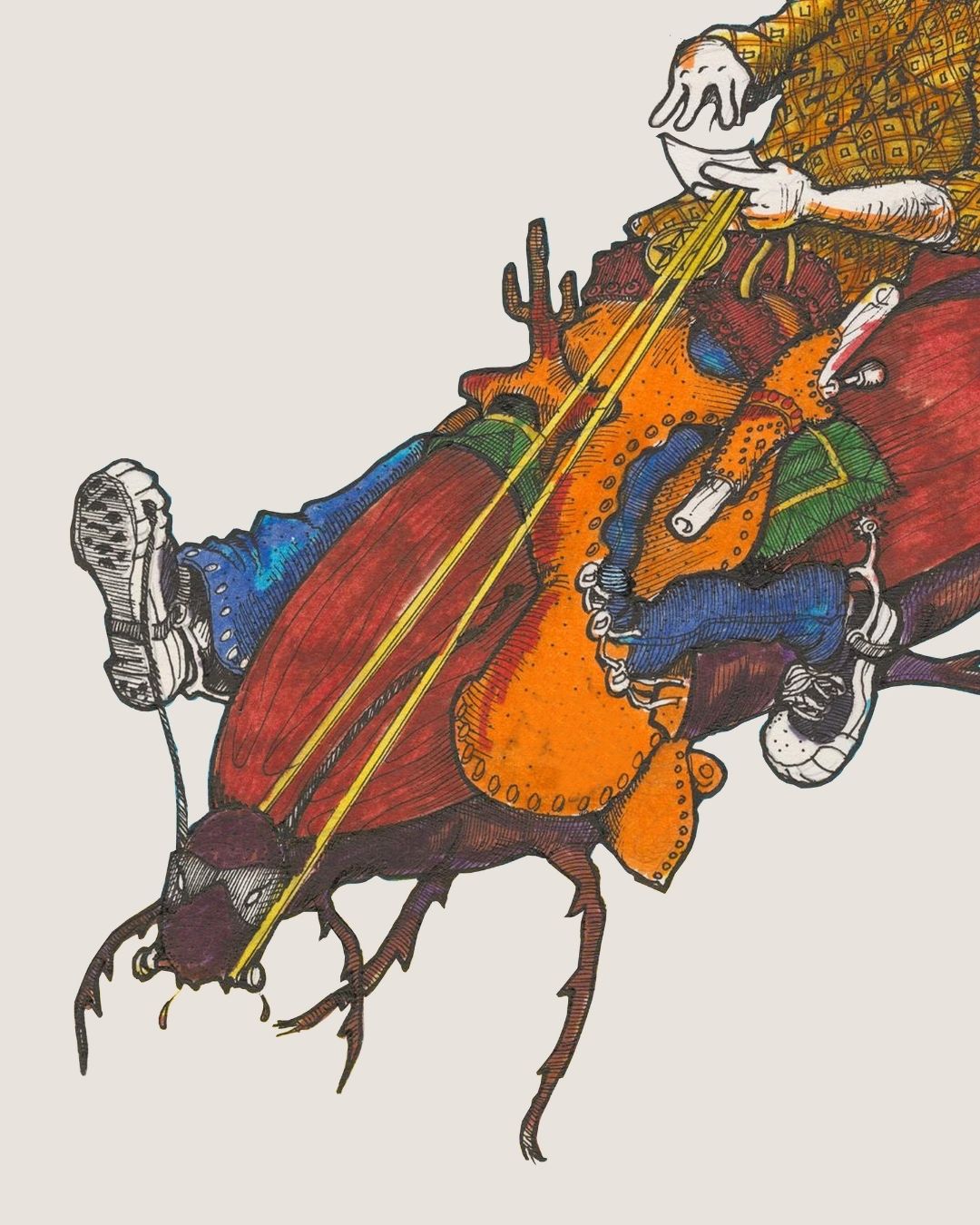
11-year-old me witnessed a dramatic turn of events on television during the rise of Anna Hazare and the political turnover that led to the dominance of political neo-Brahminism of Hindutva. The Aam Aadmi Party (AAP) emerged as a pressure group championing anti-corruption, infrastructure, and employment. Years later, I am witnessing the supposed GenZ revolt in the name of the Cockroach Janata Party (CJP). The coincidence is that its founder was an AAP social media handler, who has found his own Anna in Sonam Wangchuk.
CJP as something born out of satire claims to be the voice of millennials and GenZ. But is the Indian GenZ homogeneous? The politics of Marxism or Liberalism in India is itself classist; it reaches the elite liberal humanities kidz, influenzas, and akedemics rather than the working class people of the country. The Indian youth is separated by castes, class, educational qualification, and ethnic differences. This imagined utopia of unison can be credited to the pervasiveness of 4G internet and Instagram slop. In real sense, there is zero social intercourse. The Lavanya of South Delhi and Aryan from South Bombay are grossed out by the lowered class-, caste GenZ students whose parents cannot afford National Eligibility cum Entrance (NEET) classes & their supposed ignorance about Sidney Sweeney’s latest shenanigans.
The outrage over paper leaks is serious, yet it stems mainly from middle- and upper-middle class (followed by the caste privileges of Savarna Hindu) frustration: “The government college route no longer guarantees I can become a doctor.” The problem that NEET itself produces ghastly consequences for the underprivileged is ignored – the institutional murder of 17-year-old S. Anitha who scored an outstanding 1176/1200 in the Class 12 State board but could not pass the newly implemented NEET medical entrance exam (scoring 86 out of 720). Her inability to secure a medical seat, coupled with the Supreme Court's refusal to exempt Tamil Nadu students from the NEET system, drove her to take her life. What change does it bring if the Union Education Minister resigns? Forget the changes in the stagnated, unequal, and comatose educational system, it cannot even reverse the consequences of paper leaks.
The founder Abhijeet Dipke is an interesting figure, who seems to strategically deploy his Dalit identity at opportune moments in his campaigns. “Being Dalit” has long been reduced to performance: a LARP, a masquerade, a play-pretend – from Jagjivan Ram to recent Chief Justices. To be a Dalit explains nothing nor does it reproduce anything useful politically; its proclaiming is just a remark, an ornamental distraction. How would Dipke’s movement liberate Dalits from his campaign of forcing the resignation of the education minister when the rot is elsewhere?
Ironically, Dipke insists that both he and his movement stand on the principles of Gandhi, Nehru, and Babasaheb Ambedkar. For anyone acquainted with preliminary reading of Ambedkar’s works, this is at most absurd and laughable. Gandhi, Nehru, and Ambedkar cannot be clubbed together. Their ideological incompatibility and historical conflicts make the fusion grotesque. Gandhi humiliated Dalits and curtailed their emancipation by using his fast as political pressure, forcing Babasaheb Ambedkar to concede in 1932 Poona Pact. Nehru was the silent intellectual bully who ignored Babasaheb’s pleas to promote welfare and safety of the Scheduled Castes, instead advancing Brahminism dressed up as liberal socialism. Gandhi and Nehru are the ideologues of modern Brahminism!
That Dipke, who claims he is not delusional, is indeed in delulu, for he forgets that beyond the “Annihilation of Caste” there is a large corpus of literature which seeks to expose his icons. The language of syncretism of Gandhi-Nehru with Ambedkar needs to be purged, for there can’t be both but one! The fusion is so sacrilegious that it’s like reciting the verses of the Quran from the Panchajanya (the sacred conch of Vishnu) in a cathedral.
Dipke brings a book from his airport arrival with a photo of Babasaheb Ambedkar, a book which isn’t even his own. Babasaheb never wrote a formal autobiography, he wrote personal experiences that were collated under the title Waiting for Visa. Dipke, a follower of Babasaheb Ambedkar, couldn’t even bring one set of BAWS! For which the Ambedkarites of his state had to face a long battle. In a recent interview with YouTuber Samdish, he reveals that “he has to bring Babasaheb’s photo to avoid challenges of the state.” Isn’t it sus? This makes me wonder: is this a strategy to use the sentiments of Ambedkarites who will revolt the very moment Babasaheb’s image or ideology is harmed? Just as the opposition used Babasaheb’s name to galvanize his followers when the current home minister exposed their antics?
Even at the first protest filled with SFI and AISA musical instruments, the book of Babasaheb Ambedkar that was floating the most was the bizarre production by Roy instead of BAWS. Dipke is from Sambhaji Nagar, earlier known as Aurangabad. He claims that India once had a sense of true democracy? I ask him: when? Is Mr. Dipke not aware about the horror that the people of Aurangabad or Marathwada faced during the Namantar Andolan in the Congress regime? Is Mr. Dipke a product of the “Oh we lost India after 2014” narrative? Is he like that internet personality Meghnad or his comrades like Sourav Das who were praising Modi years ago and had a sudden change of heart?
Has Mr. Dipke not understood that democracy for his supposedly icon Babasaheb Ambedkar is a task yet to be achieved, as Indian society is rigged with castes. Castes, Babasaheb notes, doesn’t even make India a society, as there is no desire for welfare, loyalty to the public, and mutuality of sympathy and cooperation that caste is the greatest obstacle in the achievement of Indian democracy? (Prospects of Democracy in India, Vol 17 part 3 ,page 548)
Such LARPs or the chimeric orgies of ideologies which only lead to chlamydia make me think of the words of Babasaheb in his text Some Questions to the Hindus and Their Friends.
“The youths who fill the Universities and who follow the Pandit’s lead are ever ready to fight the political battle of India against the British. But what do these children of the leisured class Hindus have done to redress the wrongs their forefathers have done to the Untouchables? You can get thousands of Hindu youths to join political propaganda but you cannot get one single youth to take up the cause of breaking the caste system or of removing Untouchability. Democracy and democratic life, justice and conscience which are sustained by a belief in democratic principle are foreign to the Hindu mind.”
Yet here I’m waiting for Joey, Dee-Dee and Marky to bring out a reaction from Our Oggy.