
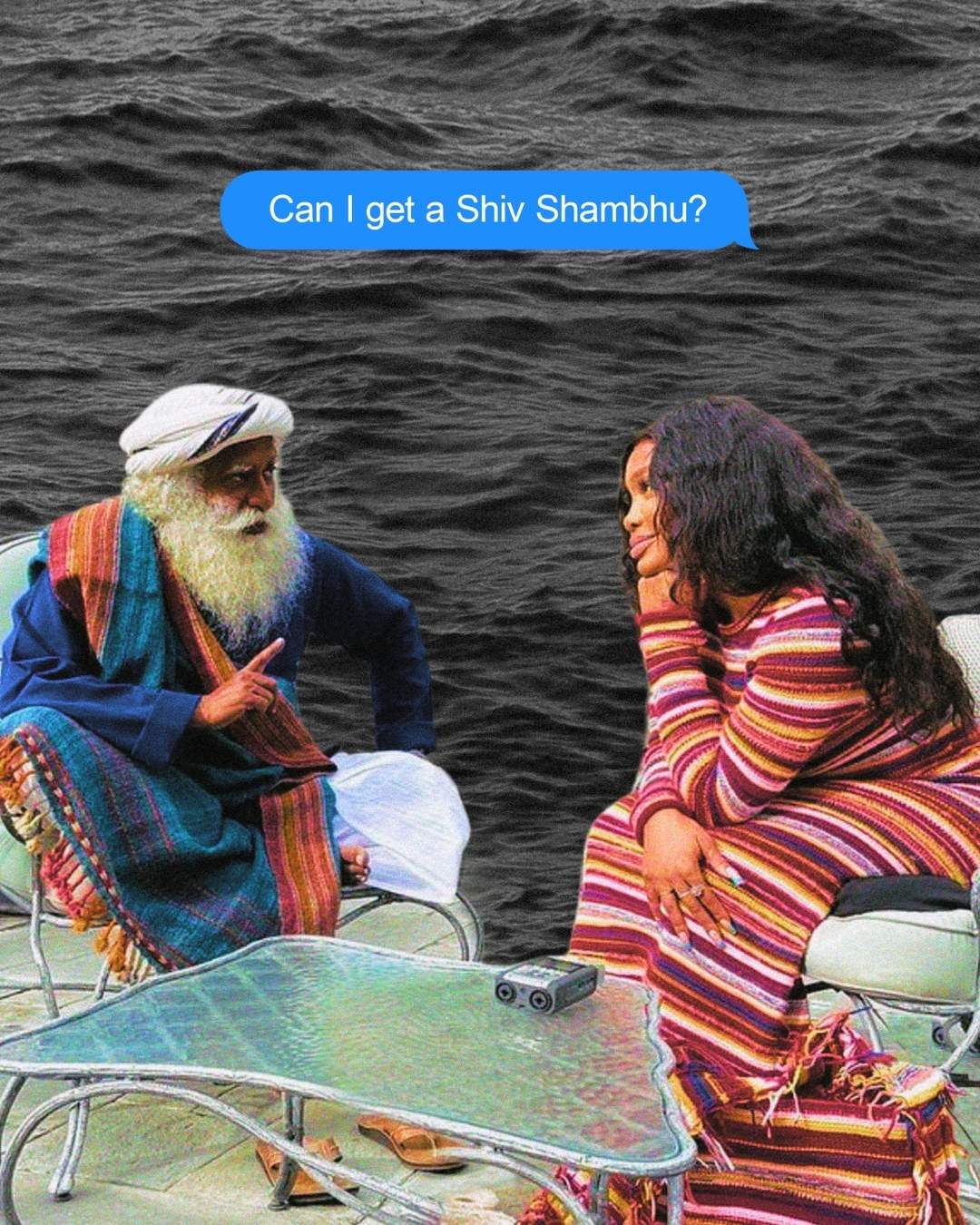
At a sprawling Mahashivaratri event hosted by Sadhguru, the camera cut to the crowd and caught American R&B star SZA cheering which rang like earworm, dancing with her mother and niece. Within hours, the moment was circulating across platforms, framed as charming proof of Indian spirituality’s global reach. Comment sections filled with pride and delight. A global pop icon vibing with hinduism, culture crossing borders, and ancient wisdom going mainstream.
But the cheer, harmless as it appeared, offers a window into a much larger machinery. It reveals how a carefully curated version of Hindu spirituality is packaged for global consumption, how celebrity culture functions to legitimate it, and how deeply political projects can be laundered through the language of transcendence.
Sadhguru’s appeal, especially outside India, rests on fluency in a particular idiom. He speaks not as a priest or theologian, but as a kind of spiritual technocrat. His vocabulary is studded with terms that sound empirical without being accountable to evidence: “energy,” “vibrations,” “inner engineering,” “karma”. This language does crucial work. It detaches Hindu religious ideas from their historical and social grounding, presenting them instead as universal tools for self optimization.
This intentional mistranslation travels well around the globe. In Western wellness culture, already primed to fetishise “Eastern wisdom”, such framing feels both radical and safe. It promises depth without obligation, mysticism without complexity and transcendence without politics. In yoga studios, meditation apps, and self-care podcasts, Hindu concepts already circulate as tools for balance and productivity. They are admired precisely because they are imagined as ancient, mystical, and untouched by the messiness of modern politics. A spirituality that can be consumed without asking hard questions. So when a global celebrity echoes a chant, even playfully, it appears to confirm that this culture is open, borderless, and benign.
What disappears in this process is caste, conflict, and centuries of subjugation. A history shaped by an atrocious ritual authority, exclusion, and struggle. The language of universal vibrations flattens these histories. It shows inequality as ignorance, oppression as mere imbalance, and liberation as an inward journey. Structural injustice is rendered irrelevant in a world where the primary work is to align one’s energy.
This erasure is of course not accidental. Sadhguru’s global facing spirituality sits alongside a domestic political posture that is far from detached. He has repeatedly aligned himself with India’s right wing government, publicly endorsing state initiatives and appearing alongside political leaders while maintaining a steady silence on caste violence, majoritarianism, and dissent. The mystic’s carefully constructed image of being “above politics” functions less as neutrality and more as insulation which allows proximity to power without accountability to those harmed by it.
The rhetoric of inner transformation sits well with this arrangement. If suffering is reframed as a failure of awareness, then demands for redistribution, representation, or justice appear crude, even counterproductive. Harmony becomes the highest value; anger and resistance are viewed as spiritual immaturity. In such a framework, the ideal citizen is calm, adaptable, and inward looking, perfectly attuned to a political order which likes to treat silence as peace.
Celebrity moments like SZA are powerful precisely because they obscure this alignment. They shift attention from unjust discriminatory institutions to a spectacle of vibes and false inclusivity. Global recognition becomes proof of universality, drowning out questions about whose experiences are being erased to make such universality possible.
This is not about policing cultural exchange or assigning blame to individual artists. SZA’s participation was likely spontaneous, mediated by hospitality and spectacle rather than ideology. But focusing on intent misses the point. The issue is infrastructure: who builds the stage, who controls the narrative, and whose politics are advanced when spirituality is stripped of social consequence. When Hinduism is exported primarily as a mood – serene, ancient, therapeutic – it becomes easier to ignore how it is mobilised at home to consolidate power and subjugate a people.
The global circulation of this softened spirituality also feeds back into domestic politics. International admiration is repeatedly invoked as validation. Western fascination becomes a shield against local dissent. The more celebrities chant, the harder it becomes to ask uncomfortable questions about land, labour, caste, and state violence without being accused of attacking “culture” itself.
In this sense, these spectacles show how religious symbolism can be repackaged as global wellness while doing quiet ideological work of the right wing. The viral chant becomes a soundbite detached from its histories, silencing those who have historically been denied access to spiritual authority, whose labour sustains these spectacles, and who pays the cumulative price.
To interrogate moments like this is not to reject spirituality or cross-cultural curiosity. It is to insist that culture is never just culture. It doesn’t exist in isolation. When enlightenment is sold as a personal upgrade the structural injustices embedded within it move to the backstage.
“If we are being told to focus on our inner peace while the outer world burns then the voice is surely coming from those setting it on fire.”
If we are being told to focus on our inner peace while the outer world burns then the voice is surely coming from those setting it on fire.