
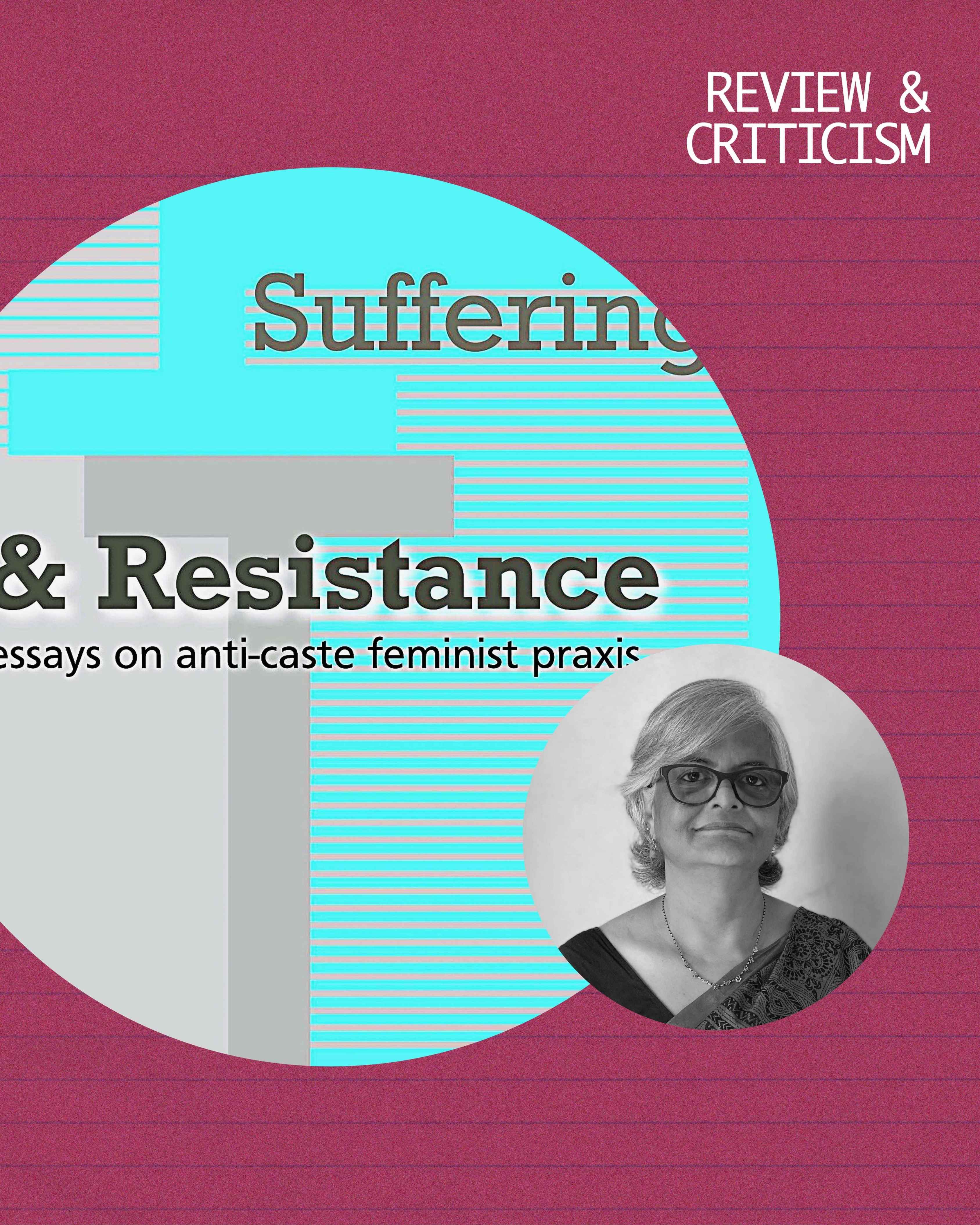
Suffering & Resistance is a collection of essays on anti-caste feminist praxis drawn from Kalpana Kannabiran’s ethnographic fieldwork, teaching, and intellectual engagements. While terms like oppression, discrimination, exclusion, and violence are processes utilized for marginalization, suffering is the outcome of these mechanisms. The acts of reclaiming, reimagining, and reconstructing legacies as part of anti-caste praxis then become resistance.
The central intervention of the book is locating the “anti-socialities” of caste, which establishes that caste is not only a hierarchical system of social gradation but reproduces a fragmented Indian society. Anti-sociality is a structured refusal of human fellowship, empathy, and fraternity, in terms of caste, gender and sexuality. Kannabiran’s key conceptual contribution is her formulation of “castes of gender”. Castes of gender can be understood as one of the central mechanisms by which anti-sociality of caste is reproduced and maintained. She argues that caste and gender are not separate systems that sometimes overlap but they are “welded formations”. She moves beyond the conceptual formation of intersectionality in the additive sense i.e. caste AND gender discrimination, to argue that caste is reproduced through the control of women’s bodies, sexuality, and labour. In the chapters that follow in three sections of the book, Kannabiran shows that the anti-sociality of caste is not only a characteristic of caste relations but it also structures knowledge production, body and kinship, and citizenship.
The first section of the book maps anti-socialities of caste within the domain of knowledge production. It asks whose knowledge is considered legitimate sociology. The section discusses the works of three scholars – C. Parvathamma, Joan Mencher, and Gail Omvedt – in separate chapters dedicated to each, who practiced anti-caste feminist sociology from different positions of insider and outsider.
C. Parvathamma is the most institutionally erased of the three. Parvathamma argues that some level of subjectivity is inevitable in social science and locates this subjectivity in one’s social position within Indian society. Her critique of M.N.Srinivas’s The Remembered Village shows how savarna vantage point gets naturalised as sociological objectivity. By mapping Parvathamma’s private life, her court case, her administrative struggles, and her scholarly work together as a single account, Kannabiran refuses to separate the scholar from her social location. This is where “castes of gender” becomes methodologically operational as Parvathamma's journey to establish herself as a Dalit woman sociologist and Head of Department was not separate from her intellectual contribution or private life. In opening the book with C. Parvathamma’s work, Kannabiran is making a disciplinary recovery and building a genealogy of anti-caste feminist sociology that remained side-lined.
If the first section recovers an anti-caste feminist sociology obscured by disciplinary practices, the chapters in the second section demonstrate how anti-sociality is reproduced through caste-regulated sexuality and kinship located in the body. The section examines how caste reproduces itself through sexuality, kinship, and bodily regulation. The chapter Queering the Annihilation of Caste boldly extends Ambedkar’s project into new territory, in which Kannabiran is moving between Ambedkar’s text, constitutional jurisprudence, Dalit queer testimonies, family-studies, and feminist theory without always signalling the transitions. The structure of the chapter emphasises the point that theory and the lived reality are not separable in anti-caste praxis. Kannabiran introduces the concept of “social endosmosis,” drawn from Ambedkar, as the aspiration for a caste-free and gender-plural society. An important reminder by Kannabiran is that the Annihilation of Caste as a text cannot be read without a queer lens. Queering the annihilation of caste then means extending Ambedkar’s revolutionary project to include the dismantling of hetero-normative patriarchal caste regulations.
Kannabiran’s bold suggestion in this book is for Family Studies to recognize that the hetero-patriarchal endogamous family is itself a caste institution and move beyond merely including queer and Dalit families as case studies. Kannabiran illustrates this complexity through an anecdote in the postscript, about Rajappa, her father’s cousin, whose homosexuality was implicitly known and managed within the family by forcing him into a heterosexual marriage and tolerating his queer male partner. This management of queerness within the family can be read as a requirement as Rajappa provided emotional and financial support to the family that it could not afford to lose. However, the cost of this management and absorption was paid by his wife whom he never touched and never had children with. Queer sexuality also disrupts the reproduction of caste through the family to a degree as it breaks the reproductive chain. Here, Kannabiran’s grandmother’s desire for any woman to claim that he was the father of her child reveals the extent to which heterosexual reproduction remains central to the maintenance of the caste family. The possibility of bypassing endogamy becomes preferable to the threat posed by queerness. The imagined child symbolically serves to restore the hetero-patriarchal family order.
Having explored how castes of gender reproduce anti-sociality through body and kinship in the second section, the last section addresses questions of citizenship. The chapters titled ‘Dalit Women’s organisations’, ‘Political Reservations for Women’, and the ‘Constitution as Commons’ map the anti-sociality of caste that operates through political exclusion. Kannabiran documents how anti-socialities of caste resulted in the invisibilization of Dalit women’s experiences within both mainstream feminism and mainstream anti-caste politics. The formation of Dalit women’s autonomous political organizations like National Federation of Dalit Women and transnational advocacy is thus read as resistance. Political reservations for women, although imperfect, emerge as a necessary instrument to break down the entrenched caste-gender monopolies that are active within the political domain.
The book opens with Parvathamma’s chapter, specifically her claim that a degree of subjectivity is inevitable in all social sciences; the post-script performs this subjectivity but in order to bring in accountability of the researcher and making knowledge production more transparent. The post-script enacts this methodology through what Sandra Harding would call ‘strong objectivity’. Kannabiran is engaging in auto-ethnography that can be read as an exercise in unarchiving the entanglements of caste and gender through family histories. In doing so, she is practicing what C Wright Mills’ calls ‘sociological imagination’ that is rooted in anti-caste feminist praxis
By engaging in recovery of anti-caste knowledge systems, reimagining modes of belonging, and democratic reconstruction, the book itself becomes an act of resistance towards erasure. The book’s detailed engagement with ethnography will be an enriching read for the social sciences researcher in the field trying to fathom the complexities of Indian society encountered in the field.
Suffering & Resistance: Essays on Anti-Caste Feminist Praxis by Kalpana Kannabiran is published by Women Unlimited, Delhi, 2026