
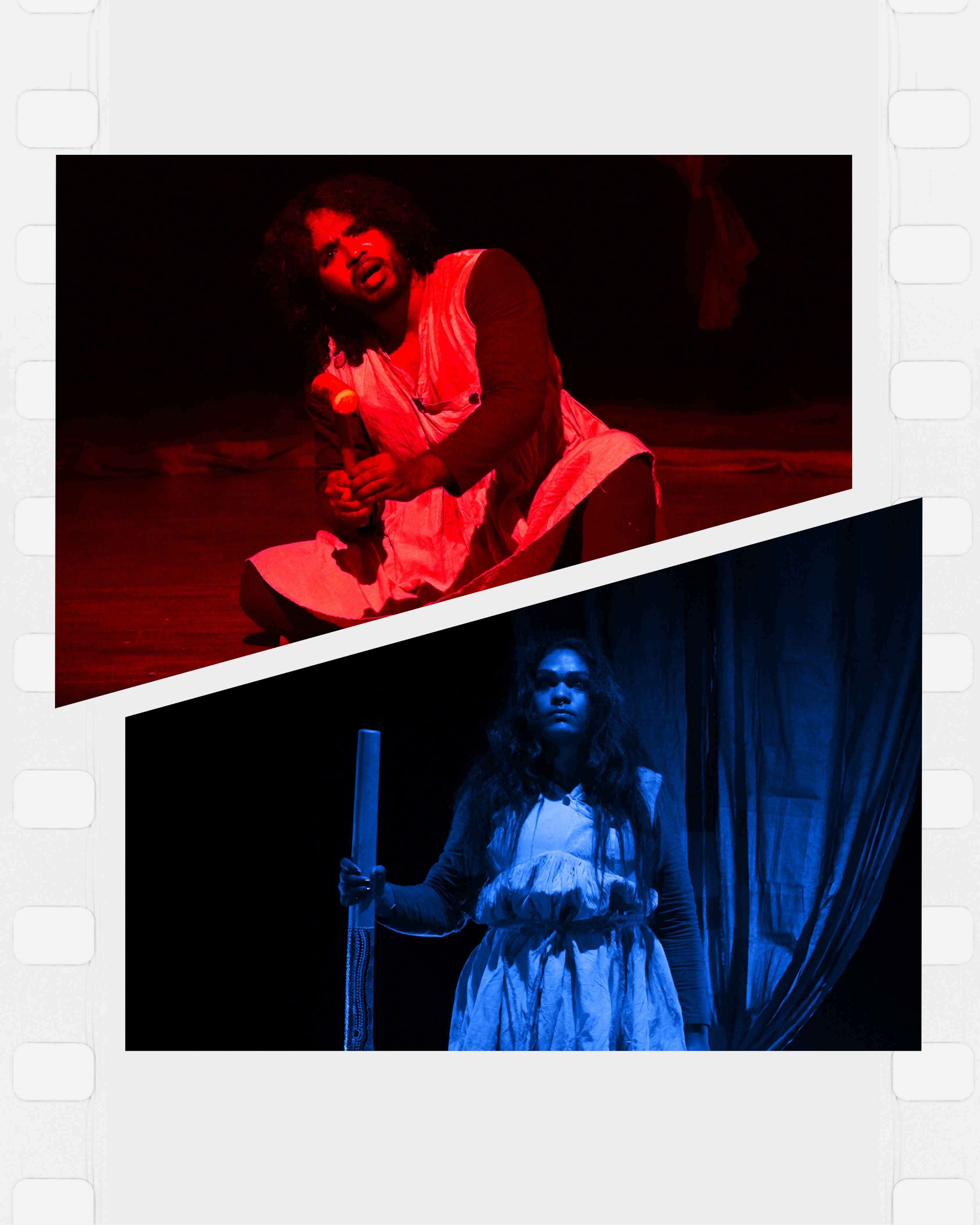
What happens to a child born in an untouchable caste deprived of any sensation of touch? How does he learn to read the world? In the Tamil play titled Vanapuri Vaathukaaran, such a figure becomes a clown who speaks politics. Speaks in an irony because the titular Vaathukaaran keeps reiterating to the audience that he has no tongue, and what you perceive of him is his disembodiment. The amusement of his disembodiment is what makes him a clown and not his costume which is unlike the extravagant or typical of any clown, but simple washed-out grey overcoat. The reticence of love out of reason, to build politics out of it, a kind of shamelessness for what you believe in, is what director Naren and the actors seem to describe as a clown. Vaathukaaran is an outcast in his love for his land, in his choice to stay with and nurture it. Choosing his land, Vanapuri – now Tirupattur in Tamil Nadu – even when the consequence of it is his own dispossession. Vaathukaaran makes instruments out of animal hides, he is a duck herder of many things. The play traces the trajectory of an untouchable clown whose perceptivity is unreturned, and the deep impact his death leaves on the people.
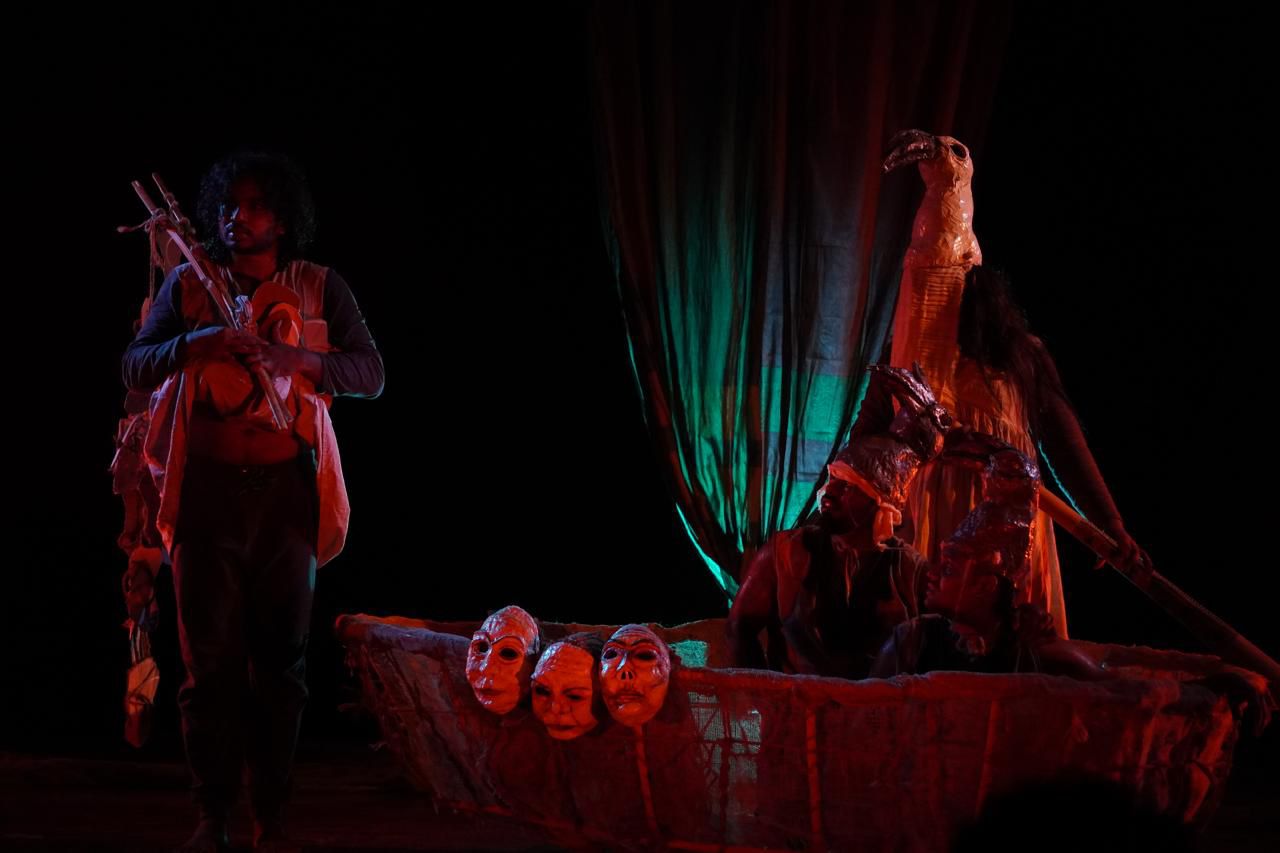
The shape our lives take are sometimes wedged on delicate decisions and life-altering choices we make. Marrying your daughter off to a city, choosing an education abroad over your beloved, writing the land off or your job to only one of your children or siblings, and so on. Vaathukaaran, played by Bengaluru based theatre artist Sachin Sreenath, makes such a choice to return to the village Vanapuri out of love for his land, which outcasts him to death. He says, “Our land is our body. Our body and land are not different entities.” As simple and universal the sentiments of these lines, they are further contextualised: “Like how gold found in soil is made into jewelry to decorate the power of the dominant group, our labor facilitates their luxury.” Poetry is how the play moves ahead, with monologues by each actor. There are dreamy theatrical props like hornbills that carry messages, clusters of chappals hung over the shoulders, a huge oracle the play concludes to, accompanied by music by Reuben, Ahilan and Naren. The play aims to depart from the traditional forms of hierarchical execution, the actor has a command over the direction he takes. There are rooms for improvising, a scope for dialogue with the audiences. It plays out even in the way we understand the story of the play. Sachin is heckled by the villagers which draws him to his disappearance, we are as helpless as the emotions he enacts. We do not know what death is in this scene, is it cessation of his body or his social boycott, both indistinguishable for a Dalit. In another scene, somewhere in the middle, Sindhu, a Dalit trans woman actress, pleads for water to the audience. As an audience, it is hard to not resist your own passivity as a mere witness.
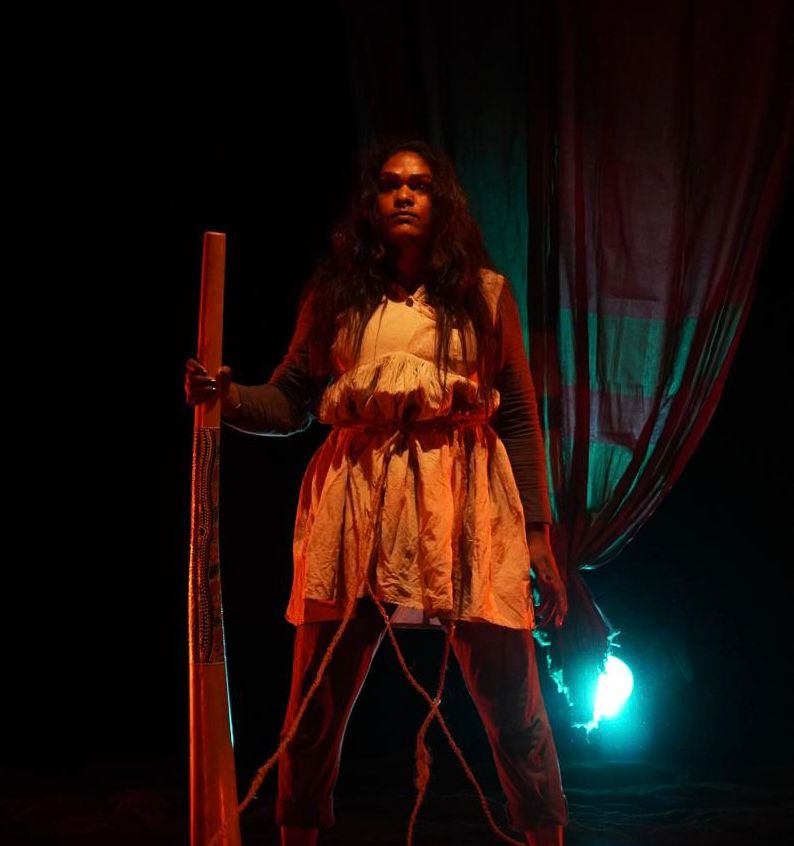
At the heart of the play is the choice we make in life that alters our destiny, that in turn shapes us. Even if it is dispossession that most Dalits end up with in the end of their lives. One might find Vaathukaaran in their single old uncle who might not have left a hereditary lineage, but you remember him for his kindness, how he could never say no to you. As one of the progeny of Vaathukaaran, Parai artists and actors Veeramani and Arputhan, says, “He left without a trace…” so you remember him in diffusion of his kindness. This diffusion encompasses everything about Dalits’ relation with the world other than the one that caste makes for them. Dalits are often taught to respect the most dispossessed because a leprosy infested beggar on the roadside is sometimes a distant relative. The director and actors of the play expand and magnify this deep horizon of unarchived terrain of Dalit’s lives that constitutes figures who are often forgotten. Their vague contours are illuminated by the character Vaathulkaaran, the irony of being a political clown, whose joke is you who can hear him speak when in fact he isn’t. And it is he who laughs, and not you.
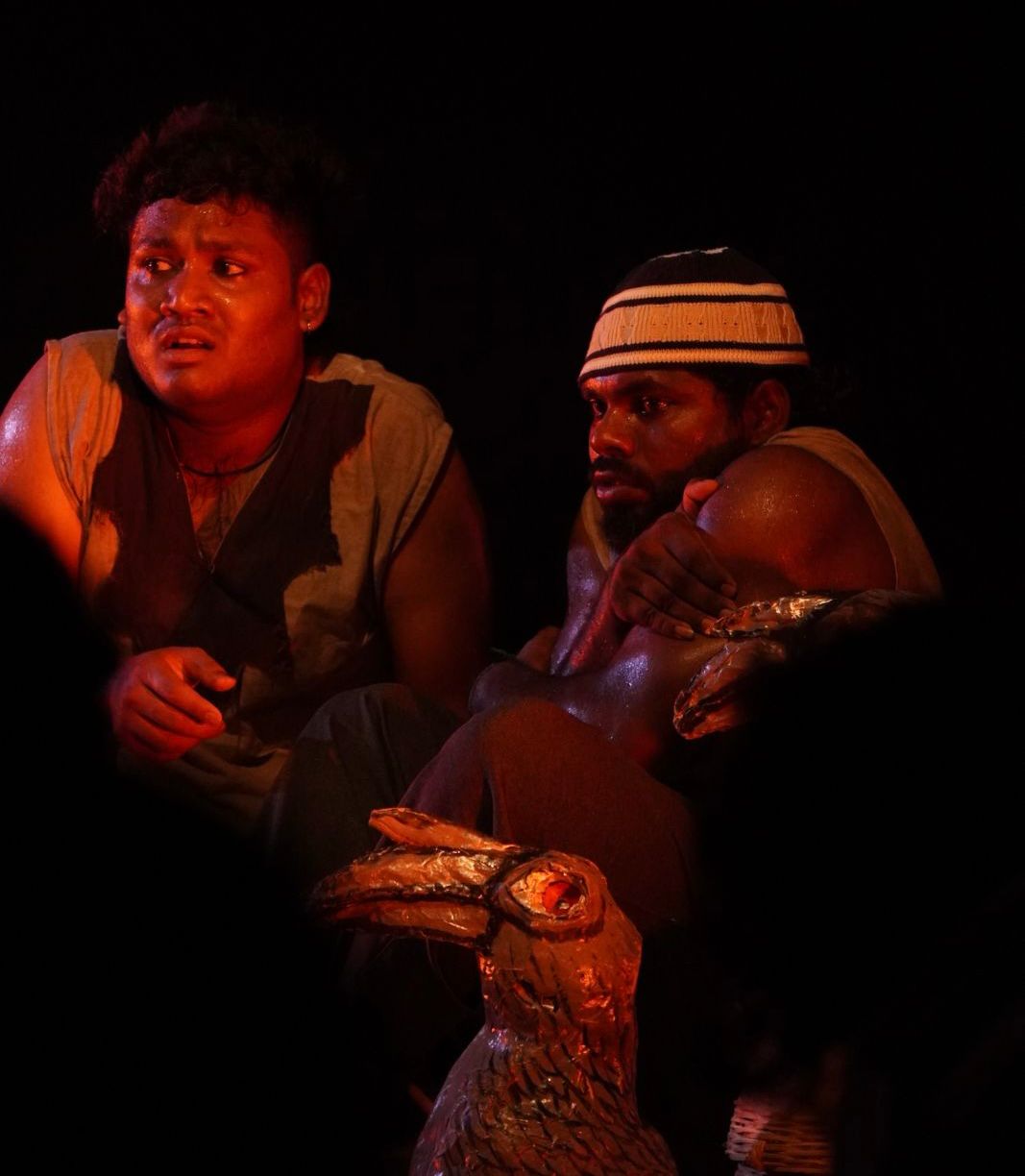
Adavi Arts Collective began as a group of Parai artists, and gradually expanding their pedagogical practice into a production house, now makes its foray into theatre with its first production, Vanapuri Vaathukaaran. The play is a fresh articulation of anti-caste culture, instead of knife-clean political language, it offers a literary landscape to show the cost of dignity. Vaathukaran’s progeny describe him as “the gravitational force of this world. It finds the hands that play it. Like a snake coiling a body, the instrument attaches to the body and becomes part of it.” We are reminded that our present rests on the back of someone who suffered the first step into the time we seamlessly shape our days into.
Appeal for support: This play is one of a kind. The performers hope to bring it to more audiences and create more opportunities to perform. Help them sustain their work and take the play to more places. Donate at: 9080117469@ptsbi
Director: Naren
Cast: Sindhu, Arputhan, Veeramani, Sachin Sreenath