
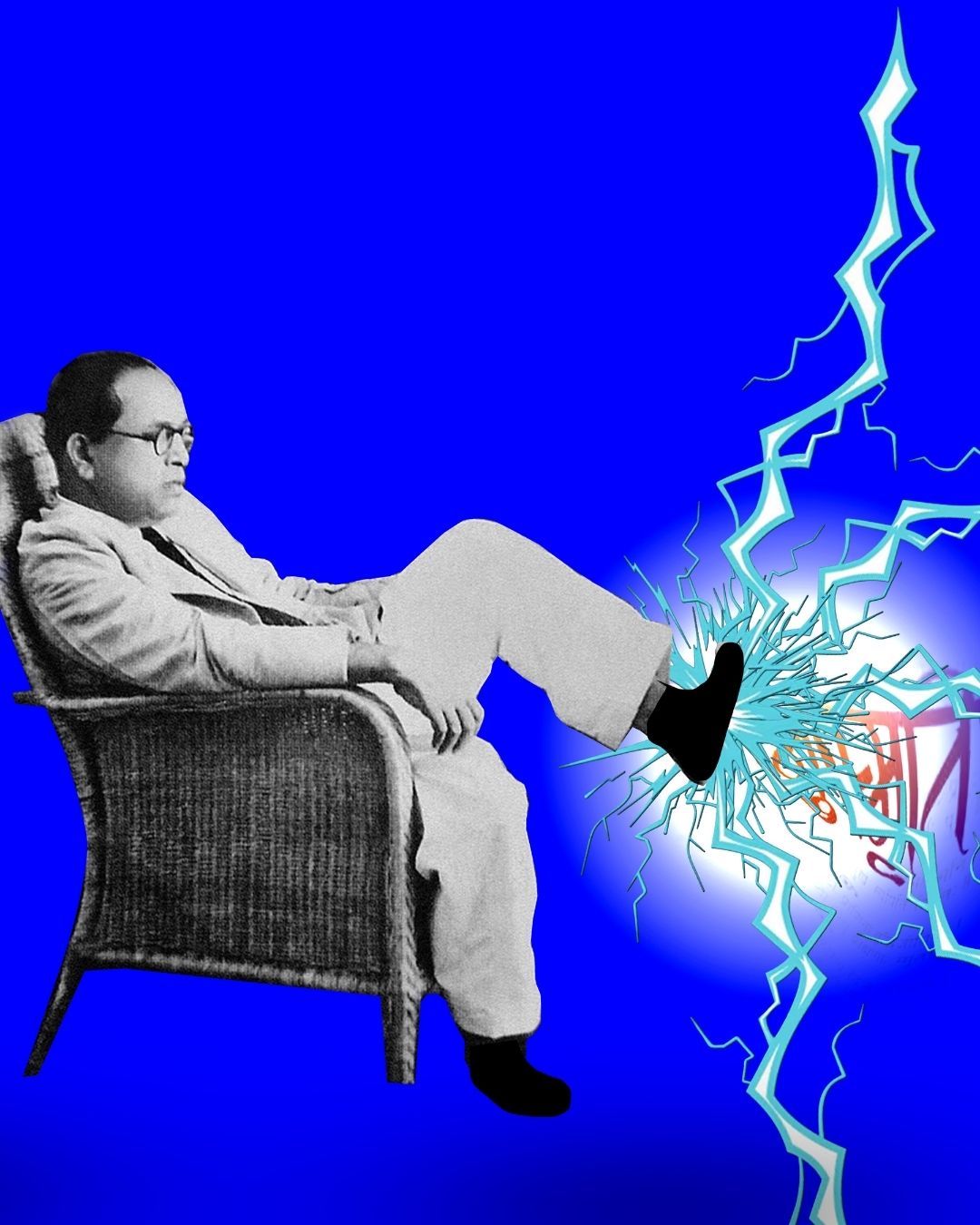
Every year, the Indian state announces: one crime against a Dalit every 18 minutes, 13 Dalits murdered every week, 27 atrocities every day. But this is not merely the neutral functioning of a modern state. On the contrary, this very enumeration functions ideologically – it tells Dalits: you may suffer, but within limits; remain the perfect welfare subject, do not cross the boundary.
Democracy, when placed in the hands of ruling castes, does not fail by accident – it works precisely as it should. It produces not the emancipatory effects it promises, but their inversion. As Ambedkar warned, postcolonial India simply transferred power into upper-caste hands; what we witness is not the betrayal of democracy, but its caste-saturated realization.
“Democracy, when placed in the hands of ruling castes, does not fail by accident – it works precisely as it should.”
The post-Ambedkar Dalit intelligentsia plays its role here with tragic precision. By reducing politics to autobiographical guilt and recognition, it prevents Ambedkar’s radical doubt from becoming a political program. The Dalit middle class and bureaucracy do not oppose the state; they mediate it, translating structural violence into the language of recognition.
Thus, Dalits are not only oppressed – they are administered. Contained within welfare and surveillance, they are allowed culture, even “agency,” but only within the structure as it remains legible to the Master. Recognition replaces transformation.
Even the grand celebration of Ambedkar Jayanti bears this contradiction. It signals an unconscious awareness that the struggle is too vast, too prolonged – and that the failure of democracy is so traumatic that it must be overperformed as celebration. Ambedkar did not see this as ritual but as war: “The problem of Untouchability is a matter of class struggle," he advised.
The real question, then, is not whether we read Ambedkar, but whether we dare to inherit his anger – or whether we are even afraid to be angry?
Ambedkar said against the passivity:
“It must be remembered… without the use of force all ideals remain empty; without purpose, activity becomes mere fruitless fooling".