
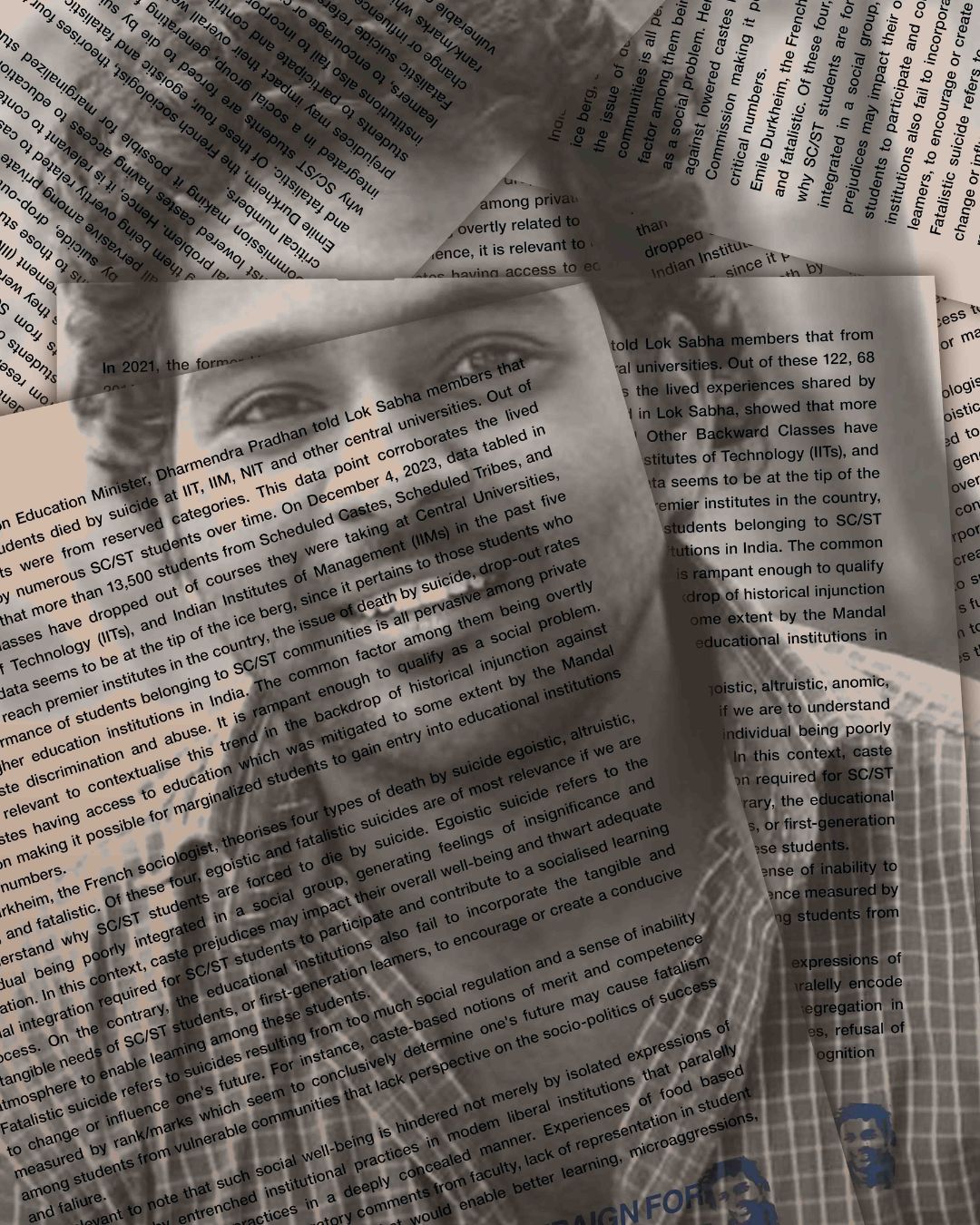
“Discrimination, for the purpose of this Act, means any intentional or unintentional action or omission that has an adverse effect on an individual or a group of individuals belonging to Scheduled Castes or Scheduled Tribes failing to treat such individuals in parity with others or preferential treatment of an individual or a group of individuals belonging to castes considered as superior in the caste hierarchy, or such other caste-based cultural practices.” (Campaign for Rohith Act, 2025, p. 15)
The institutional murder of Sahil Wakode underscores a systemic nature of discrimination in the form of normalized omissions present in Higher Educational Institutions. In Sahil’s case, the nature of the discrimination becomes apparent through an omission by the investigator, Suryanarayana Doolla. In the event of alleged malpractice in an examination, the stipulated protocol allows the student to write the exam and ensures a fair chance of being heard by a Departmental Academic Disciplinary Action Committee. In this case, the invigilator arbitrarily omitted the process, taking it into their own hands. In addition to this act of omission, there was an alleged commission of an offence through forms of verbal aggression.
P. Thirumal in his paper “Regurgitative Violence: The Sacred and the Profane in Higher Education Institutions in India” poses a question on verbal aggression through an incident of discrimination and hostility which took place at IIT Kharagpur. A video of faculty offering special online coaching to marginalized students to prepare for the IIT entrance was circulated during the pandemic. Thirumal emphasizes the mode of the faculty’s aggression: “The screaming, yelling, verbal abuse and hostility against the marginalized students suggest an intensity of anger that refuses to be contained. Is this anger more than an individual expression?... Anger and disgust are related emotions. It is difficult to know when anger turns to disgust or disgust into anger, or it is possible in some extreme cases like this one, that they come together.” (P.16)
Thirumal’s observation on anger and disgust becomes pertinent to note in the institutional murder of Sahil Wakode in terms of the response of the invigilator. How an individual responds, the conversation that gets initiated between the invigilator and the student, is it procedural or beyond procedure? If it goes beyond procedure, does it embed certain ethics of care in handling the psychological stress at that point, or does it aggravate? Given the social composition of a non-heterogeneous mass of faculty in elite institutions, does it elicit a form of disgust, be it verbal or facial, that can be judged from both an individual and social standpoint?
What is even more appalling is the institution’s response to Sahil’s death. It pronounced a verdict against him without any enquiry, while a different protocol was followed in another alleged cheating case. The Faculty Forum’s open support for Doolla undermines the possibility of a fair enquiry and creates an intimidating environment for students to speak out. As seen in the IIT Kharagpur case, such an atmosphere can shield faculty from accountability, particularly when students from marginalized communities are involved. The aftermath of Sahil’s death was further marked by a tirade of anti-reservation discourse on social media, shifting attention away from institutional accountability.
Castes exist as a relation, one that is mediated by the sub-ordinated consciousness of the castes below with a super-ordinated consciousness of the one above. It breathes life into the one above while making the ones below in the order of hierarchy docile, devoid of any independent consciousness, thereby resulting in the death of the individual and the community. Rohith, in his last words, writes “All the while, some people, for them, life itself is curse. My birth is my fatal accident”, underscoring the systemic form of oppression which suffocates oppressed castes across life.
However, the history of anti-caste was a testimony to countless resistances at the cost of many lives against oppression and subjugation; because of such struggles, caste is denied in public; however, it is practiced in private and as a deep-seated psychological stereotype by caste-elites. Denial of non-practice of caste does not absolve individuals of caste-based association, as they are moulded by histories of coercive accumulation resulting in the privileged advantages of the present, be it in terms of better educational and employment opportunities. For them, reservation appears as a hindrance, as they are unable to see the past as an unjust past but see it as a naturalized one. The tirade of anti-reservation discourse in educational institutions produces a sub-ordinated consciousness for those who need equal participation. The anti-reservationists essentially carry this deep-seated sentiment in advocating caste-based superiority throughout their lifetime, breathing life into the system of caste, unlike those who advocate for equal participation through affirmative action as a baby step of liberation.
The nature of discourse built around anti-reservation sentiment lambasted through social media by caste supremacists in the aftermath of Sahil Wakode’s institutional murder testifies to the deep-seated nature of caste in Indian society. Caste consciousness does not merely imply knowing or expressing one’s caste; it lies in its expression in relation to the other. Vegetarianism as an undetestable culture against non-vegetarianism as detestable, while beef and pork consumption as deeply repulsive are not isolated in themselves; they stand in relation to the superior projection of vegetarianism tied in rituals and religious sense. Such projection is not limited to religious denominations; rather, it extends to educational institutions, which must maintain secular credentials and a scientific temperament. The recent institutional murder of Akilan, who was discriminated against by teachers and students for consuming beef, becomes a testimony of countless mutilations and many deaths suffered by Dalits with the inferiorization as a day-to-day practice in the hands of caste.
The omissions that happen in setting aside government directives, deliberate omission of a rule position in pushing students from Dalit-Adivasi backgrounds in insisting them to pay the fees despite a guarantee provided through post-matric schemes of scholarship, design of discriminatory rules by the institutions omitting constitutional values and rights, omissions in the form of non-allocation of supervisors to students coming from marginalized sections, are a few amongst many omissions that have an adverse effect on the students from depressed classes.
It becomes important to frame acts of omissions and commissions leading to discrimination of the marginalized sections in higher educational institutions through legislation. The Call for Rohith Act is a step in this direction. To quote Ambedkar, “The question is, what is there for the State to police if there are no rights? Rights must exist before policing becomes a serious matter of substance” (Ambedkar, 1943). The first step is to identify and document forms of omissions and commissions leading to various forms of discrimination, which need to be recognized in the domain of law to prevent their recurrence. However, Ambedkar further notes that the existence of rights need not necessarily guarantee their implementation, as it is the social conscience that determines the acceptance of rights-related provisions. He writes, “The prevalent view is that once rights are enacted in a law then they are safeguarded. This again is an unwarranted assumption. As experience proves, rights are protected not by law but by the social and moral conscience of society.” (Ambedkar, 1943)
The recognition and, thereby, prevention of discrimination in legislative and legal framework is important. Beyond such recognition, if the conscience of the individuals governing higher educational institutions is shaped by caste consciousness, then no number of safeguards will guarantee an anti-discriminatory environment. While omission concerns the failure to affirm regulations, institutions also need to employ care mechanisms to cultivate a non-alienating atmosphere. It thus becomes important to instil an active mechanism of anti-caste consciousness within institutions, through both learning and unlearning the nature of caste consciousness, among students, teachers, and administrators, to cultivate a mutual fellow-feeling.
References:
1) Ambedkar, B. R. (2019). Ranade, Gandhi and Jinnah. In Dr. Babasaheb Ambedkar: Writings and speeches (Vol. 1, pp. 205-257). Dr. Babasaheb Ambedkar Source Material Publication Committee, Government of Maharashtra. (Original work published 1943)
2) Campaign for Rohith Act. (2025). Karnataka Rohith Vemula Prevention of Caste Discrimination and Harassment in Higher Educational Institutions (Prohibition & Redressal) Act, 2025: People’s draft.
3) Thirumal, P. (2021). Regurgitative violence: The sacred and the profane in higher education institutions in India. Economic & Political Weekly, 56 (23), 15-18.