
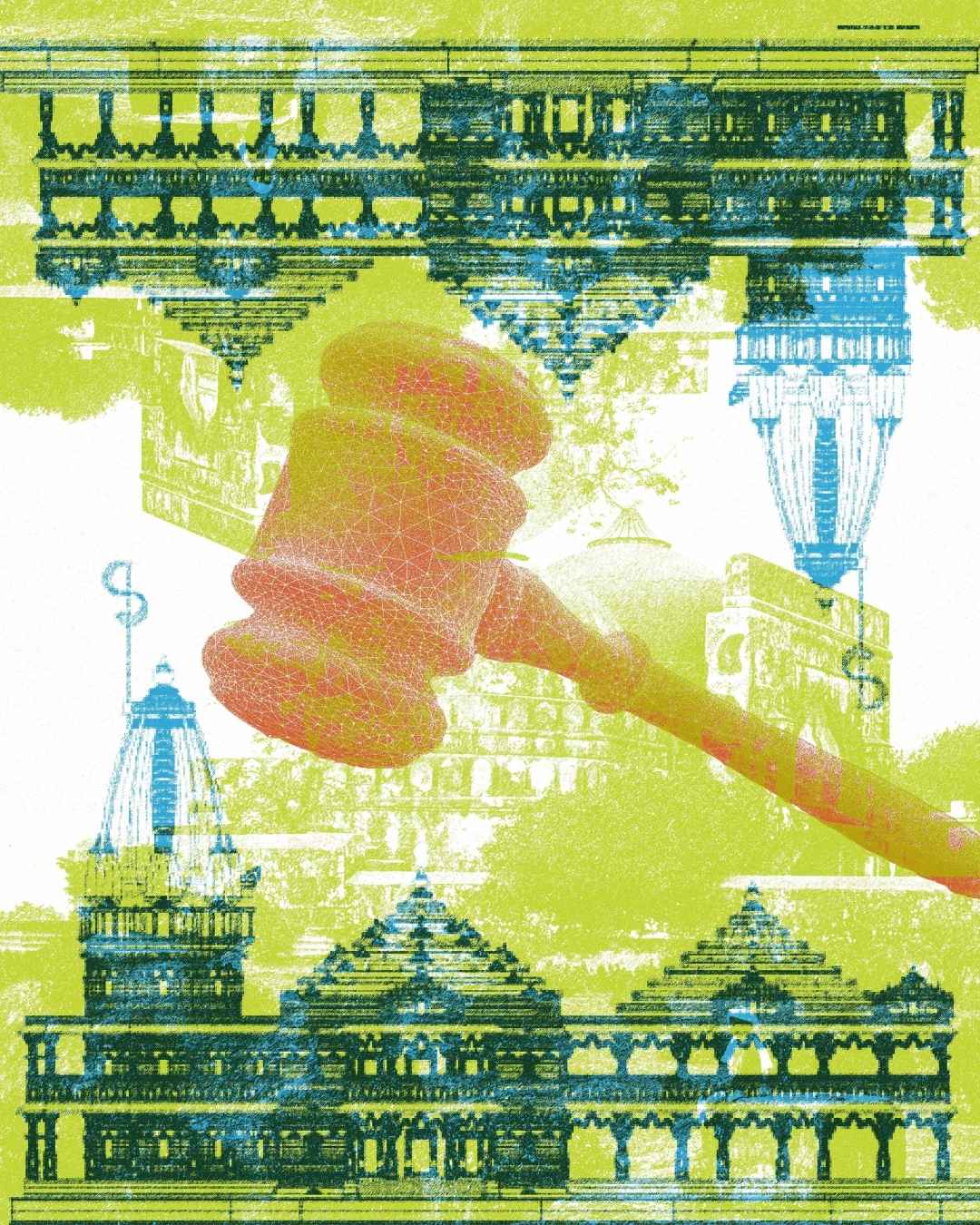
In the last seven years, since the Babri Mosque or Ayodhya judgement in 2019, mosque demolitions have been a systemic practice of Hindu right-wing politics based on land claims for building temples. These destructions have been legally justified through both assertions of pre-Muslim existence of temples and linking such assertions to these places being a ‘birthplace’ of Hindu deities. Though this is critically understood as an assertion of a right-wing interpretation of the Hindu religion, otherwise considered to be a ‘pluralistic’ faith, these assertions of claims over land in the South-Asian subcontinent in fact rest on mythological battlegrounds for political and social control. Within critical legal theory, Peter Fitzpatrick's work argues that modern law should be understood as a form of mythology assertion of racial civilisational narratives. In the subcontinent in particular, Fitzpatrick’s thesis finds its potential but also its limitations. In the sociological context and history of the sub-continent, mythology and the process of making myths i.e. mythologization, is the central principle of constructing social power through the caste hierarchy. However, understanding law as mythology only in racial terms ignores this specificity that has its own pre-orientalist, pre-colonial periphery steeped deeply in the mythos that shaped and defined caste hierarchy. This essay unpacks how understanding caste mythology as part of a racial colonial and thus post-colonial legal discourse becomes important to understand law as mythology in the sub-continent. Thus, conservative judicial decisions on religious claims are not merely about ‘narrow’ interpretations of ‘Hindu Law’ but reveal the historiographic process of caste power as a form of mythology operating across social, political and legal registers.
Caste power, i.e. Brahminism, as Ambedkar states, is the structuring and segregation of the population into a graded hierarchy of social, spiritual and economic hegemony. It is understood by the majority of sociologists and historians as a central organising force in the subcontinent. Religious myths in the Hindu social system, as anti-caste intellectuals Ambedkar and Phule, remind us, are inherently caste myths, as the genesis of caste itself comes to reiterate itself in these stories for the consolidation of caste power. Although the legal or normative claim of ‘caste’ comes in a later period of Indian History through the Dharmashastras, such as the Manusmriti, earlier Vedic myths, such as the Mahabharata and the Ramayana, also assert the Brahminical social structure by tying it to ritualistic practice. Within the Indian context, the shadow of these caste myths looms large through the violence of developmental nation-building of an ethno-racial and casteist state whose foundation is being laid on what scholar Shivangi Mariam Raj aptly describes as the ‘ruination’ of Muslim life-worlds.
Thus, law as mythology operates in post-colonial India as a reassertion of social and political power mediated primarily through the Brahminical, caste-supremacist view of the sub-continent. Here, it is important to understand the underlying logic of myth-making as part of the juridical assertion of land claims made over Babri Masjid. Regardless of the form ‘Hindu’ practice takes, Indian historiography understands the centrality of caste power rooted within the mythological assertions from where textual or codified notions of the ‘Hindu’ religion emerge. In his crucial contribution to Indian Marxist historiography, DD Kosambi centred the cultural materiality of myths as a core aspect of constructing the anthropology, and thus history, of ancient India.2 Folklores and rituals tied to mythology became part of his method to determine how caste as class structured itself in Indian social history. In their own way, organic anti-caste intellectuals such as Ambedkar and Phule have reframed the historiography of India through a counter-reading of Hindu mythology as a colonising one long before Kosambi.
Crucially, from a historical perspective as well, understanding mythology as caste power also unveils how the Muslim subject is racialised and castefied through a Brahminical world-view. Historian Devya Cherian, for example, points out how in pre-colonial Brahminical rule in the Kingdom of Marwar, untouchability was ascribed to both Dalit communities as well as Muslims. Regardless, in the sub-continent, caste also became the social power for Muslim rulers before and after British colonial rule, and continues to this day amongst Muslim communities in India and Pakistan. This became clearer within the codification of personal laws and customary rules, which were rooted in the colonial construction of religion, as caste was understood as an ancient Hindu custom belonging to the ‘Hindu’ community. When it was seen in Muslims, as the case of Khoja and Memon (1846)3 demonstrates, stories or myths of conversion were taken as the basis for ‘keeping ancient customs’. The construction of Muslims through caste was seen as one where they are either a convert or a true Muslim (i.e. upper-caste or Ashraf/Syed). In addition to caste myths of conversion, the court also referred to the racial perception or image of a true Muslim to distinguish between a ‘Syed’ and a ‘convert’ i.e. what does a ‘true’ Muslim do. Concluding on whether caste customs should be upheld for certain Muslims in a later case on a similar matter of caste customs amongst Muslims, Judge Russel described a Muslim convert who practices caste as ‘Living Mohammaden, but a dead Hindu’.4
This description resonates still in how Muslims are viewed as ‘dead Hindus’ by right-wing hindu men who force Muslims to chant Jai Shri Ram and show deference to ‘Hindu’ gods, since it represents the mythological discourse of an ‘ancient India’ as a ‘Brahminical India’. More significantly, it also echoes a lesser heard concern by lowered caste Muslims or Pasmanda scholar-activists, who point out how defining a ‘true’ Muslim inherently becomes an exercise of ‘Sayed/Ashraf’ (upper-caste) assertion. This assertion inadvertently positions Muslims as perpetual outsiders – either in terms of being Muslim converts (or dead ‘Hindus’) or ‘Sayeds/Ashraf’ Muslims (who are linked to an original place of Islam, outside of the subcontinent). Consequently, it is not surprising that conversion becomes the epistemic basis for social rejection and assertion of dignity by Pasmanda and erstwhile Dalit communities. By understanding and practising anti-caste praxis through acknowledging, unravelling and rejecting the attendant mythos of caste, we not only redefine our terms as Muslims but also affirm a political act beyond the caste-racial constructions of religion. Without attending to this reality, Muslims will remain embroiled within the confines of Brahminical violence. When the significance of Brahmanism in shaping who a Muslim is and what place Muslims have in India is ignored, we turn a blind eye to a crucial social force that defines how Islam and Muslims are shaped within and outside the South Asian Muslim community. Keeping in mind the above historiographic practice of anti-caste tradition, as well as the construction of Muslimness through dually caste-racial terms, the juridical claims over mosques are not merely a right-wing monolithic interpretation of ‘Hindu’ religion. In reality, they are assertions of caste power through the reiteration of mythological claims in courts in the form of legal facts.
Thus, in the Ayodhya Judgement, Judge Sharma’s claim that ‘Hindus’ need the land underlying the Babri Mosque to carry out cultural rituals is a claim of caste power that inscribes into law the mythology of Ayodhya as Ram’s birthplace. This claim goes beyond a narrow interpretation of Hindu law, reflecting how caste materialises through juridical frames of reference that naturalise what Ambedkar refers to as the ‘socio-ritual’ nature of Brahminism as caste power. Post-colonial analysis by legal scholars such as Ratna Kapur ultimately fails to explain the conditions under which Ayodhya comes to be, as it ignores the central relationship between myths and caste (Brahminism) in the construction of religion. Legal claims regarding the destruction of mosques based on Hindu ritual practices and the corporeality of Hindu gods enabling ‘land ownership’ do not merely reflect a ‘right-wing’ appropriation of the ‘right to religious practice’ as Kapur argues. The judgment, as well as the related political violence against Muslims outside of the juridical sphere, revolves around assertions of Brahminical mythologies surrounding an ‘ancient India’ that is inseparable from the caste order.
The Ayodhya decision in 2019 is then not only about an extremist strand of the ‘Hindu’ religion asserting nationalistic power, given that the history of Hindutva exemplifies supremacist notions of nationhood. What is actually at stake is the centrality of caste myths that are foundational to caste as a category of difference itself, and in the case of the subcontinent, centre on Brahminism. In the current context, it is difficult to imagine how any liberatory politics in India can broach the existential question of political solidarity without understanding and annihilating the structure of caste. Such a task is, however, necessary, and requires the unravelling of the socio-ritual power of Brahminism’s mythos materialising in social and political dominance.
References:
- 1) Kapur, R. (2024). The Ayodhya case, freedom of religion, and the making of modernist ‘Hinduism’. Contemporary South Asia, 32(1), 10-25.
- 2) Kosambi, Damodar Dharmanand. Myth and reality: studies in the formation of Indian culture. Popular Prakashan, 1962.
- 3) Memon and Khoja Case, Hirabae and ors v. Sonabhae and ors, 4 I.D. (O.S.) 100
- 4) Rashid Karmali v. Sherbanoo (1904) I.L.R. 29 Bom. 85