
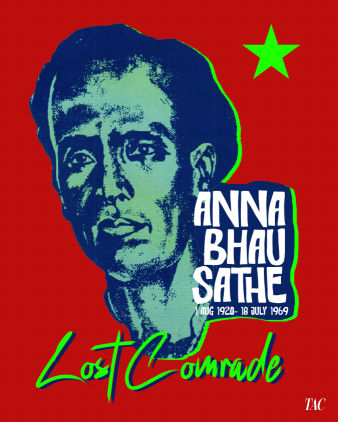
He was born poor and died poor, like his ideal Marx. But ask any thinker or artist: was his life rich? Artists and thinkers live and die reimagining the world. We made a mockery of his death. He is unworthy, you say, because he died drinking, in destitution. Yet many thinkers and artists have met such deaths, and it is no less unfortunate for that. He did not die of alcohol. He died of the failure of family, devoid of care and love. A great writer, in whose speech he proclaimed the right of the Dalit to have a family, and what an alas it is, that he should die without that care himself. Even before his death he insisted on self-respect and self-worth, rejecting the Congress leader's offer for the sake of his ideology, holding firm to what he believed: the emancipation of the working class, of Dalits, of women. I will die eating soil, he said, but I will not live at anyone's mercy. If drinking was immoral by the morals of the world, then at the very least he had the right to reclaim his own morality. He died of the stress and failure of his material life, and like his own characters, he had to reclaim his evil. At least he deserved that.
Sathe's life was full of hardship. The brutality of the Brahmin teacher drove him from school, though he had barely been enrolled, on account of his caste. Yet on the second day, leaving school, he rebelled against his Brahmin master by throwing a stone back at him. His life was his teacher. He learnt to write on the roads, in the slums of Bombay, in the girni kamgar mills. Even from such a state, without formal education, by force of extraordinary thinking, he wrote thirty-five novels, numberless short stories, and ballads.
Where the mass of Mangs were dispossessed of their own history, Sathe became one of the first well-known stories of their glory. The reality of caste for the most marginalised is that caste is their belonging. And for them, there was no story within. If consciousness was of caste, then the story too had to come from caste, in order to awaken caste against caste. In the absence of history, every story is opium for the masses. The story of Sathe and his characters shaped the self-worth of Mangs. Mangs had never seen such a figure; his story became their pride.
Working among Mangs, the one courageous story that appealed to me was the story of Fakira, a story with more potential even than Sage Matanga. Those ballads of childhood carried us to Wategaon, to Valubai, to Fakira’s great robbery against the British. That story created pride among Mangs. Fakira was our hero, and that courageous imagination trickled down into our lives only because of Annabhau Sathe.
Within days of his passing in 1969, Sathe’s name began circulating across the Mangwadas. Within three decades it reached ours: 1992, when my father and his friends first celebrated Sathe’s Jayanti. Sathe did not give rights to Dalits but in his stories he reclaimed those rights, and reclaimed humanity. He gave justice to the stories of working-class Dalits.
My father tells me his first organisation was the Annabhau Sathe Foundation. For the Jayanti, the whole Mangwada would begin planning a month in advance. Every household contributed money, even in destitution. My father used to take permission from the police. Every year there was an argument over whether to invite an orchestra, that sophisticated name for Tamasha, or a Shahiri troupe. Only later did I understand that my father was an activist: he would invite activists and leaders to speak. He even wrote speeches for me; I would memorise them and deliver them each Jayanti. Before the DJ, the Mang boys performed dandpatta. The whole Mangwada, dancing, would be immersed in haldi, the bhandara. For the Jayanti we bought clothes, or at least ensured that what we had was washed well beforehand. We made small bracelets of beads, yellow and red. The yellow flag with the red sun at its centre, the sword, the dandpatta, the pen, the horse: these were the symbols of Mang life. From Pandharpur people brought badges bearing Annabhau's photograph on a yellow-and-red ground, and sometimes handmade badges with red and yellow stripes and his photograph at the centre. Each year we preserved those badges for the next. Before Sathe, there was no well-known memory of such a figure among Mangs. Later, the Jayanti of Sathe brought Lahuji too into the public sphere.
Sathe’s life and career need justice, at the very least from Dalits. In a time when Mangs had no cultural icon, Sathe – a comrade, a staunch communist – became the first. For Mangs, Sathe is a hero; and a hero, too, has a master. If politically and ideologically he was committed to communism and to Marx, he was also inspired by Ambedkar and submitted himself to his authority and thought. Whenever Mangs imagined Sathe, they imagined Ambedkar too and that is how Ambedkar came to the Mangwada. Not in his lifetime, but in death, Sathe carried a force of ideas that could lead us back to our emancipator. His iconic lines Jag Badal Ghaluni Ghav, Sanguni Gele Mala Bhimrao were among my earliest encounters, in childhood, with our relation to Ambedkar.
The feud between communists and Ambedkarites, however, never let Sathe escape his identity. He was reduced not merely to Dalit but to Mang alone and to Marxist. The insistence on his being Mang, his being alcoholic, his being Marxist: these were the greatest injustices of his life. Slowly, he was reduced to apolitical titles: Lokshahir and Sahityaratna. He was proud to be a comrade. Yet the communists abandoned Sathe’s legacy, and the Ambedkarites abandoned his ideology and his activism. This feud produced today’s alter-image of Sathe: Lokshahir Annabhau Sathe. A lost comrade would have been far more revolutionary for Mangs than today's Lokshahir. Rarely is his activism, beyond his cultural work, discussed at all.
Sathe’s life needs honest reflection, his context, his ideology, and his iconisation, with all its potencies and limitations. Dalits and the working class must be proud of Sathe, and must own him with his limitations. On his death anniversary, I remember Comrade Annabhau Sathe. I claim him as Comrade.