
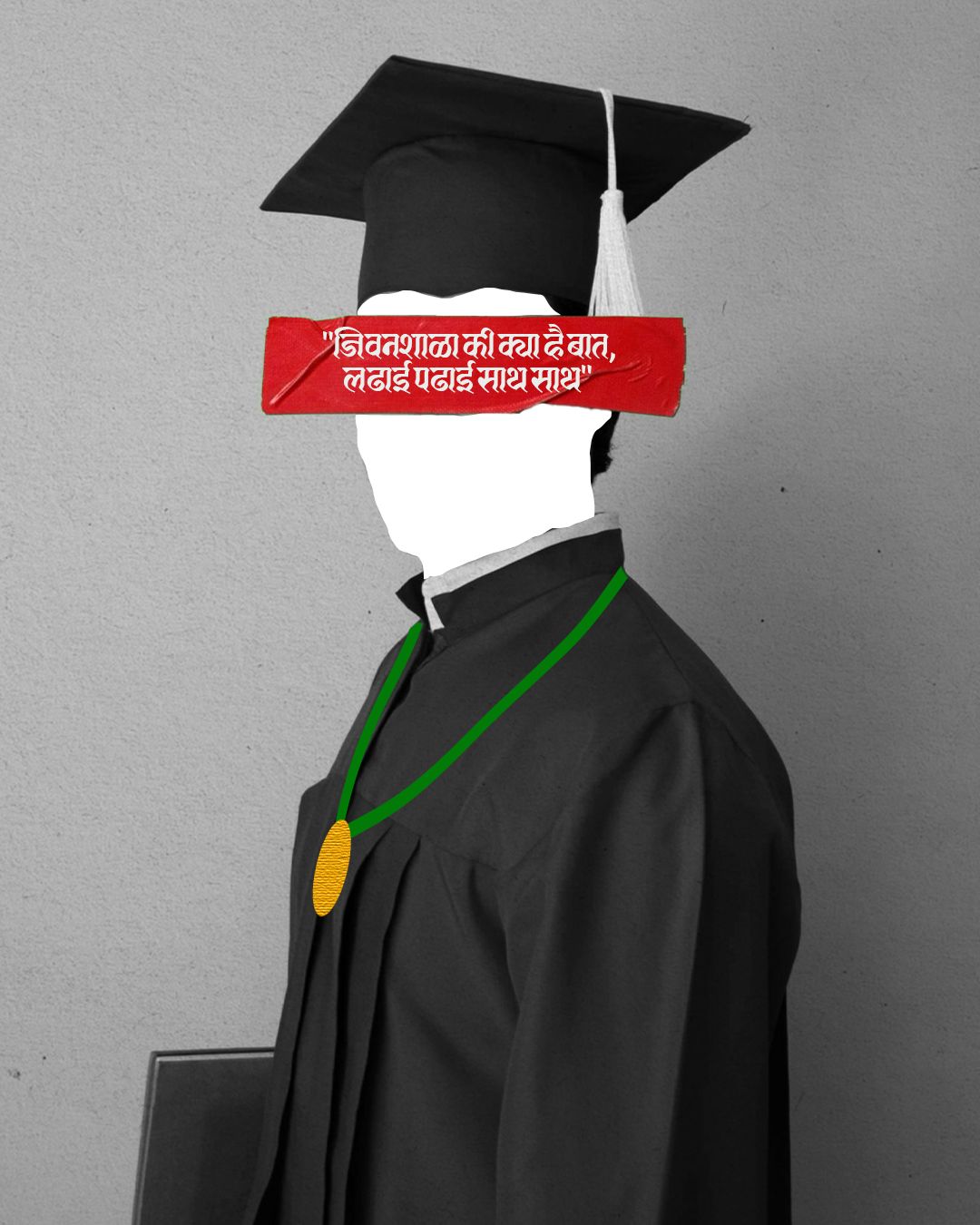
It must have been 5 July 2014. I am quite sure it was a Saturday. The day before, at the weekly market in Walpur, Madhya Pradesh, Baba bought me a slate, a pencil and a new dress for school. I used the slate that very evening. I could not sleep properly that night. I kept thinking about school. What happens there? What will I do? I woke up before the rooster. Mother emptied the vegetables and snacks from Baba’s market bag and put a plate, a tumbler, my slate, pencil and some old clothes inside. Baba emptied the trunk in the corner of our house and put two sheets in it for me to sleep on. I wore my new school dress and was ready. I was the first child in my family to go to school. On the way, Baba told me about a teacher he knew. He explained how much salary the teacher received, counting and multiplying on his fingers. At that time, I did not understand why he was telling me this. Now I understand. For Baba, education was not just about reading and writing. It was a way of imagining a different life for his son. We reached the school around noon. The students were playing outside. I did not care much about what Baba and Guruji were discussing. I was watching a Lagori match between Bhadal and Khaparmal. Bhadal won. The boys started dancing, and I joined them because I was from Bhadal too. That was my first school memory. When government schools could not reach our villages in the Narmada Valley, the Narmada Bachao Andolan started Jivan Shalas for children like us. We studied in Pawari, our own language. We used to say, “Jivanshala ki kya hai baat, ladhai padhai sath sath.” (What’s special about Jivanshala? Learning and fighting go hand in hand.) For me, Jivan Shala was like a second mother.
In Class 2, Guruji used to read Dr. Rajendra Bharud’s Mi Ek Swapna Pahila and explain it to us in Pawari. I listened carefully to his story. Somewhere in my mind, I decided that I too would become a Collector. I did not know what a Collector really did. I only knew that I wanted to become one. By Class 4, I understood that if I wanted to continue studying, I would have to leave my village. Then came the questions. Where would I stay? What would I eat? Who would pay for my travel? In our community, child marriage was also common, and some people believed that studying for too long made children lazy. My family had started thinking about my engagement after Class 4. I felt that studying in the city was the only way to avoid that future. That is how the Krida Prabodhini (state-supported sports academies) entered my life. I had to pass the Battery Test. I was selected for the district-level test, but on the day of the examination, I was at home. My cousin came running to give me the message. By the time we reached school, the other students had already left. We ran towards Bilgaon. There was no proper road beyond it. We walked and ran for almost twenty-five to thirty kilometres. My right toe was injured, and the nail had lifted, but I kept going. I passed the test and was selected for Sports Prabodhini at Gadchiroli. For a boy who had hardly left his village, travelling across Maharashtra was a big thing. The movement helped me with travel, and the Sports Academy covered the athletes’ expenses. I started training seriously. I reached the state level within two years. My name was announced at school functions, and people clapped for me. For some time, I thought sports was going to be my life. I even started dreaming about the Olympics.
Then the pandemic came and everything stopped. We returned home. In my village, there was not even a proper path where I could practise running. I had reached the state level, and suddenly I was back home doing almost nothing. During this time, I spent a lot of time at the movement’s office in Dhadgaon. I started learning English. Until then, English had always frightened me. I also discovered books. The office library became important to me. I read about Babasaheb Ambedkar, Mahatma Phule, Savitribai Phule, Gandhi, Nehru, Sardar Patel, Rajendra Prasad, Ram Manohar Lohia, Birsa Munda and Tantya Mama. I noticed that many of the people who had played important roles in the freedom movement were lawyers. Slowly, I started thinking about law. After the lockdown, I returned to sports. I won a bronze medal in the 400 metres at the State School Athletics Competition in 2022-23 and came 13th in the country in the triathlon at (National Inter-District Junior Athletics Meet) NIDJAM in Patna. I was still competing at district, divisional and state levels. But my thinking about sports had started changing. One incident affected me deeply. At a state athletics championship in Nashik, I came first in a 600-metre final after two other runners collided near the finish. According to the rules, the race was finished. I went back to the hostel and ate my meal. Two hours later, I was told that the race was being conducted again. I returned and finished fourth. Later, I learned that one of the athletes who had fallen was the son of a coach affiliated with the athletics association. I cannot forget that incident. I began looking at sports differently. There were other problems too – doping, lack of food supplements, money problems and, most importantly, my old dream of becoming an IAS officer. I knew that if I stayed in sports for too long, I would lose time for studies. So I left sports. It was not an easy decision. I had once dreamed of the Olympics. Now I was preparing for CLAT.
I shifted my Class 12 admission from Nashik to Dhadgaon and worked as a caretaker in a student hostel. My work included waking the children, leading prayers, supervising studies, taking sick children to the hospital, maintaining records, and doing office work. Alongside all this, I had to prepare for Class 12 and entrance examinations. My college attendance was very low due to practical difficulties and a shortage of teachers. Then came the board examination. CCTV cameras had been installed at the centre. Everyone was tense. But when the cameras were switched off, slips were openly distributed in the examination hall. Some students received special treatment. The next day was similar. I kept writing my own paper. In the end, I passed Class 12. I was the first person in my family to do so. I was also the first student from my small Pada to pass Class 12. In our area, even today, many children do not have birth certificates, and many do not attend school. This became important later when I was asked to produce documents of my ancestors.
I needed a Scheduled Tribe caste validity certificate for higher education. I collected every document that I could find. I had my caste certificate, birth certificate, school records, my grandfather’s caste certificate and Village Form 7/12, my father’s caste certificate and records, and the caste validity certificate of my cousin brother, who was a blood relative from my father’s side. Still, when I went to the Scheduled Tribes Certificate Scrutiny Committee in Nandurbar, I was asked, “Where is the caste proof of your ancestors?” I did not know what to say. My grandparents and parents were illiterate. Our village records are incomplete. Many people around us do not even have basic birth records. How was I supposed to produce documents from before 1950? I searched for answers myself and found a Bombay High Court judgment concerning the caste validity of a blood relative on the father’s side. I read the judgment carefully and submitted another application with the relevant documents. My file was accepted, but the certificate still hasn’t arrived. On 29 June 2026, I went to the Committee again. I was again asked to bring caste proof of my ancestors. I came back with the same question in my mind: what more can a poor family produce? At the same time, I was preparing for CLAT. I had left sports to study law, but CLAT required strong English skills. I came from a place where nobody in my family spoke English. The first few months went mainly into learning the language. I was also working, preparing for boards and helping with the hostel. When I reached the CLAT centre in Pune, I saw students sitting with their parents, some praying, others crying. I entered the examination hall. The two hours passed quickly. I came out disappointed. The result was also disappointing. But I still had other examinations – MH-CET Law and APU. I spent some time travelling to villages and working with people on social issues. I closely monitored government schemes and helped families with housing-related work. I also worked for some time to earn money. It was difficult to decide what to study for. Board examination or entrance examination? I kept asking myself the same question. I appeared for APU in Mumbai and later for MH-CET. While waiting for the result, I applied to colleges. I was admitted to one college, but immediately another problem arose: where would I stay? The fee had to be paid before the CET result came. The fee was arranged. The next day, the CET result came and opened new possibilities for me. Once again, I felt that I had not travelled this far alone.
I often think about entrance examinations. They are supposed to give everyone an equal opportunity. But is the opportunity really equal? One student may have good English, expensive coaching, a laptop, internet access, books, transport, and people to guide them. Another may start with a slate, a small village school and no one in the family who has been to college. Both are then given the same question paper. I sometimes think of it like a race between a fish and a rabbit. We tell both to prepare for the same race, but we do not ask whether the race suits both. I also remember the story of the forest school, where every animal is trained in the same skills and then tested. The foxes are naturally good at those skills, so they get the important positions. We call it equal opportunity because everyone took the same test. But giving everyone the same test does not mean everyone started from the same place. For children from Adivasi, Dalit and poor communities, the struggle often begins much earlier. Their language may not be part of the system. Their schools may not have teachers. Their families may not know about scholarships, colleges or entrance examinations. They may not have money for coaching. Many may stop dreaming before they ever reach an examination hall. My own life has been a series of such examinations. My first examination was the Battery Test, because I needed it to continue my education. Then came sports, where I reached the state level. Then came the decision to leave sports. Then CLAT, APU, MH-CET and Class 12. Alongside all of them was the struggle for a caste validity certificate. I have walked long distances, travelled across Maharashtra, learned English from the beginning, worked while studying and searched for documents that my ancestors could never have created. I do not say this to ask for sympathy. I only want people to understand the distance behind the result. An examination measures what a student writes in a few hours. It does not measure the years that brought that student to the bench. I still want to study law. I still want to prepare for the UPSC examination. I do not know how far I will go, but I know where the dream began. It began at Jivan Shala, when a teacher translated a book into Pawari, and a boy from Bhadal decided he would become a Collector. Since then, the dream has changed many times, but it has not disappeared. I was once a child who did not know what school was. Today I understand that education is not only about passing examinations. Sometimes it is about fighting to remain in the race. Sometimes it is about finding a way when there seems to be no way. I began with a slate. I am still walking. And I do not think this is the end. As the Marathi poet Suresh Bhat wrote, “Even if I am extinguished today, this is not my end; tomorrow I will rise anew; this strength is not mortal.”