
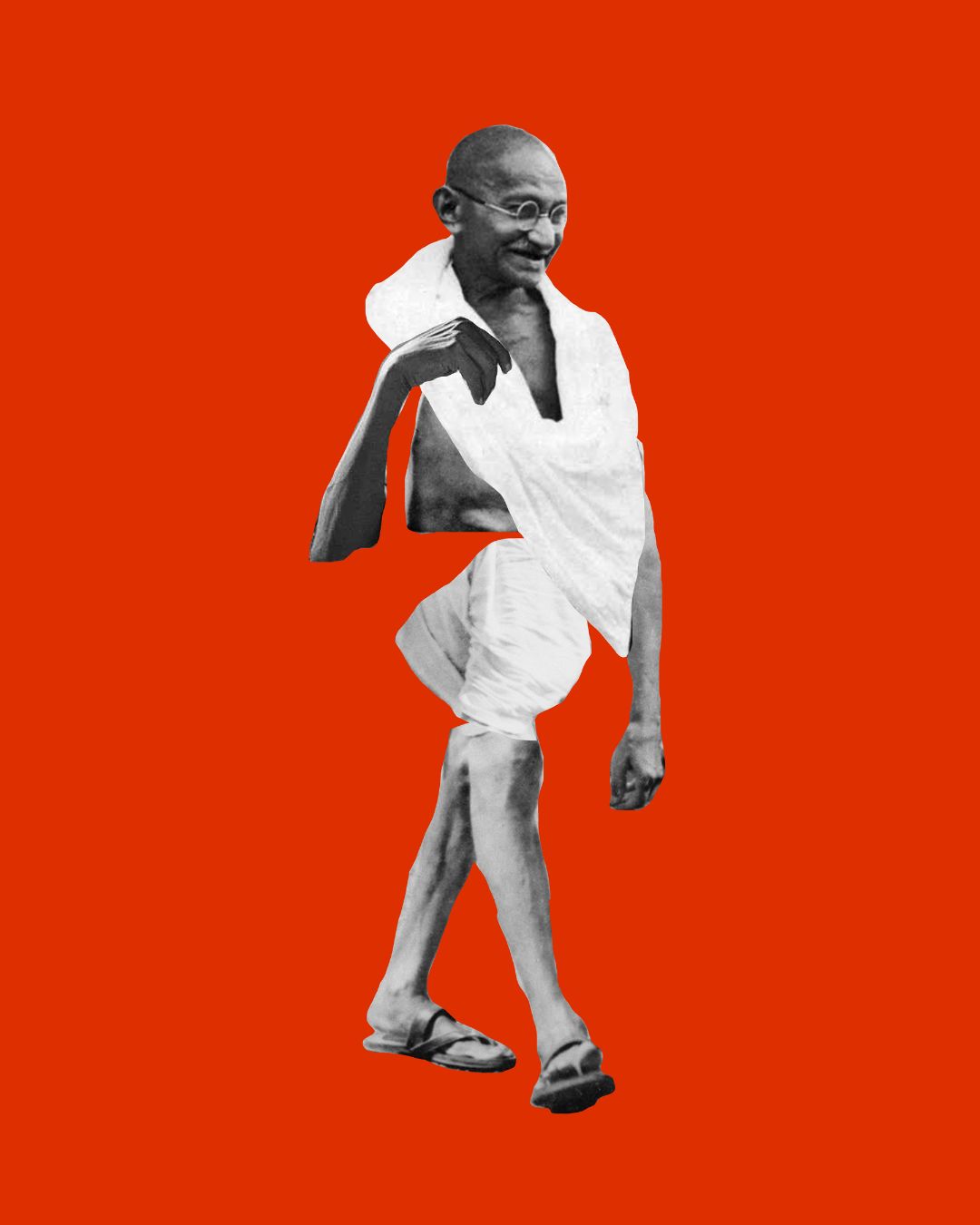
“A just society is that society in which an ascending sense of reverence and a descending sense of contempt is dissolved into the creation of a compassionate society.” – B.R. Ambedkar.
A few years ago, staff at the Gandhi Research Foundation in Jalgaon opened a trunk at Kasturba Ashram in Indore and found a decaying handwritten diary. It belonged to Kasturba Gandhi. Nine months of her life, from January to September 1933, were written in Gujarati in her own hand. Her great-grandson, Tushar Gandhi, transcribed and translated it as The Lost Diary of Kastur, My Ba (HarperCollins India, 2022).
For a woman routinely dismissed in her own lifetime as illiterate, the diary is not merely a curiosity. It is an archival event. And as we mark Gandhi’s 157th birth anniversary on 2 October, 2026, it is worth asking why an event of this magnitude, proof that Kasturba authored her own record of imprisonment, satyagraha and survival, has done so little to unsettle the terms on which she is remembered.
In her article “Married to the mahatma: The predicament of Kasturba Gandhi,” the historian Emma Tarlo captured the problem starkly: “We cannot read Kasturba Gandhi; we can only read about her.” Ramachandra Guha’s biographical work has done more than most to recover her resistance, her political participation, her repeated imprisonments as a satyagrahi in her own right, not merely as the Mahatma’s dependent. Yet the greater difficulty is not that Kasturba lacked a voice. The archive is full of her disagreement, her defiance, her independent judgment. The difficulty is that this agency has almost always been metabolised into Gandhi’s own account of himself. He could write that she resisted his will, that she became his “teacher” in non-violence, that she had “chosen to lose herself in me,” and each of these admissions, however generous, folds her resistance back into the story of his moral development. She has the spine of the story. He retains his authorship.
Gandhi and Philosophy
Shaj Mohan and Divya Dwivedi’s Gandhi and Philosophy: On Theological Anti-Politics (2018) moves away from the binaries of the postcolonial-versus-Hindu nationalist framework that dominates scholarship on Gandhi. The duo employs the Kantian term “hypophysics” for the systematicity in Gandhi’s thought, which is traced through the ideas of will, truth, non-violence, authority, resistance, and anarchy, and, as one library catalogue record confirms, is about a sustained treatment of Kama examined independently of desire and pleasure. The review of the book by J. Reghu in The Wire further notes their reading of Gandhi as opposed to multiple laws defining a single phenomenon, a near-mathematical view they term “polynomia.” Reading them together, Gandhi comes to us as a character thinker who is striving for inner discipline and an outer system that spans the body, tongue, and authority. And no one was more tightly bound within this system than his own wife, Kastur Kapadia, who was the very person his marriage vow obliged him to protect. Like the Yam between two boulders, Kastur was ground between two immovable stones, which were Gandhi’s political will and her wifely duties.
This asymmetry becomes sharper once Gandhi’s philosophy of Swaraj is placed beside the life of the person who had to live inside it. Swaraj, for Gandhi, was never simply national sovereignty; readings by Shaj Mohan and Divya Dwivedi, and by Faisal Devji, have shown how thoroughly it was a philosophy of self-rule, i.e., Swaraj over body, will and desire; brahmacharya, dietetics, fasting, anger, possession, all disciplined in the name of truth. But self-rule is never wholly private when someone else has to live with its consequences. Gandhi’s vows reorganised his marriage. His experiments in celibacy, most notoriously his practice in his final years of sleeping beside young female relatives, including his grandnieces Manu and Abha, to test his mastery over desire, were framed by Gandhi himself in the language of dharma: “For me, Manu sleeping with me is a matter of dharma.” Contemporaries were not silent. Vallabhbhai Patel warned him that such practice was adharma; associates resigned in protest. The episode is now widely read, in Guha’s own account, among others, as a serious ethical failure, inseparable from the enormous imbalance of power, age, and reverence between Gandhi and the women involved.
Swaraj as a Discipline of Wanting
In Hind Swaraj, Gandhi’s objection to modern civilisation is not primarily that it is unjust but that it is insatiable. Railways, lawyers, doctors and machinery do not merely fail to solve India’s problems; for Gandhi, they manufacture new wants faster than they can be met, and a society organised around the manufacture of wants is a society that has lost self-rule, at the most basic level, over its own appetite. In this reading, khadi is not simply an economic programme. It is a technology of restraint: a discipline that limits what a person is permitted to consume, produce and desire, in the name of a higher, national self-control.
This is precisely the same vocabulary Gandhi used for the body. Shyam Pakhare’s study of Gandhi’s model of masculinity in “Gandhi’s Model of Masculinity in the Backdrop of Colonial India” notes that Gandhi wanted India to become “a celibate nation,” believing that the unchaste man “loses stamina, becomes emasculated and cowardly.” Fasting and dietary restriction were understood in the same register: control of the palate as “the first essential rule” of celibacy, food that should be “limited, simple, spiceless.” Restraint of the sexual appetite and restraint of the economic appetite were, for Gandhi, the same virtue practised at different registers of the self. A nation that could not govern its want for foreign cloth was, on his account, of a piece with an individual who could not govern his want for a woman’s body. Both failures were failures of will. Both were remedied by the same instrument: discipline, exercised by someone with the authority to define what counted as excess.
Gandhi and Carnal Desire
For Gandhi, the idea of Brahmacharya (Celibacy) was a political instrument and not a private virtue. Such a view stemmed from his belief that sexual restraint was linked to his capacity to be a perfect Satyagrahi. This came to a head on 3 December 1935 at Wardha. He was approached by Margaret Sanger, who had sought Gandhi’s endorsement for contraception. Gandhi responded with a rejection; he feared that this would loosen restraint, and instead offered the rhythm method of contraception as a concession.
Ramchandra Guha’s biographical work on Gandhi further complicates this. On the final day, he was disturbed by the violence in the Noakhali riots. What came out was Gandhi sleeping unclothed beside his young companions, including his grandniece Manu, an act described as a test to conquer his desire. Guha further spoke to The Print, saying he found it genuinely strange. The academic treatment of this takes a more sympathetic view. Gandhi attributed the violence around him to his own imperfections, and Sushila Nayar (Gandhi’s personal physician and the sister of his secretary, Pyarelal) later said that sharing a bed with Gandhi was like sharing a bed with her own mother. There is a gap that this brings between these readings, a clinically weird self-experiment against moral aberration; this comes as a tension worth noting. Gandhi is a man who is constructing the philosophy of self-mastery through the most outlandish and odd methods that even the most sympathetic of his biographers may consider outwardly strange.
Desire, Discipline, Dominance
Read together, Gandhi’s economics of restraint and his sexual asceticism describe a single political technology: a claim to decide, on behalf of others, how much wanting is legitimate, exercised by a figure whose own authority depends on being seen to have mastered wanting more completely than anyone around him. This technology does real political work. It is genuinely difficult to overstate what non-violent mass mobilisation against an empire, organised around collective self-restraint, has achieved. But the same technology also does the work caste has always done in the subcontinent: it produces a hierarchy of who is disciplined enough to be trusted with authority over the body. His own and others’, and it does so using a vocabulary of purity that caste supplies ready-made.
When Gandhi asked all of India to become “a celibate nation,” disciplined in the mould of the satyagrahi, he was – whether he intended it or not – asking the nation to aspire to a Brahminical body as the political body, leaving the question of legitimate desire exactly where caste has always kept it: with the purity-keeper, not the labourer who cleans up after him.
Gandhi, Language and Access
Gandhi’s work, Hind Swaraj, originally written in Gujarati in 1909, argued that learning English would enslave them, a view that stemmed from the educational foundation laid by Macaulay. However, Gandhi states that it was not Macaulay’s intention. Recent scholarship frames Gandhi’s position as linguistic swaraj, in which the idea of Self-rule has been extended to thought as well.
The bilingual corpus of his work produced a genuinely divergent practice; it was not a mere repetition that he did across English and Gujarati. By repetition here, it means exact bilingual duplication: the English simply restating the Gujarati’s meaning word for word, with nothing lost or reshaped during the translation process. Ajay Skaria has noted an important aspect here: the English translation that Gandhi made of his works in Gujarati shows a tendency to drop words or phrases, or to shift connotation. Tridip Suhrud’s critical edition of the Autobiography, which has been discussed in The Wire article, shows us this closely: the English text’s blunt disclaimer of the “finality or infallibility” is, in Gujarati, a longer, more hedged formulation.
Is Gandhi conservative for his Gujarati readership and more for the English? Checking against the record of such a claim does not survive the scrutiny stated. But instead, what is documented is the differentiation between the audience being catered to and the one that is not, not about doctrinal contradiction. Ambedkar argued that Gandhi’s biographers relied primarily on Gandhi’s writings in English, such as the Harijan and Young India, rather than his writings in Gujarati. A review of the Collected Works of Gandhi found this assumption mistaken because of authentic compilations. In 1917, Gandhi rebutted the orthodox Gujarati periodical over his attendance at the Antyaj conference in Godhra. Gandhi wrote in Navajivan that for two thousand years Hindu society had carried a “load of sin” because of untouchability, a moral burden that caste Hindus now had to acknowledge and repay by abolishing the practice. He called the orthodoxy that defends such a practice outright hypocrisy. This stance would recur in his later works on Navajivan and Harijan, rather than diluting language for an orthodox readership. The dualism that exists is documented rather than outrightly asserted: Skaria found that Hind Swaraj’s Gujarati original critiques “history” while separately naming ithihaas, a distinction that Gandhi’s own English translation collapses into one word. Suhrud found that the Gujarati text privileges Atmakatha, “the story of a soul”, over mere chronicle. The English title, which leads with the generic word “autobiography,” obscures this priority. This remains worth taking up. Why was such a method adopted, and what did it cost the reader who could only follow him in one of the two languages?
Kasturba occupies the unstable space this history opens up. She was not the submissive wife of nationalist hagiography, nor simply a hidden feminist heroine awaiting rediscovery. She organised sanitary drives, ran cottage-industry initiatives, courted arrest, served her own prison sentences twice in 1933 alone for her own acts of civil disobedience, not as an appendage to her husband’s. Partha Chatterjee’s account of the nationalist “new woman,” confined to an inner, spiritual domain of the household while men occupied the outer, political one, does not quite hold for her: the Gandhi household was never outside politics. It was one of the sites where Gandhian politics was lived, negotiated, and at times imposed. The very qualities through which Kasturba earned authority, endurance, service, and sacrifice were also the qualities that made her legible chiefly in relation to him.
“Ba” is an intimate name. It is also a way of turning a political actor into a maternal one, whose authority is relational rather than her own.
This is why the diary matters, and why it should matter more than it currently does, ahead of a birth anniversary that will inevitably return Gandhi to the centre of the conversation. Its significance is not that it proves Kasturba could think and feel; the documentary record already establishes that. Its significance is epistemological: a sustained record in her own hand shifts the scale of the available archive, and unsettles the long-standing assumption that Gandhi's writing can serve as the primary medium through which her life becomes knowable. The question worth asking this October is not whether Gandhi was a saint or a hypocrite; that debate is exhausted. It is who gets to author history, whose writing counts as evidence, and what it does to a person's political legacy when the person who lived alongside them finally begins to write for herself.
References
Ambedkar, B. R. (1936/2014). Annihilation of Caste. Navayana.
Guha, R. (2019, interview with NPR). In Frayer, L., “Gandhi Is Deeply Revered, But His Attitudes On Race And Sex Are Under Scrutiny.” NPR, 2 October 2019.
Guru, G. (2017). How Egalitarian Are the Social Sciences in India? Economic and Political Weekly (Engage), 52. Madras Courier (n.d.).
“Gandhi Slept Naked With His Adolescent Grand Nieces to Test His Sexual Urge. Are His Perverse Celibacy Tests Justified?” Gandhi’s Model of Masculinity in the Backdrop of Colonial India. Gandhi Marg, 37(2).
Gandhi, M. K. 1909. Hind Swaraj. Chapter XVIII, “Education.” Reproduced at MKGandhi.org.
Ghosh, Soumya Sankar. 2026. “Linguistic Swaraj: Gandhi’s Vision for Language and National Identity in a Pluralistic India.” National Identities. Published online 15 March 2026.
Mohan, Shaj, and Divya Dwivedi. 2018. Gandhi and Philosophy: On Theological Anti-Politics. London: Bloomsbury Academic.
Reviewed in: The Wire. n.d. “Book Review: Gandhi as Chrysalis for a New Philosophy.”
Jindal Global University Library. n.d. Catalogue record, Gandhi and Philosophy: On Theological Anti-Politics.
NPR. 2019. “Gandhi Is Deeply Revered, But His Attitudes On Race And Sex Are Under Scrutiny.” Reported by Lauren Frayer, 2 October 2019.
ThePrint. n.d. “Mahatma Gandhi’s Little-Known Love Affair With a Married, Progressive Woman in Lahore.”
ThePrint. n.d. “Ambedkar Was Wrong, Gandhi Wrote Against Untouchability in Gujarati Journals Too.”
Lal, Vinay. 2011. “The Sexuality of a Celibate Life.” The Asian Age, 1 May 2011; reproduced at UCLA Centre for India and South Asia.
Margaret Sanger Papers Project, New York University. n.d. “Gandhi and Sanger Debate Love, Lust and Birth Control.”
Gandhi, M. K. 1909. Hind Swaraj. Chapter XVIII, “Education.” Reproduced at MKGandhi.org.
Skaria, Ajay. 2014. “Gandhi’s Radical Conservatism.” Seminar, no. 662.
Skaria, Ajay. n.d. Tag archive entry on Unconditional Equality: Gandhi’s Religion of Resistance. Kafila.
Suhrud, Tridip, ed. and intro. 2018. M. K. Gandhi, An Autobiography or The Story of My Experiments with Truth (Critical Edition), trans. Mahadev Desai, foreword by Ashis Nandy. New Delhi: Penguin Random House India; New Haven: Yale University Press.
Reviewed in: The Wire. 2018. “Who Wrote Gandhi’s Autobiography of Errors?” 5 August 2018.
Gandhi, M. K. 1954. The Removal of Untouchability. Compiled and edited by Bharatan Kumarappa. Ahmedabad: Navajivan Publishing House.
The Wire. n.d. “Who is a Sanatani Hindu? Here’s What Gandhi Had to Say.”