
J J Nandakumar in his painting titled Gandhi after Pune Karar (2009) portrays Gandhi’s walking stick as a trident whose end pierces through the body of a Dalit. Inspired by the Poona Pact, Gandhi is depicted as the destroyer of political rights of the depressed communities by blackmailing Babasaheb Ambedkar into signing the pact. The art depicted Gandhi in red, his round-rimmed Windsor style glasses that generally evoke a Nationalist sentiment of a fatherly figure, is transformed in Nandakumar’s choices of palette to a sinister one. Whereas the bodies lie on the floor in the background are rendered in different shades of blue. Nandakumar’s paintings were deemed as too provocative and taken down from the Nehru Centre Art gallery, Mumbai in 2019 where they were being showcased, following Hindutva protests. In a painting titled Dalit Pissing on Manu by Savi Sawarkar, you see the titular action taking place in a sketch-like portrait of a Manu with his face – in a typical caricature of a Brahmin – centered in the frame as only a phallus of a Dalit is shown to piss on him with the temples and their flags flowing in opposite directions in the background. Another painter Jaya Daronde in her 2009 painting Relationship portrays, what at least I conceive as, a very discomforting relationship between a Brahmin male and an “untouchable” girl. The theme of this relation is explored in one of Gogu Shyamala’s collection of Telugu stories titled Deepasundari (A Beauteous Light), when a Brahmin boy falls in love with a Dalit woman, she is aghast at his audacity and rejects his proposal – which in turns makes him impure, for which his Brahmin family performs penance and purification. In his poem Nimita 15 August, the poet Namdeo Dhasal questions the end of British colonialism for Dalits in India: “Where is this donkey named independence? In which tenement of Ramrajya do we live?” Sarang Punekar, the iconic transgender activist from Pune, during the CAA-NRC protest gave us the slogan “Bajao Pungi, Hathao Sanghi”. If Samta Kala Manch gave us a Halgi-infused protest song “Manavta Ko Chale Raundne Jute Maro Sanghiyo Ko..” (Those who trample humanity, beat them with shoes), anti-caste singer Sheetal Sathe in a ballad sings soulfully about Ambedkar’s legacy as a quilt passed down by ancestors to wash in a song titled गोधडी झाली जुनी (My quilt is worn).
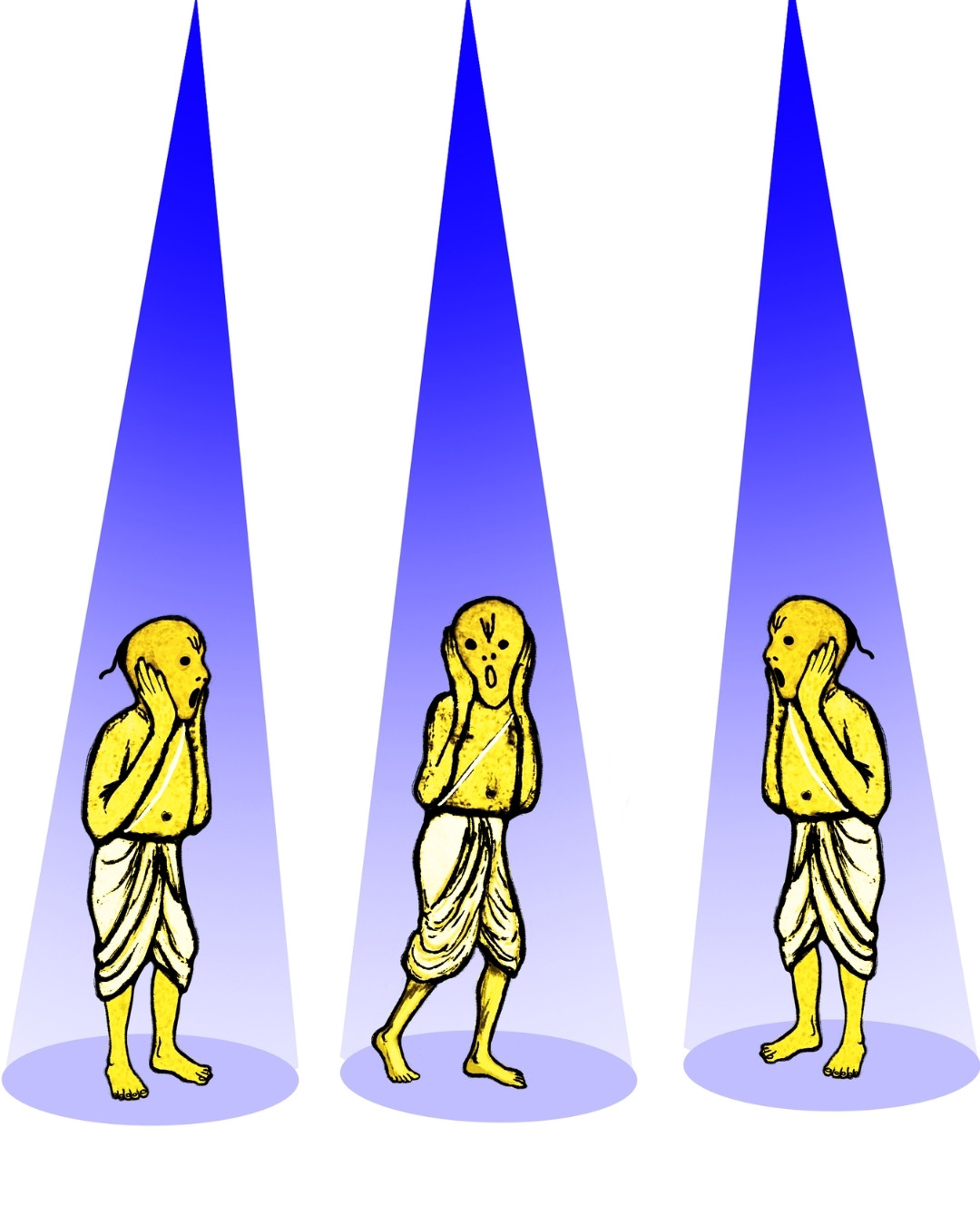
The works of these artists are deeply inventive in their styles – what was deemed provocative was the necessary directions the subject matter demanded them to take as artists. Their imagination is sublimated into the everyday as a form of knowledge to abstract, build and take forward. What is now used by the Right Wing to incarcerate, terrorise and subjugate a voice, was already spoken and done with so casually for us in the past. Our work at The Ambedkarian Chronicle(TAC) is to dwell in and expand in their traces. This is why the reception of the Frontline magazine cover on UGC regulations – featuring an interpolation of Edvard Munch’s The Scream (1893) as a Brahmin – seemed like a delayed backlash for the very concrete history of anti-caste work that preceded the illustration. Even though it first appeared in TAC in a different context of a series on UGC, it scarcely received any degree of backlash there, as it did elsewhere. The image was part of a curation which could not have been read without the text it accompanied and the series the image and text were part of. This is the ecosystem of anti-caste we want to build which is deeply contextual, interconnected and rooted. This is central to our purpose of running TAC: anti-caste expression cannot be divorced from the ecosystems that give it meaning. We do not seek to enter the domain of upper-caste readership because to even shake their consciousness, one has to bend to their rules, make their feelings the dominant mode of functioning.
“We want to build a platform as a form of extension to the quiet work already done by our predecessors. A deliberate incitement may garner a momentary visibility but not a sustained critical engagement we want to foster in our communities.”
We want to start and circle back to where we are, among the people. When the atrocities on Dalits are so quotidian, why would we aim to be spectacular? At Chaityabhoomi, musicians and organisers perform ballads and folklores, activists and readers from the remotest of rural India distribute pamphlets that otherwise considered as agitational, inciting or seditious are structural to the ordinary that makes up the geography of Shivaji Park, in that gathering, criticising the Hindutva regime is as banal as hanging dryer on a clothesline. This is the community we want to write and publish for.
We are a self-run and reader-supported multi-media magazine whose impetus is dignifying the voices that are otherwise greatly compromised in consumer-driven outlets. We want to build a mode of knowledge production where perceptive and dissident writers have free range in expressing their voice, where the language can remain close to the texture of their lives, giving fresh articulation to the varied and changing contours of how caste affects and deteriorates. Our editorial challenges does not limit to curating themes or editing, ghostwriting and proofreading an article, or logistics of producing creatives and carousels for social media and so on; they extend in provoking writers from the slums, chawls and rural to situate themselves in their surroundings and write from their complex particularities. The work of editorial is not just mere publishing but a process of helping writers and artists locate themselves in their surroundings and histories, of reflecting on their conditions, and mutating attention to things that are undervalued by caste. Such work is materially fragile. A paid subscription to TAC – ₹150 or more monthly – will allow us to continue working with writers over time, to remain accountable to the communities we come from, and to resist the pressures of censure and simplification that dominate most media today. Continue to publish work for free and be able to eventually remunerate our writers. You can visit our website (theambedkarianchronicle.in) for the subscription pop-up to become a monthly subscriber or make a one-time donation. We aim for 2000 subscribers in order to run the magazine seamlessly.
Jai Bhim