
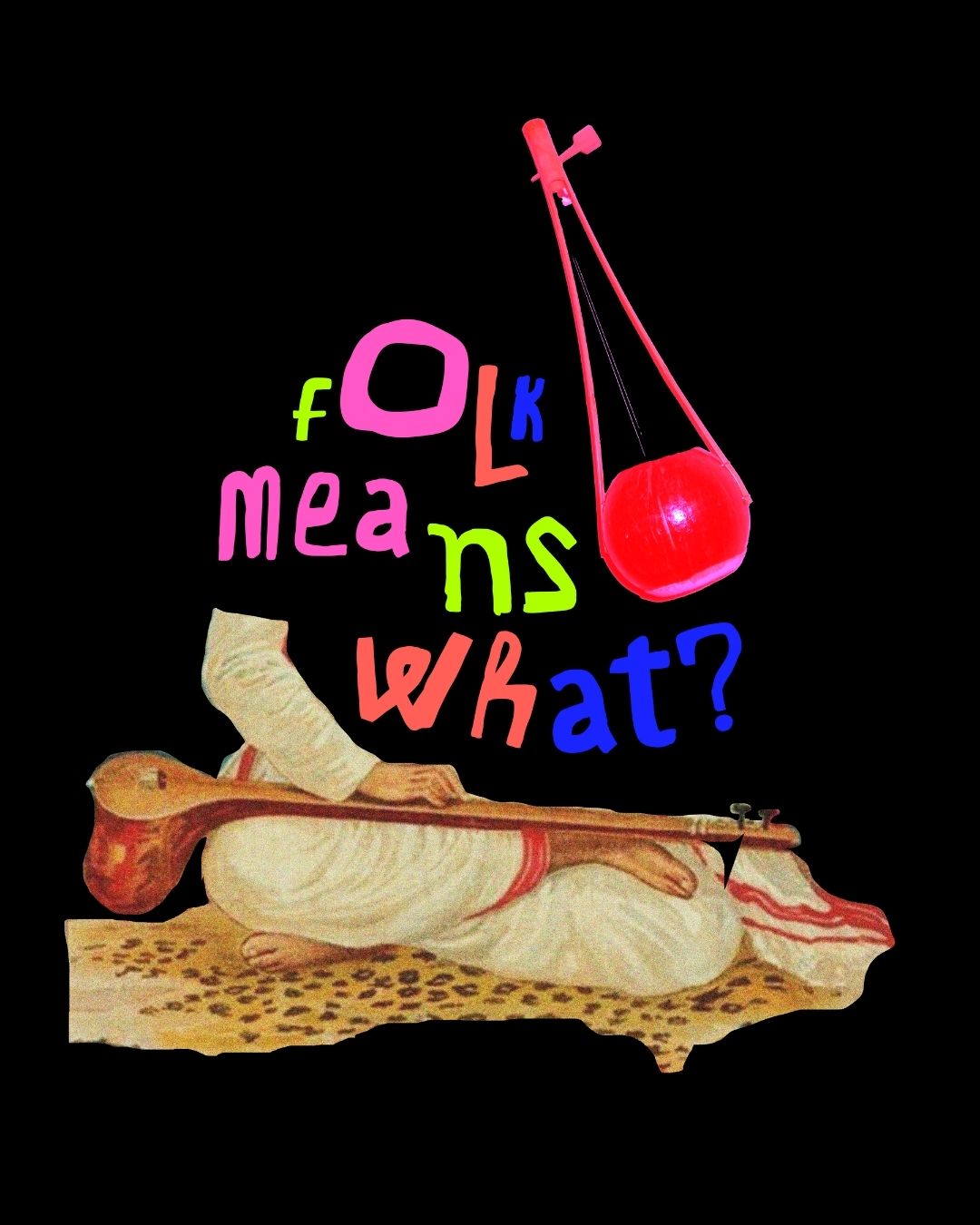
As a consumer of Maharashtra’s traditional and contemporary cultural performances over the last two years, I have been closely following three performance groups that have garnered considerable traction on Instagram and YouTube: Folk-Akhyan, Folk Prabodhan and Folk Lok (Studio). I have attended performances by the first two and am yet to experience Folk Lok, whose ticket prices remain beyond my modest budget. At first, these groups appear to be engaged in a celebration of Maharashtra’s cultural traditions. They do not seem to overtly glorify or romanticise the past nor do they present themselves as cultural preservationists in the conventional sense. Rather, they perform. They bring together diverse musical and performative traditions into a single stage experience where rhythm, percussion, narrative, devotion, memory and what Du Bois (1903) might call “sorrow songs” coexist within a carefully curated atmosphere.
The performances are undeniably compelling. Old instruments return to the stage. Familiar stories acquire new sonic textures. Audiences respond with enthusiasm. Yet I often leave these performances with a question that lingers longer than the rhythms themselves: Why folk? The question is not merely semantic. It is historical and political. As three of these groups claim that they have the kohl for the audiences’ eye to open from sleep, yet its struck me that across these performances the presence of a recurring narrative thread: the yashogatha that means the celebratory retelling of the achievements and victories of “Chhatrapati Shivaji Maharaj” and sitting with the mainstream narrative. And there is nothing surprising about “King Shivaji’s” presence in Maharashtra’s public culture. His life has inspired generations of poets, prabodhankars, powadakars, activists, historians and political movements. Yet the repetition of the heroic narrative raises another question: What aspects of Maharashtra’s cultural history become amplified and what aspects remain unheard? Are they questioning inflation? No. Have they said anything new that Dhangari Ovi (traditional and rhythmic songs performed by the Dhangar/Shepherd community) has not said before? No. Have they spent sleepless nights like Tamashgir and Gondhalkar’s do? No. Then what is “folk” in them?
Historically, many non-Brahmanical performance traditions did not simply celebrate heroes. Warkari Tradition, Bhakti movements and Satyashodhaki Jalsa questioned Brahmanical authority. Ambedkari Jalsa challenged caste oppression and cultivated political consciousness. Bharud, a traditional Maharashtrian folk art form that blends music, poetry and drama to convey spiritual teachings and social messages, frequently employed satire to expose hypocrisy. Powada, a traditional Marathi ballad that originated in Maharashtra during the 17th century, was not merely praise; it was also commentary on power, conflict and collective memory. These traditions used performance as a means of public reasoning.
The contemporary “folk” stage appears to operate somewhat differently. Its power often lies in generating emotional connection, cultural pride and a sense of fake belonging. There is value in that. After COVID-19 and the resulting social and economic challenges, communities need shared symbols that help them recognise themselves and strengthen their sense of belonging. Yet one wonders whether the performance stops at recognition or proceeds towards reflection. Perhaps this is the central tension of the contemporary “folk” revival. The performances are rich in sound, memory and symbolism. But the historical traditions from which they draw were not created merely to make audiences feel. They were often created to make audiences think. And that is why I continue to return to the same question after every performance: when they brand “folk” to themselves, what are they implying? The word “folk” is often presented as a harmless description of ordinary people’s culture. It evokes images of villages, inherited traditions, ancestral instruments and songs transmitted across generations.
In Europe, the distinction between the cultivated elite and the folk emerged alongside nation-building, industrialization and colonial expansion. The term was commonly associated with peasants, labourers, servants, agricultural workers and those who lived outside the worlds of aristocratic and educated elites. The individuals who cleaned homes, maintained estates, prepared food and sustained the material lives of wealthier classes were frequently imagined as belonging to the realm of “the folk.” What is useful here is to look at how Raymond Williams (1983) on culture and class distinction clarifies when it comes to the people and their relation. Especially the entries on Culture, Folk, Educated and Work. Williams (1983) traces in his work “Keywords”, how these words became socially and politically charged rather than merely descriptive. It reflected an existing hierarchy between those who observed and those who were observed, those who documented culture and those whose culture was documented.
Colonialism expanded this logic. European administrators, missionaries, travellers and scholars often described colonized populations through categories emphasizing tradition, custom and folklore. Colonized peoples became subjects of ethnographic curiosity. Their songs, rituals, stories and practices became objects of collection and preservation. The category of folk thus became entangled with colonial systems of knowledge production. Colonized people could be celebrated as culturally rich while being denied equal political and intellectual status.
The history of African-American culture reveals a similar contradiction. As Jon Cruz demonstrates in Culture on the Margins, Black expressive traditions became objects of fascination during and after slavery. Spiritual, work songs and later the blues were celebrated as authentic cultural expressions even while Black communities remained marginalized. Culture became valuable, people-the culture was derived from and remained excluded. Folk culture was archived, preserved and admired, often through institutions controlled by others (Cruz 1999). This runs through much of the scholarship on folk culture. W. E. B. Du Bois’s The Souls of Black Folk transformed “folk” into a language of collective historical identity. Alain Locke saw Black folk traditions as cultural resources for artistic renewal (Locke, 1936). Langston Hughes (1926) defended vernacular culture against elite standards of respectability. Yet later scholars such as Benjamin Filene and Erich Nunn demonstrated how the category itself remained unstable, romanticized and politically loaded. Folk was never simply a description of culture; it was a struggle over who had the authority to define culture (Filene 2000; Nunn 2015).
The same tension appears within India regarding the representation of the commons. Most of them are written by upper-caste academicians about ghetto culture, tradition and particular art form. Although conveniently ignored, many traditions labelled as “folk” emerge from Bahujan communities whose histories are rooted in labour, production, mobility, devotion, resistance and collective memory. Yet once these traditions are classified as folk, they are often positioned outside the realm of intellectual, philosophical or artistic sophistication. Some cultural forms are recognized as classical, others become “folk”. Some are treated as repositories of theory and aesthetics; others as repositories of custom and heritage. The contemporary revival of folk aesthetics through digital media introduces a new tension. Traditions once embedded in collective movements increasingly circulate as cultural brands and marketable identities. Such distinctions cannot be separated from caste or needs to define which “folk”? The category of classical culture in India has historically been associated with Brahmanical institutions, textual authority and upper-caste control over cultural legitimacy. In contrast, numerous musical and performative traditions created by Bahujan communities have been situated within the category of folk. This distinction is not merely aesthetic. It reflects broader structures of social power. The language of folk often conceals the historical realities of caste. Hence, folk is further divided by caste. For this reason, Bahujan musical traditions are perhaps better understood as forms of non-Brahmanical cultural production. They emerge from communities whose relationship to knowledge has often been oral rather than textual, collective rather than institutionalized and experiential rather than sanctioned by elite cultural authorities. Their significance lies not in their distance from modernity but in their alternative relationship to it.
This becomes evident in Maharashtra’s rich history of public performance. Traditional forms such as Powada, Bharud, Chakkad, Abhang, Gondhal, Jagaran, Lavani and Tamasha etc. were never merely entertainment. They functioned as spaces of public pedagogy. They debated religion, caste, labor, morality, superstition, social reform and political rights with soulful melodies and with rough-raw tunes. Their performers were not simply artists. They were educators, critics, organizers and interpreters of social reality along with entertainment. The instruments themselves were never politically neutral. The Halgi, Sambal, Daf, Tuntuna, Flute, Dholki, Pipani and many other instruments as well as performers’ voices associated with non-Brahmanical traditions were not employed merely to create atmosphere. They gathered crowds. They created public attention. They transformed performance into a collective act of listening. Sound became a medium through which people encountered critique. Instruments were used to make people think. And signing made people ask the question. Their purpose was not to lull audiences into cultural comfort but to provoke reflection about the conditions of their lives.
The contemporary resurgence of “folk” in urban Maharashtra raises a different set of questions. Over the last decade, a number of musical projects, digital collectives and performance groups have embraced the language of folk as a central component of their identity. Instagram, YouTube and short-form video platforms have accelerated this process. “Folk” has become a recognizable cultural brand capable of attracting audiences seeking authenticity, roots, tradition and regional belonging. At the outset, it all looks non-Bramhanical – challenging the caste system and mainstream. This development has undoubtedly revived interest in instruments and performance traditions that might otherwise remain invisible to younger generations. Yet the digital revival also introduces a new tension. Old instruments are reintroduced into contemporary arrangements, creating a powerful sense of continuity with the past. Instead of mobilizing culture to interrogate authority, performance increasingly becomes a vehicle for emotional identification, nostalgia, devotional sentiment and symbolic belonging.
And that is why the result is a paradox. The instruments survive but the questions disappear. The sounds remain but the critical traditions attached to those sounds become increasingly faint. This transformation is closely linked to the contemporary attention economy. Social media platforms reward visibility, emotional intensity, recognizability and shareability. Complex histories are compressed into short videos. Structural critiques become aesthetic experiences. Instruments become visual symbols of authenticity. Heritage becomes content. What in person-audiences often encounter is not necessarily the historical tradition but a curated representation of tradition. And that is why the paradox is real here. The listener receives the feeling of connection without necessarily receiving the history that produced that connection. Pride becomes easier to circulate than critique. Heritage becomes easier to market than analysis. This process creates what might be called the folk industry. Within this industry, authenticity becomes a commodity. Ancient instruments function as cultural branding devices. Regional identity becomes a market category. Folk aesthetics become valuable precisely because they appear rooted, organic and untouched. Yet the very conditions that produced those traditions: labour, caste oppression, social reform movements, struggles for dignity and intellectual resistance may receive far less attention than the allurement of folk’s symbolic power.
The danger is not the preservation of tradition. The danger is the reduction of tradition to sentiment. The appeal through “sorrow songs” as Du Bois commented on the black cultures Blues will not question the power making them performers. Historically, non-Brahmanical performance traditions sought to awaken audiences. They challenged inherited hierarchies, questioned superstition and expanded public understanding. Their purpose was pedagogical as much as artistic. They transformed spectators into participants in a larger social conversation. Contemporary cultural production faces a different challenge. In an age of algorithms, virality and cultural branding, the task is not merely to preserve older sounds. It is to preserve the critical spirit that animated those sounds in the first place. The question, therefore, is not whether contemporary musicians use ancient instruments. Cultural traditions have always evolved through adaptation and reinvention. The more important question concerns the social function of that reinvention. Do these symbols encourage critical engagement with history? Do they help audiences understand the worlds from which these traditions emerged? Do they connect sound to labor, caste, memory and social struggle? Or are they just cultural programmers to the political groups of western Maharashtra’s shady politics which kills their own leaders in accidents?
Or do they offer only a consumable experience of authenticity?
The future of non-Brahmanical cultural traditions may depend upon how this question is answered. The challenge today is not simply to keep the instruments alive. It is to ensure that the intellectual, ethical and emancipatory traditions carried within those instruments remain audible. The history of Satyashodhaki and Ambedkari performance reminds us that culture was never intended to put the people to sleep. It was intended to wake them up. Just for instance, Shahirs like Sambhaji Bhagat,Sagar Gorkhe or Shital Sathe’s troupe never fall for this attention in the name of “success”. The shift from tradition as public pedagogy to folk as cultural branding in the age of YouTube and Instagram. The persuasive and stronger form of people may be how individual artists make this phenomenon into the question in the mind of the people who are listening and experiencing this programme.
As I experienced it the mixture of Gondhal, Jagaran, Bharud, Lavani, Tamasha, Dhangari Ovi etc., from Bahujan communities working as counter-culture to what they were actually meant to along with the old instruments. As they are claiming in TV news and Neo-Podcasts that they are carrying the burden to repair the depressed societies through the performances? And the question to me is why Banjo or Bulbul Tarang is not adapted by these “Folk Performers” yet? Since they are carrying the burden of entertaining the depressed societies as they claim?
Why “Folk”?
The age of folk branding has only begun. Soon, Folk-Shivakhyan, Folk-Bhimakhyan, Folk-Ramakhyan and countless others may populate our screens and stages. The challenge will be to ensure that history survives the branding and that memory remains more than a marketable aesthetic.
References
- Du Bois, W. E. B. The Souls of Black Folk. Chicago: A. C. McClurg & Co., 1903.
- Filene, Benjamin. Romancing the Folk: Public Memory and American Roots Music. Chapel Hill: University of North Carolina Press, 2000.
- Cruz, Jon. Culture on the Margins: The Black Spiritual and the Rise of American Cultural Interpretation. Princeton: Princeton University Press, 1999.
- Locke, Alain. The Negro and His Music. Washington, D.C.: Associates in Negro Folk Education, 1936.
- Hughes, Langston. The Negro Artist and the Racial Mountain. The Nation 122, no. 3187: 692–694, 1926.
- Nunn, Erich. Sounding the Color Line: Music and Race in the Southern Imagination. Athens: University of Georgia Press, 2015.
- Williams, R. Keywords: A vocabulary of culture and soci Cfga as qx ety (Rev. ed.). Fontana Paperbacks, 1983.