

Intro: With an estimated population of nearly 16.5 crore, Denotified, Nomadic and Semi-Nomadic Tribes could constitute the second largest Indian state. Yet, despite their demographic significance, they remain among the least visible communities.
Denotified, Nomadic and Semi-Nomadic Tribes (DNT/NT/SNT) constitute one of India's most historically marginalized populations. Their exclusion is rooted in colonial policies, which fundamentally disrupted the traditional livelihoods of nomadic, pastoralist, hunter-gatherer, and transport communities. The expansion of railways displaced traditional transporter communities like Banjara, while forest laws restricted hunting, gathering, and grazing. Communities that had historically provided logistics, livestock products, forest resources, and artisanal services became increasingly vulnerable. As their livelihoods came under threat, many resisted colonial authority and participated in anti-British uprisings, including the Revolt of 1857. To control these mobile and resistant populations, the British enacted the Criminal Tribes Act, 1871, laying the foundation for the long-term marginalization of many Denotified and Nomadic Tribes.
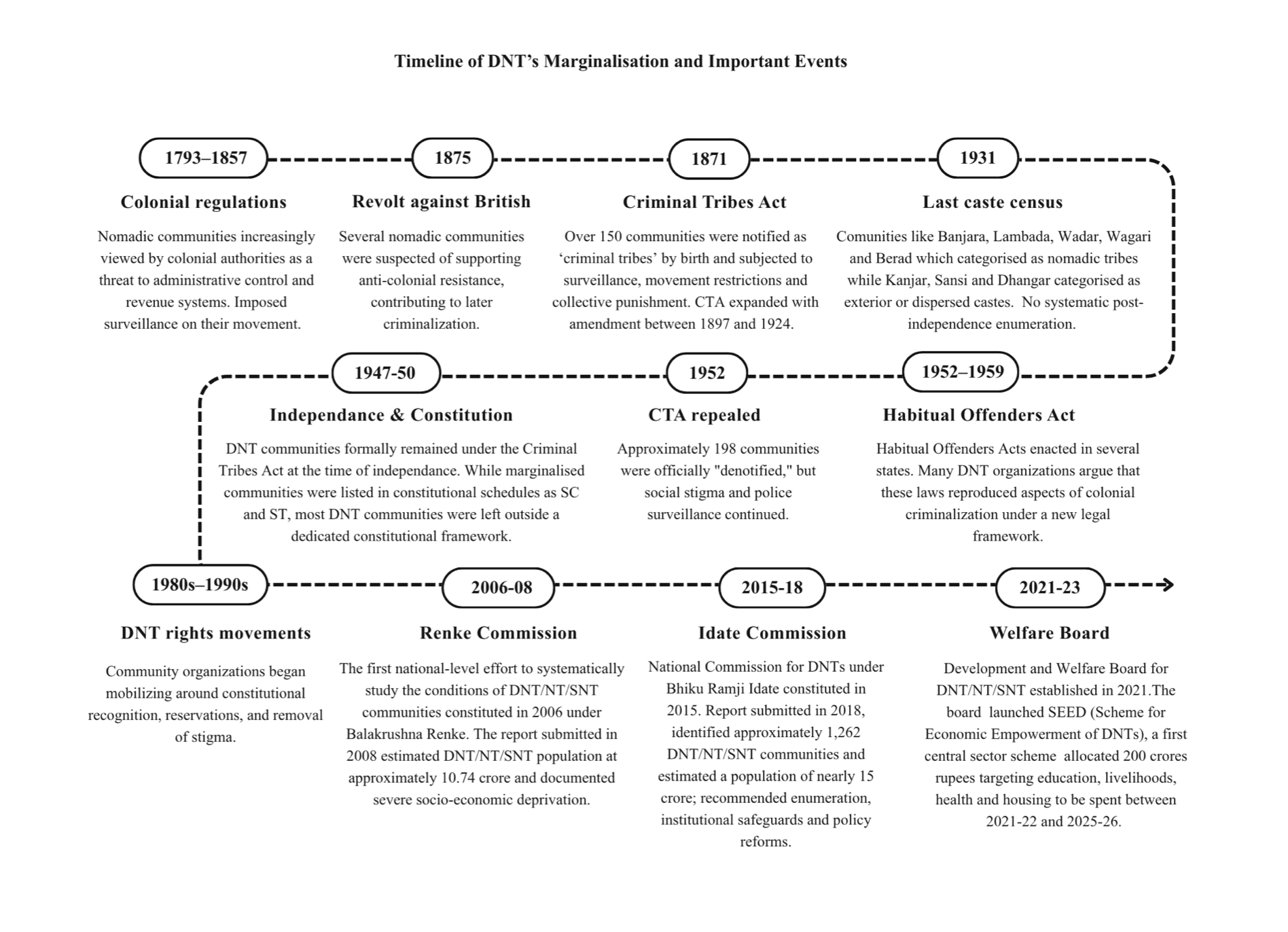
While India gained independence in 1947 and adopted a Constitution founded on liberty, equality, and justice in 1950, many of these communities continued to live under the shadow of the Criminal Tribes Act until its repeal in 1952. Communities remain deprived of constitutional recognition, rights, entitlements and safeguards as available to Scheduled Castes (SCs) and Scheduled Tribes (STs). Unlike Scheduled Castes and Scheduled Tribes, DNT communities were not recognized as a distinct constitutional category despite sharing a history of extreme social exclusion, economic deprivation, and state-sponsored discrimination. Consequently, many post-independence social justice policies – including reservation frameworks, political representation mechanisms, tribal development programmes, and protective legislation – either excluded DNT communities entirely or extended benefits to them only partially through state-specific arrangements. Take a look at the chart below which traces the timeline of historical marginalisation of DNTs and important events.
The timeline of historical marginalisation of DNTs and important events.
Enumeration and Classification Challenges
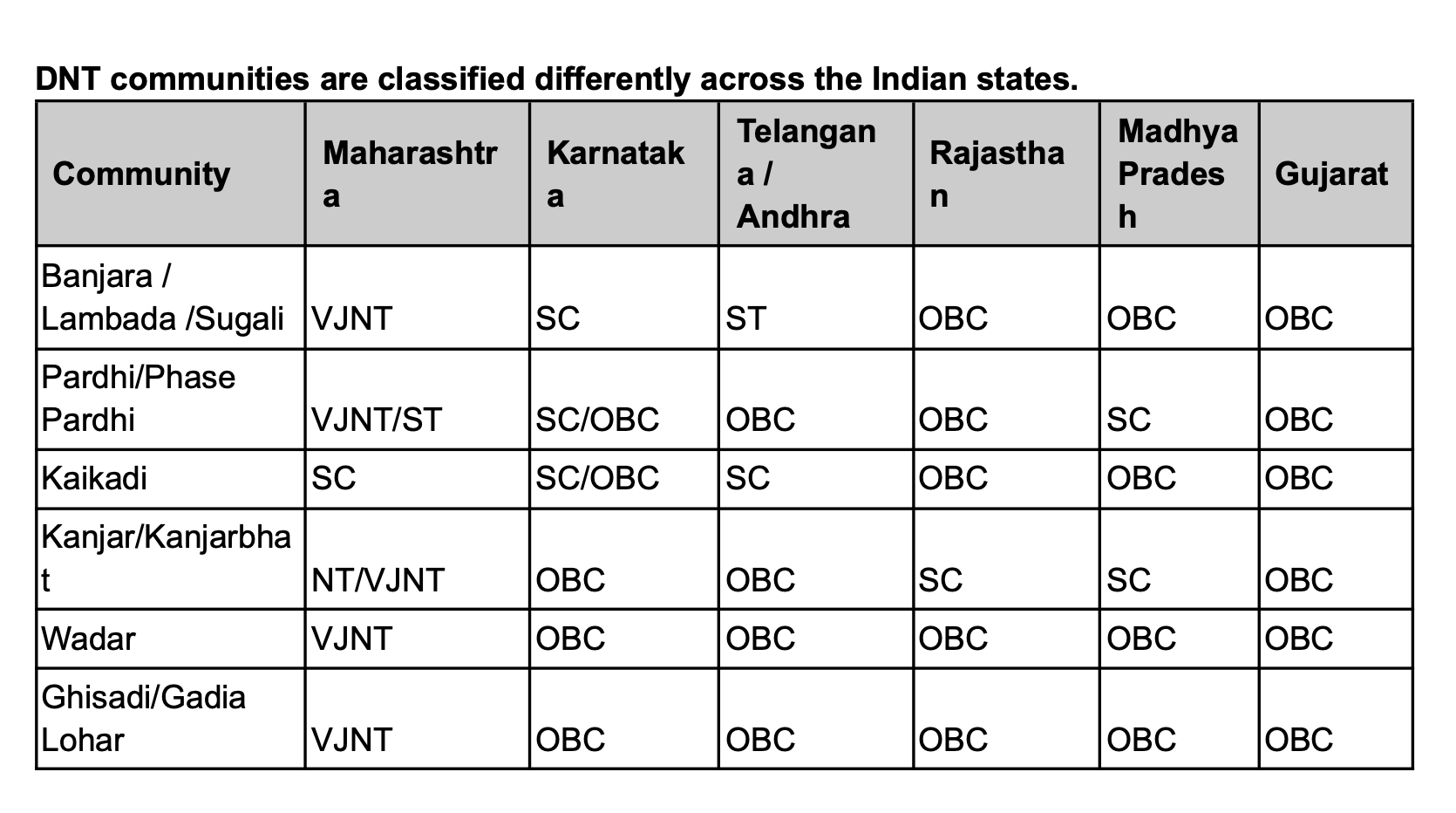
One of the most significant barriers to justice for DNT communities is the absence of reliable and comprehensive demographic data. Since the colonial era, India has lacked a systematic national enumeration of Denotified, Nomadic and Semi-Nomadic Tribes. Communities sharing common histories, cultural characteristics, and patterns of exclusion are often placed in different constitutional categories across states. For example, Banjaras are recognized as Scheduled Tribes in Telangana and Andhra Pradesh, but are classified as Vimukta Jati (denotified) and Nomadic Tribes (VJNT) in Maharashtra and OBC in Rajasthan, Madhya Pradesh, and Gujarat. Similarly, Pardhis are classified as VJNT or Scheduled Tribe in Maharashtra, Scheduled Caste in Madhya Pradesh, and OBC in several other states. Kaikadis are Scheduled Castes in Maharashtra and Telangana but are categorized as OBC in Rajasthan, Madhya Pradesh, and Gujarat. The table below highlights how DNT communities are classified differently across the Indian states.
Constitutional Framework for DNT Justice
The persistence of inherited stigma associated with communities historically labelled as “criminal tribes” raises important concerns under Article 21 of the Constitution, which guarantees the right to life, dignity, and equal citizenship. Although the Constitution does not currently recognize DNTs as a separate category, several constitutional provisions provide a strong normative and legal foundation for addressing their historical exclusion. Article 15(4) empowers the State to make special provisions for the advancement of socially and educationally backward classes or for Scheduled Castes and Scheduled Tribes. This provision provides constitutional legitimacy for targeted interventions addressing the historical disadvantages faced by DNT communities. Many DNT communities continue to experience low literacy levels, insecure livelihoods, landlessness, poor access to healthcare and education, housing insecurity, and continued social stigma. Article 16(4) enables states to extend reservation and other affirmative measures in public employment to ensure adequate representation of underrepresented communities.
Under Article 340 of the Constitution, the Government of India constituted the National Commission to examine the conditions of DNT/NT/SNT communities. The Renke Commission in 2008 and Idate Commission in 2018 report recommended a nationwide caste-based enumeration of DNT/NT/SNT communities, dedicated institutional mechanisms, targeted welfare measures, enhanced political representation, and a review of classification policies to ensure equitable access to social justice and affirmative action. But the recommendations of the commission are yet to be implemented.
With an estimated population of nearly 16.5 crore, Denotified, Nomadic and Semi-Nomadic Tribes (DNT/NT/SNT) could constitute the second largest Indian state. Yet, despite their demographic significance, they remain among the least visible communities. This section examines three nationally significant developments concerning DNT communities during 2025–26: the performance of the first Central Sector Scheme (SEED), the debate over the inclusion of DNTs in the forthcoming socio-economic caste census, and emerging reservation movements across multiple states.
Did the SEED Germinate?
The Government of India established the Development and Welfare Board for DNT/NT/SNT Communities under the Ministry of Social Justice and Empowerment (MoSJE) on 21 February 2019. Subsequently, the ministry launched the Scheme for Economic Empowerment of DNTs (SEED) in 2021.1 The scheme was allocated Rs. 200 crore for the period 2021–22 to 2025–26, aimed to support four key areas: education, livelihood generation, health insurance, and housing. Education and livelihood schemes directly implemented directly by the board by appointing implementing agencies. While health and housing schemes implemented through existing PM Ayushman Bharat and PM Awas Yojana. Despite its significance as the first central sector scheme for DNT communities, administration intention and implementation of the scheme has remained limited.
Underspending: According to information provided by the MoSJE Minister, in Parliament, only Rs. 15 crore was released in FY 2023–24, Rs. 35.16 crore in FY 2024–25, and Rs. 15 crore in FY 2025–26, benefiting 61,419 individuals under the livelihood component, 3,665 students under the free coaching component, and 50,287 beneficiaries under health insurance support.2 These figures indicate that a substantial portion of the allocated budget remains unspent even in the final year of the scheme cycle.
Delhi to Gully challenge: Unlike welfare programmes for SC and ST that are implemented through dedicated departments, corporations and district-level administrative structures, SEED lacks an equivalent implementation ecosystem. District or taluka level administration are not well informed about the SEED scheme for DNT. Evidence from parliamentary records raises concern of state apathy and indicates coordination gap between the Union and state governments. For example, beneficiary lists for housing and health-related interventions were sought from state governments, yet only Madhya Pradesh submitted a list of beneficiaries.3 The challenge of taking a programme “Delhi to Gully” becomes particularly challenging in the case of DNT communities, many of whom remain geographically dispersed, mobile, and administratively invisible.
Lack of transparency and awareness: Interactions with community members, grassroots activists, and local leaders across DNT settlements in Maharashtra suggest that awareness regarding SEED remains low despite the scheme having completed nearly five years. This raises questions regarding outreach, information dissemination, and the ability of intended beneficiaries to access programme components. The experience of the free coaching component raises concern. As the scheme provided stipend and reimbursement as DBT to attend coaching and expected students to submit the proof of coaching attendance. Here, how can we assure that there is no leakage in this method? There are chances of generating fake proof of attendance from private coaching institutes. The effective mechanism to prevent such leakage is lacking. Eventually, efforts were made to engage government agencies such as the Dr. Ambedkar Centre of Excellence at the Central University of Tamil Nadu4, but such arrangements remained limited and not materialized in other states. In 2025, a private platform was engaged to process applications and publish a list of 501 selected candidates, indicating continued experimentation with implementation mechanisms even in the final phase of the scheme5.
Inadequate staff and funding to the board is another serious concern. The existing members of board wrote to the PM demanding more members, staff, financial power, statutory backing and permanent commission status. A five-year allocation of Rs. 200 crore represents a relatively small public investment for one of India's most marginalized populations. The inability to fully utilize even this allocation underscores deeper issues relating to identification of beneficiaries, inter-governmental coordination, outreach, monitoring, and political prioritization.6 The question that emerges at the end of the scheme cycle is not whether the policy was well intentioned, but whether the SEED truly germinated among the communities it was meant to serve.
Uncounted and Invisible
More than seven decades after Independence and denotification, India still lacks an official population count of Denotified, Nomadic and Semi-Nomadic Tribes. The issue came into sharp focus during discussions surrounding the forthcoming Census. In 2025, Dakxin Chhara, a social activist from a Denotified Tribe community, approached the Supreme Court seeking the inclusion of a distinct category for DNT/NT/SNT communities in the Census. But the Supreme Court dismissed the plea, holding that matters relating to census design fall within the domain of the executive.7 While the judgment did not address the substantive question of DNT enumeration, it drew attention to a long-standing governance challenge: communities acknowledged as historically marginalized continue to remain absent from the statistical framework that guides welfare planning and resource allocation.
Scholar and activist Ganesh N. Devy has repeatedly argued that DNT communities must have a separate entry in the Census.8 According to him, the issue is not merely one of counting people but of acknowledging a historical category that has remained outside the mainstream social justice framework. Political scientist Yogendra Yadav similarly described the forthcoming Census as an opportunity to correct a long-standing injustice by recognizing communities that have experienced both colonial criminalization and post-independence neglect.9
The consequences of this data deficit are visible across sectors. Welfare schemes struggle to identify beneficiaries. Budget allocations remain arbitrary. Educational interventions cannot be properly targeted. Most importantly, the State continues to formulate policy for millions of people whose demographic profile remains unknown.
This invisibility is not merely a technical issue. The Renke Commission (2008) estimated the DNT/NT/SNT population at approximately 10.74 crore, while the Update Commission (2018) estimated nearly 15 crore people belonging to 1,262 communities. Yet these remain estimates rather than official counts. In the absence of reliable data, policymakers struggle to determine the scale of deprivation, estimate budgetary requirements, or assess the adequacy of welfare interventions.
Struggle for Representation
The demand for representation emerged as one of the most visible expressions of DNT politics during 2025–26. Across several states, communities mobilized around questions of reservation, constitutional recognition, and affirmative action. While these movements appeared to focus on quotas, they reflected deeper concerns regarding identity, representation, and unequal access to constitutional safeguards.
In Maharashtra, the Banjara community intensified its demand for inclusion in the Scheduled Tribe category.10 Large demonstrations, public meetings, and hunger strikes were organized across Marathwada and other regions.11 Community organizations drew upon historical records, particularly the Hyderabad Gazette and the classification of Banjaras as Scheduled Tribes in neighbouring states such as Telangana and Andhra Pradesh, to argue that their exclusion from the ST category in Maharashtra represented a historical anomaly. Protest leaders emphasized that the demand was not merely for reservation but also for constitutional recognition, political representation, and access to welfare programmes available to Scheduled Tribes.
In August 2025, thousands of members of Denotified, Nomadic and Pastoralist communities gathered in Bhilwara and demanded a 10 per cent quota in education, employment, and political representation. Community leaders argued that DNTs constitute nearly 15 per cent of the state's population yet remain significantly underrepresented in administration, higher education, and elected institutions. Their demands also included model residential schools, scholarships, and targeted development measures. Subsequent demonstrations and highway blockades reflected growing frustration over the absence of substantive policy responses12
These mobilizations reveal a broader structural issue. Unlike Scheduled Castes and Scheduled Tribes, DNT communities do not constitute a separate constitutional category. Instead, they are distributed across SC, ST, OBC, NT, VJNT, Special Backward Class, and state-specific categories. Consequently, access to reservations, scholarships, political representation, and welfare schemes often depends on administrative classification rather than comparable levels of deprivation.
The persistence of such movements demonstrates that the questions of enumeration, classification, and representation remain unresolved. Until these foundational issues are addressed, the quest of DNT communities for dignity, visibility, and equal citizenship will continue to shape public policy and political discourse across India.
Conclusion
The experience of Denotified, Nomadic and Semi-Nomadic Tribes (DNT/NT/SNT) reflects one of the most enduring gaps in India's social justice project. While the Constitution sought to dismantle historical hierarchies and create pathways for inclusion, communities formerly stigmatized under the Criminal Tribes Act continue to face exclusion from the full range of constitutional safeguards available to other marginalized groups. More than seven decades after denotification, DNT communities remain inadequately counted, inconsistently classified, and underrepresented in public institutions.
The developments during 2025–26 reveal three interrelated challenges. First, the implementation of the SEED scheme demonstrates that policy recognition alone is insufficient without dedicated institutions, administrative accountability, and effective outreach mechanisms. Second, the continuing absence of reliable enumeration has left one of India's largest marginalized populations statistically invisible, limiting evidence-based policymaking and resource allocation. Third, recurring reservation and recognition movements across states underscore the unresolved nature of classification and representation within India's affirmative action framework.
Recommendations
- Undertake Comprehensive Enumeration of DNT Communities and Include a separate category for Denotified, Nomadic and Semi-Nomadic Tribes in the forthcoming Census and all major socio-economic surveys.
- The Anthropological Survey of India’s pending report on unclassified communities should be released.
- States must streamline DNT certification to prevent exclusion from welfare schemes by developing uniform certification mechanism
- Create a permanent National Commission for DNT/NT/SNT communities with powers comparable to commissions for Scheduled Castes and Scheduled Tribes.
- Constitute an expert committee to examine anomalies in the classification of DNT communities across states and ensure affirmative action such as reservation which is a long standing demand.
- Expand the financial allocation of SEED, establish dedicated implementation units at state and district levels and ensure proactive awareness campaigns, transparent beneficiary selection, and public disclosure of scheme-wise progress.
- Establish residential schools, hostels, scholarships, create targeted pathways for higher education, professional courses, overseas scholarships, and skill development.
- Examine mechanisms to enhance the representation of DNT communities in local governance institutions, legislatures, and public bodies.
- Make legal safeguard to address distinct discrimination against DNT communities unlike atrocity acts for SC/ST to address historical stigma and social exclusion
- Integrate welfare, education, livelihood, housing, health, enumeration, and representation into a comprehensive National Policy for DNT/NT/SNT communities.
- Importantly, include DNTs population in the constitutional schedule to ensure address historical injustice and provide welfare entitlements as right
Endnotes
- 1. Development and Welfare Board for De-notified, Nomadic and Semi-Nomadic Communities. (n.d.). Official notification/document. Ministry of Social Justice and Empowerment, Government of India.
- 2. Lok Sabha Secretariat. (2025). Starred/Unstarred question no. AS225. Sansad Digital Library.
- 3. Lok Sabha Secretariat. (2025). Starred/Unstarred question no. AS125. Sansad Digital Library.
- 4. Central University of Tamil Nadu. (n.d.). Scheme for Economic Empowerment of DNTs (SEED).
- 5. Buddy4Study. (n.d.). Free coaching for DNT students under SEED: Scholarship result.
- 6. The Hindu. (2015, April 19). Welfare board for nomadic, de-notified groups tells PM it needs funds, staff, permanent commission status.
- 7. The Hindu. (2026, May 22). Supreme court denotified nomadic semi-nomadic tribe DNT enumeration 2027 census.
- 8. Down To Earth. (2025, December 5). De-notified, nomadic and semi-nomadic tribes must have their own separate entry in forthcoming census: Ganesh Devy.
- 9. Yadav, Y . (2026, May 15). Census is opportunity to correct injustice towards denotified nomadic tribes. The Indian Express.
- 10. The Indian Express. (2025, November 12). Banjaras, Hyderabad gazette, Marathas ST status.
- 11. The Times of India. (2025, March 14). Banjara community demands recognition under ST category.
- 12. The Times of India. (2025, February 20). Denotified communities threaten highway blockade over demands.