
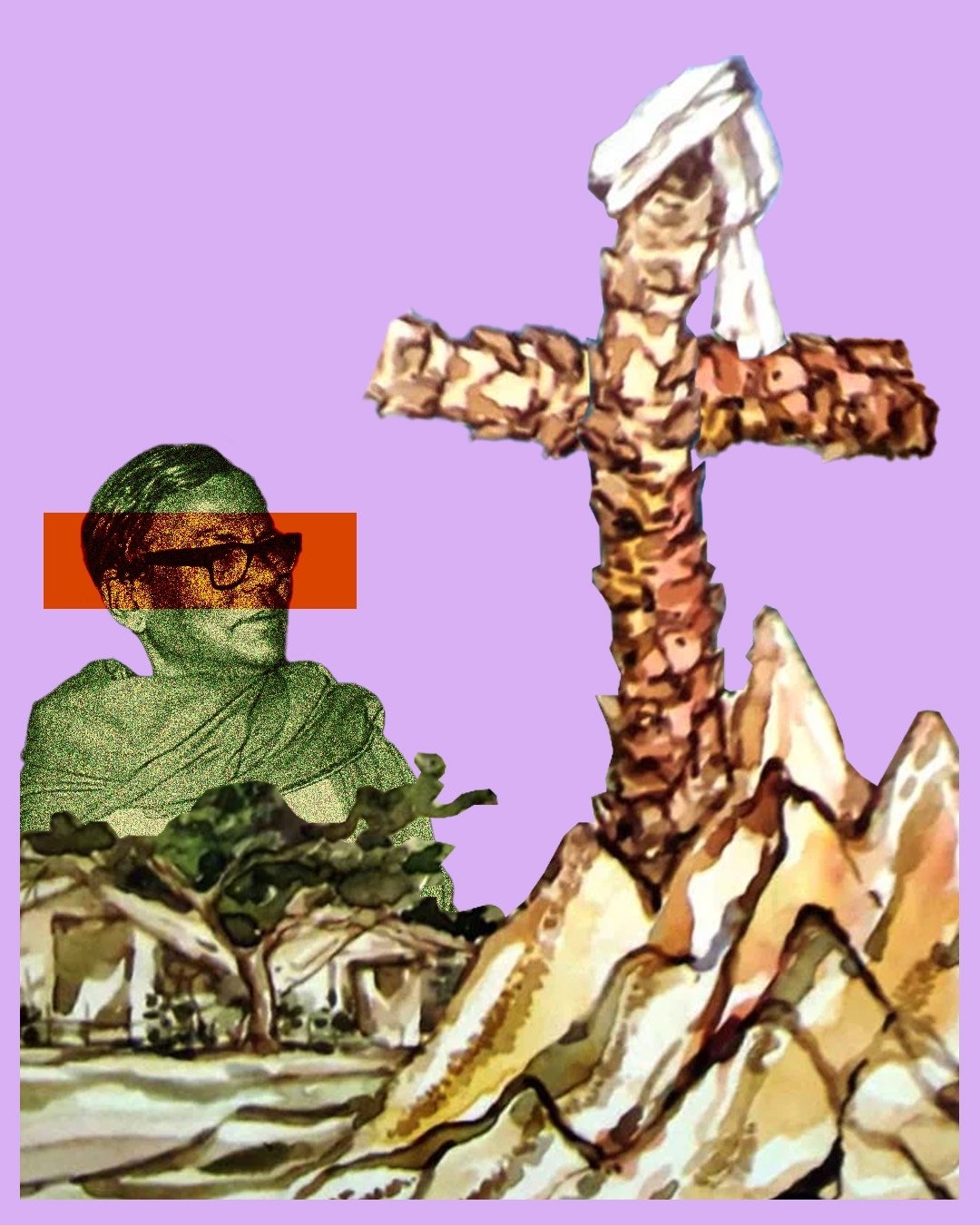
Dadi Buddha (The Ancestor) is one of the earliest Odia novels to vividly depict tribal life in South Odisha. Written by Gopinath Mohanty during his tenure as a civil servant in Koraput District and published in 1944, during the formative years of Odisha as a newly constituted state, the novel and generally Mohanty’s writings have been acclaimed as a critique of external intervention in the tribal world (Singh, 2017; Ramesh, 2017). Dadi Buddha is often read as an account of how such interventions lead to the disintegration of a tribal (Porja) society and its moral economy that possesses its own norms, values, and modes of living.
However, in celebrating the novel’s anti-outside and anti-interventionist stance, commentators have largely and uncritically accepted Mohanty’s negative portrayal of the Dombo caste, particularly their conversion to Christianity and exposure to the “outside world”, as forces that introduce disorder into an otherwise harmonious tribal society. This literary representation of the Dombos, an untouchable caste, requires closer scrutiny and should be situated within the broader context of the Odia vernacular literary sphere, colonial writings and writings in English by Odia scholars that shaped perceptions about them during the first half of the twentieth century. Otto Waack (1997) who has worked extensively on the early church history among Dombos in the region presents multiple accounts of Colonial and Odia elite labelling Dombos as criminals. It will be useful to cite here one such example; Laxmi Narayan Sahu, a member of the Servants of Indian society writing about the Hill Tribes of Jeypore in 1942, says that the Dombos are devilish in their character and that they are wild, shrewd and deceptive (Sahu, 1942). He further writes they are great cattle lifters. Hardenberg (2018) an anthropologist in South Odisha has detailed the biases against Dombos prevalent within the discipline of anthropology for decades.
Even as Dalit subjects were constructed through negative and essentialising stereotypes, their subjecthood was excluded from the dominant narratives and political processes that shaped the formation of the Odisha state. The Odia intellectuals of this period were largely engaged in reconciling caste-Hindu histories with those of Adivasis as part of their political and cultural project of consolidating an Odia-speaking state that came into being in 1936 (Mishra, 2018). I argue that it is this larger ideological and discursive context with which Gopinath Mohanty’s focus on tribes and negative portrayal of Dombos in Dadi Buddha corresponds. Gopinath Mohanty hailed from Coastal Odisha, the centre of literary and political activities during this period and it remains to be analysed in what ways these debates influenced his understanding of Dombos. However, it is beyond the scope of this essay. I would rather delineate his negative representation of Dombos through an analysis of three sets of Dombo characters in the novel.
The first set comprises Dombo men who have recently converted to Christianity. Mohanty contrasts their beliefs and practices with those of the Porjas. The second set consists of Dombo men represented as thieves, reinforcing stereotypes prevalent in colonial writings. The third character and the most significant one is Santosh Kumari, a Dombo Christian woman. Her love affair with Thenga Jani, the son of the Porja headman Ram Muduli, forms the central narrative axis of Dadi Buddha. Mohanty presents their relationship and eventual elopement as the novel’s climax, a moment where catastrophe and social disorder unfold.
Aligning with scholars who emphasize vernacularity and vernacularization as a contested and unstable space, this essay foregrounds the tenuous nature of representing marginalized social groups within the Odia literary vernacular through a close reading of Dadi Buddha (John, 2024; Mishra, 2018; Singh, 2018). It is crucial to underscore that Mohanty was an upper-caste official writing about Dalit and Adivasi communities during this period. Much later, anthropologist Georg Pfeffer, based on his extensive fieldwork in the region, highlighted the unequal relationships between upper-caste officials from coastal Odisha and the Dalit and Adivasi populations of Koraput (Pfeffer, 2014). Additionally, he explicitly regarded ethnographic portrayals of the Dombos as unjust (Pfeffer, 1997). Literary canons, like anthropology and bureaucratic engagements are not insulated from such social hierarchies. Indeed, scholars have pointed to caste-biased representations of Dalits in Indian novels authored by upper-caste writers (Saxena, 2022). Dadi Buddha must therefore be read not only through arguments about missionary intrusion but also as a text embedded within caste and power relations that shape its narrative imagination. Having outlined this broader literary, academic and social context, I now briefly summarize the novel before turning to a detailed analysis of the three sets of Dombo characters. Since my focus is exclusively on the representation of Dalits in the novel, narrative elements that do not bear directly on this concern are not discussed in detail.
Characters and Social Setting of Dadi Buddha
Dadi Buddha is set in Koraput District in southern Odisha and primarily revolves around the hilltop village of Lulla, where members of the Porja and Dombo communities live together. The villagers subsist through the cultivation of ragi, paddy, maize and Suan(little millet). They also have cattle and work in the fields. While the Porjas constitute the majority in Lulla, the Dombos form a small minority. The village is geographically isolated from the town of Koraput, with villagers visiting the weekly market at the foothills only once a week. The village headman is Ram Muduli, a prosperous Porja cultivator who has accumulated wealth through cultivation of paddy and ragi. His son, Thenga Jani, is portrayed as hardworking and physically robust from a young age and is widely seen as Ram Muduli’s successor. Another important Porja character is Hari Jani, who frequently accompanies Ram Muduli and hopes to arrange his daughter Saria Daan’s marriage to Thenga Jani. Ram and Hari are seen walking through the hills with Eleo Suna and Chancheri, both members of the Dombo community. Eleo Suna is a Christian convert who has interacted with missionaries and has some familiarity with courts and administrative institutions. Chancheri works as a barber. Ram Muduli occasionally seeks Eleo’s advice, valuing his exposure to the outside world but does not show his clear agreement in public.
The village also has a Dishari (village priest) who mediates between the villagers and Dadi Buddha, the ancestral spirit. In the Porja language, dadi means grandfather and buddha means old. Dadi Buddha is symbolized by a palm date tree believed to house the spirit of the ancestors. Villagers offer sacrifices of chicken, pigeon, and liquor to appease Dadi Buddha and secure his blessings. Communication with Dadi Buddha occurs through the Gurumai, a medium with long hair whom the Dishari summons to interpret the ancestor’s will. Near Dadi Buddha stands a termite mound known as Hunka Buddha, which is believed to be a companion or friend of Dadi Buddha. The Dishari strictly instructs the villagers not to disturb it. Among the younger Porja characters are Saria Phool and Saria Daan, both of whom are romantically interested in Thenga Jani, leading to tension between them. Santosh Kumari is the daughter of Alberio, Eleo Suna’s brother, and plays a pivotal role in the novel’s central conflict.
The village has separate dormitories for young men (Dhangda) and young women (Dhangdi), where Porja youth gather at night to sing, dance, and socialize. In contrast, the Dombo youth in the village are described as sick and physically undesirable. Mohanty referring to Dombo young men in chapter four writes “Beniamani never shaved his beard nor washed his face. As for Masik–who would care to look at him? Simon had a bulging stomach–probably he was ill with some disease” (p.19). Reverend Solomon, is a Dombo Christian pastor closely associated with the missionaries and the white missionaries are referred to in the novel as Sahibs who frequently visit the villages to preach. Ram Muduli’s wife, whose name is never mentioned, appears intermittently in the narrative, primarily expressing concern over Thenga Jani’s marriage and urging her husband to make suitable arrangements.
Christianity as an Outsider Religion and its moral implications among Dombo Christians
In the very first chapter of the novel, Mohanty juxtaposes the religious beliefs of the Dombos and the Porjas of Lulla village. As Ram Muduli, Chancheri Domb, Hari Jani, and Eleo Sunna descend the hill from their village at night carrying sticks and torches, they encounter wild fire. Mohanty does not explicitly state what caused the fire, but he hints at natural conditions such as dry grass and parched bushes and places the fire in the final phase of Phaguna. In Odia, Phaguna generally corresponds to the period between February and April. The villagers of Lulla are stunned by the sight. Although forest fires are a familiar phenomenon for them, they pause to observe it as if witnessing a magical spectacle. They even play with the fire momentarily before continuing their walk toward the village.
Suddenly, the group begins to speculate about the wildfire illuminating the darkness: “how does it happen? Who causes it ? How does it spread and look so beautiful ?” (p.2). Eleo intervenes to argue that the fire has spread because human beings lit it and dismisses the Porja belief that Dumas (ghosts) are responsible as superstition. Hari Jani, the Porja man, counters by suggesting that while humans may have ignited the fire initially in a small area, it is impossible for it to spread across vast stretches of forest without supernatural intervention. He asserts that it is the work of the Dumas. Eleo responds by saying that “people go there during the daytime. They light the fire over there, and it gradually spreads and continues through the night as well” (p.2).
Ram Muduli, the village headman, objects and asks whether Eleo has actually seen people lighting the fire, to which Eleo retorts by asking whether Ram has ever seen the Dumas doing so. Hari Jani attempts to mediate, suggesting that both beliefs may be valid in their own ways. Ram, however, firmly reiterates his position, declaring that it is the Dumas “they who make the night, the stars, mountains, valleys and all. They alone cause the fire and the rain. This is not what only we believe today; it has been the belief of our forefathers. These mysteries are beyond you Dombs” (p.2). Eleo responds by stating that his faith does not recognise such entities, to which Ram replies by invoking the antiquity of Porja belief. He refers to the Pothi (palm-leaf manuscript) kept in the house of the Dishari and claims that “it’s quite old–as old as the hill, as old as the darkness. Yours is new” (p.2). Eleo ultimately concedes that each community is entitled to its own beliefs and suggests that they should not quarrel.
Through this exchange, Mohanty establishes not merely a contrast but a hierarchy of religious belief systems, along with their moral implications on the Porjas and the Dombos in rest of the chapters. Christianity is represented as a relatively new faith in comparison to the ancient belief system of the Porjas. Moreover, it is portrayed as a foreign intrusion. In chapter eight, when Mohanty refers to the Dombo Christian pastor Solomon preaching in villages, he describes Christianity as “the religious message of a foreign land” (p.32).
“The novel consistently evaluates Dombo characters through a Porja-centric moral framework, positioning Porja society as the normative center while relegating Dombs to the margins.”
At first glance, Mohanty appears to be representing competing belief systems and acknowledging the historical fact that Christianity was introduced by missionaries from outside recently. However, a closer reading reveals that the narration passes moral judgement on Dombo Christians by questioning the ethical efficacy of their faith. This judgement is articulated through the persistent portrayal of Dombo Christians as thieves and wrongdoers, individuals whom Christianity fails to morally redeem. In chapter eight, Mohanty writes:
“There were many–Eleo, John, Alihander, Peter, Simon, Paul, Michel–who had embraced Christianity. But faith alone would not do it. One had to repent and confess his or her crime. But what was the value of Reverend Soloman’s preaching in courts, in society and in practical life” (p.32).
In contrast, despite calamities in the village, cattle dying, villagers being killed by tigers, and widespread suffering, Mohanty does not subject the Porjas’ faith to similar scrutiny. This is particularly significant given the numerous instances in the novel where sacrifices and pujas are performed for Dadi Buddha to ensure protection and prosperity. Even when these rituals fail to avert disaster, the Porjas’ belief system remains morally unquestioned.
Furthermore, Dombo Christians are seen to be concerned with proselytization in moments of personal and communal crisis. When Santhosh Kumari and Thenga Jani elope, Ram Muduli is shown to be mentally devastated. Mohanty writes, “Ram Muduli seemed to lose his mental balance; he behaved like a mad man” (p.46). In stark contrast, Pastor Solomon and Eleo are portrayed as being “not at all unhappy” about the elopement. They interpret the situation strategically, viewing it as an opportunity for Thenga Jani’s conversion. Mohanty writes:
“The Pastor and Eleo were not at all unhappy with Thenga Jani and Santhosh Kumari’s elopement. They believed that one day both of them would return to the village. With the permission of the sahib, Thenga Jani could be accepted by the church” (p.47).
Thus, at a moment of acute distress for the Porjas, Dombo Christians are depicted as thinking of their religion. A similar pattern recurs in chapter sixteen, when Ram Muduli and the Porjas decide to abandon the village following the Gurumai’s declaration that it is the will of Dadi Buddha. At this juncture, Eleo is shown calculating the economic advantage he can derive from the Porjas’ departure. He tells fellow Dombo Christians:
“These Parajas are cowards. They are obstinate. Once they make up their mind, they won’t listen to reason. Since they are leaving this village, they will sell their land cheap. We will stay here. Let them go” (p.65).
Here, Dombo Christians are portrayed as opportunistic beneficiaries of Porja suffering.
Dadi Buddha and the Representation of Dombos as Thieves
Mohanty explicitly represents Dombos and Dombo Christians as thieves in the novel. In chapter three, he describes Porja villagers approaching Dadi Buddha to seek blessings for socially sanctioned desires: Ram Muduli asks for a suitable bride for his son, while Porja girls pray for husbands. In contrast, Mohanty depicts three or four Dombo men visiting Dadi Buddha at midnight with markedly different request. He writes: “They were Dombs, whom the police wandered through the dense forest searching for” (p.12). These men plead that the police should not conduct an inspection and that they should not return empty-handed that night.
In another instance, Mohanty again describes a group of thieves confessing before Dadi Buddha that they have stolen cows and plates. Immediately following this confession, he lists seven Christian names and identifies them as the perpetrators. Although Dombo Christians are at times shown praying for reasons unrelated to theft, their supplications are framed in contrast to the morally legitimate desires of the Porjas. For instance, in chapter eight, Santosh Kumari is depicted praying to Dadi Buddha for her union with Thenga Jani. In the novel, marriage with the Dombos is to be forbidden among the Porjas but no such prohibition among the Dombos is mentioned. Mohanty presents the prohibition as a natural order in a tribal village that is to be followed while linking Santosh’s desire for love and relationship as dangerous and links it to outside influence. By outside, Mohanty means Santosh’s visit to Koraput town.
Santosh Kumari, Seduction, and the Collapse of a Tribal Village
A substantial portion of the novel is devoted to narrating the relationship between Santosh Kumari and Thenga Jani. Ram Muduli and Hari Jani repeatedly contemplate arranging the marriage of their children but continue to delay the decision. Meanwhile, Thenga, as a young man, is shown to be attracted to several Porja girls, though he remains indecisive. Among them, Saria Daan, Hari Jani’s daughter, is portrayed as the most interested in him.
Mohanty vividly describes Thenga’s desire as an expression of youthful sexuality rather than moral deviance. In chapter three, he writes:
“Before the eyes of Thenga Jani floated the pictures of groups of young women. Above the yellow alasi fields, above the bluish ragi fields, their loud laughter threw a mist of enchantment over the mind. Thenga would feel excited. His mind would grow hazy. Into this deeply passionate experience would enter the thorn and flowers of feeling” (p.10).
However, from the moment Santosh Kumari enters the narrative, her desire is framed as manipulative and risky. When Thenga encounters her near the river for the first time in the novel, Mohanty writes:
“Water dripped from her loose hair. There was no cloth around her body. Thenga Jani watched her spell-bound, his heart pounding. Santhosh Kumari, her hair hanging loose, started turning and twisting her body. Then all on a sudden, as if she had become aware of Thenga’s presence just at the moment, she pulled her saree up to her neck. She turned her back and went away with slow steps” (p.16).
Santosh’s sexuality is repeatedly represented as excessive and transgressive. Mohanty writes, “Santosh Kumari could not wait. She impressed people so that they would forget she was a Domb girl” (p.19). He further associates her with urban and transient spaces, writing:
“On dark nights she had seen loaded lorries halting on the town square. She had seen huge men carrying sticks rushing to places; she had seen dark roads from inside running trucks. She had learnt to savour the comfort of rest houses in dark rainy night” (p.19).
Santosh is thus portrayed not only as morally unanchored but also sexually expressive. Mohanty reinforces this depiction by contrasting her with Saria Daan:
“Daan was fair and lovely, good and innocent. She was simple like a cow. She left one cold. A man would not feel drawn to her. She could not entice a man. On the other hand, Kumari was alluring; her beauty was captivating. She could torment” (p.35).
When Ram Muduli finally approaches Hari Jani to propose Saria Daan’s marriage to Thenga, Thenga, unable to confront his parents, chooses to elope with Santosh. Santosh proposes that they flee to the tea estates of Assam, where no one can find them and that they save money, and later come back to settle in Koraput or Jeypore.
After their elopement, village gossip focuses on Santosh’s sexuality. Saria Daan overhears someone saying:
“Where has Kumari gone? God knows where she is. She’s bit showy by nature, always runs after young men. She keeps on looking at a young man’s face when she sees him, knowingly forgets to cover parts of her body in the presence of a young man. Oh, Domb people are like that. How shameless !” (p.45).
In chapter fourteen, in referring to the anger of Ram Muduli after the elopement of Thenga and Santosh, Mohanty writes Ram was angry with “ Santosh Kumari, who like other Dombs, knew the art of seduction”(p.52).
The crisis does not end with the elopement. Thenga’s parents grieve for months, the Dishari dies, cattle perish, and villagers are killed by tigers. Significantly, Mohanty does not depict the reaction of Santhosh Kumari’s family to their daughter’s elopement. In a singular and unidirectional narrative framing, Dombos and particularly a Dombo Christian woman are made responsible for the gradual collapse of an otherwise orderly tribal society. Santhosh is blamed for seducing Thenga, her character is repeatedly questioned, and her transgression becomes the narrative catalyst for the crisis in the village.
Conclusion
Mohanty depicts a number of Dombo and Dombo Christian characters as morally wrong; however, he does not present or pass any such judgement on any of the Porja characters in the novel. On one occasion he presents the arguments between Ram Muduli and his wife but that is about the future of their son. On another occasion, both Saria Daan and Saria Phool like Thenga and don’t speak to each other for a while but eventually they become friends after Thenga’s elopement with Santosh. The only Porja character who is negatively portrayed is Thenga Jani and that too after his elopement with Santosh when both of them are declared as bad dumas (bad spirits). By drawing attention to the narrative patterns across multiple instances in the novel, I have sought to critique Mohanty’s representation of Dalits, which I argue is essentialising in nature and fails to acknowledge the Dombs’ right to their own religious beliefs and social trajectories. The novel consistently evaluates Dombo characters through a Porja-centric moral framework, positioning Porja society as the normative center while relegating Dombs to the margins. At the same time, the text openly acknowledges that the Porjas look down on Dombs and yet, rather than interrogating this at any point in the novel, the narrative implicitly endorses it by allowing Porja beliefs to structure moral judgement within the novel.
References
- Hardenberg, R. (2018). Children of the Earth Goddess society, marriage and sacrifice in the highlands of Orissa. Berlin : De Gruyter.
- John, Joya, 'Adivasi Poetry: The Poetics of Indigeneity in Contemporary India', in Ulka Anjaria, and Anjali Nerlekar (eds), The Oxford Handbook of Modern Indian Literatures, Oxford Handbooks (2024; online edn, Oxford Academic, 23 Feb. 2023), https://doi.org/10.1093/oxfordhb/9780197647912.013.18.
- Mahanty, G., Mahānti, A. & Sahitya Akademi. (1997). The ancestor = Dadi budha. New Delhi : Sahitya Akademi.
- Mishra, P. (2018). Language and the Making of Modern India : Nationalism and the Vernacular in Colonial Odisha, 1803-1956. [Place of publication not identified] : Cambridge University Press.
- PFEFFER, G. 1997. The Scheduled Tribes of Middle India as a Unit: Problems of Internal and External Comparison, (p. 3-27) in G. Pfeffer & D. K. Behera (eds.), Contemporary Society: Tribal Studies. Vol. 1: Structure and Process. New Delhi: Concept Publishers.
- Pfeffer, G. (2014). Ethnographies of States and Tribes in Highland Odisha. Asian Ethnology, 73(1), 259-279. https://proxy.library.upenn.edu/login?url=https://www.proquest.com/scholarly-journals/ethnographies-states-tribes-highland-odisha/docview/1637726077/se-2.
- Ramesh, C. A. (2017). Gopinath Mohanty: The Asian ‘Achebe’. Contemporary Literary Review India, 4(3), 10-24. https://proxy.library.upenn.edu/login?url=https://www.proquest.com/scholarly-journals/gopinath-mohanty-asian-achebe/docview/2757164837/se-2.
- Saxena, A. & Rosengarten Family Fund. . (2022). Vernacular English : reading the Anglophone in postcolonial India. Princeton, New Jersey : Princeton University Press.
- Sāhu, L. (1942). The Hill tribes of Jeypore. [Cuttack] : [Orissa Mission Press].
- Singh, A. (2018). Conceptualizing Bhojpuri for a National Hindi Elite: A Critical Reading of Folklorist Krishna Deva Upadhyaya. Prabuddha: Journal Of Social Equality, 1(1), 33-44. Retrieved from https://prabuddha.us/index.php/pjse/article/view/10
- Singh, S. K. (2017). Disintegration of the Moral Economy in Gopinath Mohanty’s Paraja. History and Sociology of South Asia., 11(2), 101–116. https://doi.org/10.1177/2230807517696550.
- Waack, O., Lies, C. & I.S.P.C.K. (Organization). (1997). Church and mission in India : the history of the Jeypore church and the Breklum Mission (1876-1914). Delhi : Published for the Northelbian Centre for Worldmission and Church World Service by the Indian Society for Promoting Christian Knowledge.