

This year is marked by the Panchayati Raj elections in a few states, including Himachal Pradesh, scheduled for May 26, 28, and 30, 2026, across 3,754 gram panchayats. These elections are projected as a semi-final in the context of the upcoming assembly elections in the state. The long-awaited roster for reserved seats for marginalised sections of society, including Scheduled Castes (SC), Scheduled Tribes (ST), and women, has now been released. Interestingly, the state had empowered the District Commissioner to alter up to five per cent of the reservation roster within the existing framework. The opposition argues that such strategies were aimed at delaying the elections. However, later this provision was struck down by the High Court of Himachal Pradesh stating the violation of Article 243D of the Constitution and Section 125 of the Panchayati Raj Act.
The reservation roster in Panchayati Raj institutions, especially the ST reservation in Shahpur Nagar Panchayat, is changing the dynamics of politics by shifting political power away from traditionally privileged castes in the urban areas. This has triggered caste tensions and intensified political contestation, while elevating the Gaddi community (Gaddi community is one of the tribal groups which is considered as agro-pastoralist and transhumant pastoralist community of the Himachal Pradesh where they seasonally migrated from one place to another in the search of grazing land) into a decisive electoral force that both the Bhartiya Janta Party and the Congress seek to mobilise.
The Case of Shahpur Urban Nagar Panchayat Seat
The case of the Shahpur Urban (Nagar Panchayat) seat is interesting. The Shahpur Assembly constituency, located in the Kangra district, is numerically dominated by marginalised groups, including Other Backwards Classes, followed by Dalits and Tribals. In the 2020 Panchayati Raj elections, this seat was converted into a Nagar Panchayat for the first time. Earlier, it was the Gram Panchayat. A seat was reserved for the Open Women category (where any woman, irrespective of caste, could contest) in the last election.
However, in the current election cycle, the seat has been reserved for the ST category. This creates discomfort among the already established local politicians from the privileged castes. Their immediate responses can be seen on their social media accounts, and their supporters’ comments rooted in similar caste backgrounds reveal much in this context. A peak moment occurred when Rajiv Patial, a current Nagar Panchayat councillor (ward member) of Shahpur, made remarks about the Gaddi community on his social media account. In his post, he made casteist comments, describing Gaddis and Gujjars as ‘untrustworthy’ and portraying them as stigmatised identities. This reaction unfolds the region's caste tensions and political contestations.
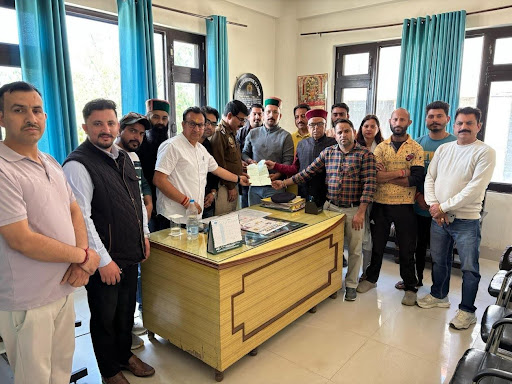
This photograph was captured while submitting the FIR copy in the police station.
In response, politically aware and socially mobile members of the Gaddi community collectively condemned the remarks and lodged an FIR against him under the SC/ST (Prevention of Atrocities) Act. In a democratic setup, making such stigmatising remarks against communities goes against the spirit of the Constitution. Urban Panchayati Raj seats have historically been seen as the domain of privileged castes. The demographic profile of Himachal Pradesh clearly shows that it is one of the least urbanised states in the country, and control over urban political spaces carries significant symbolic and strategic value.
With the introduction of reservations, this control is perceived as under threat, and the manifestation of contestation becomes evident. These anxieties are evident in online criticism of reservations, often framed as a defence of hardworking politicians.
In the Shahpur Assembly constituency, one of the important assembly seats in Himachal Pradesh, the Tribal community, particularly the Gaddis, plays a crucial role in determining electoral outcomes. The Gaddi community is primarily concentrated in the districts of Kangra and Chamba. Across this region, approximately 15–18 assembly seats are significantly influenced by this community's voting patterns.
Mobilisation Among the Gaddi Community and its Political Implications
After the reservation roster surfaced on the internet, online backlash quickly began across social media platforms. This is not limited to the Shahpur Urban (Nagar Panchayat) seat; similar reactions can be observed in other parts of Himachal Pradesh. The state has a history of such attempts by upper castes to protect their social and political dominance. Earlier last year, the state government increased the monetary incentive for inter-caste marriages from ₹50,000 to ₹2 lakh to promote inter-caste marriages. There was significant backlash from upper-caste groups.
“The reservation roster in Panchayati Raj institutions upholds the constitutional spirit by redistributing power to historically marginalised communities, even as it leads to visible social anxiety and tensions.”
The Devbhoomi Kshatriya Sangathan organised rallies to oppose the move. These groups not only protested against the policy measures but also demanded the constitution of a Swaran Aayog Committee, a long-standing demand to safeguard upper-caste interests in the region. In the state, where Dalits constitute nearly one-fourth of the population, the second-highest proportion after Punjab. Notwithstanding, there has been no strong anti-caste movement in the state.
Historically, the Gaddis belonged to the Bharmour region (a Scheduled Area) and nearby parts of the Chamba district, where they traditionally practised shepherding as their primary occupation. Over the generations, a significant section of the Gaddi community migrated in search of better educational and economic opportunities to regions such as Dharamshala, Shahpur, Palampur, Nurpur, and other nearby areas in the Dhauladhar range.
In pursuit of better educational and employment prospects beyond their traditional occupations, many Gaddis have migrated to the Kangra district, which provides greater opportunities and fewer geographic constraints. It has contributed to the emergence of an educated middle-class with sufficient economic and cultural capital to articulate and advocate for community interests. This Gaddi middle class is both vocal and articulate, actively mobilising to advance its interests within the political sphere.
A close examination of the political history of Himachal Pradesh suggests that the discourse of development has remained more prominent than other issues. The question of caste has not acquired significant political currency. Despite the relatively large proportion of Dalits in the state, caste has not emerged as a decisive factor in its political dynamics, unlike in states such as Bihar and Uttar Pradesh. However, emerging caste tensions have the potential to reshape the political discourse of Himachal Pradesh.
The reservation roster in Panchayati Raj institutions, especially in the context of the Shahpur Nagar Panchayat, for the Scheduled Tribe, upholds the constitutional spirit by redistributing power to historically marginalised communities. Such constitutional measures, which diminish the political dominance of privileged castes in the region, lead to social anxiety and visible tensions.
This shift has coincided with the growing political influence of the Gaddi community in regions such as Kangra and Chamba. These changes are reshaping local politics and intensifying community-based competition for political power in Himachal Pradesh, a state that has historically witnessed limited explicit caste mobilisation in the realm of politics.