
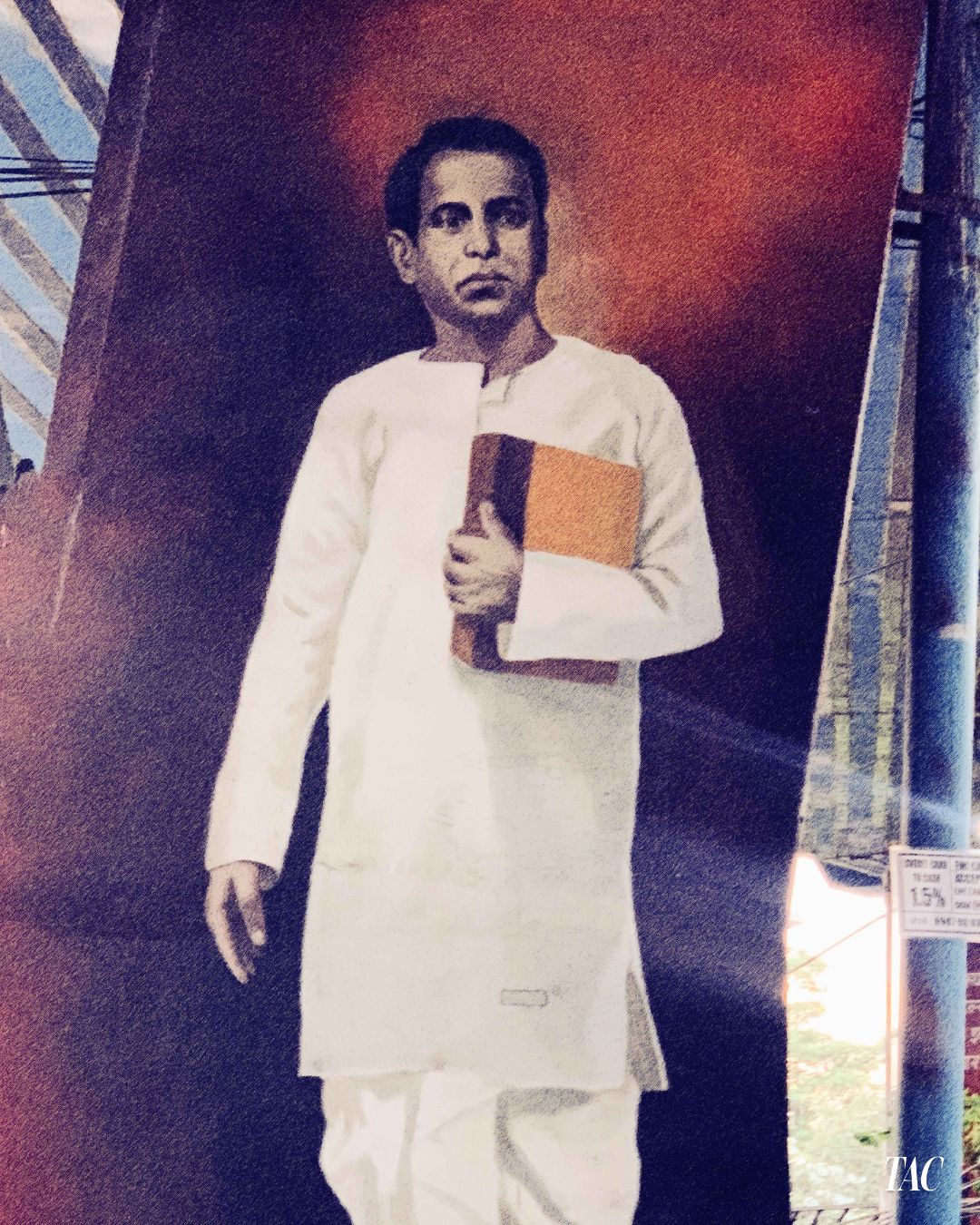
The Birth of the Tukaram
This year, we mark the 106th birth anniversary of Comrade Annabhau Sathe. His poems, novels, and stories are often analysed, yet the context that shaped them is rarely discussed. Sathe's story is powerful precisely because of his commitment to the cause of the oppressed everywhere. As he himself put it:
“The life I live, see, and experience is the life I write about. No bird am I, to fly on the wings of fantasy. I am a frog, close to the ground… All my characters are real. Alive.”1
Any justice to his life is possible only by considering the context into which he was born and in which he lived. Without an account of those experiences, Sathe's story remains ordinary. Indeed, Sathe was an extraordinary, working-class organic intellectual, and to understand his life, one must return to that time when in march 1920s at Mangaon Ambedkar had been declared leader of the Depressed Classes by Rajarshi Shahu Maharaj. After a few months, Com. Annabhau Sathe was born on 1 August, in Vategaon, a small village in Sangli State, under late colonial rule. In October of the same year, the communist party of India was founded at Tashkent. Mere coincidence but sathe’s life and posthumous life is intricately shaped by these two.
Any honest account of Sathe’s life and work is complete without understanding national, global context and his personal circumstance. Sathe was born in a region which often saw famines and was largely impoverished. This was a time when cultivators in Sangli were resisting extractive revenue policy, while the poorest among them, the Depressed Classes, remained landless and subject to severe forms of untouchability. In 1899, the Criminal Tribes Act of 1871 was extended to the Bombay Presidency under which Mangs (and Mang Garudis), a caste in which Sathe was born. were declared criminals subjected to excessive bodily regulation and surveillance. Sathe's early childhood, then, must be situated within colonial rule, the oppression of feudal landlords, the everyday practice of untouchability, landlessness, poverty, and destitution.
Migration to Bombay and Communist influence
Due to untouchability, Sathe left his school within a day. However due to poverty and famine in his region, for livelihood, his father took his family towards Bombay, with days and nights they walked, hungry, barefoot, in journey they were detained by camps of criminal tribes2, and over a period of six months they reached Byculla in 1931.3 An eleven year old Sathe, was a migrant for the city, worked as porter, watchman, shoeshine worker, coal loader, daily wage labourer, babysitter, hawker and mill worker. Bombay, during those days had became fort for communist movement and By 1929, textile workers of Bombay already started mobilisations4 because of the new hope of October Revolution 1917 for the working class revolution. After coming to Bombay, multiple accounts say that he learnt to read from one of the men, belonging to Mahar caste, by following sign boards on shops, streets and slowly became active participants of communist movement.5
The Making of Comrade
By 1935, Ambedkar declared his renouncement of hinduism, while 15 year old Sathe, entered in the ranks of communists. Unconfirmed, but often said that, he, then 18, founded Dalit Yuvak Sangh in 1938.6 His association with the Communist Party of India began with an early encounter in which the party provided him a room to stay, a connection that later deepened considerably. During this period, the Matunga labour camp was one of the centres of communist mobilisation and meetings. Annabhau Sathe was shaped by comrades such as Com. R. B. More, Com. K. M. Salave, and Com. S. K. Pagare, who influenced his ideology. R. B. More was one of the organisers of the Mahad Satyagraha, and this must indeed have carried an influence into Sathe's understanding of Ambedkar's ideas.7 This is quite visible in his 1946 folk play, Deshbhakt Ghotale, where we find his iconic lines: "Jag badal ghaluni ghav, sanguni gele mala Bhimrao" [“Change the world by striking a blow — this is what Bhimrao told me”].
His first impromptu satire on the plague in the slums where he lived was probably his earliest written work. Later, Pagare would ask Sathe to write songs and poems, offering five rupees or a shirt in return. During this period, Sathe would often recite his work to communist leaders on the terrace of the party office, sessions frequently attended by B. T. Ranadive and P. C. Joshi.8 From that point on, Annabhau was actively engaged in writing. He was also an active part of the left's cultural movement Indian People's Theatre Association (IPTA). In 1942, Bengal was going through severe droughts, Annabhau’s ballad ‘Bangalachi Haak’ became so popular during the fundraising campaign of IPTA in Bombay circles, that Vinay Roy later translated it into Bengali and recorded it in Kolkata.9 Later Sathe, along with Amar Shaikh and Gavankar founded IPTAs grassroots, working-class cultural wing, the Lal Bawta Kalapathak (Red Flag Cultural Squad) in 1944. The first cultural program of Kalapathak was organised in the same year at Titwala, Mumbai.10 The Kalapathak became one of the most important instruments of the left's cultural movement, and his ballads and lavanis served as tools to awaken the masses to the cause of the oppressed, the working class, and Dalits. Later Sathe, also became All India President of IPTA in 1949.
Literature of Comrade
Across a literary career, from 1940s, spanning about thirty years, Sathe contributed thirty-five novels, fourteen collections of short stories, twenty-four loknatyas (people's plays), twelve screenplays, two proscenium plays, one travelogue, and innumerable songs and poems. Many of his novels were translated into Hindi, English, Kannada, Russian, and Polish, and several were adapted into films.
Of his ten ballads, three spoke specifically to the changing global scene in the context of the Second World War: the Nanking ballad, the Stalingrad ballad, which cheered on Soviet soldiers and their commander, Georgy Zhukov11, and the Berlin ballad. His remaining ballads focused specifically on contemporary Indian issues, such as the riots in Punjab and Delhi, the Telangana Sangram, Maharashtrachi Parampara, Amalnerche Hutatme, and Kalya Bajaracha Powada. Sathe was not writing for the sake of entertainment but rather for a change in world order. He was a firm believer in communist utopia, in the politics of the left, and he was inspired by the October Revolution. In his ballads he saw all oppressed, working class of the world as ‘Dalits’.
Sathe after the late 1940s, devoted himself to writing novels and also he was interested in making films on his novels. In the March of 1947, Sathe also had completed another novel ‘Warnechya Khoryat’ about exploitation, and resistance of peasants and workers in the Warana river valley. His novels span several major themes such as courage; women's lives; love; and rural life. His most popular novel is Fakira, dedicated to the “militant writing of Babasaheb Ambedkar,” and translated into many languages. Annabhau Sathe's first published short story was Majhi Diwali, which appeared in 1949 in the weekly magazine Mashal.12
By the 1950s, owing to Ambedkar's movement, literary institutions of the Scheduled Castes had flourished numerously across the state, and the Maharashtra Dalit Sahitya Sangh, whose activist in consultation with Dr. Ambedkar had planned to hold a “one-day literary conference” on 17 December 1956, the day after the Dhamma Deeksha ceremony. Dr. Babasaheb Ambedkar's passing, however, forced its postponement, and the conference was finally convened on 2 March 1958, chaired by B. C. Kamble and inaugurated by Annabhau Sathe, who stepped in for P. K. Atre, the originally intended inaugurator.13 He who self lettered without any formal education proclaimed that
“The earth is not balanced on the snakes head but on the strength of Dalit and working class people… A dalit’s life is like pure spring water that trickles down from rocks… live life the way the other person lives to understand his suffering…Thus, the people who write about dalits have to be first committed to their cause. it is important to make dalits realize that they are not slaves and this world needs them…Thus, the people who write about dalits have to be first committed to their cause.”14
Sathe's influence and popularity as a writer, artist, and cultural activist grew rapidly during the Samyukta Maharashtra Movement (SMM), and his lavani “Majhi Maina” on Mumbai, remains the most popular of his writings. During the SMM, Sathe was a leading figure of cultural activism, revered for his contribution to the movement as “Lokshahir”. After which, in 1961, Sathe went to the USSR as part of an Indo-Russian cultural delegation. Because his progressive and proletariat-focused works, such as Fakira, had been translated into Russian, he was already widely read and deeply respected in Soviet academic and working circles. Upon returning to India, he penned the iconic Marathi travelogue titled Maza Russia cha Pravas (My Travel to Russia), capturing daily life, industrial progress, and human interactions in the Soviet state, which is also an important cultural and historical document, offering glimpses of life in the (then) Soviet Union. That same year, however, Fakira won the Maharashtra government's award for best novel.
Last days of Comrade and his Passion for Films
Probably after his return from the Soviet Union, Sathe began seriously engaging with film as a medium to bring his stories to a wider audience. His first film adaptation, based on his novel Vaijayanta, was released in 1961, directed by Gajanan Jagirdar and produced under Rekha Films. Gradually, his other novels also gained cinematic attention, with Fakira (1963) directed under Kumar Chandrashekhar's Chitra Niketan Studio. Later, in 1969, further novels Chikhaltil Kamal, Makdicha Maal, and Aavadi were also released as films.15 Sathe was continuously attending events of his movie release.
On 17 July 1969, Annabhau Sathe travelled to Mumbai for an event marking the release of a film based on his novel. On his way back, late at night, the taxi failed to locate his address; Com. Subodh More recalls having helped Annabhau find his way home. Sathe was then just forty-nine years old. The next day, Sathe passed away, reasons for his death are unclear however many conspiracies and myths surrounded his last days. It is often believed that Sathe died of hunger, his body left unattended in his home for three days, one of several false stories that have come to surround his life. In reality, Sathe had been given a 2BHK government house in Siddharth Nagar-02, Goregaon, and in his final days he left Chiragnagar, where he had spent most of his life. The government also gave him a small monthly stipend of Rs 300; Baburao Baraskar, another leader from the Matang community, was a minister at the time. Indeed, these stipend payments were often late or postponed and also it was too meagre (Rs 17,000 today) to live in a city like Mumbai.16
It is also popularly believed, when India got independence, Sathe led a march at Azad Maidan against this independence, raising the slogan “yeh azadi jhoothi hai, desh ki janata bhookhi hai” [this freedom is false, the country's people are hungry], with thousands gathered in pouring rain. Unfortunately, no such protest actually took place, and there is no written or oral evidence of it; the story appears to have become common knowledge only because of an early piece of writing on Sathe that repeated the claim. On the contrary, Sathe’s both daughters confirm that he took them to see Gateway of India, as an occasion of independence and places nearby Bori Bandar.17
In addition to myths surrounding his birth and the belief that Fakira was a real historical figure, Sathe's life is further surrounded by posthumous politics around his identity as a Mang and his ideology as Marxist-Ambedkarite, with layers of complexity around both. Over the years, Sathe has become an important political icon in Maharashtra, mobilised to garner a vote bank around him, even as a continuous tussle persists between Communists and Ambedkarites, a tussle actively exploited by Hindutva forces to erase Sathe's image as Comrade in favour of “Lokshahir,” a title he does rightly deserve, but which is used here to portray him as an apolitical poet and novelist, much like many middle-class literary figures.
Sathe is also being cast as a symbol of the Hindu Dalit, positioned against non-Hindu Dalits in Maharashtra, and as an alternative figure to Dr. Ambedkar, even though Sathe himself could never escape Ambedkar's politics and influence. Unfortunately, Hindutva forces appear to be succeeding in this project, and what both Ambedkarites and Communists urgently need to do is radically reclaim Sathe, not merely as Lokshahir, but as Comrade, and, if necessary, as Panther. After all, there is everything in a title and a name. To reclaim Comrade Sathe is to reclaim his radical ideas and his politics in public space. With this commitment, I remember the great working class hero com. Annabhau Sathe and I wish you all Happy Sathe Jayanti!
References
- [1] Annabhau Sathe, (Barbadhya Kanjari, Pune: Vidyarathi Graha Publication, 1960) 6. (In the introduction to a collection of short Stories. Trans. Milind Awhad.)
- [2] During this period, reformatory camps were run by missionaries under government oversight. As Mangs were classified as a "criminal tribe," many were forcibly interned and routinely treated as inherent criminals. Extensive regulations were imposed on the mobility of these castes.
- [3] Maitreya, Y. (2017, October 15). The sound and fury of Anna Bhau Sathe's words: An icon of Maharashtra's Dalit literature. Firstpost.
- [4] Ranadive, B. T. (1990). B. T. Ranadive on trade union movement (M. K. Pandhe, V. Ranadive, K. Bannerjee, P. K. Ganguly, J. Roy, & R. Basu, Eds.). Centre of Indian Trade Unions.
- [5] Bhattacharya, A. (2018, August 1). Ambedkarite or Marxist? Annabhau Sathe chose to cast his lot with the oppressed. Scroll.in.
- [6] Bagate, R. (2024). अण्णाभाऊ साठे यांचे सामाजिक तत्त्वज्ञान [Annabhau Sathe's social philosophy]. In R. Landge, S. Kothawale, & K. Khandare (Eds.), सत्यशोधक अण्णा भाऊ साठे: अनुभवाचे विद्यापीठ [Satyashodhak Annabhau Sathe: The university of experience] (Chap. 36). Shaurya Publication. Pg 187-194
- [7] Max Maharashtra. (2023, July 31). Annabhau Sathe | साहित्यरत्न अण्णा भाऊ साठेंच्या जीवनातील समज - गैरसमज | Subodh More[Video]. YouTube.
- [8] Awad, M. (2010). The life and work of Annabhau Sathe: A Marxist-Ambedkarite mosaic. Gaur Publishers & Distributors.
- [9] Patole, S. K. (2018). Annabhaunchi shahiri [Annabhau's balladry]. In Sahityasurya Annabhau Sathe: Kartutva ani vyaktimatva [Sahityasurya Annabhau Sathe: His work and personality] (Chap. 2, p. 27). Pratibha Publications.
- [10] Max Maharashtra. (2023, July 31). Annabhau Sathe | साहित्यरत्न अण्णा भाऊ साठेंच्या जीवनातील समज - गैरसमज | Subodh More[Video]. YouTube.
- [11] Georgy Konstantinovich Zhukov (1 December 1896 – 18 June 1974) was a Soviet military leader who served as a top commander during the Second World War, rising to the rank of Marshal of the Soviet Union. Under Joseph Stalin, he served as deputy commander-in-chief of the Soviet armed forces, overseeing some of the Red Army's most decisive victories. At various points he also held the roles of Chief of the General Staff, Minister of Defence, and a member of the Presidium of the Central Committee of the Communist Party (the Politburo).
- [12] Pawar, J. V. (2019). The history of Marathi Ambedkarite literature (S. Shekhar, Trans. Marathi to Hindi; D. Auchoybur, Trans. Hindi to English). Forward Press.
- [13] ibid
- [14] Sathe, A. (2018/1958). Inaugural speech, Dalit Literary Meet, 1958 (A. A. Sonawane, Trans.). [New Man International Journal of Multidisciplinary Studies], 5(3).
- [15] Indiancine.ma. (n.d.). Annabhau Sathe: Filmography. Retrieved [1 August 2026].
- [16] Max Maharashtra. (2023, July 31). Annabhau Sathe | साहित्यरत्न अण्णा भाऊ साठेंच्या जीवनातील समज - गैरसमज | Subodh More[Video]. YouTube.
- [17] Ibid