
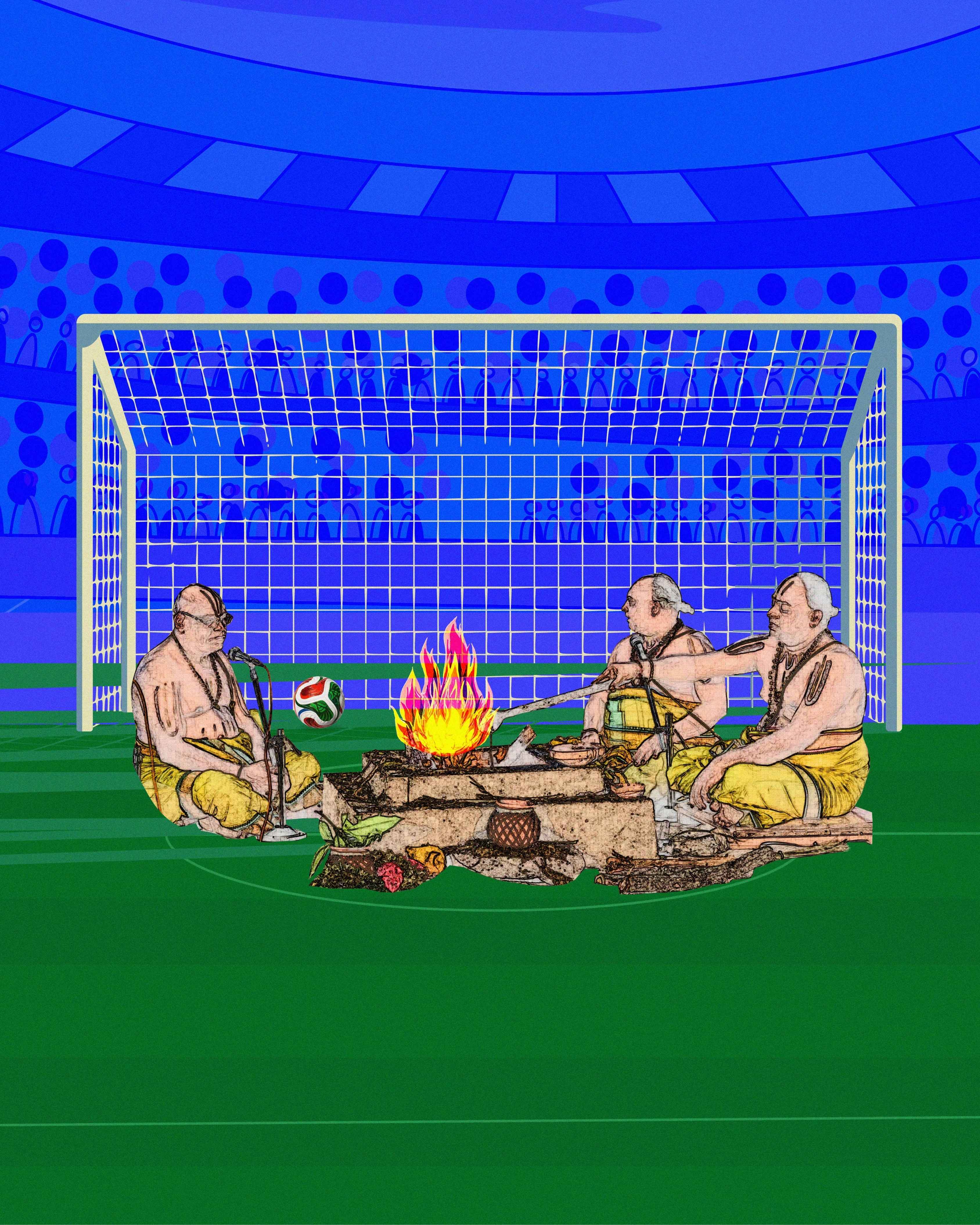
As I write this, the 2026 FIFA World Cup is deep into its knockout rounds across the United States, Mexico, and Canada, the first edition ever expanded to 48 teams – the biggest FIFA has ever fielded. India is not there. India has never been there, barring a walkover entry in 1950 that the All India Football Federation (AIFF) itself withdrew from before a ball was kicked. Forty-eight slots, 1.4 billion people, and not one of them is ours. Meanwhile Cape Verde, barely half a million people, a set of volcanic islands with a GDP smaller than a mid-sized Indian city’s annual municipal budget didn’t just qualify for its first-ever World Cup, it held Spain to a draw and became the first debutant nation to reach the knockout stage since Slovakia in 2010. Jordan qualified for the first time too. Curaçao, a Dutch Caribbean island of about 156,000 people smaller than several Indian college campuses’ catchment areas became the smallest nation ever to reach a World Cup. Sit with that discomfort for a second, because the usual excuses of poverty, population pressure, lack of resources collapse the moment you actually look at who is in the room and who isn’t.
In 1969, Pelé landed in Nigeria tearing itself apart in civil war. Legend says the guns fell silent for 48 hours so both sides could watch Santos play. Historians have since cast serious doubt on the story: contemporary newspapers barely mention any truce, and even Pelé's own accounts of the date have shifted over time. But the fact that the myth was believable at all tells you something. Nobody doubted that football could do that. Decades later, in 2005, Didier Drogba didn’t need a myth. After Ivory Coast qualified for its first World Cup, he got on his knees in the dressing room, television cameras rolling, and begged a country split by five years of civil war to lay down its weapons. The rebel-held north and the government-held south sat and watched the same eleven men in orange. Peace talks resumed within weeks. A nation with a fraction of India's population, a nation with an active civil war and a murder rate that would make Delhi blush, produced a footballer whose presence on a pitch did more for national unity than most of India’s sports administrators have managed in seventy years of independence.
That’s the comparison that should embarrass us. Ivory Coast: 31 million people, a civil war, and a World Cup team. Croatia: 3.8 million people smaller than most Indian districts and a World Cup final. Brazil pulled Neymar out of Mogi das Cruzes, a rough, crime-scarred township where his family’s electricity got cut off for unpaid bills. Senegal’s Sadio Mané grew up kicking a ball barefoot in a village that didn’t have a stadium worth the name. India has 1.4 billion people, the fifth largest economy, and it cannot beat Qatar.
This isn’t a talent problem. It’s a filtration problem. And the filter is caste and class, working exactly as designed.
Only Brahmin-Baniya gets to hold the ball
Look at who actually runs Indian football. The AIFF has spent years as a case study in how a “national” body can be captured by commercial and political interest rather than sporting merit. The Big Baniya Ambani Reliance’s subsidiary Football Sports Development Limited (FSDL) has held sweeping commercial control over the Indian Super League and the federation’s structural affairs for a decade, a private conglomerate deciding what professional football in a country of 1.4 billion looks like. Meanwhile the AIFF’s own former principal legal advisor, Nilanjan Bhattacharjee, publicly accused president Kalyan Chaubey of siphoning federation funds and rigging broadcast tenders in a letter sent to the Prime Minister in 2024. Earlier, in 2023 it emerged that national coach Igor Stimac was made to run India’s Asian Cup qualifying squad past an astrologer who was paid ₹12–15 lakh, who rated each probable player’s horoscope before selection. This is the administrative Brahminical culture presiding over a sport whose actual audience packs gullies and maidans to play with a rubber ball are overwhelmingly poor and belong to the working-class. The people running the game and the people who love the game do not come from the same India, this is brahmin-baniya India.
Now compare this to cricket where the pattern is less a scandal and more a quiet, permanent architecture. Palwankar Baloo, the first Dalit cricketer of any renown, was made to drink his tea outside the pavilion in a paper cup while his upper-caste teammates drank inside in 1911. He was denied the captaincy for a decade despite being the best bowler in the country, because handing the leadership of a “Hindu” team to a Chamar was unthinkable. More than a hundred years later, commentators and historians still struggle to name more than a handful of Dalit cricketers who have worn the Indian cap at all. This is not an accident of talent distribution in a country where Dalits make up roughly a quarter of the population. It is what happens when a sport’s entire feeder system is brahmin-baniya monopolised. The academies, the coaching camps, the nutrition, the equipment, the years of unpaid practice a middle-class or upper-caste family can subsidise quietly filters out everyone without generational capital, and then calls the survivors “meritocratic.”
The gully is not the problem, it’s the walls around it
“Gully cricket” has become an aesthetic shorthand, a style, a Netflix trope. The actual gullies of the working-class and Dalit neighbourhoods that produce the raw, improvised talent are treated as a source of flavour, not a source of players. We have built a cultural common sense in which gully cricket is where you’re from, and international cricket is where the well-fed brahmin-baniya will go. Nobody built a bridge between the two, because nobody with power benefits from building it.
FIFA doesn’t call it “affirmative action,” but its DEI action plans and its women’s football quotas exist precisely because someone decided that historical disparity doesn’t correct itself; it has to be corrected. India runs from that idea everywhere except the one place it might do the most good: on a football pitch or a cricket square, where merit is supposedly self-evident and blind to birth. It isn’t. It never was. Caste-based reservation is treated as a university-admissions argument in India, confined to classrooms and government jobs, as if a coaching academy in Baroda or a franchise scouting network is somehow exempt from the same social gravity that the monopoly of the brahmin-baniya system shapes everything else in this country.
Educate. Organise. Agitate.
Here’s what gets left out of the sanitised, garlanded version of Dr. Ambedkar taught in Indian classrooms: he understood sport as a battleground long before anyone was writing PhDs about it. Dr. Ambedkar used to raise funds for Dalit sporting clubs in Bombay in the 1930s and 40s. One such example is the Bhimraj Sporting Club and others that ran football tournaments exclusively for the untouchable community when mainstream clubs wouldn’t have them. His newspaper, Janata, gave column space to Dalit sportsmen and felicitated Dalit cricketers at a time when the mainstream press pretended caste and cricket had nothing to do with each other. He knew a Dalit footballer walking onto a Bombay maidan in front of a mixed crowd was doing something a courtroom argument couldn’t do being seen, being undeniable, in a space the community was told it didn’t belong in. We have lost that hunger to be everywhere.
When Dr. Ambedkar said Educate, Organise, Agitate, he wasn’t handing out a slogan for university gates alone. It was a method for every arena of life where Scheduled Caste people were shut out and sport is one of the starkest of those arenas, precisely because it markets itself as the one place where caste supposedly doesn’t matter. So apply the method literally.
Educate: Understand exactly how the system works, who runs the federations, who owns the broadcast rights, who sits on the selection committees, who decides which eleven-year-old gets a scholarship to an academy and which one gets told to stick to the gully.
Organise: Build the same kind of collective pressure that has forced change in classrooms, in government hiring, in politics because a scattered grievance changes nothing, and a scattered grievance is exactly what a monopoly is built to survive.
Agitate: Ask the uncomfortable question, loudly and repeatedly, until it can’t be waved off as bitterness.
That question isn’t new. Decades ago, the Ambedkarite shahir Vaman Dada Kardak set it to song for a generation of Dalits, a plain, furious demand to know where their share of the country’s wealth had gone. It’s worth asking the same thing of the people who now own Indian football’s broadcast rights, sponsorship deals, and league structure: Ambani, sang: Amcha vata kuthay ra? (Ambani, tell us: Where is our share?) Not as a rhetorical flourish, but as a literal audit: of who profits from the crores generated by a working-class, largely Dalit-working class audience, and how little of it is reinvested in the neighbourhoods that supply the sport’s raw talent and none of its boardroom seats. Until Indian sport asks who gets access to a pitch, a coach, a diet plan, and a decade of unpaid training and not just who’s good enough once they’ve already had all four it will keep losing to countries with less money, less peace, and a tenth of its population. Talent was never India’s shortage. Access was. And access, in India is in hands of Brahmin Baniya caste bosses, has never been distributed by merit. It’s distributed by caste until enough people educate themselves on how the system works, organise against it, and agitate loudly enough that it can no longer pretend otherwise.