
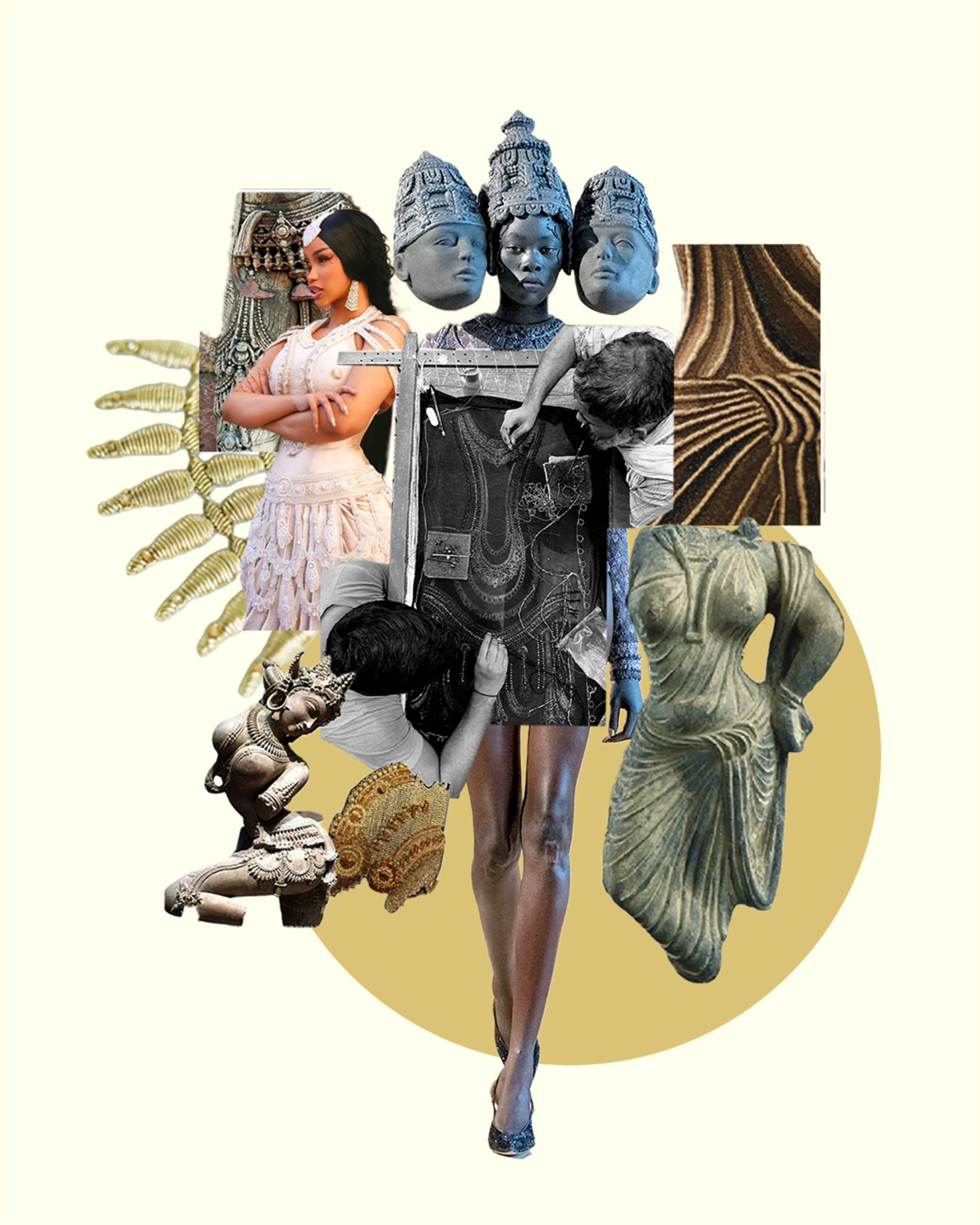
On July 6, Rahul Mishra opened Paris Haute Couture Week with a collection called Devi: The Eternal Muse. Within days, an Instagram post by the account @acfindiaofficial (Acfindia Magazine) had distilled the collection into a single headline: “Rahul Mishra’s Devi: From the Ajanta to Paris,” describing the show as tracing “India’s temple sculpture and history.” By then Isha Ambani and Cardi B had already taken their front-row seats, the show had gone viral, and coverage across fashion media had settled into calling it a journey through India’s “ancient temples” – the Ajanta Caves named in the same breath as genuinely Hindu sites like the Chennakeshava and Tarakeshwara temples.
When the season’s biggest Indian couture moment gets summarized as ancient Indian history, the caption matters as much as the embroidery. Ajanta is not a temple – it is one of the subcontinent’s great Buddhist monastic sites, and the ease with which it gets folded into a generic “ancient Indian temple” lineage, indistinguishable from monuments that are genuinely Hindu, isn’t a small slip. It’s a demonstration of how casually Buddhist heritage gets absorbed into a Hindu visual default when India is asked to represent itself to the world, and it’s happening at the exact moment three of the country’s most visible couturiers are independently reaching for goddess and temple iconography as India’s calling card on the global stage. Fashion doesn’t need a conspiracy to do this work, it only needs a vocabulary where “ancient India” and “Hindu India” have quietly become the same phrase.
Antiquity
Ajanta is a cluster of thirty rock-cut caves carved into a cliff face above the Waghora river in present-day Maharashtra, and every one of them belongs to a single religious tradition: Buddhism. The site divides into two architectural types, both distinct from a Hindu temple, chaitya-grihas, prayer halls built around a stupa rather than a deity image, and viharas, monastic dwellings where Buddhist monks lived, studied and meditated. The earliest caves date to the second century BCE, carved under Satavahana patronage; a second, more elaborate phase followed under the Vakataka dynasty in the fifth century CE, producing the murals and sculpture the site is now famous for- extended cycles of the Jataka tales narrating the Buddha’s past lives, along with images of the Buddha and Bodhisattvas in meditation, teaching, and courtly scenes. (UNESCO)
None of this maps onto what “temple” means in Indian architectural vocabulary. A Hindu temple is organized around a garbhagriha, sanctum housing a consecrated deity image, approached through a defined ritual sequence and typically crowned by a great tower superstructure (shikhara in India’s northern region or the vimana in southern region) (Dokras, 2022). Ajanta has no sanctum and no deity in that sense; its central image is the stupa, a reliquary mound, and its sculpture serves narrative and devotional purposes specific to Buddhist practice, not temple worship. The site was rediscovered only in 1819 by a British officer, John Smith. Ajanta re-entered Indian public memory not as a living devotional site but as an archaeological one, which is part of why it’s so easily relabeled by whoever tells its story next.
Vocabulary
Coverage of Devi: The Eternal Muse routinely lists its sources in a single undifferentiated sentence, all folded into phrases like “ancient Indian temple sculptures.” Nobody is arguing that Ajanta is Hindu, they’re simply not bothering to notice it isn’t. The effect is the same either way – a Buddhist site becomes indistinguishable from a Hindu one because the vocabulary available to writers doesn’t ask them to distinguish.
“Two different processes, one outcome: Buddhist material keeps supplying the raw imagery, and Hindu vocabulary keeps supplying the story.”
The more deliberate mechanism shows up in Gaurav Gupta’s own words. Responding to comparisons with Mishra’s collection, Gupta posted an image of his earlier “Divinity Breastplate,” captioning it as an “Ancient Temple Murti (Sculpture) recreated as the stone-like Divinity Breastplate.” He went on to describe the form as rooted in the Mauryan Yakshi body, evolving into what he called Gupta-period temple devis (Dutta, 2026). This is a lineage, stated by the designer himself: Mauryan-era iconography flowing directly into Hindu temple sculpture. But the Yakshi is not a Hindu figure in any exclusive sense – it’s a pre-sectarian folk deity whose image appears as prominently on Buddhist monuments like Sanchi and Bharhut as it does anywhere else. A Mauryan-era form with genuine Buddhist provenance gets narrated into a purely Hindu inheritance, and nobody has to argue the point – the caption just states it as continuity.
Two different processes, one outcome: Buddhist material keeps supplying the raw imagery, and Hindu vocabulary keeps supplying the story.
Tarun Tahiliani, for his part, has spent recent seasons revisiting Nataraja iconography – Shiva as the cosmic dancer – as a recurring couture motif, resurfacing those archival references in the same news cycle as Mishra’s show. Three separate houses, three separate seasons, one shared vocabulary: goddess, temple, deity, stone brought to life.
None of this requires the designers to be acting in concert, but what it reveals is the historical narrative increasingly being presented as “ancient India” itself. A civilisational past assembled from Buddhist, folk, and other pre-sectarian traditions is repeatedly retold through an exclusively Hindu visual language, until “ancient Indian history” and “Hindu history” begin to appear interchangeable.
Counter Revolution
Speaking to the Madras Rational Society in 1944, Dr. B.R. Ambedkar argued that Indian historians had missed the one fact necessary to understand the subcontinent’s past at all: that ancient India was defined by a great struggle between Buddhism and Brahminism, and that its history could not be understood as anything else. When Buddhism receded from India, he argued, it wasn’t a natural fading but a defeat: a revolution overwhelmed by a counter-revolution that endured long enough to write the surviving version of the story. (BAWS 17)
That argument reframes what “From Ajanta to Paris” actually is. It isn’t only sloppy captioning. It’s a small, contemporary instance of the exact dynamic Ambedkar was describing: a Buddhist form being absorbed into the tradition that historically worked to displace it. Seen this way, the Gupta caption and the “ancient temples” headline aren’t new phenomena dressed in couture. They’re the latest iteration of a much older pattern, one where the counter-revolution doesn’t need to argue its case- it only needs to be the version that gets to do the naming.
Indian couture has drawn on temple iconography and Hindu mythology for decades. Bridalwear alone has run on this vocabulary long before any current political moment. It’s also worth conceding that Ajanta’s own art isn’t doctrinally pure in the way a strict reading of “Buddhism” might suggest: its sculptural and painted world includes apsaras, yakshas, and courtly figures that circulate across religious traditions rather than belonging exclusively to Buddhist theology. Buddhist art has always shared a visual vocabulary with the wider subcontinent it grew out of.
The claim here isn’t that three designers conspired against Buddhist India. It’s that none of them, or the writers covering them, had to think twice before calling a Buddhist monastery a temple, and that ease is itself worth examining, regardless of what anyone intended by it.
References:
- Acfindia Magazine
- Dr. B.R. Ambedkar. Differences between Brahminism and Buddhism. Dr. Babasaheb Ambedkar: Writings and Speeches, vol. 17, pt. 1, Government of Maharashtra, Education Department, 2003.
- Dokras, D. U. (2022). Evolution of the Garbagriha of Hindu Temples. Indo Nordic Author’s Collective.
- Dutta, H. (2026). Rahul Mishra and Gaurav Gupta Are Turning Indian Mythology Into Fashion’s New Language – And We’re Here For It. Robb Report India.
- Ajanta Caves. UNESCO World Heritage Centre, United Nations Educational, Scientific and Cultural Organization.